

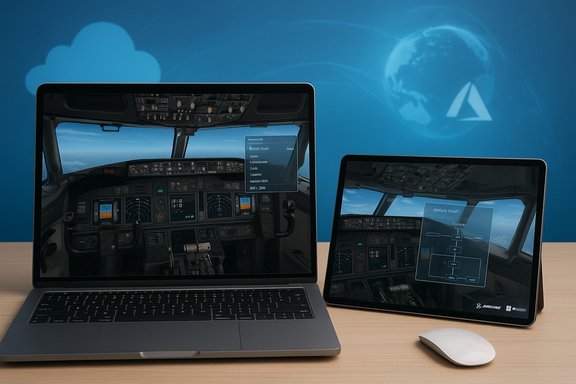
Boeing has turned a mainstream flight‑sim engine into an enterprise training product: the company’s new Virtual Airplane Procedures Trainer (VAPT) uses Microsoft Flight Simulator technology and Microsoft Azure cloud services to deliver high‑fidelity, 3D cockpit procedure training to laptops and iPads — starting with the Boeing 737 MAX and marketed as a complementary, cloud‑first preparation tool rather than a replacement for certified full‑flight simulators.
Boeing unveiled the Virtual Airplane Procedures Trainer (VAPT) at the European Aviation Training Summit on November 6, 2025. The company describes VAPT as the first application in a broader Virtual Airplane product family: an enterprise, cloud‑delivered procedures trainer that combines the visual and systems fidelity of Microsoft Flight Simulator with Azure’s streaming, identity, and content distribution capabilities. Boeing frames the product as a way to reduce familiarization time in full‑flight simulators, standardize operator‑specific procedures, and let crews practice checklists and flows anywhere they carry a laptop or an iPad. Multiple trade outlets picked up Boeing’s announcement, echoing the central claims: cloud rendering and streaming to lightweight devices, a self‑service authoring tool for airlines to create and distribute lesson content at scale, and an initial focus on the 737 MAX with other types to follow. Several industry reports and commentary confirm Boeing’s positioning of VAPT as a procedures‑first training aid, complementary to — not substitutive of — certified flight training devices (FTDs) and Level‑D full‑flight simulators.
This is a notable industry inflection point: consumer simulation technology has matured to the point that, with cloud scale and enterprise controls, it can be productized for operational aviation training. The next 12–24 months will show whether regulators, training organisations and airlines can create robust, audited pathways that harvest VAPT’s operational gains without compromising safety or regulator mandates.
Source: Simple Flying Microsoft Flight Simulator? How Boeing Is Training Real Pilots In 2025
 Background / Overview
Boeing unveiled the Virtual Airplane Procedures Trainer (VAPT) at the European Aviation Training Summit on November 6, 2025. The company describes VAPT as the first application in a broader Virtual Airplane product family: an enterprise, cloud‑delivered procedures trainer that combines the visual and systems fidelity of Microsoft Flight Simulator with Azure’s streaming, identity, and content distribution capabilities. Boeing frames the product as a way to reduce familiarization time in full‑flight simulators, standardize operator‑specific procedures, and let crews practice checklists and flows anywhere they carry a laptop or an iPad. Multiple trade outlets picked up Boeing’s announcement, echoing the central claims: cloud rendering and streaming to lightweight devices, a self‑service authoring tool for airlines to create and distribute lesson content at scale, and an initial focus on the 737 MAX with other types to follow. Several industry reports and commentary confirm Boeing’s positioning of VAPT as a procedures‑first training aid, complementary to — not substitutive of — certified flight training devices (FTDs) and Level‑D full‑flight simulators. What VAPT is and what it is not
The stated capability set
- High‑fidelity 3D cockpit environment for procedural practice and cockpit familiarization, including interactive panels, switches and displays.
- Cloud streaming of heavy simulation processing to lightweight endpoints (laptops, iPads), reducing local hardware requirements.
- Authoring and distribution tools that let airline training managers create, customize, and push procedure lessons and scenario-based drills across pilot populations.
- Offline lesson support for situations with poor or no internet connectivity (Boeing materials indicate an offline mode for issued lessons), coupled with centralized telemetry when reconnecting.
- Initial aircraft support: Boeing 737 MAX, with a roadmap for additional Boeing families.
What VAPT is explicitly not
- VAPT is not a certified Flight Simulation Training Device (FSTD) in the sense required for type‑rating or formal regulatory credit. Boeing’s public messaging and industry commentary position VAPT as a readiness and familiarization tool designed to reduce simulator familiarization time, not to replace the regulatory function of Level‑D FFS devices. Airlines looking to claim formal training credit from desktop/cloud products must still work with regulators for approvals or specific allowances.
The technology: Microsoft Flight Simulator + Azure
Why Microsoft Flight Simulator?
Microsoft Flight Simulator (the modern franchise entry widely referenced in industry coverage) provides a mature simulation and rendering engine with:- Photogrammetry‑based scenery and a near‑global “digital twin” for realistic out‑the‑window visuals.
- Detailed cockpit modelling and a rich ecosystem of aircraft and developer tools that speed up aircraft‑specific modelling.
- A systems modelling approach capable of reproducing complex avionics, displays and procedural flows — features Boeing is leveraging for cockpit fidelity in VAPT.
Why Azure matters
Microsoft Azure supplies the enterprise backbone that makes VAPT possible at scale:- Server‑side compute and streaming to offload rendering and physics so the client device can be thin (similar to cloud gaming).
- Global content distribution and caching to reduce latency for geographically distributed pilot cohorts.
- Identity, access control and logging demanded by airlines for compliance and auditability.
- Telemetry and analytics ingestion for instructor dashboards and learning‑outcome measurement.
What this means for pilot training and airline operations
Immediate operational advantages
- Access and flexibility: Pilots can rehearse procedures during layovers, at home, or between duties on devices they already use. This reduces the need to travel to fixed simulator sites for low‑value familiarization work.
- Reduced FFS familiarization time: By pushing checklist practice and flows to VAPT, airlines can concentrate expensive FFS hours on handling, manoeuvres, and validated scenarios that require motion and control‑force fidelity.
- Standardization and rapid updates: The authoring tool allows operators to encode SOPs and push updates fleet‑wide almost instantly, improving procedural standardization across a distributed workforce.
- Scalability: Cloud deployment enables thousands of pilots to be trained or refreshed simultaneously without local IT heavy lifting.
The blended‑learning model
VAPT strengthens a blended approach: short, high‑frequency, task‑oriented sessions delivered on lightweight devices for cognitive rehearsal; certified FFS sessions retained for tasks that require validated motion cues, exact aerodynamic fidelity and regulatory credit. For training managers, this rebalances the “training pyramid” and can increase throughput without diluting the quality of credit‑bearing simulator activity.Critical analysis — strengths, limitations and risk areas
Strengths
- Rapid development leverage: Tapping the Microsoft Flight Simulator engine avoids years of building a world‑scale rendering and scenery pipeline, reducing time‑to‑market.
- Enterprise distribution: Azure plus a Boeing authoring tool is a pragmatic, airline‑friendly path to standardised, auditable procedure training.
- Realistic visual cues: Photogrammetry and global scenery improve airport recognition and out‑the‑window tasks — practical when teaching location and visual approach tasks.
- Cost and scheduling relief: For airlines under pressure from limited FFS availability and rising training costs, moving routine procedural rehearsal off FFS may free scarce simulator slots for higher‑value use.
Key limitations and risks
- Regulatory boundaries: VAPT is not a substitute for FSTD qualification. Any attempt to substitute VAPT sessions for credit‑bearing simulator time must be validated and approved by aviation authorities (FAA, EASA, national regulators). Relying on VAPT to reduce credited simulator hours without formal regulatory engagement would be non‑compliant.
- Simulation fidelity: Even high‑quality engines lack the motion cues, exact control‑force feedback, and validated aerodynamic models that certified FFS devices provide. VAPT is strong for cognitive and procedural tasks; it is inherently weaker for psychomotor training and handling assessments.
- Data privacy & governance: Centralised telemetry and lesson logs create sensitive personnel data; airlines must negotiate data residency, retention and access controls. Azure provides enterprise controls, but contractual SLAs and penetration testing are operational prerequisites.
- Operational dependencies: Cloud outages, regional availability issues, or local connectivity problems can disrupt distributed training. While Boeing indicates offline lesson support, the practical limits of offline functionality (scope, duration, telemetry resync behavior) remain to be verified in product documentation.
- Vendor lock‑in and IP: Airlines must clarify ownership of authoring content, integrations with LMS systems, and what happens to created lessons if contracts change. Negotiation of IP, exportability of content, and long‑term archival are commercial must‑haves.
- Human factors: Procedural practice in a 2D or streamed 3D environment differs cognitively from working in a physical cockpit with tactile cues. Training syllabi must be carefully designed to avoid false confidence or skill‑fade illusions.
Verification and points requiring confirmation
The following are practical items that require confirmation from Boeing, Microsoft, or adopting airlines before procurement or procedural changes:- Regulatory treatment and crediting: Will any regulator accept VAPT as part of an approved blended learning pathway without additional device qualification? (Answer: regulatory engagement required; current messaging positions VAPT as pre‑sim only.
- Offline mode specifics: How many lessons can be cached, what features are available offline (interactive failures, instructor tracking), and how telemetry resynchronizes on reconnect? (Boeing references offline support but does not publish granular limits publicly.
- Exact Flight Simulator engine/version: Boeing references Microsoft Flight Simulator generically; whether VAPT uses the 2024 edition or a bespoke enterprise branch influences API compatibility and long‑term support. Industry coverage commonly cites the 2024 generation, but Boeing’s materials avoid binding edition language in some places — this nuance should be clarified.
- SLA and availability commitments: Airlines must confirm Azure region strategy, uptime guarantees, and contingencies for regional outages impacting distributed pilot cohorts.
Practical checklist for training departments (how to evaluate and integrate VAPT)
- Run a technical validation: compare VAPT procedural fidelity against current SOP checklists and identify which tasks map to cognitive (OK for VAPT) vs psychomotor (retain FFS) learning outcomes.
- Engage regulators early: present a blended learning proposal, acceptance criteria and validation trials to FAA/EASA or relevant authority before reducing FFS hours in syllabi.
- Conduct a security and privacy assessment: require Azure regional deployment options, encryption standards, penetration test results and an incident response plan.
- Pilot a controlled roll‑out: choose a representative cohort and define measurable success criteria (reduced familiarization time, fewer procedural errors in FFS, pilot satisfaction).
- Define content ownership and exportability: insist on rights to export lessons, interoperability with LMS systems, and archival policies for audit.
- Negotiate commercial SLAs: availability, regional redundancy, data residency, and clearly defined support response times.
- Build instructor buy‑in: involve line instructors and check airmen in authoring content to ensure pedagogical and human‑factors rigor.
Broader implications: OEMs, regulators and the sim community
- OEM endorsement of consumer‑grade engines heralds a shift: large airframer involvement brings credibility and scale to an ecosystem hobbyists helped build. Microsoft Flight Simulator’s engine gains enterprise recognition, and the flight‑sim community — long viewed as a niche hobby market — finds its tooling formalized into aviation services.
- Regulators will be forced to refine guidance on blended learning: as cloud and desktop tools become enterprise products, authorities must specify objective validation pathways if any credit is to be allowed.
- Competition and partnerships: expect rivals and established simulator manufacturers to respond with hybrid offerings (integrations, enterprise cloud options, or validated desktop devices) to protect their position in the credit‑bearing simulator market.
- For the hobbyist ecosystem, enterprise versions may close off access to airline‑specific content but will likely create certification or licensing opportunities for third‑party developers and avionics modelers.
Conclusion
Boeing’s Virtual Airplane Procedures Trainer represents a pragmatic, well‑timed push to modernize the lower rungs of pilot training: it converts the visual horsepower and global data of Microsoft’s flight‑sim platform into an authorable, cloud‑managed procedures trainer that fits neatly into a blended‑learning syllabus. The approach offers clear operational benefits — improved access, faster familiarization and fleet‑wide standardization — while preserving the role of certified full‑flight simulators for validated, credit‑bearing tasks. The value is real, but so are the limits. VAPT addresses cognitive rehearsal and procedural muscle memory; it does not and should not supplant the validated physical and aerodynamic fidelity of Level‑D simulators. Airlines must therefore adopt a careful, regulator‑engaged path: validate fidelity, negotiate enterprise SLAs and data governance, pilot the service with measurable outcomes, and preserve rigorous human‑factors oversight so that convenience does not become complacency.This is a notable industry inflection point: consumer simulation technology has matured to the point that, with cloud scale and enterprise controls, it can be productized for operational aviation training. The next 12–24 months will show whether regulators, training organisations and airlines can create robust, audited pathways that harvest VAPT’s operational gains without compromising safety or regulator mandates.
Source: Simple Flying Microsoft Flight Simulator? How Boeing Is Training Real Pilots In 2025
