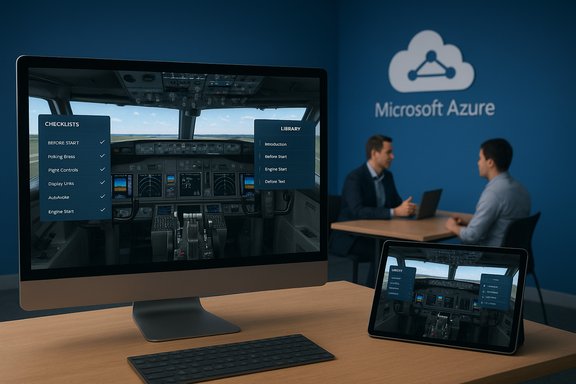
Boeing’s new Virtual Airplane Procedures Trainer (VAPT) — a cloud-powered, Microsoft Flight Simulator–driven tool billed as a way to bring high-fidelity flight‑deck procedure practice to laptops and tablets — was unveiled at the European Aviation Training Summit in Cascais and immediately positioned as a potential game-changer for how airlines prepare crews before they step into full‑flight simulators.
Boeing presented VAPT as the first application in a broader “Virtual Airplane” product suite built on Microsoft Azure and Microsoft Flight Simulator technologies. The company says the product targets flight‑deck familiarization, checklist flows, and standardized operator procedures — functions traditionally handled inside full‑flight simulators (FFSs) or in live training sessions — and aims to deliver them on lightweight devices to reduce early simulator time and related costs. The initial release is enabled for the Boeing 737 MAX and is available for computers and tablets (Boeing has specifically described iPad support). Boeing executives framed the product as a flexible, operator‑configurable tool to standardize instruction and reduce variation between training instructors. Microsoft representatives were quoted as endorsing the partnership and the safety‑focused intent behind using Flight Simulator technology for procedural training. This announcement sits at the intersection of three trends: an aviation industry stretched for simulator capacity, rising interest from OEMs in software and services revenue, and ever‑improving consumer flight‑simulation technology (notably Microsoft Flight Simulator) that has blurred the line between enthusiast-grade visuals and operationally useful simulation fidelity.
Microsoft, meanwhile, benefits from an expanded enterprise footprint for its Flight Simulator technology and Azure platform, and the flight‑sim community and software ecosystem stand to gain from increased investment and professional use cases. But the move does not render legacy simulator suppliers obsolete; rather, it refines the training pyramid: desktop/cloud–based familiarization feeding validated, regulated simulators for formal checks and advanced scenario work.
However, regulatory boundaries and simulation fidelity limits mean VAPT’s logical role today is procedural familiarization and standardization, not replacement of certified devices for tasks that require validated FSTD performance. Airlines should approach adoption with a plan that includes independent validation, early regulator engagement, and robust cybersecurity and data governance measures. Where implemented carefully, VAPT can deliver measurable efficiency gains — but those gains must be proven with data, not assumed from marketing claims.
The future of pilot training will likely be hybrid: cloud and desktop tools for high‑frequency, low‑complexity learning; certified FSTDs and live flying for high‑fidelity, high‑stakes training. Boeing’s announcement signals a reinforcement of that hybrid model and a strategic push by OEMs and cloud providers into the operational training domain — a space where technical promise must always be reconciled with regulatory rigour and human factors realities.
Source: Airways Magazine Boeing to Use Microsoft Flight Simulator for Pilot Training
 Background / Overview
Boeing presented VAPT as the first application in a broader “Virtual Airplane” product suite built on Microsoft Azure and Microsoft Flight Simulator technologies. The company says the product targets flight‑deck familiarization, checklist flows, and standardized operator procedures — functions traditionally handled inside full‑flight simulators (FFSs) or in live training sessions — and aims to deliver them on lightweight devices to reduce early simulator time and related costs. The initial release is enabled for the Boeing 737 MAX and is available for computers and tablets (Boeing has specifically described iPad support). Boeing executives framed the product as a flexible, operator‑configurable tool to standardize instruction and reduce variation between training instructors. Microsoft representatives were quoted as endorsing the partnership and the safety‑focused intent behind using Flight Simulator technology for procedural training. This announcement sits at the intersection of three trends: an aviation industry stretched for simulator capacity, rising interest from OEMs in software and services revenue, and ever‑improving consumer flight‑simulation technology (notably Microsoft Flight Simulator) that has blurred the line between enthusiast-grade visuals and operationally useful simulation fidelity. What Boeing Announces: Product, Capabilities, Claims
The product as presented
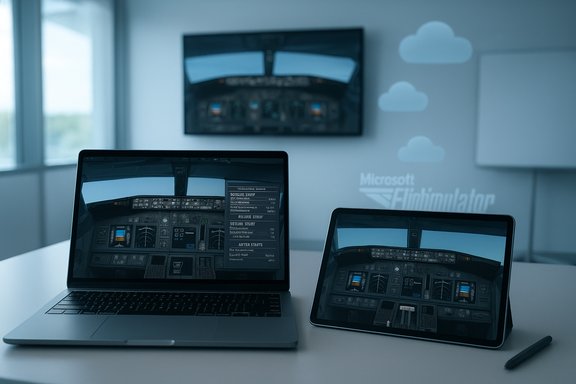
- The Virtual Airplane Procedures Trainer (VAPT) is described by Boeing as a high‑fidelity, 3D flight‑deck procedural trainer that runs on laptops and tablets and is powered by Microsoft Azure and Microsoft Flight Simulator. Boeing says VAPT includes an authoring tool so airlines and training organizations can create, configure, and push procedure lessons and standardized flows to pilot groups.
- Boeing’s messaging emphasizes three operational benefits:
- Faster flight‑deck familiarization before entering physical simulators.
- Standardization of procedure training across an airline’s pilot population.
- Flexibility to train anywhere, reducing simulator scheduling pressure and potentially lowering costs.
- Public statements attributed to Boeing Global Services leadership (Chris Raymond and Chris Broom) and Microsoft’s Dayan Rodriguez appear in Boeing’s rollout materials and third‑party coverage; those quotes stress digital innovation, safety, and confidence building for pilots.
What is already available
Boeing’s public materials show that virtual‑procedures and desktop training tools have been part of its digital training portfolio for some time; the VAPT name formalizes a cloud‑backed, Microsoft Flight Simulator–integrated offering with a commercial push toward airlines rather than individual users. The company’s Virtual Procedures Trainer messaging (an adjacent Boeing offering) already lists benefits like improved retention and reduced familiarization time when used as a pre‑simulator tool.Why Microsoft Flight Simulator (and Azure) Matters Here
The technical angle
Microsoft Flight Simulator (the consumer and developer platform that traces its roots to the early 1980s) has evolved into a visually and technically sophisticated platform capable of modelling detailed cockpits, satellite imagery scenery, live weather, and networked traffic. Those capabilities make it attractive as a rendering and world‑simulation engine for training‑style exercises that do not require certified FSTD (Flight Simulation Training Device) status. Microsoft Azure contributes cloud scalability, global distribution, and compliance tooling — attributes Boeing highlights as necessary to support operator management, content distribution, and enterprise security for a product that will be used by large airline customers. Azure’s compliance and certification footprint (ISO, SOC, FedRAMP, and more) is a relevant factor when airlines evaluate cloud‑based training products and the regulatory, contractual, and data‑protection obligations that come with them.The significance of using a consumer‑grade engine
Using Microsoft Flight Simulator as a foundation provides obvious advantages:- Rapid development using an existing, constantly updated rendering and simulation engine.
- Access to an ecosystem of avionics modelling and community expertise.
- Lower delivery cost compared with building an FFS‑grade engine from scratch.
The Training Value Proposition: Where VAPT Helps
Measurable benefits Boeing is selling
Boeing’s pitch focuses on practical, tangible operational outcomes that training managers prize:- Reduce the amount of expensive full‑flight simulator time spent on basic flows and cockpit familiarization.
- Create consistent, operator‑specific lesson content and update it centrally, so that all pilots receive the same procedural messaging.
- Enable remote/anytime practice to support recurrent training schedules and initial indoctrination for new hires.
How training teams might use VAPT
- Publish a standardized checklist and flow lesson to a pilot cohort.
- Require completion of a VAPT lesson and assessment before scheduling an FFS session.
- Use the authoring tool to inject company‑specific SOPs and document compliance or completion records for quality assurance.
Regulatory and Certification Reality: What VAPT Is — and Isn’t
Certified devices and official training credits
Major aviation regulators (FAA in the U.S., EASA in Europe) require that any simulator used for official training credits, checking, or certification be a qualified Flight Simulation Training Device (FSTD) that meets specific Qualification Performance Standards. Those qualification regimes are codified in rules such as 14 CFR Part 60 in the U.S. and EASA’s CS‑FSTD documents in Europe. Devices not qualified under those frameworks cannot generally be used to claim official training or recency credit without specific regulatory authorization.Implication for VAPT
- VAPT, as presented, is a preparatory and procedural training tool intended for familiarization and standardization. It is not described as a certified FSTD, and Boeing’s messaging limits claims to readiness improvements and reduced familiarization time rather than regulatory training credit. Airlines wanting to use any desktop or cloud‑delivered tool for formal credit must either operate within regulatory allowances (e.g., LOAs for specific devices, or accepted blended‑learning paths) or work with authorities to gain approvals.
- In short: VAPT can improve performance and reduce non‑value‑added simulator time, but it does not replace certified simulators for tasks that require FSTD standards unless regulators explicitly allow substitution in defined circumstances. This limitation is a central operational reality that training departments will have to manage.
Cross‑Checks and Verification of Key Claims
- Boeing’s announcement and quoted executives: Covered by Boeing’s rollout and multiple news outlets reporting from the European Aviation Training Summit. The press release and media coverage reproduce the quotes and the partnership details.
- Product scope and platform dependencies: Boeing materials and third‑party reporting consistently describe Microsoft Azure and Microsoft Flight Simulator as the platform components and name 737 MAX as the first supported type. Boeing’s Virtual Procedures Trainer product pages also reflect virtual, pre‑simulator training objectives.
- Heritage and capability of Microsoft Flight Simulator (why this approach is technically plausible): The Microsoft Flight Simulator franchise dates back to the early 1980s and has evolved into a modern, cloud‑enabled platform with high fidelity visuals and aircraft systems modelling — attributes that make it a logical base for cockpit procedural simulations, while stopping short of FSTD qualification status.
- Regulatory constraints on official credits: FAA and EASA qualification frameworks for FSTDs show that only devices meeting published standards can be used for formal training credits; desktop or consumer simulators do not automatically satisfy that bar. Airlines will therefore need regulatory sign‑off if they intend to use VAPT as anything more than a preparatory tool.
Strengths: Why This Could Work
- Accessibility and scale: Delivering high‑fidelity procedural practice to laptops and tablets enables large pilot pools to practice on demand, solving the logistical bottleneck of limited FFS slots.
- Standardization: Centralized content authoring and distribution reduces instruction variability across instructor teams and bases. For airlines operating multiple bases and fleets, that consistency is operationally valuable.
- Lower per‑pilot cost for early familiarization: By shifting basic flows to a lighter device, airlines can reserve expensive FFS time for scenarios that absolutely require full motion and high fidelity.
- Rapid updates and operator customization: Cloud delivery and authoring tools let airlines update SOPs and roll out standardized changes quickly across their pilot cohort.
- Technical synergy with Microsoft Flight Simulator and Azure: Using a mature, visually rich engine plus enterprise cloud infrastructure reduces development time and leverages proven compliance and security tooling in Azure.
Risks, Caveats, and Practical Limits
1. Regulatory and training‑credit boundaries
The most immediate practical limit is that VAPT is, in its announced form, not a qualified FSTD and therefore not an automatic substitute for official simulator credit. Training departments must design blended programs and coordinate with regulators to ensure compliance if they intend to reduce official FFS time based on VAPT usage. Airlines should not assume regulatory acceptance without formal approvals.2. Simulation fidelity vs. certified devices
While Microsoft Flight Simulator offers exceptional visual fidelity, critical differences remain between an FFS (which is validated for aerodynamic behaviour, control forces, motion, and very precise systems simulation) and a consumer‑grade simulation engine. Tasks that require tactile cues, exact control‑feel, or validated flight dynamics will still call for certified devices. VAPT is best framed as a cognitive and procedural preparatory tool, not a full physical training substitute.3. Measurement and validation
Boeing’s claims about reducing simulator time and costs are plausible, but the magnitude of those benefits is unverified in public domain materials. Airlines should request pilot‑performance studies, validation data, and clear success metrics before changing regulatory training syllabi or booking policies. If no independent validation exists, any claimed percentage reductions should be treated as marketing statements.4. Cybersecurity and data governance
Cloud‑hosted training platforms carry inherent data‑security and privacy obligations. Microsoft Azure offers a broad set of compliance certifications and security tooling, but building a secure operator deployment remains a shared responsibility: Boeing and airline customers must properly configure cloud services, manage access controls, and protect PII and training‑sensitive data. Airlines should demand detailed security architecture, audits, and continuous monitoring commitments from Boeing and Microsoft.5. Human factors and overreliance
There’s a human‑factors risk if procedural training is abstracted away from physical cues and high‑stress simulation. Overreliance on desktop procedural practice could reduce exposure to integrated scenario work where systems, environment, and crew interaction create the complexity that seeks to be trained in the FFS. Blended programs must preserve high‑fidelity scenarios to train for non‑procedural decision making.6. Liability and legal exposure
If an airline reduces FFS training hours based on VAPT‑led efficiencies and subsequently experiences an event where procedural memory or behaviour is in question, liability issues could arise unless training equivalency is robustly documented and regulator‑approved. Legal and insurance teams will likely scrutinize any reductions that are not backed by well‑documented validation. This is a governance and risk issue training leaders must address proactively.How Airlines Should Evaluate VAPT Today
Airlines, training organizations, and regulators will take a pragmatic, evidence‑based approach to adopting VAPT. A suggested evaluation pathway:- Request a full technical whitepaper and threat model from Boeing and Microsoft describing:
- Simulation fidelity boundaries and what is and is not modelled to FSTD standards.
- Data flows, storage locations, and encryption/identity controls.
- The authoring tool’s scope and the audit trail for content changes.
- Pilot an operational trial:
- Run a pilot cohort where VAPT is used as a prerequisite for FFS sessions.
- Measure time spent in FFS, instructor assessment of readiness, and objective performance metrics during FFS sessions.
- Engage regulators early:
- Submit trial protocols to the relevant authority (FAA, EASA, or national body) for concurrence on intended use and any crediting approach.
- Seek formal LOAs or approvals if planning to reduce FFS hours as part of certified training pathways.
- Validate human factors:
- Conduct controlled studies to ensure that remote procedural practice translates into cockpit performance under workload and stress.
- Review contractual and SLAs:
- Ensure Boeing/Microsoft commitments on patching, availability, security incidents, and data portability meet airline expectations.
The Bigger Picture: OEMs, Simulators, and the Training Market
Boeing’s move is emblematic of the industry adjusting to a crowded and costly simulator market. Full‑flight simulators (often supplied by specialist OEMs) are extremely expensive to procure and operate; any credible shift that reduces the duration of non‑value‑added simulator tasks addresses an industry pain point. At the same time, aerospace OEMs increasingly look to software and services as recurring revenue streams, and partnerships with major cloud providers allow rapid scaling and global distribution.Microsoft, meanwhile, benefits from an expanded enterprise footprint for its Flight Simulator technology and Azure platform, and the flight‑sim community and software ecosystem stand to gain from increased investment and professional use cases. But the move does not render legacy simulator suppliers obsolete; rather, it refines the training pyramid: desktop/cloud–based familiarization feeding validated, regulated simulators for formal checks and advanced scenario work.
Practical Examples of Use Cases Where VAPT Adds Value
- New‑hire indoctrination: First‑month crews use VAPT to master flows and checklists before initial FFS sessions, raising minimum baseline knowledge and reducing instructor briefing time.
- SOP change rollouts: Fast global distribution of revised checklists or non‑normal procedures to all pilots with an auditable completion trail.
- Recurrent refreshers: Routine refresher modules for procedural memory that pilots can complete remotely before a recurrent simulator day.
- Multi‑crew coordination drills (limited scope): Tabletop practice for flows and callouts before moving to integrated crew simulation in an FFS.
Conclusion: A Useful Tool — Not a Silver Bullet
Boeing’s Virtual Airplane Procedures Trainer is a credible, well‑timed product that leverages Microsoft Flight Simulator’s rendering and Azure’s cloud scale to tackle a real operational challenge: the cost and scarcity of full‑flight simulator time. The offering’s strengths lie in accessibility, standardization, and rapid content distribution — all meaningful advantages for large training organizations.However, regulatory boundaries and simulation fidelity limits mean VAPT’s logical role today is procedural familiarization and standardization, not replacement of certified devices for tasks that require validated FSTD performance. Airlines should approach adoption with a plan that includes independent validation, early regulator engagement, and robust cybersecurity and data governance measures. Where implemented carefully, VAPT can deliver measurable efficiency gains — but those gains must be proven with data, not assumed from marketing claims.
The future of pilot training will likely be hybrid: cloud and desktop tools for high‑frequency, low‑complexity learning; certified FSTDs and live flying for high‑fidelity, high‑stakes training. Boeing’s announcement signals a reinforcement of that hybrid model and a strategic push by OEMs and cloud providers into the operational training domain — a space where technical promise must always be reconciled with regulatory rigour and human factors realities.
Source: Airways Magazine Boeing to Use Microsoft Flight Simulator for Pilot Training