

Nestled between Alpine peaks and bilingual street signs, the Autonomous Province of Bolzano has quietly rewritten how a modern regional government engages with its citizens — moving from dozens of brittle legacy systems to a unified, AI‑assisted platform built on Microsoft’s Dynamics 365, Power Platform, and Azure communications and agent tooling. The move, led by Sudtiroler Informatik AG (SIAG / Informatica Alto Adige S.p.A.), is more than a technology refresh: it’s an attempt to turn fragmented administration into a proactive, multilingual, omnichannel civic service that meets residents where they are and reduces the friction of getting help. ]
For decades SIAG supported the region with bespoke systems and local portals. Over time that led to a sprawling digital estate — a mosaic of roughly four dozen siloed applications, portals and databases that complicated end‑to‑end service delivery and hunt through multiple places to find the right contact or form. This sort of fragmentation is a common pain point in mid‑sized governments and is what drove SIAG to look for a single, consistent front door for citizen interactions.
At the same time, the most consequential work is governance, not engineering. To solidify trust and ensure the transformation is durable, SIAG and other public bodies following this model must:
Conclusion
The SIAG story is not simply about buying technology; it’s about redesigning the citizen journey and rebuilding trust in public services through clarity, access and automation. The technical choices — Dynamics 365, Power Platform, Azure Communication Services and Copilot‑style agents — give SIAG a coherent, extensible foundation. The long‑term outcome will depend on governance: clear consent, robust DPIAs, human oversight and vigilant contract management. Done right, Bolzano’s initiative points to a future where a citizen can ask, “What help am I entitled to?” and receive an accurate, timely, bilingual answer — without getting lost in a maze of portals.
Source: Microsoft SIAG transforms public services and enhances support for citizens with Microsoft Dynamics 365, Power Platform, and AI agents | Microsoft Customer Stories
 Background and context
Who is SIAG and why Bolzano matters
SIAG is the in‑house digital services provider for the Autonomous Province of Bolzano (South Tyrol), the province government and the Consortium of Municipalities, with a remit stretching across healthcare, agriculture, education, social services and more. The province — home to roughly half a million residents — is uniquely bilingual (Italian and German) and has a high degree of administrative autonomy, which makes citizen services both locally complex and politically sensitive. Population estimates for the province are in the 530k–540k range in recent official counts and statistical estimates.For decades SIAG supported the region with bespoke systems and local portals. Over time that led to a sprawling digital estate — a mosaic of roughly four dozen siloed applications, portals and databases that complicated end‑to‑end service delivery and hunt through multiple places to find the right contact or form. This sort of fragmentation is a common pain point in mid‑sized governments and is what drove SIAG to look for a single, consistent front door for citizen interactions.
The public sector problem SIAG set out to solve
The challenges were clear and familiar:- Multiple portals and inconsistent user journeys for the same citizen across different departments.
- Duplicate data, manual reconciliation and brittle integrations that slowed case handling.
- Rising demand for digital services at a time when many public staff are approaching retirement, creating continuity and skills concerns.
- A need for multilingual support and channels that citizens actually use: phone, chat, messaging apps and — increasingly — voice and video.
What SIAG built — the technology and architecture
The platform stack at a glance
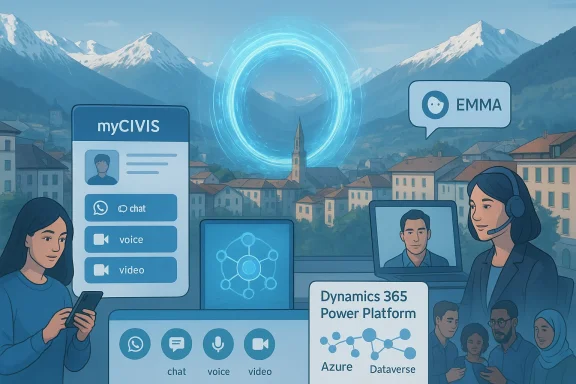
SIAG’s new architecture centers on Microsoft’s cloud and business application stack:- Dynamics 365 Customer Service and Dynamics 365 Contact Center as the operational backbone for case management, agent desktop and omnichannel routing.
- Microsoft Power Platform for low‑code process automation, forms, and citizen‑facing workflows.
- Azure Communication Services (and the broader Azure calling/video capabilities) to provision voice and video channels natively.
- Copilot / agentic AI tooling (Copilot Studio and Dynamics Copilot features) to provide conversational assistants, knowledge retrieval, summarization and workflow automation.
- A unified data layer (Dataverse / governed integrations) to reduce duplication and give agents and services a consistent, real‑time view of citizen records.
Omnichannel reach: from WhatsApp to video
A core requirement was to meet citizens on the channels they already use. Dynamics 365 Contact Center supports a wide set of channels natively — including web chat, SMS, Apple Messages for Business and, more recently, a first‑party WhatsApp channel integrated via Azure Communication Services. The Microsoft platform also provides a voice channel that integrates PSTN calling, live transcription, sentiment analysis and the ability to escalate chat to voice or video within the same session — exactly the sort of seamless handover SIAG needed. That makes it possible for a citizen to start on mobile messaging and escalate to a live agent with screen sharing or a video call when necessary.Multilingual AI companion: EMMA and proactive service suggestions
SIAG’s public portal, rebranded and redesigned as myCIVIS, introduces an AI assistant named EMMA that converses in both Italian and German, helping citizens find benefits, download records (for example, healthcare documents) and discover services for which they may be eligible. Importantly, the platform is designed to be proactive: where citizens opt in, the system can suggest services they qualify for based on consolidated records from provincial and federal datasets. Local reporting and independent coverage describe myCIVIS and EMMA as the front‑end experience citizens interact with for secure access to records and guided support. ([news.microsoft.rosoft.com/source/latam/features/ia-pt-br/o-renascimento-digital-da-provincia-de-bolzano-colocando-os-cidadaos-em-primeiro-lugar-com-a-ia/?lang=pt-br&utm_source=openai))Phased rollout and pragmatic adoption
SIAG adopted an iterative rollout model. According to SIAG’s implementation notes, an initial case management module launched for a small group of internal users in mid‑to‑late 2025 to validate workflows and gather feedback; subsequent expansions enabled omnichannel capabilities and additional agent seats. While the detailed seat counts and exact launch dates are provided in the project write‑ups from SIAG and its Microsoft customer story, not all of those deployment details are yet independently corroborated in public reporting, so they should be treated as implementation milestones reported by the project team.What changed for citizens and staff
For citizens: a single, conversational front door
The most visible change is a simpler path to services:- A single portal (myCIVIS) with conversational guidance via EMMA means fewer dead‑ends and less need to hunt across departmental sites.
- Multichannel support lets citizens choose messaging, chat, phone or video depending on the case complexity and personal preference.
- Proactive eligibility nudges (for example, scholarship or benefits notifications) can reduce friction and increase take‑up of available support.
For staff: unified cases and faster resolution
Internally, agents now work from a shared case management workspace with:- A consolidated citizen record and real‑time context across departments.
- AI‑assisted knowledge search and summarization to speed triage.
- Omnichannel routing and supervisor tooling to manage workload and quality more effectively.
Why Microsoft’s stack was chosen — practical strengths
1) Deep omnichannel integration
Dynamics 365 Contact Center is explicitly designed for omnichannel service and now includes first‑party channels (WhatsApp) and a native voice channel with Azure calling. That reduces the need for third‑party connectors and simplifies data capture across channels. For regions like Bolzano that require multi‑channel access, this lowers operational complexity.2) Low‑code extensibility with Power Platform
Power Platform enables SIAG to build and iterate citizen workflows and back‑office automations without large software engineering cycles. For public organizations with limited developer capacity, low‑code reduces time to value and allows a controlled citizen‑facing evolution.3) Built‑in AI capabilities (Copilot / agents)
Copilot/agent tooling brings summarization, context retrieval and workflow automation into agent desktops and conversational UIs. In contact center scenarios, those features can materially cut handling time and improve response consistency when paired with governance. The Dynamics 365 roadmap and release plans emphasize agentic features in 2025 that align with SIAG’s use of AI assistants.4) Multilingual and compliance capabilities
Microsoft’s cloud offerings include language support and regional controls that make it straightforward to build bilingual services for Italian and German users. For an autonomous province where language parity is a political imperative, native multilingual tooling simplifies interface design and service parity.Critical analysis: strengths, trade‑offs and unresolved questions
Strengths — what this approach gets right
- User‑centric consolidation. Replacing fragmented portals with a single conversational front door is a proven path to improved citizen satisfaction and easier discovery of services.
- Operational efficiency. Shared cases and AI assistance reduce repetitive tasks and help mitigate workforce shrinkage from retirements.
- Future extensibility. A Power Platform + Dynamics foundation is extensible: new services, channels and agents can be added iteratively without ripping up the architecture.
- Channel parity. Native support for messaging (WhatsApp), voice and video lowers friction for citizens who expect modern, mobile‑first experiences.
Trade‑offs and risks — what deserves scrutiny
- Privacy, consent and GDPR risk
- Aggregating provincial and federal records into a single profile and then using AI to make proactive suggestions raises classic GDPR concerns: legal basis, purpose limitation, data minimization and transparency.
- SIAG’s portal appears to rely on an opt‑in model for consolidation, which is good—but the effectiveness of privacy protections depends on the Data Protection Impact Assessment (DPIA), contractual controls with cloud vendors and the exact data flows between SIAG, Microsoft and downstream services. Local reporting flags the opt‑in approach; project documents should be reviewed publicly for DPIA details.
- Vendor concentration and lock‑in
- Building deep service logic, AI agents and data flows inside one vendor ecosystem accelerates development but increases long‑term dependency. Governments should plan for portability, exportable data schemas and exit rights in supplier contracts.
- AI governance and hallucination risk
- Agentic AI that drafts responses, suggests services, or summarizes cases must be governed to avoid incorrect advice or inappropriate automated decisions. Human‑in‑the‑loop escalation, provenance labeling (showing how a suggestion was derived) and conservative guardrails are essential.
- Operational complexity under the hood
- While the public experience can be unified, the back‑end still requires careful integration: identity mapping across datasets, reconciliation of conflicting records, and robust retry/failure strategies for external APIs. These are typical but non‑trivial engineering problems.
- Digital inclusion
- A bilingual AI assistant and omnichannel access are strong steps toward accessibility, but governments must also ensure support for residents who are digitally excluded or prefer in‑person services. The digital channel should complement, not replace, human access.
- Cost and operations
- Real‑time voice/video, Azure Communication Services usage, and AI agent runtime come with consumption costs that must be budgeted for recurring operations — especially significant for a public body ransparent cost modeling and monitoring are needed.
Governance checklist — what public IT teams should demand before scaling
If you’re an IT leader in a public organization contemplating a similar path, use this practical checklist to manage risk and maximize value:- Conduct a thorough DPIA before any production consolidation and publish a summary for transparency.
- Require model‑level governance: logging of model prompts, input data lineage, confidence scores and an explanation for any automated eligibility decision.
- Keep human escalation as a default for any high‑impact or benefits‑related decisions; label AI suggestions clearly in the UI.
- Define retention and deletion policies for consolidated profiles, and provide citizens with an easy way to export or revoke consent.
- Negotiate data residency, portability and audit rights into vendor contracts; insist on exportable schema and a documented exit plan.
- Start small with a proof‑of‑value cohort (as SIAG did) and measure both operational metrics and citizen satisfaction before broad rollout.
- Budget for ongoing consumption costs (voice/video minutes, agent runtimes) and build real‑time monitoring to prevent budget surprises.
Implementation lessons from Bolzano — practical takeaways
- Iterate with pilots: SIAG validated case management with a small group before enabling omnichannel voice seats — a textbook agile approach for public sector projects that must manage risk and political scrutiny. This incremental strategy helps catch workflow problems early and build staff confidence.
- Design for language parity: For bilingual jurisdictions, build identical workflows and tes language to avoid asymmetries in service quality and legal risk.
- Measure both efficiency and equity: Don’t measure success only by case throughput; track citizen outcomes, accessibility, and take‑up among vulnerable populations.
- Invest in staff re‑training and governance: Low‑code platforms change the nature of development but increase the need for governance, change management and domain knowledge inside the IT and service teams.
Where independent reporting corroborates the narrative
Multiple outlets and local communications corroborate core elements of the SIAG story:- Microsoft’s customer storytelling around the project highlights the use of Dynamics 365, Power Platform and agent tooling to build myCIVIS and the EMMA assistant.
- Local provincial media and the province’s communications office confirm a redesign of the myCIVIS portal with AI integration and emphasize the planned rollouts and public testing. Those communications note the provincial intent to bring myCIVIS online in refreshed form and underscore the opt‑in approach for consolidated services.
- Independent tech coverage describes the portal, the bilingual AI companion, and the province’s aim of consolidating records to proactively suggest services — lending third‑party confirmation to the broad project goals and architecture.
The broader significance for government IT
SIAG’s approach crystallizes several trends that will shape public sector IT for the next five years:- Agentic AI as an operational multiplier. When responsibly governed, AI agents can reduce routine effort and free skilled staff for complex, judgment‑heavy cases.
- Low‑code + cloud = speed, but governance is the limiter. Low‑code reduces build time; governance and procurement become the key bottlenecks.
- Omnichannel is now table stakes. Citizens expect messaging, chat, voice and video parity; contact center platforms that natively support these channels lower integration cost and improve continuity.
- Privacy and inclusion will decide political reputations. The technology works only if communities trust it: clear consent, transparent DPIAs and accessible alternatives are not optional.
Final verdict and recommendations
SIAG’s project is a strong example of practical digital government: it aligns a modern, integrated technical stack with an explicit objective — make public services discoverable and usable, not just available. By centering a unified case model, multilingual conversational access and an incremental rollout, the province has positioned itself to reduce friction that once pushed citizens into phone queues and form confusion.At the same time, the most consequential work is governance, not engineering. To solidify trust and ensure the transformation is durable, SIAG and other public bodies following this model must:
- Publicly document DPIA outcomes and mitigation measures.
- Maintain clear human oversight of high‑impact decisions and provide citizens simple ways to opt out and recover their data.
- Negotiate vendor contracts that protect data residency, audit rights and portability to avoid strategic lock‑in.
- Budget for ongoing operational costs and monitoring of AI performance and fairness.
Conclusion
The SIAG story is not simply about buying technology; it’s about redesigning the citizen journey and rebuilding trust in public services through clarity, access and automation. The technical choices — Dynamics 365, Power Platform, Azure Communication Services and Copilot‑style agents — give SIAG a coherent, extensible foundation. The long‑term outcome will depend on governance: clear consent, robust DPIAs, human oversight and vigilant contract management. Done right, Bolzano’s initiative points to a future where a citizen can ask, “What help am I entitled to?” and receive an accurate, timely, bilingual answer — without getting lost in a maze of portals.
Source: Microsoft SIAG transforms public services and enhances support for citizens with Microsoft Dynamics 365, Power Platform, and AI agents | Microsoft Customer Stories
