

The Bureau of Meteorology’s much-criticised new website has blown out from an initially reported $4.1 million front-end redesign to a total bill of roughly $96.5 million — a revelation that has intensified political pressure, provoked alarm in regional communities that rely on the service, and thrown a harsh light on public-sector IT procurement and digital transformation practices.
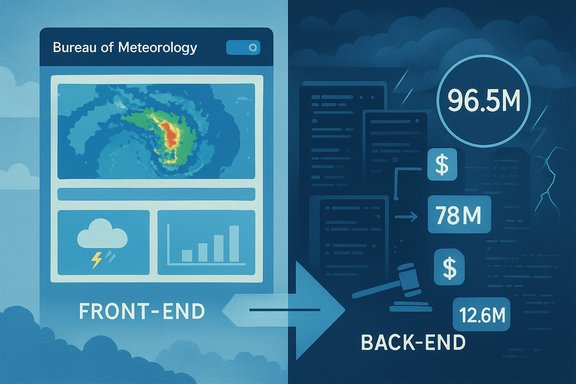
The Bureau of Meteorology (BoM) launched a redesigned public website on 22 October 2025. The revamped site replaced a 12-year-old interface and was presented as part of a broader program of technical upgrades intended to improve security, resilience and accessibility for a high‑traffic national service. Within days of the rollout, users — especially farmers, regional councils and emergency services — flooded the bureau with complaints about the site’s usability, the readability of radar overlays and the discoverability of hyper‑local data such as river heights, rainfall observations and property‑level information. Nine days after launch the BoM reverted the radar map visual style to the former look while promising a program of fixes. What began publicly as a $4.1 million redesign rapidly metastasised into a far larger program once back‑end contracts and testing costs were accounted for. The bureau’s new chief executive, Dr Stuart Minchin, has since confirmed the total program cost as approximately $96.5 million, with a three‑part breakdown the agency provided: $4.1 million for the front‑end redesign, $79.8 million for the build/engineering work (primarily the content management system and integration), and $12.6 million for launch and security testing. The bureau says the larger sums reflect the effort required to rebuild and secure the systems that ingest massive volumes of observational and model data.
Key governance questions that arise:
There are defensible technical reasons for significant back‑end investment — securing observational pipelines, ensuring high availability, and integrating complex model outputs are expensive but defensible priorities. However, those technical necessities must be balanced by tight procurement oversight, staged deployment strategies, and continuous user co‑design. The bureau’s immediate path to repair is straightforward: stabilise the public experience, publish an independent audit of procurement and delivery, and run an intensive user‑centred recovery sprint to fix the most damaging usability regressions.
If executed with speed and transparency, the bureau can convert this public relations crisis into a disciplined modernization story. If it fails to provide credible accountability and clear technical fixes, the political and community costs will continue to mount — and the wider lesson for government digital transformation will be stark: high‑stakes infrastructure demands not only engineers, but governance that matches the scale of the technical challenge.
Source: psnews.com.au Massive blowout to cost of the BoM's bungled new website sparks outrage | PS News
 Background / Overview
The Bureau of Meteorology (BoM) launched a redesigned public website on 22 October 2025. The revamped site replaced a 12-year-old interface and was presented as part of a broader program of technical upgrades intended to improve security, resilience and accessibility for a high‑traffic national service. Within days of the rollout, users — especially farmers, regional councils and emergency services — flooded the bureau with complaints about the site’s usability, the readability of radar overlays and the discoverability of hyper‑local data such as river heights, rainfall observations and property‑level information. Nine days after launch the BoM reverted the radar map visual style to the former look while promising a program of fixes. What began publicly as a $4.1 million redesign rapidly metastasised into a far larger program once back‑end contracts and testing costs were accounted for. The bureau’s new chief executive, Dr Stuart Minchin, has since confirmed the total program cost as approximately $96.5 million, with a three‑part breakdown the agency provided: $4.1 million for the front‑end redesign, $79.8 million for the build/engineering work (primarily the content management system and integration), and $12.6 million for launch and security testing. The bureau says the larger sums reflect the effort required to rebuild and secure the systems that ingest massive volumes of observational and model data. Why the numbers matter: cost, context and confusion
The headline figure — A$96.5 million — matters for three independent but related reasons.- Public accountability: The BoM is a taxpayer‑funded national service used by millions of Australians every day. A large cost blowout invites scrutiny about value for money and governance in procurement of IT systems.
- Operational risk: The site is a critical communication channel for weather warnings. Any degradation in usability can have direct safety implications during extreme weather events.
- Institutional trust: Repeated missteps in a high‑profile public service can erode confidence among key user groups — particularly in regional and agricultural communities that depend on precise, localised data.
The technical anatomy of the cost blowout
Understanding why a public website can attract a near‑nine‑figure price tag requires unpacking what “a website” actually entails for a national meteorological bureau.Three major cost drivers
- Content Management System (CMS) and platform engineering: The BoM’s public interface sits atop a complex CMS that must deliver high volumes of radar and satellite imagery, integrate observational feeds from thousands of sensors, host model outputs, and support rapid updates during fast‑moving events. The primary CMS contract listed on AusTender to a major professional services firm shows the core platform element grew to roughly A$78 million after amendments and extensions.
- Security, testing and resilience: The bureau points to substantial costs for launch readiness and security testing — a non‑negotiable line item given the agency’s history and the sensitive, mission‑critical nature of weather forecasts. The confirmed A$12.6 million for launch and security testing reflects extensive integration testing, penetration testing, resilience exercises, and certification work required to protect data flows and service continuity.
- Data integration and systems rebuild: Weather systems are not simple web pages; they are distributed stacks that ingest telemetry from satellites, radar, automatic weather stations, river gauges, and observational networks. Rebuilding the underpinning systems — the APIs, databases, geospatial tile services, and streaming pipelines — carries significant engineering costs reflected in the A$79.8 million engineering line.
Why back‑end work dwarfs front‑end design
A public‑facing UI can be expensive — but in this case the visible redesign (A$4.1M) is only the surface. The far larger effort sits below the waterline: ensuring the CMS can scale to millions of daily hits, that map tiles render with millisecond latency, and that integration with operational forecasting models is secure and auditable. Those are legitimate technical imperatives, but the public conversation has centred on the visible usability failures rather than on these invisible, but costly, engineering components.What went wrong: governance, procurement and product delivery failures
The BoM and its contractors were operating against a backdrop of complex digital change, but the sequence of events reveals several preventable governance and delivery failures:- Poor communication of scope: The initial public messaging focused on the front‑end figure ($4.1M), which — without clear context — created a misleading impression that the project was small. Disclosing the full program costs only later amplified public outrage.
- Procurement drift and contract amendments: The main CMS contract to a large consultancy began at a much lower value and was amended multiple times. Recurrent contract amendments, extensions and scope creep without clearer parliamentary oversight or published change logs raise legitimate questions about contract management. Reporting shows Accenture’s CMS contract alone expanded significantly.
- Insufficient user‑centred rollout: The redesign was launched into production with obvious usability regressions for core user groups. For services used by farmers and emergency services, discoverability of location‑specific data and map readability are not optional luxuries — they are essential requirements that should have been validated by live user testing and staged rollouts.
- Inadequate staged deployment / rollback planning: A high-risk public service should have allowed easy toggles between old and new experiences and provided clear fallback options. The fact that the public clamoured for an immediate reversion of the radar visual style suggests the rollout lacked robust feature‑flagging and rollback strategies.
The human and safety impacts
When a national weather service becomes harder to use during an active weather week, the consequences extend beyond inconvenience.- Farmers and regional operators reported being unable to find locally‑relevant rainfall and river height data, and users complained that the new platform restricted searches to towns and postcodes instead of allowing latitude/longitude or precise coordinates, interfering with property‑level planning. Politicians argued these issues risked lives and livelihoods during flood and storm events. The BoM has contested some of these claims, noting that many data elements remained available but were harder to find. The split between user perception and back‑end reality underscores a failure in user experience design and stakeholder testing.
- The timing of the launch — coinciding with a severe weather weekend in several states — magnified the problem. When users were actively seeking guidance, the user experience friction undermined confidence. The bureau later delayed planned updates because resources were redeployed to operational forecasting as Severe Tropical Cyclone Fina threatened northern Australia. That pause frustrated rapid fixes but reflected appropriate operational priority during a hazard.
Valid technical justifications — and where the agency is right
It’s important to balance criticism with an acknowledgement of legitimate technical considerations.- Security and resilience investments are necessary. The BoM has publicly cited the 2015 cyber intrusion and the imperative to modernise legacy infrastructure. For agencies that support critical national infrastructure, investing in secure, tested platforms is legitimate and defensible. The A$12.6M security and launch testing figure, while headline‑worthy, aligns with the kind of independent verification, penetration testing and platform hardening required for mission‑critical systems.
- Integration with complex observational networks is expensive. The BoM’s services rely on a global and national sensor network; ensuring consistent, low‑latency delivery of radar tiles, satellite composites, and model grids to a public map is not a trivial project. The engineering effort to rebuild those pipes plausibly accounts for a large share of the bill.
Procurement and vendor issues: vendor lock‑in, contract oversight and penalties
Independent reporting shows large consultancy contracts (with Accenture and Deloitte among the named parties) increased substantially from their original budgets. Multiple contract amendments, extension options and the absence (or unenforceability) of penalty clauses were raised in media and parliamentary discourse. Those are standard procurement risk areas for large public programs.Key governance questions that arise:
- Were contract amendment paths and expected worst‑case costs adequately disclosed to oversight bodies?
- Were options for competitive re‑procurement or modular architecture (reducing vendor lock‑in) sufficiently explored?
- How were penalty clauses, service level agreements and exit arrangements structured to protect taxpayers in case of poor delivery?
A practical recovery plan (what competent remediation should look like)
The immediate priorities for the BoM — and for any public agency facing a comparable debacle — are straightforward and executable.- Stabilise: Reintroduce a fully usable legacy experience as the default for users who need it, while leaving the new platform available in a clearly labelled beta mode for testers and early adopters.
- Audit: Commission an independent audit of procurement, contract amendments, and change‑control records to provide transparency about how costs evolved.
- User‑centred fixes: Run a rapid, funded program of co‑design with primary stakeholders (farmers, SES, council officers, Aboriginal land managers) to identify and fix the top 10 usability regressions within a fixed two‑ to four‑week window.
- Governance reform: Publish a clear remediation roadmap with milestones, owners and dates; make contract change‑logs public (redacting sensitive commercial material) to restore trust.
- Publish telemetry and user metrics: Make anonymised usage metrics — such as search types, most‑frequent queries, and failure rates — available to independent reviewers so fixes can be prioritised empirically.
Long‑term lessons for public-sector digital transformation
The BoM episode is not unique; it echoes a familiar pattern in government IT projects. The following principles should be institutionalised across agencies:- Make the whole‑program cost visible from the outset, not just the visible UI line item.
- Require staged, feature‑flagged rollouts with production parity testing and clear rollback paths.
- Mandate ongoing co‑design with high‑reliance user groups, especially where safety is implicated.
- Use modular procurement to reduce vendor lock‑in: separate CMS, geospatial services, and public APIs so each element can be evolved or replaced independently.
- Require independent penetration and resilience testing before public launch, but pair those tests with staged usability checks that include stress periods (simulated high traffic during hazard events).
Political fallout and accountability
The political reaction has been swift. Coalition politicians have labelled the program a “disaster” calling for reviews and consequences; crossbench scrutiny and media attention have intensified. Environment Minister Murray Watt has publicly asked the new BoM chief to make the website a priority and to report back — a reasonable ministerial demand that signals oversight will be sustained. The combination of political pressure and public mistrust creates a narrow window for the bureau to demonstrate corrective action.Where reporting remains uncertain — flagged claims and open questions
- Some media outlets have reported higher upper‑bound estimates (up to A$150 million) based on aggregated tender notices and informal sources. Those higher figures remain estimates and are not verified as the bureau’s final accounting. Treat them as potential exposure scenarios rather than confirmed amounts.
- The precise contractual arrangements, amendment justifications and any internal sign‑offs that authorised scope increases have not been fully published. An independent audit or parliamentary inquiry would be necessary to produce a definitive timeline and accountability trail.
- Several public claims about missing features (for example, inability to enter GPS coordinates) have been contested by the BoM, which says many features remained accessible but were harder to locate. This gap between availability and discoverability is a real UX failure, but it also means some alarmist statements require careful qualification.
Conclusion: accountability, technical legitimacy and rebuilding trust
The BoM website fiasco is a multifaceted failure: a legitimate, necessary investment in platform security and resilience collided with weak rollout governance, poor stakeholder engagement, and a communications strategy that obscured the program’s full scope. The result is a large financial headline figure, a frustrated set of users who felt legitimately let down in the middle of active weather events, and a political imperative for transparent remediation.There are defensible technical reasons for significant back‑end investment — securing observational pipelines, ensuring high availability, and integrating complex model outputs are expensive but defensible priorities. However, those technical necessities must be balanced by tight procurement oversight, staged deployment strategies, and continuous user co‑design. The bureau’s immediate path to repair is straightforward: stabilise the public experience, publish an independent audit of procurement and delivery, and run an intensive user‑centred recovery sprint to fix the most damaging usability regressions.
If executed with speed and transparency, the bureau can convert this public relations crisis into a disciplined modernization story. If it fails to provide credible accountability and clear technical fixes, the political and community costs will continue to mount — and the wider lesson for government digital transformation will be stark: high‑stakes infrastructure demands not only engineers, but governance that matches the scale of the technical challenge.
- Key figures at a glance:
- Approximate total cost reported by the BoM: A$96.5 million.
- Public front‑end redesign disclosed earlier: A$4.1 million.
- Reported main CMS contract value (AusTender / reporting): ~A$78 million (contract amendments noted).
- Immediate priorities recommended (summarised):
- Restore a fully usable legacy default experience for high‑reliance users.
- Commission an independent procurement and delivery audit.
- Run focused, user‑centred co‑design sprints to resolve top usability failures.
- Publish a remediation roadmap with transparent milestones and metrics.
Source: psnews.com.au Massive blowout to cost of the BoM's bungled new website sparks outrage | PS News
