

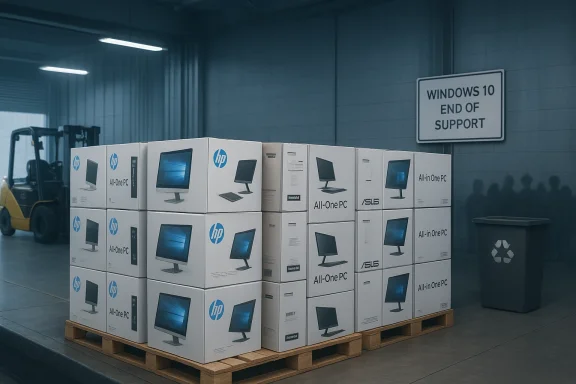
A single photograph of neatly lined, company-branded all‑in‑one PCs, boxed and waiting to be hauled away, ignited a flurry of online anger—and for good reason: the image exposed a blunt, recurring tension in modern IT purchasing and sustainability cycles. What one passerby saw as a neat corporate disposal turned into a wider conversation about forced obsolescence, responsible asset disposition, and a very real surge in electronic waste as Windows 10 reached end‑of‑support and organizations rushed to move to Windows 11‑capable hardware.
Windows 10, first released in July 2015, was the dominant desktop operating system for a decade. Microsoft set a firm end‑of‑support date for most consumer and mainstream business editions: October 14, 2025. After that date the company stopped issuing routine free security and feature updates for unenrolled devices, leaving owners with four basic options: upgrade eligible machines to Windows 11, enroll eligible devices in Microsoft’s consumer Extended Security Updates (ESU) for a limited period, migrate to alternative operating systems, or continue running Windows 10 without vendor security patches.
This sunset wasn’t just a technical milestone; it created a discrete policy and market signal: devices that cannot or will not be upgraded suddenly become less attractive to corporate procurement, resale markets, and managed service providers. That dynamic is already shifting lifecycle decisions for millions of PCs and is one reason a line of boxed AIOs can look like evidence of a larger problem.
At the heart of the debate are two competing realities:
What’s clear is this: the policy deadline pushed millions—potentially hundreds of millions—of working devices into a status where reuse and resale become harder, and disposal becomes more likely.
When the total cost of ESU, device upgrades, staff time, and disposal logistics is modeled against the cost of replacing hardware with modern, secure machines, organizations will make different choices. The public photo suggests at least one organization chose the hardware replacement pathway quickly—and in doing so, created a visible environmental backlash.
Strengths:
There are concrete, practical ways to reduce the environmental harm without compromising security or operational needs: extend transition windows, fund community refurbishers, require certified recycling, and make reuse the default. Those changes require coordination across vendors, governments, NGOs, and large buyers. Until they become commonplace, images like the disposed AIOs will continue to serve as uncomfortable reminders that technology progress and environmental responsibility are not automatically aligned; they must be deliberately designed to be.
Source: The Cool Down Passerby sparks outrage after sharing photo of disturbing corporate practice: 'You have another choice'
 Background: why this moment matters
Windows 10, first released in July 2015, was the dominant desktop operating system for a decade. Microsoft set a firm end‑of‑support date for most consumer and mainstream business editions: October 14, 2025. After that date the company stopped issuing routine free security and feature updates for unenrolled devices, leaving owners with four basic options: upgrade eligible machines to Windows 11, enroll eligible devices in Microsoft’s consumer Extended Security Updates (ESU) for a limited period, migrate to alternative operating systems, or continue running Windows 10 without vendor security patches.This sunset wasn’t just a technical milestone; it created a discrete policy and market signal: devices that cannot or will not be upgraded suddenly become less attractive to corporate procurement, resale markets, and managed service providers. That dynamic is already shifting lifecycle decisions for millions of PCs and is one reason a line of boxed AIOs can look like evidence of a larger problem.
The photo that started the conversation
The shared photo—posted in a community space where hardware enthusiasts discuss repairs, modifications, and second‑hand gear—showed several all‑in‑one PCs staged for pickup. The caption framed them as “perfectly good” hardware headed straight to e‑waste recycling. Responses ranged from outrage to practical opportunism: some commenters called the disposal wasteful and environmentally irresponsible, while others pointed out that this exact scenario creates a second‑hand market opportunity for hobbyists and refurbishers.At the heart of the debate are two competing realities:
- Corporate and institutional IT teams are under pressure to manage security compliance and reduce exposure to unsupported platforms.
- Many devices that are functionally sound are blocked from free upgrades to the vendor‑recommended OS by hardware requirements (TPM, Secure Boot, CPU whitelists), leaving them in a gray zone—usable, but downgraded in market value.
Why companies discard working gear: the asset‑life calculus
From a purchasing and compliance perspective, retiring entire classes of devices can seem sensible—even inevitable. Here are the main business drivers:- Security posture and liability. Running an unsupported OS raises audit, compliance, and cybersecurity risk. For many CIOs, the calculus is straightforward: an unmanaged or patchless fleet is an unacceptable liability.
- Vendor policy and support agreements. Software vendors and managed service providers often require supported configurations to qualify for support, contracts, and SLAs.
- Operational simplicity. Standardizing on a single, vendor‑supported OS reduces complexity for help desks, imaging, and driver management.
- Resale and warranty considerations. For many organizations the cost of refurbishing, securely wiping, and reselling older equipment—plus logistics—outweighs the immediate gain from trade‑in programs.
- Visible brand and security messaging. New devices are marketed as materially more secure (hardware‑rooted features such as TPM 2.0 and virtualization‑based security), and some organizations prefer to advertise modern, up‑to‑date infrastructure.
The scale of the problem: numbers and competing estimates
How many machines are affected? Estimates vary because the baseline populations, sampling methodologies, and assumptions about upgrade eligibility differ.- Industry analyst reports cautioned that a large cohort of older systems—ranging in the hundreds of millions—would be impacted by Windows 10’s support end. Different analyses have produced figures spanning roughly a few hundred million devices at risk of becoming hard‑to‑sell or destined for disposal when corporate buyers or consumers choose to replace rather than migrate.
- Advocacy groups warned about even larger figures, reflecting a broader definition of “at risk” devices and the global installed base complexity.
What’s clear is this: the policy deadline pushed millions—potentially hundreds of millions—of working devices into a status where reuse and resale become harder, and disposal becomes more likely.
The environmental stakes: why e‑waste is more than an eyesore
Electronic waste is not simply clutter. It is a growing global waste stream with real human and environmental consequences.- The global volume of e‑waste measured in recent international assessments is staggering—tens of millions of metric tons annually—and only a minority is formally collected and recycled in an environmentally sound way. Valuable materials such as gold, silver, copper, and rare earths are lost when devices are landfilled or mishandled, while toxic elements like lead, mercury, cadmium, and brominated flame retardants can leach into soil and groundwater.
- Informal recycling streams—often located in lower‑income countries—can expose communities to hazardous substances and create long‑term health impacts from burning, acid baths, and uncontrolled dismantling.
Alternatives and good practices that weren’t obvious in the photo
Every retired PC that is responsibly handled can be part of a circular solution—if the right actors and processes are in place. Here are concrete pathways organizations and individuals can adopt immediately.- Prioritize reuse and refurbishment over destruction. Devices that power on and meet baseline reliability can be refurbished and donated to community organizations, schools, or small businesses.
- Use certified recyclers when disposal is necessary. Certifications such as e‑Stewards or R2 indicate firms that adhere to environmental and labor standards during processing.
- Implement robust data sanitization and chain‑of‑custody practices so organizations can feel secure about donating or remarketing former corporate gear.
- Consider software alternatives before hardware replacement: lightweight Linux distributions, ChromeOS Flex, or specialized long‑term support OSes can keep older devices productive for years.
- Leverage trade‑in and take‑back programs offered by retailers and OEMs as a last resort to ensure devices are handled responsibly.
- Plan refresh cycles around circular metrics, not just TCO: factor in reclamation value, resale potential, and environmental cost in procurement decisions.
A short checklist for IT managers and procurement teams
- Audit your fleet: identify Windows 11 upgrade eligibility and machines suitable for refurbishment.
- Prioritize high‑risk devices for immediate upgrade or ESU enrollment.
- Establish partnerships with certified refurbishers and recyclers ahead of refresh waves.
- Create donation channels with non‑profits and educational institutions.
- Publish transparent disposition reports for stakeholders and regulators.
The economics: ESU, trade‑in, and the costs of transition
Microsoft and other vendors offered bridging options—such as consumer Extended Security Updates (ESU)—to give organizations time to migrate. That program and its conditions alter the financial calculus for many owners:- ESU enrollment options included free paths under certain conditions, reward‑point redemptions, or a modest one‑time fee per account, but the consumer ESU is a short‑term bridge—not a permanent fix.
- For enterprises, paid multi‑year ESU options exist but become increasingly expensive over time and are meant strictly as a transition instrument.
When the total cost of ESU, device upgrades, staff time, and disposal logistics is modeled against the cost of replacing hardware with modern, secure machines, organizations will make different choices. The public photo suggests at least one organization chose the hardware replacement pathway quickly—and in doing so, created a visible environmental backlash.
Policy and corporate responsibility: who should be accountable?
This is not simply a matter of individual corporate decisions. The dynamics expose gaps in public policy and corporate commitments:- Extended Producer Responsibility (EPR) can move the burden for end‑of‑life management onto manufacturers and system integrators. Where EPR laws exist, they shift economics toward reuse and circular design.
- Longer software lifecycles or subsidized update programs for low‑income and public interest customers could reduce premature hardware turnover.
- Right to repair and stronger repair ecosystems can lower barriers to refurbishing older machines.
- Transparency obligations—requiring companies to report asset disposition routes and recycling partners—would let stakeholders hold large buyers to higher environmental standards.
Practical steps for consumers and enthusiasts who spot similar scenes
If you encounter corporate disposals or piles of hardware that look usable, here are responsible actions to consider:- Don’t attempt to take devices directly from the curb or a secured area—there may be legal or privacy concerns.
- If the devices are in a public donation or certified recycling bin, contact the retailer or recycler for information on pickup and potential refurbishment programs.
- Contact local nonprofits, schools, and community tech programs to offer information on available hardware, but avoid claiming devices without express permission.
- If you’re interested in picking up hardware for personal use, verify chain‑of‑custody, ask about data wiping, and prefer devices accompanied by authorization from the owner.
Strengths and weaknesses of current industry practice
This moment—captured in a single image—reveals both progress and persistent weaknesses.Strengths:
- Many major retailers and OEMs now offer trade‑in and recycling options, and certified recyclers exist that recover precious materials responsibly.
- There is a growing circular market for refurbished hardware, driven by specialized marketplaces and B2B refurbishers.
- Awareness among consumers and organizations about e‑waste hazards has increased, creating pressure for better disposal practices.
- Vendor OS transitions that hinge on hardware eligibility can accelerate hardware churn, especially when support windows are short.
- Not all organizations prioritize refurbishment or donation—logistics, risk aversion, and procurement rules often favor disposal.
- Recycling capacity and formal collection rates remain far below what’s necessary; a substantial proportion of global e‑waste is still unmanaged or informally processed.
- Short ESU windows and tiered commercial pricing can make continued support prohibitively costly for small organizations and individuals, nudging them toward hardware replacement.
What responsible companies should do next
Large buyers—OEMs, governments, and corporate fleets—have the leverage to bend the system toward reuse and sustainability. Practical practices include:- Publish and enforce a corporate policy that prioritizes reuse and donation before recycling.
- Require secure data‑sanitization documentation and reuse certifications from disposal vendors.
- Contract with refurbishers who provide employment and training in local communities, thus creating social as well as environmental value.
- Design procurement cycles that consider modularity and replaceable components, increasing the odds that devices can be upgraded rather than replaced.
- Advocate for policy frameworks that make long‑term software support more compatible with environmental goals.
Conclusion: beyond the photograph
The boxed AIOs that sparked online outrage are more than a social media moment; they are a focal point for a systemic challenge. Software lifecycles, corporate procurement practices, and an underdeveloped circular economy for electronics intersect in ways that can either accelerate waste or promote reuse. The difference comes down to choices—policy choices by vendors, buying and disposal choices by organizations, and consumer and community choices about reuse and repair.There are concrete, practical ways to reduce the environmental harm without compromising security or operational needs: extend transition windows, fund community refurbishers, require certified recycling, and make reuse the default. Those changes require coordination across vendors, governments, NGOs, and large buyers. Until they become commonplace, images like the disposed AIOs will continue to serve as uncomfortable reminders that technology progress and environmental responsibility are not automatically aligned; they must be deliberately designed to be.
Source: The Cool Down Passerby sparks outrage after sharing photo of disturbing corporate practice: 'You have another choice'
