

Microsoft’s cut-off for Windows 10 support has become a precipitating event for an avoidable e-waste crisis: security-driven upgrade pressure, strict Windows 11 hardware gates (notably TPM 2.0), and uneven recycling capacity risk turning hundreds of millions of still-functional machines into hazardous waste unless industry, governments and buyers act fast.
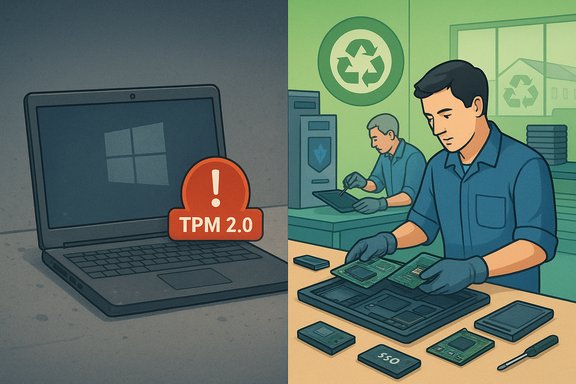
On 14 October 2025 Microsoft ended mainstream free support for Windows 10, leaving consumer installations without routine security updates unless they enrol in the company’s Extended Security Updates (ESU) programme or upgrade to Windows 11. Microsoft’s lifecycle pages explain the options — upgrade to Windows 11 where hardware allows, buy a new PC that ships with Windows 11, or enrol in ESU (available through several consumer routes) — and explicitly state that devices will continue to function but will not receive technical, feature or security updates after the cut-off. Campaign groups, recyclers and circular-economy advocates have quickly framed the date as a fork in the road: millions of devices that cannot meet Windows 11’s hardware prerequisites may be discarded, or else routed into repair, reuse and responsible recycling channels. Repair-focused NGOs estimated that roughly 400 million PCs worldwide are unable to upgrade to Windows 11 because of the operating system’s hardware requirements (for example, the Trusted Platform Module TPM 2.0, UEFI Secure Boot and certain CPU generation checks), and they warned of a large e-waste surge if those machines are replaced en masse. A separate, high‑profile calculation by WEEE analysts projected that, under specific assumptions, the UK’s share of those retired devices could contain nearly £1.8 billion of recoverable metals (gold, copper and silver), illustrating both the material value locked in end-of-life electronics and the scale of the disposal problem should devices be mishandled. That arithmetic is sensitive to the inputs and should be read as an order‑of‑magnitude estimate rather than a guaranteed cash pile. The global context is stark: the United Nations’ Global E‑waste Monitor reported 62 million tonnes of e-waste generated in 2022 and documented that only about 22% was formally collected and recycled. A sudden or concentrated spike in device retirements will pressure collector networks, refurbishers and recyclers already operating near capacity.
Three priorities should guide immediate action:
Source: allthingsbusiness.co.uk Ewaste and Tackling The Issue - All Things Business
 Background and the immediate story
On 14 October 2025 Microsoft ended mainstream free support for Windows 10, leaving consumer installations without routine security updates unless they enrol in the company’s Extended Security Updates (ESU) programme or upgrade to Windows 11. Microsoft’s lifecycle pages explain the options — upgrade to Windows 11 where hardware allows, buy a new PC that ships with Windows 11, or enrol in ESU (available through several consumer routes) — and explicitly state that devices will continue to function but will not receive technical, feature or security updates after the cut-off. Campaign groups, recyclers and circular-economy advocates have quickly framed the date as a fork in the road: millions of devices that cannot meet Windows 11’s hardware prerequisites may be discarded, or else routed into repair, reuse and responsible recycling channels. Repair-focused NGOs estimated that roughly 400 million PCs worldwide are unable to upgrade to Windows 11 because of the operating system’s hardware requirements (for example, the Trusted Platform Module TPM 2.0, UEFI Secure Boot and certain CPU generation checks), and they warned of a large e-waste surge if those machines are replaced en masse. A separate, high‑profile calculation by WEEE analysts projected that, under specific assumptions, the UK’s share of those retired devices could contain nearly £1.8 billion of recoverable metals (gold, copper and silver), illustrating both the material value locked in end-of-life electronics and the scale of the disposal problem should devices be mishandled. That arithmetic is sensitive to the inputs and should be read as an order‑of‑magnitude estimate rather than a guaranteed cash pile. The global context is stark: the United Nations’ Global E‑waste Monitor reported 62 million tonnes of e-waste generated in 2022 and documented that only about 22% was formally collected and recycled. A sudden or concentrated spike in device retirements will pressure collector networks, refurbishers and recyclers already operating near capacity. Why Windows 10’s end of support matters beyond UI changes
The technical life-cycle decision here combines three distinct risks into one public event:- Security exposure: After end‑of‑support, unpatched Windows 10 installations become more attractive targets for malware, ransomware and exploitation. ESU is a time‑boxed mitigation but is not a permanent security commitment for most users. Microsoft documents ESU requirements and limitations — it extends critical and important security updates through a one‑year consumer window (to 13 October 2026 for the consumer ESU offering) and carries prerequisites that not every device will meet.
- Forced turnover and obsolescence by policy: Windows 11 enforces a set of hardware requirements (TPM 2.0, Secure Boot, minimum RAM and storage, and relatively modern CPUs) that leave many mid‑2010s devices ineligible for an in‑place upgrade. That gate turns a software lifecycle decision into a hardware replacement pressure — a form of software-driven obsolescence that repair advocates argue sidesteps the environmental lifecycle of the product. Advocacy groups have used the Windows 10 deadline to call for regulatory reforms to prevent this kind of software obsolescence.
- Waste-system strain and safety hazards: E-waste is not inert. Lithium‑ion batteries inside laptops and other devices pose fire risks when compacted or crushed during collection and transport, and improper processing can release toxic by‑products. Local recycling and collection infrastructure can be overwhelmed by concentrated flows, creating operational hazards and the potential for informal processing that damages human and environmental health. Municipal and academic investigations have documented fire incidents and toxic emissions linked to battery events in waste trucks and facilities — evidence that capacity and safety planning matters.
Understanding the headline figures — what the big numbers mean
Several widely reported numbers have shaped the public debate: “400 million devices,” “£1.8 billion of recoverable metals (UK),” and “700 million+ kg of potential e-waste.” These figures come from different models and actors and must be contextualised.- The ~400 million figure is an aggregate estimate used by repair and consumer-rights organisations to indicate the global pool of Windows 10 devices that fail Windows 11 compatibility checks — it is an extrapolation from fleet scans, market-share data and publicly reported compatibility failure rates rather than a device-by-device census. As a working scenario it highlights scale, but the actual count varies by sample and timeframe.
- The £1.8 billion headline, cited widely in UK media, is derived from a BusinessWaste model that: (1) allocates 400 million devices worldwide to the UK using a 3.6% share, (2) assumes a device mix (70% laptops, 30% desktops) with average weights, (3) applies per‑ton recovery yields for copper, gold and silver, and (4) multiplies by a price snapshot. The arithmetic is internally consistent but extremely sensitive to each choice (market share, device mix, recovery yield and metal prices). Interpreted carefully it demonstrates material value at scale — not an instant windfall ready for collection.
- The global e‑waste baseline from the UN — 62 million tonnes generated in 2022 with roughly 22% documented formal recycling — shows the structural problem: the world already discards more electronics than formal systems currently capture, so a concentrated retirement event adds pressure to an already strained landscape.
What’s driving incompatibility: TPM 2.0 and other hardware gates
Windows 11 introduced a clear set of minimum requirements that were justified publicly on security grounds. The two most visible technical gates are:- TPM 2.0 (Trusted Platform Module) — a hardware-based security component used to store cryptographic keys and to enforce platform integrity checks. TPM availability varies across older laptops and desktops; where present it can be an on‑board discrete module or implemented as firmware (fTPM), but many older systems lack the capability or the vendor firmware to enable it.
- CPU family and firmware features — Microsoft’s support matrix for Windows 11 generally requires processors new enough to support virtualization‑based security features and specific microarchitecture capabilities. Combined with UEFI Secure Boot and other platform prerequisites, many devices produced before roughly 2018 were left out of official upgrade paths.
The circular-tech response: modular design, reuse and In2tec’s approach
Modular design and assembly-for-disassembly are practical technical responses to the lifecycle problem. Companies working on repairable and modular electronics are building solutions that aim to reduce embodied‑material loss and enable second‑life component reuse.- Modular electronics let technicians replace only the failing or unsupported parts (batteries, storage, screens, or even security modules where possible), delaying whole-unit replacement and increasing reuse flows.
- Reuse and refurbishment capture value and lower embodied emissions compared with new manufacture. Several refurbishers and social enterprises have ramped services — secure reimaging, battery and drive replacement, and OS swaps to ChromeOS Flex or Linux where appropriate — to keep devices in productive use. These options are especially important for education, charities and low-income households.
Where the numbers, the tech and policy collide — risks and blind spots
The headline narratives and proposed solutions reveal important trade-offs and vulnerabilities:- Capture rate uncertainty: The amount of recoverable metal depends on capture and processing quality. Formal recyclers get significantly higher yields than informal operations, and most of the world’s e-waste is not processed in certified facilities. If a large share of retired devices is exported or processed informally, environmental harm and value loss will rise.
- Refurbisher and ITAD capacity: Refurbishers and certified IT asset disposition (ITAD) firms can absorb a lot of functional devices, but they need customer channels, logistics, labour and quality-control processes. A sudden peak can create backlogs that either delay reuse or force lower-quality processing that reduces metal yield and increases environmental harm. Forum analyses and practitioner checklists emphasise staged inventory triage and pre‑processing (battery removal, secure erasure) as necessary steps.
- Security vs. access: ESU buys time for users but is a short bridge that sometimes includes prerequisites (for example, Microsoft requiring account linkage for consumer ESU options). This raises equity concerns: lower-income users and community organisations may lack the funds or administrative simplicity to enrol in paid or account‑linked ESU, while being more likely to rely on older hardware. The result risks shifting security burdens onto the most vulnerable.
- Regulatory gaps: Current ecodesign rules in many jurisdictions require multi‑year update commitments for some categories (e.g., smartphones in the EU), but laptops, many IoT devices and general-purpose PCs remain less regulated. Campaign groups call for a minimum of 15 years of security updates or stronger repairability mandates to prevent software‑driven obsolescence; those are political asks that would require new legislative work and industry buy‑in.
- Battery fire risk and public safety: Waste system operators have documented battery-triggered fires that endanger crews and infrastructure. Policymakers must account for this operational hazard by expanding safe battery-collection options and pre-processing requirements to remove or secure cells before transportation and shredding.
Practical pathways for different actors (what to do now)
Avoiding the worst outcomes requires action at multiple levels. The following are pragmatic, prioritized steps for households, IT teams, manufacturers and policymakers.For households and small organisations
- Inventory devices: record model, CPU, TPM/fTPM status, RAM, storage and Windows build. Use the PC Health Check or OEM upgrade tools before deciding.
- Enrol in ESU if security updates are essential and the device meets ESU prerequisites — treat this as a bridge, not a permanent solution.
- Consider alternative OS options for devices that are otherwise healthy: ChromeOS Flex and mainstream Linux distributions (Ubuntu, Linux Mint, Zorin) are viable for web and office tasks and extend security support.
- Reuse, donate, or sell via certified refurbishers; never place batteries or whole laptops in kerbside bins. Use retailer takeback, municipal WEEE collection, or certified ITAD firms for disposal.
For IT managers and enterprises
- Treat ESU as a controlled bridge while running compatibility tests and planning staged refresh cycles.
- For legacy endpoints, apply network segmentation, strict access controls and endpoint protection to reduce risk while migration is underway.
- Establish relationships with certified ITAD and refurbishers to ensure secure data destruction and maximize reuse/value recovery. Demand chain‑of‑custody certificates.
For manufacturers and OEMs
- Design for disassembly, publish clear lifecycle/upgradeability information at the point of sale, and expand trade‑in/refurbishment programs that prioritise reuse over immediate replacement. Support firmware upgrades where possible to enable longer OS support windows.
For policymakers and regulators
- Strengthen producer responsibility rules (EPR), mandate minimum software‑support durations or transparency about upgradeability, and invest in scaling formal collection and certified recycling infrastructure to avoid leakage into informal streams. Consider targeted grants or procurement rules for reuse in public sector procurement. Advocacy groups are pressing for minimum 15‑year update guarantees for some categories — those proposals deserve consultation and impact analysis.
Why modular design and repairability matter — technical and economic benefits
Designing devices for disassembly does more than make hobbyists happy: it materially shifts lifecycle emissions, improves supply‑chain resilience and reduces the demand for mined materials.- Material recovery vs. component reuse: Recycling melts and separates materials, which consumes energy and sometimes destroys the highest-value components (connector plating, packaged ICs). Recovering intact components for second‑life use preserves the greatest value and requires far less energy than producing new components from virgin materials. Patented approaches that allow full‑board recovery at low temperatures (as claimed by modular innovators) would expand the pool of reusable parts and close more of the circular loop.
- Cost benefits for buyers and refurbishers: Repaired or upgraded devices (battery swap, SSD upgrade, firmware tweak) cost far less than new machines and provide many households, charities and schools with lower-cost access to secure computing. That reduces the social equity impacts of forced hardware refresh cycles. Forum and industry analyses repeatedly describe refurbishment as the most cost-effective pathway to delay mass disposal.
A reality check — what’s likely to happen
The immediate post‑EOL period will not produce a one‑day landfill avalanche; the flows will be staged. Many users will:- Enrol in ESU or accept the security risk for non‑critical devices.
- Upgrade eligible devices to Windows 11.
- Seek refurbished devices, donate or repurpose hardware where practical.
- Some proportion will replace devices with new units, which will enter circular systems in varying quality.
Conclusion — policy, markets and practical priorities
The Windows 10 end‑of‑support event exposed a systemic mismatch between software life cycles, hardware longevity and the capacity of circular systems. The technical rationale for stricter Windows 11 security gates is real, but policy and product design choices have amplified the environmental stakes.Three priorities should guide immediate action:
- Stop treating the headline numbers as inevitable collapse; triage, reuse and refurbishment materially reduce both security risk and environmental harm. Practical alternatives (ESU as a bridge, ChromeOS Flex/Linux migrations, certified refurbishment) are available today.
- Scale safe, certified collection and pre‑processing to handle increased volumes and prevent informal, hazardous recycling flows. Investments here protect workers, communities and material value.
- Align regulatory incentives to reward repairable design, extended software support where feasible, and accountable producer take‑back. Demand‑side pressure from public procurement and civil-society advocacy can shift market behaviour more quickly than voluntary programmes alone.
Source: allthingsbusiness.co.uk Ewaste and Tackling The Issue - All Things Business
