

Background
The argument over Windows 10 is not really about one operating system version. It is about what happens when a dominant platform reaches the end of its lifecycle and millions of users discover that their hardware is still fine, but the software ecosystem has moved on. Microsoft’s official guidance makes the point plainly: Windows 10 PCs will continue to function after support ends, but they will no longer receive security updates, technical assistance, or feature updates. That leaves users with a familiar but uncomfortable choice: upgrade, pay for a temporary support bridge, or change platforms entirely.
For repair advocates, that choice is a deeply political one. Their complaint is not that Microsoft is wrong to end support in principle; rather, they argue that the company’s hardware requirements for Windows 11 and its lifecycle model together create avoidable waste. In the Border Counties Advertizer report, Shropshire volunteers said the result would be “hundreds of thousands” of still-fg discarded unnecessarily, and they framed the issue as one of electronic waste, not just consumer inconvenience. That language matters because it shifts the story from a vendor support policy to a broader environmental and consumer-rights debate.
The repair café movement has been building this critique for years. Across the UK and Europe, repair groups have argued that the easiest way to reduce e-waste is to keep devices in service longer, repair them more often, and make software transitions less punishing. That philosophy collides directly with modern PC lifecycle economics, where security, compatibility, and vendor sh buyers toward replacement rather than refurbishment. The more tightly a vendor ties support to specific hardware, the more quickly a repair café begins to look like a countercultural institution rather than a hobbyist service.
There is also a practical difference between what Microsoft says and what users feel. Microsoft emphasizes that unsupported Windows 10 machines will still run, and that consumers can either upgrade to Windows 11, enroll in Extended Security Updates, or buy a new device. Repair advocates hear that as a three-way fork with a hidden fourth option: use open source software and keep the machine alive at zero software cost. The gap between those messages is where the public debate now lives.
What the Repair Cafés Are Arguing
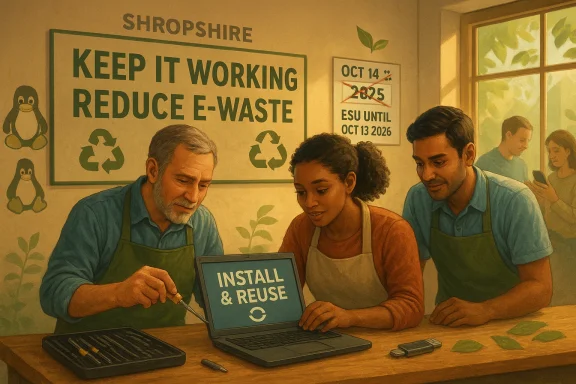
The Shropshire response is rooted in a simple claim: if a laptop still works, software policy should not be the reason it is scrapped. Volunteers from BRACE Llanfyllin Oswestry and Borders, and Repair Cafe Wales are presenting repair and reuse as the default, not the exception. Their argument is that a system that encourages disposal when a machine remains usable is misaligned with both sustainability goals and common sense.
Waste, not just inconvenience
The strongest part of their case is environmental. They are pointing to the UK’s already heavy e-waste burden and warning that Windows 10 retirement will add to it by nudging people toward replacement hardware. That concern is amplified by Microsoft’s hardware gating for Windows y older PCs even though they remain usable for web browsing, office work, and general home computing. The emotional force of the critique comes from that mismatch: the machine still works, but the support model says it should leave the house.
The repair café line is also politically effective because it reframes the laptop as a repairable object rather than a depreciating asset. In that framing, a device is not obsolete when a vendor saysen it can no longer meet a user’s needs. That sounds obvious, but the modern PC market is built around the opposite assumption. The result is a recurring tension between planned replacement and practical longevity.
The open source escape hatch
The volunteers’ proposal is not just to complain, but to offer an exit route. They say their “techy fixperts” can help people switch to open source alternatives safely and at no cost. The it turns repair from a protest into a service. A lot of sustainability rhetoric fails because it asks ordinary users to accept risk and uncertainty; a supported migration clinic lowers that barrier.
This is also where repair cafés become more than community workshops. They are effectively creating a human support layer around Linux and other open systems, which is exactly what many mainstream users need to feel comfortable making thay still be good, but without someone to help with installation, data transfer, and first-time setup, “reuse” can feel too abstract. The fixperts’ role is to make reuse concrete.
Microsoft’s Position and Why It Matters
Microsoft’s official position is less dramatic than the public backlash suggests. The company says Windows 10 support ended on October 14, 2025, and that devices will continue to function, even though they no longer receive security fixes or feature updates. It also points users toward Windows 11, the consumer ESU program, and trade-in or recycling pathways. On paper, that is a standard lifecycle message; in practice, it is a large-scale hardware filter.
Support ends, but the product keeps running
This distinction is the heart of the controversy. Microsoft is not shutting off Windows 10, and it is not forcing the machine to stop booting. It is withdrawing the guarantee that the platform will remain secure and maintained. For a technically literate user, that sounds rational. For a family with a perfectly serviceable laptop and limited money, it sounds like a forced upgrade with friendlier wording.
That is why the support deadline has such power. It creates a deadline without making the device unusable, which means the urgency is driven by security and ecosystem pressure rather than mechanical failure. Users can delay the decision, but the risk profile keeps getting worse. In other words, the operating system keeps working while the assurance around it decays.
Windows 11 compatibility is the real bottleneck
The bigger frustration for repair groups is not the end-of-support date itself; it is the fact that many older laptops cannot move to Windows 11. Microsoft’s own recommendation is to upgrade to Windows 11 if the device is eligible, otherwise enroll in ESU or replace the device. That leaves millions of older PCs in a kind of limbo: still useful, but not welcome in the next version of Microsoft’s ecosystem.
This is where the vendor logic and the repair logic diverge. Microsoft optimizes for security, consistency, and supportability across a vast fleet. Repair advocates optimize for life extension, reuse, and waste minimization. Both positions are defensible, but they produce very different outcomes when applied to the same laptop. That tension is not going away. If anything, it is becoming more visible toff.
The Environmental Case
The environmental argument is the most emotionally potent part of the story because it connects a private computing decision to a public sustainability cost. Repair café volunteers are effectively saying that software policy can become a hidden driver of landfill pressure. That message is hard to ignore when the devices in question stilge, and still perform everyday tasks.
E-waste is the unsaid consequence
Electronic waste has become one of the most persistent byproducts of the consumer tech cycle. A laptop that is thrown away not because it failed, but because it fell behind a support schedule, is a particularly frustrating example of waste. The repair café critique lands here because it exposes a contradiction: the industry tells users to be greener, while simultaneously designing upgrade policies that encourage replacement.
The problem is not unique to Microsoft, of course. Apple, Google, and the broader PC ecosystem all use combinations of software requirements, certification decisions, and service timelines to shape hardware turnover. But Windows 10 matters because of scale. When the world’s most common desktop platform reaches end of support, the environmental consequences are multiplied across households, schools, businesses, and public institutions. End of support for Windows 10, Windows 8.1, and Windows 7 | Microsoft Windows is more realistic than perfect recycling
Repair groups also make a subtle but important point: recycling is not the same as reuse. Recycling sounds tidy, but it still consumes energy, logistics, and labor, and it rarely recovers the full value of a working computer. Reuse, by contrast, preserves the embedded carbon, materials, and manufacturing effort already sunk into the device. That is why keeping a machine alive for an extra two or three yearslimate action, even if it looks modest from a marketing perspective.
This is where the open source option becomes environmentally relevant rather than just ideologically appealing. If a Linux distribution or ChromeOS Flex can make the laptop useful again, the embodied value of the hardware is preserved. In practical terms, that means fewer new machines are sold to accomplish the same daily tasks. That is the kind of quiet sustainability win that repair cafés love, precisely because it is unglamorous and measurable.
Why Windows 10 Support Ended Now
Microsoft’s support cutoff was not random. Windows 10 launched in 2015, and a ten-year lifecycle is in line with what many enterprise buyers expect from major platform support windows. The company has also been steering users toward Windows 11 for years, so the retirement date was always part of the plan. The suddenness people feel now is really the result of delay accumulating into a deadline.
A normal policy with abnormal scale
On a purely technical level, end-of-support is routine. Vendors cannot patch old products fornomics require transitions. The unusual part is how many machines remain in active use and how many of them fail the Windows 11 compatibility bar. That turns an ordinary lifecycle event into a system-wide sorting mechanism.
The compatibility issue is especially painful for consumers because many of those PCs are not slow by everyday standards. They may be older, but they are still sufficient for browsing, streaming, email, word processing, and schoolwork. When a machine is still useful in the ways most people use computers, the line between “upgrade” and “forced replacement” can feel thin indeed.
Microsoft’s bridge is not a bridge for everyone
Micprogram is meant to soften the landing, and that matters. It gives eligible users an extra year of security updates, buying time for planning or migration. But it is still a temporary measure, and temporary measures do not solve the underlying hardware mismatch. They just delay the moment when the user has to choose a new path. (microsoft.com)
That delay is useful for organizations, which can phase migrations and budget for fleets. It is less satisfying for households and small groups that simply want to keep their machines alive. From the repair café perspective, temporary support can look like a toll booth on the road to the same destination. The laptop may be safe for now, but the model still nudges it toward# The Open Source Alternative
If there is a constructive counterproposal in this story, it is the repair café idea of moving people to open source software instead of treating Windows 11 compatibility as the only acceptable outcome. That is a meaningful change in mindset because it treats the computer as a platform owned by the user, not as a leasing arrangement with the vendor.
Linux a
The appeal of Linux in this context is not novelty. It is stability, longevity, and the ability to keep older hardware useful without paying for a new license or a new computer. For many users, especially those whose needs are browser-based, a lightweight Linux distribution can be enough. That makes it a practical rather than ideological choice.
The trick is support. Linux has long strlity, but with the perception that it is too technical for ordinary users. Repair cafés help close that gap by providing local guidance, installation help, and a trusted social setting. In that sense, they are doing for Linux what communities once did for home networking and broadband setup: making the unfamiliar feel survivable.
What the migration really involves
A successful transition is not a single act. It requires checking whether data is backed up, choosing a distro, confirming hardware support, installing the new system, and teaching the user where their familiar tools went. That is why the repair café modelns migration into a guided process instead of a lonely weekend project.
In practical terms, the repair café workflow can be summarized like this:
- Identify whether the laptop is actually suitable for reuse.
- Back up files and photos before any changes are made.
- Choose the most appropriate open source system for the user’s needs.
- Install and test the new software with the user present.
- Leave the person with enough knowledge to keep going confidently.
That pr, but it is exactly what makes reuse scale. It replaces panic with routine, and routine is what most people need when the operating system changes. A good migration feels boring by the end.
Political and Consumer Pressure
The Shropshire story is also a political story because the volunteers are not only asking users to adapt; they are asking lawmakers to intervene. The group welcomed support from Montgomeryshire MP Steve Witherden and highlighted the Repair Reuse Declaration, which calls for moreskills training, and a repair product index for consumers. That is a direct attempt to move the debate from individual choice to policy design.
MPs, declarations, and campaign pressure
Political endorsements matter in issues like this because they signal that repair is no longer being treated as a niche hobby. When MPs sign reuse declarations, they give campaigners a foothold in tions about product design, right-to-repair standards, and consumer information. That is important because software support policy alone cannot solve the reuse problem if hardware remains effectively sealed off from alternative operating systems.
Campaigns also need visibility. Repair cafés thrive on local trust, but policy change needs scale. Asking residents to contact Helen Morgan MP and support the declaration is a classic grassres frustration into a legislative ask. Whether that produces meaningful change is another matter, but it does show that the repair movement has matured beyond simple protest.
Consumer power is limited, but not irrelevant
Consumers cannot force Microsoft to keep Windows 10 alive forever, and they cannot rewrite Windows 11 compatibility standards on their own. What they can do is choose whether they participate in the replacement cycle. r cafés and open source migration help gives them a little more leverage than they would otherwise have. That leverage is modest, but it is real.
The deeper consumer issue is the lack of transparency around longevity. People are often told whether a device is fast, pretty, or feature-rich, but not how long it will remain supportable, repairable, or adaptable. The Repair Reuse Declaration’s idea of a product index is compelling precisely because it would make longevity easier to compare. Consumers rarely reject sustainability; they just need it presented as a usable buying criterion.
Strengths aShropshire criticism of Microsoft is strongest when it connects environmenta, and the practical value of reuse. It is also politically savvy, because ervice model rather than just a complaint. The repair café approple an off-ramp from the upgrade treadmill, and that is a powerful message in a year when Winready ended and the pressure to move on is intensifying.
- Reduces e-waste tops in circulation longer.
- Lowers household costs by avoiding unnecessary hardware replacement.
- Builds local skills through hands-on repair and migration support.
- Expands user choice beyond the Windows 11 upgrade path.
- Creates community trust around technical transitions that otherwise feel intimidating.
- Supports policy change by linking repair work to the Repair Reuse Declaration.
- Normalizes open source adoption for non-technical users.
Risks and Concerns
The repair café position is persuasive, but it is not without trade-offs. The biggest challenge is that security pressure is real, and unsupported Windows 10 machines do become mme. There is also a usability gap between what a technically comfortable volunteer can doer can manage alone, which means any reuse program needs ongoing support, not ju ([microsoft.com]* remains if users stay on unsupported Windows 10 without a plan.
- Migration complexity can overwhelm users who lack confidence with alternatives.
- Hardware compatibility gaps may limit how far open source can help older devices.
- Support sustainability is a challenge for volunteer-led repair networks.
- Policy change is slow, so campaigning may not keep pace with the support deadline.
- Messaging can polarize the debate if it becomes framed as anti-Microsoft rather than pro-reuse.
- Not every user can switch, especially where specialized Windows software is required.
Looking Ahead
The most interesting thing to watch is whether repair cafés can turn the Windows 10 end-of-support moment into a broader repair-and-reuse movement. If they can, Microsoft’s lifecycle decision may end up accelerating open source adoption and political pressure around product longevity, even if that was never the company’s intent. That is how tech transitions often work: a support deadline becomes a catalyst for a much larger conversation about ownership and waste. (microsoft.com)
There is also a narrower question about whether more users will 10 support is not binary. Some eligible machines can still use Microsoft’s Es can be repurposed through open source or managed recycling. The key variable is not whether people want to keep their laptops, but whether they can be shown a safe, credible path to do so. That is exactly where repair cafés may prove most valu
- Watch local repair café turnout as Windows 10 users seek alternatives.
- Watch uptake of open source migrations in older laptop fleets.
- Watch for policy momentum around repairability and product longevity.
- Watch Microsoft’s ESU adoption as a sign of how many users need a temporary bridge.
- Watch the resale and refurbishment market for signs that older hardware is being redirected rather than discarded.
In the end, the Shropshire repair cafés are tapping into a frustration that extends well beyond one county or one operating system. People do not like being told that something valuable has become disposable when it still works. Microsoft may be within its rights to end Windows 10 support, but the backlash shows that the public is increasingly unwilling to accept software policy as a justification for waste. The real contest now is not between Windows 10 and Windows 11; it is between a throwaway computing model and a culture that still believes repair should come first.