

Brave Escape arrives on Xbox with an unusually consumer-friendly co-op proposition: one player can own the full game while a second player joins through the free Brave Escape Demo + Friend’s Pass. For a precision platformer built entirely around partnership, that approach removes the most obvious barrier to starting a two-player adventure—convincing both members of a duo to buy in before they have even faced the first spike pit together.
The Friend’s Pass is not a separate, stripped-down multiplayer mode. It is the route through which a non-owner can join an invited owner for the full cooperative experience, while also providing standalone access to the game’s opening world, Ancient Cave, as a demo. On Xbox, that makes Brave Escape a notably accessible option for couch co-op partners, long-distance friends, and mixed-platform households looking for a demanding 2D platforming game with a lower financial hurdle.
At its core, Brave Escape is a two-player platforming adventure from Hit Start Studios, designed around constant coordination rather than merely allowing co-op as an optional extra. Players take control of Colin and Floyd, two very different characters whose abilities are deliberately interdependent. One can boost through the air or operate specialized tools; the other can climb and use a rope to create paths through hostile terrain.
The premise is simple. The execution is not. Brave Escape asks pairs to synchronize movement, read hazards, solve environmental puzzles, and recover from mistakes together across hundreds of handcrafted challenge rooms. Its Friend’s Pass may be the headline feature for Xbox players, but the game’s real test is whether both players can maintain communication when every jump, climb, boost, and rescue attempt matters.
The Brave Escape Friend’s Pass is the free companion download attached to the game’s demo. It allows a player who does not own the full title to join an online session hosted by someone who does.
The process is intentionally straightforward:
That arrangement is especially well suited to a title where the intended experience depends on two people. Requiring both participants to make an upfront purchase can be a significant obstacle for a niche co-op platformer, particularly when prospective partners have different tolerance levels for difficult games. By letting one player bring a friend along, Hit Start Studios makes it easier to form a team first and decide on a second purchase later.
A conventional free weekend or discount can attract interest, but it does not necessarily solve the practical problem of finding someone willing to buy a specialist co-op game at the same moment. The Friend’s Pass does. It turns the purchase decision into a one-owner commitment rather than a two-owner negotiation.
For Xbox households, it also lowers friction around spontaneous play. A Game Pass subscription is not a substitute for ownership here, but the free companion install can make it easier for a sibling, partner, or friend to try the game without creating an immediate second transaction.
There is an important limitation, however. The pass is designed for joining a full-game owner, not for granting independent ownership. The Friend’s Pass user cannot simply host the complete campaign alone or invite another non-owner into the entire game. It is a co-op access mechanism, not a permanent entitlement to the full release.
That changes the emotional texture of failure.
In a solo platformer, a missed jump is usually a private mistake. In Brave Escape, it can become a shared disaster: one player moves too early, the other fails to catch up, both tumble into danger, and the team returns to the checkpoint with a clearer—but occasionally more heated—understanding of what went wrong.
The game appears to embrace that chaos rather than trying to smooth it away. Its levels are designed to make players coordinate in real time, whether that means timing a boost into a rope climb, crossing a shifting obstacle sequence, or using a location-specific tool at the exact moment their partner needs it.
Colin has a climbing rope. This gives him a specialized role in vertical traversal, positioning, and route creation. Rope mechanics can be deceptively demanding in platform games because they introduce an additional layer of momentum, timing, and placement. In a co-op context, they also create opportunities for one player to establish access for the other.
Floyd uses a boost mechanism, allowing him to approach movement challenges differently. His ability set is expanded further by environmental gadgets that change depending on the world or region the pair is exploring.
Neither role appears designed as the “main” character. The point is not for one player to carry the other through the campaign. Instead, each character provides a capability the other cannot replicate. That division is crucial because it encourages players to think of each obstacle as a shared problem rather than two separate platforming tests happening side by side.
This is where Brave Escape can differentiate itself from co-op games that simply duplicate a single-player move set for multiple people. Asymmetry creates conversation. It forces players to discuss who needs to go first, where the rope should be used, when Floyd should activate a gadget, and how both characters can reach the next safe position.
The major tools include:
A stage can ask players not only whether they can execute a jump, but also whether they have correctly identified the order of actions that makes the jump possible. That is an important difference. It gives pairs a chance to contribute in different ways: one player may have sharper platforming instincts, while the other excels at reading the puzzle logic.
The potential risk is complexity creep. Each new tool must be introduced clearly enough that players understand its role, then developed deeply enough that it feels meaningful rather than disposable. If a gadget’s behavior is poorly communicated, repeated failure may feel confusing instead of challenging. In a two-player game, ambiguity can be magnified because each partner may form a different interpretation of the intended solution.
The best co-op puzzle-platformers avoid that problem by presenting mechanics in readable steps: introduce a tool safely, create a simple shared interaction, combine it with a known hazard, then ask the team to use it under pressure. Brave Escape’s success will depend in part on how consistently it follows that learning curve.
Standard mode is positioned as the more approachable way to play, with gentler obstacles and more forgiving timings. That matters because co-op precision platforming often creates an uneven skill dynamic. One player may be an experienced fan of games built around split-second inputs, while the other may be new to the genre or simply prefer a less punishing pace.
Brave mode is intended as the uncompromising challenge. It is presented as the game’s ultimate test of skill and synchronization, demanding sharper execution from both players.
If every room requires both players to perform near-perfectly, one less experienced participant can feel like they are blocking progress. That creates frustration quickly, especially when the game’s premise is supposed to be shared fun. More forgiving timing windows and obstacle layouts can give players room to learn without stripping away the satisfaction of eventually solving a stage.
Standard mode may therefore be the best entry point for:
The strongest approach is to make both modes feel legitimate. Standard should preserve the central mechanics and cooperative identity, while Brave should enhance the demands placed on players who already understand the fundamentals. Different challenge levels should not mean one group gets the “real” game and the other gets a diluted imitation.
Brave Escape’s concept is well served by this split. It acknowledges that communication, trust, and patience are as important as reflexes when two players share a screen or an online session.
That matters because the optimal way to experience a coordination-heavy platformer is not always online. Playing side by side makes communication immediate. Partners can point at hazards, react to mistakes together, and celebrate a hard-won sequence without headset delays or connection concerns.
At the same time, online co-op is essential for a game built around two players. The Friend’s Pass would have limited value without it, since many players will want to invite someone who lives elsewhere.
The Xbox listing also identifies Xbox cross-platform co-op support. In practical terms, players should pay attention to the specific platform combinations available at launch and to the game’s matchmaking or invite-code requirements. Cross-platform language can mean different things across storefronts, and players planning to join friends on PC or another console should verify that their game versions are current and that they are using the supported online connection method.
That is a significant detail for anyone reading “play with a friend for free” as “play online at no cost.” The companion download itself is free, but online console access may still involve an active subscription depending on the player’s account and platform.
This does not diminish the value of the Friend’s Pass; it simply clarifies the real-world cost structure. For local split-screen co-op, the subscription issue is less relevant. For long-distance partners, both players should check their online access before assuming an invite code is all they need.
A stable high frame rate can improve the feel of a platformer. It does not automatically make a game easier, and it cannot compensate for poor level design or laggy controls, but responsive animation and consistent input feedback are particularly valuable when a missed landing can force both players back to a checkpoint.
Keyboard and mouse support on console is more unusual for this type of release, though controller play will likely remain the natural choice for many local co-op pairs. The availability of alternate input methods is still a welcome option, especially for players with established preferences or accessibility needs.
For a high-intensity cooperative platformer, accessible design can include many things:
A sprawling open-world game may offer co-op but still provide dozens of hours of solo activity. A competitive shooter can fill a lobby with strangers. Brave Escape, by contrast, centers its identity on two people tackling designed challenges together. Its rope, boost, gadgets, and synchronized sequences all depend on having a reliable partner.
The Friend’s Pass therefore acts as more than a marketing incentive. It supports the game’s design philosophy.
The Friend’s Pass makes that question easier to answer. One owner can invite a friend, test the teamwork dynamic in real conditions, and decide whether the game fits their shared tastes. If the partnership clicks, the experience can continue without another purchase being required for that duo. If it does not, the financial risk is contained.
By giving a second player a free route into the full co-op campaign, the game helps preserve the social context that makes those moments work. A difficult stage is easier to tolerate when the person beside—or across the internet from—you is equally invested in finally clearing it.
The largest consideration is obvious: this is a co-op-centric precision platformer. Players who prefer relaxed solo exploration, loose drop-in multiplayer, or simple pick-up-and-play action may find its structure restrictive. Even with a Friend’s Pass, the game is best approached with a dependable partner who is willing to communicate and retry difficult sections.
If one player is considerably more experienced, they may become impatient. If the less experienced player feels they are holding the group back, the intended camaraderie can turn into anxiety. Standard mode should alleviate some of that issue, but it cannot eliminate the basic fact that Brave Escape asks two people to perform together under pressure.
Players should choose their mode based on the pair’s actual experience level, not their pride. A smoother first session can preserve the enjoyment needed to eventually tackle tougher content.
The invite-code model simplifies the act of connecting, yet both partners should ensure that they have current game builds and stable connections. Where possible, local co-op offers the most direct and predictable form of play. Online sessions add convenience and cross-platform possibilities, but also introduce technical variables the game itself cannot fully control.
That does not make the demo misleading. It simply means players should treat it as an introduction to the mechanics and cooperative rhythm, not a complete measure of the campaign’s eventual intensity. The same is true of many challenge-focused games: the opening is a handshake, while the real test comes later.
The package combines:
The Friend’s Pass is the element that gives Brave Escape a stronger chance of finding that partner. It reduces the cost and friction of starting together, which is exactly what a co-op-first platformer needs.
The underlying platformer appears purpose-built for duos who enjoy communicating through difficult levels, combining different abilities, and improving through repeated attempts. Colin’s rope, Floyd’s boost, and the game’s changing gadget set should give the campaign more texture than a standard sequence of increasingly punishing jumps.
Its two difficulty paths are equally important. Standard mode offers a realistic starting point for less experienced teams, while Brave mode preserves the uncompromising precision challenge for players who want their coordination tested to the limit.
For Xbox players who miss focused couch co-op games—or who want an online alternative that does not demand a second full-price purchase—Brave Escape Friend’s Pass is a smart, practical addition. The game still asks for patience, communication, and a partner who can laugh at failure before trying again. But with the Friend’s Pass, finding that partner has become much easier.
The Friend’s Pass is not a separate, stripped-down multiplayer mode. It is the route through which a non-owner can join an invited owner for the full cooperative experience, while also providing standalone access to the game’s opening world, Ancient Cave, as a demo. On Xbox, that makes Brave Escape a notably accessible option for couch co-op partners, long-distance friends, and mixed-platform households looking for a demanding 2D platforming game with a lower financial hurdle.
At its core, Brave Escape is a two-player platforming adventure from Hit Start Studios, designed around constant coordination rather than merely allowing co-op as an optional extra. Players take control of Colin and Floyd, two very different characters whose abilities are deliberately interdependent. One can boost through the air or operate specialized tools; the other can climb and use a rope to create paths through hostile terrain.
The premise is simple. The execution is not. Brave Escape asks pairs to synchronize movement, read hazards, solve environmental puzzles, and recover from mistakes together across hundreds of handcrafted challenge rooms. Its Friend’s Pass may be the headline feature for Xbox players, but the game’s real test is whether both players can maintain communication when every jump, climb, boost, and rescue attempt matters.
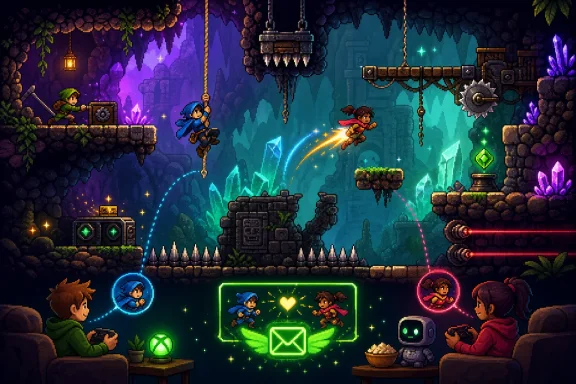 What Brave Escape Friend’s Pass Means on Xbox
The Brave Escape Friend’s Pass is the free companion download attached to the game’s demo. It allows a player who does not own the full title to join an online session hosted by someone who does.The process is intentionally straightforward:
- One player purchases or owns the full version of Brave Escape.
- Their partner installs the free Brave Escape Demo + Friend’s Pass.
- The owner begins an online session and generates an invite code.
- The Friend’s Pass user selects Join Game and enters that code.
- Both players can then play through the cooperative adventure together.
That arrangement is especially well suited to a title where the intended experience depends on two people. Requiring both participants to make an upfront purchase can be a significant obstacle for a niche co-op platformer, particularly when prospective partners have different tolerance levels for difficult games. By letting one player bring a friend along, Hit Start Studios makes it easier to form a team first and decide on a second purchase later.
A useful model for co-op-first games
The Friend’s Pass model works because Brave Escape does not treat cooperation as a side activity. Its challenges are constructed around the assumption that Colin and Floyd are present, capable, and communicating.A conventional free weekend or discount can attract interest, but it does not necessarily solve the practical problem of finding someone willing to buy a specialist co-op game at the same moment. The Friend’s Pass does. It turns the purchase decision into a one-owner commitment rather than a two-owner negotiation.
For Xbox households, it also lowers friction around spontaneous play. A Game Pass subscription is not a substitute for ownership here, but the free companion install can make it easier for a sibling, partner, or friend to try the game without creating an immediate second transaction.
There is an important limitation, however. The pass is designed for joining a full-game owner, not for granting independent ownership. The Friend’s Pass user cannot simply host the complete campaign alone or invite another non-owner into the entire game. It is a co-op access mechanism, not a permanent entitlement to the full release.
A Precision Platformer Built for Two
Brave Escape belongs to the tradition of demanding 2D platformers where mastery comes from timing, spatial awareness, repetition, and composure under pressure. What separates it from a typical single-player precision platformer is that success relies on a second person who may be moving at a different rhythm, seeing a different danger, or preparing the next part of the route.That changes the emotional texture of failure.
In a solo platformer, a missed jump is usually a private mistake. In Brave Escape, it can become a shared disaster: one player moves too early, the other fails to catch up, both tumble into danger, and the team returns to the checkpoint with a clearer—but occasionally more heated—understanding of what went wrong.
The game appears to embrace that chaos rather than trying to smooth it away. Its levels are designed to make players coordinate in real time, whether that means timing a boost into a rope climb, crossing a shifting obstacle sequence, or using a location-specific tool at the exact moment their partner needs it.
Colin and Floyd are complementary, not interchangeable
The two protagonists provide the foundation for the game’s cooperative design.Colin has a climbing rope. This gives him a specialized role in vertical traversal, positioning, and route creation. Rope mechanics can be deceptively demanding in platform games because they introduce an additional layer of momentum, timing, and placement. In a co-op context, they also create opportunities for one player to establish access for the other.
Floyd uses a boost mechanism, allowing him to approach movement challenges differently. His ability set is expanded further by environmental gadgets that change depending on the world or region the pair is exploring.
Neither role appears designed as the “main” character. The point is not for one player to carry the other through the campaign. Instead, each character provides a capability the other cannot replicate. That division is crucial because it encourages players to think of each obstacle as a shared problem rather than two separate platforming tests happening side by side.
This is where Brave Escape can differentiate itself from co-op games that simply duplicate a single-player move set for multiple people. Asymmetry creates conversation. It forces players to discuss who needs to go first, where the rope should be used, when Floyd should activate a gadget, and how both characters can reach the next safe position.
Tools of the Trade Add Variety Beyond Jumping
While the rope and boost mechanics establish Brave Escape’s core identity, Floyd’s specialized equipment gives different locations their own puzzle vocabulary. The game’s listed tools are tied to specific areas, which should help prevent the campaign from becoming a repetitive sequence of jumps and hazards.The major tools include:
- Wind Gun in Glacial Falls
- Flashlight in Glowing Depths
- Grapple Hook in Serpent’s Hollow
- Freeze Gun in Moai Chambers
- Magnet Gun in Thunder Ridge
Why location-specific abilities matter
The strength of this design is that it can keep a difficult platformer from relying too heavily on raw reaction speed. Precision is still central to Brave Escape, but tools introduce problem-solving and experimentation into the formula.A stage can ask players not only whether they can execute a jump, but also whether they have correctly identified the order of actions that makes the jump possible. That is an important difference. It gives pairs a chance to contribute in different ways: one player may have sharper platforming instincts, while the other excels at reading the puzzle logic.
The potential risk is complexity creep. Each new tool must be introduced clearly enough that players understand its role, then developed deeply enough that it feels meaningful rather than disposable. If a gadget’s behavior is poorly communicated, repeated failure may feel confusing instead of challenging. In a two-player game, ambiguity can be magnified because each partner may form a different interpretation of the intended solution.
The best co-op puzzle-platformers avoid that problem by presenting mechanics in readable steps: introduce a tool safely, create a simple shared interaction, combine it with a known hazard, then ask the team to use it under pressure. Brave Escape’s success will depend in part on how consistently it follows that learning curve.
Standard and Brave Modes Address Different Audiences
Hit Start Studios has included two difficulty options: Standard mode and Brave mode.Standard mode is positioned as the more approachable way to play, with gentler obstacles and more forgiving timings. That matters because co-op precision platforming often creates an uneven skill dynamic. One player may be an experienced fan of games built around split-second inputs, while the other may be new to the genre or simply prefer a less punishing pace.
Brave mode is intended as the uncompromising challenge. It is presented as the game’s ultimate test of skill and synchronization, demanding sharper execution from both players.
Standard mode is not merely an accessibility footnote
Difficulty options can sometimes be treated as an afterthought, particularly in games marketed around extreme challenge. In a co-op game, though, an approachable mode can be essential to keeping a partnership intact.If every room requires both players to perform near-perfectly, one less experienced participant can feel like they are blocking progress. That creates frustration quickly, especially when the game’s premise is supposed to be shared fun. More forgiving timing windows and obstacle layouts can give players room to learn without stripping away the satisfaction of eventually solving a stage.
Standard mode may therefore be the best entry point for:
- Couples with different platforming experience levels
- Parents playing with children
- Friends who enjoy puzzles more than twitch-heavy action
- Players exploring the Friend’s Pass before deciding whether to buy
- Teams using local co-op for casual sessions rather than marathon challenge runs
The trade-off of difficulty selection
There is always a tension in a game marketed as a precision platformer. If Standard mode is too forgiving, experienced players may find its early content underwhelming. If Brave mode is too severe, even skilled pairs can encounter progress stalls that turn a rewarding test into exhausting repetition.The strongest approach is to make both modes feel legitimate. Standard should preserve the central mechanics and cooperative identity, while Brave should enhance the demands placed on players who already understand the fundamentals. Different challenge levels should not mean one group gets the “real” game and the other gets a diluted imitation.
Brave Escape’s concept is well served by this split. It acknowledges that communication, trust, and patience are as important as reflexes when two players share a screen or an online session.
Xbox Features: Local Play, Online Play, and Cross-Platform Potential
On Xbox, Brave Escape lists support for both local co-op and online co-op for two players. It also supports shared or split-screen play, giving it value as a traditional couch co-op game at a time when local multiplayer remains less common than it once was.That matters because the optimal way to experience a coordination-heavy platformer is not always online. Playing side by side makes communication immediate. Partners can point at hazards, react to mistakes together, and celebrate a hard-won sequence without headset delays or connection concerns.
At the same time, online co-op is essential for a game built around two players. The Friend’s Pass would have limited value without it, since many players will want to invite someone who lives elsewhere.
The Xbox listing also identifies Xbox cross-platform co-op support. In practical terms, players should pay attention to the specific platform combinations available at launch and to the game’s matchmaking or invite-code requirements. Cross-platform language can mean different things across storefronts, and players planning to join friends on PC or another console should verify that their game versions are current and that they are using the supported online connection method.
The subscription caveat for console online play
The free Friend’s Pass lowers the price of entry, but it does not eliminate Xbox’s usual console multiplayer requirements. Online multiplayer on Xbox consoles requires an eligible Xbox Game Pass Essential, Premium, or Ultimate subscription.That is a significant detail for anyone reading “play with a friend for free” as “play online at no cost.” The companion download itself is free, but online console access may still involve an active subscription depending on the player’s account and platform.
This does not diminish the value of the Friend’s Pass; it simply clarifies the real-world cost structure. For local split-screen co-op, the subscription issue is less relevant. For long-distance partners, both players should check their online access before assuming an invite code is all they need.
Performance and Input Support Could Make a Real Difference
Brave Escape is listed with support for 60 frames per second or more, as well as console keyboard and mouse support and PC gamepad support. Those features may seem secondary next to the co-op hook, but they are relevant in a game where precision is the entire point.A stable high frame rate can improve the feel of a platformer. It does not automatically make a game easier, and it cannot compensate for poor level design or laggy controls, but responsive animation and consistent input feedback are particularly valuable when a missed landing can force both players back to a checkpoint.
Keyboard and mouse support on console is more unusual for this type of release, though controller play will likely remain the natural choice for many local co-op pairs. The availability of alternate input methods is still a welcome option, especially for players with established preferences or accessibility needs.
Accessibility is more than an on/off switch
Brave Escape lists 12 accessibility features on Xbox, alongside support for multiple languages. The exact usefulness of any accessibility package depends on its implementation, but the number signals that the developers have at least considered barriers beyond conventional difficulty selection.For a high-intensity cooperative platformer, accessible design can include many things:
- Clearer visual readability for hazards and interactable objects
- Input remapping
- Reduced visual clutter
- Adjustable effects or screen shake
- Subtitle and interface options
- Difficulty accommodations
- Better distinction between player characters and the environment
- Support for varied input devices
Why the Friend’s Pass Is a Smart Match for Brave Escape
Friend passes are most useful when they align with the structure of the game. In Brave Escape, that alignment is unusually strong.A sprawling open-world game may offer co-op but still provide dozens of hours of solo activity. A competitive shooter can fill a lobby with strangers. Brave Escape, by contrast, centers its identity on two people tackling designed challenges together. Its rope, boost, gadgets, and synchronized sequences all depend on having a reliable partner.
The Friend’s Pass therefore acts as more than a marketing incentive. It supports the game’s design philosophy.
It makes experimentation less expensive
Co-op platformers can be difficult to judge from trailers alone. A video can show attractive pixel art, elaborate hazards, and clever mechanics, but it cannot tell a prospective buyer whether their preferred partner will enjoy the cadence of repeated failure and retrying.The Friend’s Pass makes that question easier to answer. One owner can invite a friend, test the teamwork dynamic in real conditions, and decide whether the game fits their shared tastes. If the partnership clicks, the experience can continue without another purchase being required for that duo. If it does not, the financial risk is contained.
It supports the social side of difficult games
Challenging platformers often produce memorable stories: the jump that took 30 attempts, the rescue that happened by accident, the moment both players finally understood a puzzle. Those stories are central to Brave Escape’s appeal.By giving a second player a free route into the full co-op campaign, the game helps preserve the social context that makes those moments work. A difficult stage is easier to tolerate when the person beside—or across the internet from—you is equally invested in finally clearing it.
Potential Risks Before You Commit
Brave Escape’s core strengths also identify the areas where it will not suit every Xbox player.The largest consideration is obvious: this is a co-op-centric precision platformer. Players who prefer relaxed solo exploration, loose drop-in multiplayer, or simple pick-up-and-play action may find its structure restrictive. Even with a Friend’s Pass, the game is best approached with a dependable partner who is willing to communicate and retry difficult sections.
Coordination can become pressure
Asymmetric co-op is compelling because both players have meaningful responsibilities. It can also create blame when a team fails repeatedly.If one player is considerably more experienced, they may become impatient. If the less experienced player feels they are holding the group back, the intended camaraderie can turn into anxiety. Standard mode should alleviate some of that issue, but it cannot eliminate the basic fact that Brave Escape asks two people to perform together under pressure.
Players should choose their mode based on the pair’s actual experience level, not their pride. A smoother first session can preserve the enjoyment needed to eventually tackle tougher content.
Online reliability matters more than usual
Any online co-op game can be affected by connectivity issues, but timing-sensitive platforming is especially exposed to latency, synchronization problems, and version mismatches. A tiny delay can turn a coordinated sequence into a confusing failure.The invite-code model simplifies the act of connecting, yet both partners should ensure that they have current game builds and stable connections. Where possible, local co-op offers the most direct and predictable form of play. Online sessions add convenience and cross-platform possibilities, but also introduce technical variables the game itself cannot fully control.
The demo may not communicate the full difficulty curve
Ancient Cave provides an accessible way to sample the game, but early levels in a platformer are naturally designed to teach fundamentals. The later campaign, especially in Brave mode, is likely to place much greater demands on execution and teamwork.That does not make the demo misleading. It simply means players should treat it as an introduction to the mechanics and cooperative rhythm, not a complete measure of the campaign’s eventual intensity. The same is true of many challenge-focused games: the opening is a handshake, while the real test comes later.
The Value Proposition for Xbox Co-Op Fans
For Xbox players searching for a dedicated two-player experience, Brave Escape occupies a useful niche. It is not trying to be a massive live-service platform, a four-player party game, or a single-player adventure with optional companion support. Its focus is narrower and potentially stronger for it.The package combines:
- A complete two-player cooperative design
- Distinct character abilities
- Hundreds of hazard-filled levels
- Puzzle-solving alongside movement challenges
- Local shared or split-screen play
- Online co-op for two players
- A free Friend’s Pass for non-owners
- An opening-world demo
- Standard and Brave difficulty modes
- Specialized tools tied to different areas
- High-frame-rate support and flexible input options
The Friend’s Pass is the element that gives Brave Escape a stronger chance of finding that partner. It reduces the cost and friction of starting together, which is exactly what a co-op-first platformer needs.
A Strong Co-Op Idea That Needs the Right Partner
Brave Escape’s Xbox debut is defined by a simple but effective promise: one copy can bring two players into the full adventure. The Friend’s Pass does not remove every requirement—online console play may still require an eligible Game Pass subscription, and the full campaign still needs one owner—but it removes the most immediate obstacle to trying the game as intended.The underlying platformer appears purpose-built for duos who enjoy communicating through difficult levels, combining different abilities, and improving through repeated attempts. Colin’s rope, Floyd’s boost, and the game’s changing gadget set should give the campaign more texture than a standard sequence of increasingly punishing jumps.
Its two difficulty paths are equally important. Standard mode offers a realistic starting point for less experienced teams, while Brave mode preserves the uncompromising precision challenge for players who want their coordination tested to the limit.
For Xbox players who miss focused couch co-op games—or who want an online alternative that does not demand a second full-price purchase—Brave Escape Friend’s Pass is a smart, practical addition. The game still asks for patience, communication, and a partner who can laugh at failure before trying again. But with the Friend’s Pass, finding that partner has become much easier.
References
- Primary source: Microsoft
Published: 2026-07-24T01:12:07.816259
Loading…
www.microsoft.com - Related coverage: xbox.com
Loading…
www.xbox.com - Related coverage: playstationtrophies.org
Loading…
www.playstationtrophies.org - Related coverage: jeu.video
Loading…
jeu.video - Related coverage: capsulecomputers.com.au
Loading…
www.capsulecomputers.com.au - Related coverage: nextplayer.it
Loading…
www.nextplayer.it