

Brave has quietly opened the next chapter in the browser wars: an experimental, agentic AI browsing mode is available now in Brave Nightly, offering a model-driven assistant that can autonomously browse, act, and complete multi-step tasks inside a purposely isolated profile — but it arrives amid unresolved security questions and industry-wide debate over prompt-injection, data policies, and what “doing things for you” really means.
The idea of an AI that not only answers questions but acts on the web — opening tabs, filling forms, comparing options across sites, and completing multi-step flows — moved from research demos to mainstream product roadmaps in 2025. Major vendors rolled out agent-enabled browsers or browser modes: OpenAI’s ChatGPT Atlas, Microsoft Edge’s Copilot Mode, Perplexity’s Comet, Opera’s Neon, and now Brave’s Leo with agentic browsing in Nightly. These products share an ambition — compressing hours of web work into a conversational flow — and a common technical challenge: agents change the browser’s trust model and dramatically expand the attack surface. Brave positions its release as intentionally cautious: AI browsing in Brave is opt-in, only available in Nightly (the development/testing build), and gated behind a feature flag. The company frames the rollout as an early experiment that invites scrutiny and security research before a broader launch. That posture reflects both Brave’s privacy-first branding and hard lessons from the year’s security disclosures around agentic browsers.
For Windows users and IT teams, Brave Nightly provides an early opportunity to evaluate agentic workflows in a privacy-conscious architecture. The correct posture is one of cautious experimentation: test in controlled environments, keep high-value accounts out of agent profiles, and demand transparent vendor attestations before trusting any agent with production or financial operations. The agentic web is coming; Brave’s Nightly build shows what a privacy-first, security-minded approach looks like — but it also underscores how much engineering and governance work remains before autonomous browsing can be considered safe at scale.
Source: gHacks Technology News Brave Browser is testing agentic AI browsing in its nightly version - gHacks Tech News
 Background
The idea of an AI that not only answers questions but acts on the web — opening tabs, filling forms, comparing options across sites, and completing multi-step flows — moved from research demos to mainstream product roadmaps in 2025. Major vendors rolled out agent-enabled browsers or browser modes: OpenAI’s ChatGPT Atlas, Microsoft Edge’s Copilot Mode, Perplexity’s Comet, Opera’s Neon, and now Brave’s Leo with agentic browsing in Nightly. These products share an ambition — compressing hours of web work into a conversational flow — and a common technical challenge: agents change the browser’s trust model and dramatically expand the attack surface. Brave positions its release as intentionally cautious: AI browsing in Brave is opt-in, only available in Nightly (the development/testing build), and gated behind a feature flag. The company frames the rollout as an early experiment that invites scrutiny and security research before a broader launch. That posture reflects both Brave’s privacy-first branding and hard lessons from the year’s security disclosures around agentic browsers. What Brave shipped in Nightly — a technical overview
An agent confined to its own profile
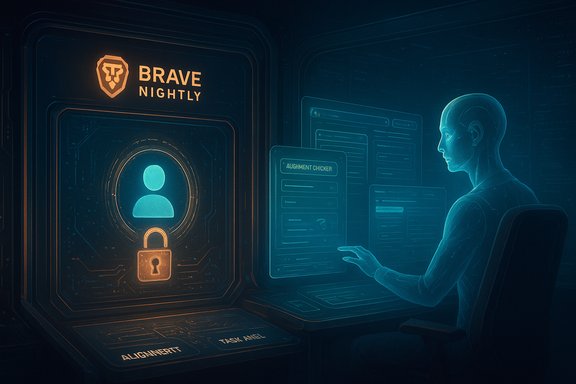
Brave’s agentic browsing mode runs in a separate, built-in browser profile that is created when you enable the feature. Cookies, cached logins, local storage and other site data in the regular profile are kept entirely distinct from the agent profile; the goal is to ensure that the AI agent cannot inherit your main profile’s authenticated sessions if defenses fail. Brave explicitly calls this isolated storage and treats it as a primary, pragmatic mitigation against catastrophic exfiltration scenarios.A two-model safety architecture: task model + alignment checker
Brave uses a two-model architecture for task execution and verification. The first model — the task model — plans and executes actions (opens pages, clicks, extracts). A second model, the alignment checker, receives the system prompt, the user prompt, and the task model’s proposed actions and decides whether those actions align with the user’s intent. Crucially, Brave firewalls the alignment checker from direct access to raw website content to reduce the risk that page-level prompt injections will directly corrupt the checker’s judgment. Brave calls this a guardrail, not a guarantee.Model choices and anti-injection tooling
Brave reports using security-aware system prompts (structured policy prompts authored and maintained by Brave) and models trained to mitigate prompt injections, citing Anthropic’s Claude Sonnet series as part of that defense mix. Anthropic’s Sonnet models are specifically marketed as hybrid reasoning models optimized for agentic workloads, which is why Brave points to them when describing mitigation strategies. Brave also emphasizes runtime controls — visible session logs, the ability to pause/stop the agent, and the insistence that actions happen in an open tab rather than hidden backgrounds.UX and access restrictions
Brave requires the user to manually invoke AI browsing via Leo (Brave’s integrated assistant). The AI cannot trigger agentic browsing on its own; the session uses a visually distinct profile and UI chrome to reduce confusion. The agent is restricted from accessing internal browser pages (brave://*), non-HTTPS pages, the Chrome Web Store, and sites flagged by Safe Browsing. When the alignment checker flags an action as potentially risky, Brave will prompt the user for explicit permission.Why Brave’s approach matters (and where it diverges)
Brave’s rollout matters because it tries to square two often-opposed commitments: agentic capability and privacy-first defaults. The company emphasizes:- Isolated profile so your main browsing sessions — where you might be logged in to banking, email, or enterprise dashboards — are not directly available to the agent.
- No-logs, no-retention data policy for agentic sessions and a stated commitment not to train models on user browsing data.
- User-visible sessions and explicit control over whether the agent can take a given action.
The security problem at the center: indirect prompt injection
What is an indirect prompt injection?
Indirect prompt injection is an adversarial technique where web content quietly carries instructions that an agent interprets as operational commands. Examples include hidden text, steganographic images, HTML comments, or nearly-invisible characters that survive extraction and OCR pipelines. Because agents treat page text as input to derive actions, these covert signals can cause an agent to reveal data or perform actions with your session privileges. Brave and independent researchers demonstrated such attacks against other browsers and assistants earlier in 2025.Real-world demonstrations and vendor reactions
Brave’s security disclosures and independent write-ups showed proof-of-concept chains where hidden instructions triggered an agent to navigate authenticated pages, read a one-time password from a logged-in email tab, and exfiltrate credentials. Perplexity patched vulnerabilities, but follow-up testing suggested mitigations were incomplete — proving the conceptual difficulty of treating page content as untrusted instruction space. Security publications and practitioner write-ups emphasize that traditional browser protections (SOP, CORS) don’t defend against an LLM that treats page text as commands.Brave’s mitigation — helpful but incomplete
Brave’s second-model alignment checker and firewalling of the checker away from raw page content is an intelligent mitigation: it attempts to separate “what the agent plans to do” from “what the page told the agent to do.” But Brave itself cautions that guardrails reduce risk; they do not eliminate it. LLMs are probabilistic and can be coaxed into unexpected behaviors through cleverly crafted inputs. The alignment checker could be targeted indirectly — for example, by manipulating the task model’s outputs in ways that make the checker mis-evaluate intent. Brave acknowledges this residual risk openly.Cross-referencing Brave’s claims
Several independent signals corroborate Brave’s public claims and the surrounding risk profile:- Brave’s official blog and support pages describe the isolated profile, two-model guardrail, and UX-based controls in detail. Those posts explicitly call prompt injection a systemic category problem and explain the opt-in Nightly approach.
- Reporting and technical write-ups from independent outlets documented prompt-injection demos against Perplexity’s Comet and contextualized the industry-wide implications; those reports motivated immediate patches and vendor advisories. This shows the attack class is real and cross-product.
- Anthropic’s documentation for Claude Sonnet models describes them as hybrid reasoning models optimized for agentic tasks and extended thinking — explaining why Brave would reference Sonnet as part of a mitigation strategy. However, model selection is not a panacea; model-level safety must be combined with runtime controls and strict architecture.
How to try Brave’s agentic browsing in Nightly (practical steps)
If you want to test Brave’s agentic browsing in Nightly, Brave’s instructions (and independent guides) are straightforward:- Download Brave Nightly for your platform and install it.
- Navigate to brave://flags.
- Search for “AI browsing” or the flag labeled “Brave’s AI browsing” (#brave-ai-chat-agent-profile).
- Enable the flag, restart the browser.
- Open Leo, Brave’s assistant, and invoke the agentic mode from the chat interface.
Practical safety guidance for Windows users and IT teams
Agentic browsing is promising but risky. Practical steps for safe experimentation:- Always run agentic browsing in a secondary machine or at minimum in a dedicated, freshly created browser profile. Brave isolates profile data by design, but additional separation is prudent.
- Do not sign into financial, healthcare, or corporate accounts inside the agent profile.
- Treat any automated action as tentative: verify confirmations and audit logs, and use the pause/inspect features Brave provides.
- For enterprise deployment, require contractual guarantees around non-training and data retention; insist on audit logs, tenant-level governance, and the ability to opt-out centrally.
- Keep Nightly strictly for testing; Nightly builds are where new features and fixes land quickly — and where regressions and experimental behavior are expected. Brave’s own messaging emphasizes this.
Broader implications: privacy, publisher economics, and regulation
Agentic browsers change the balance of incentives on the web. Vendors that synthesize content and complete tasks can create “zero-click” outcomes that reduce referral traffic to publishers, complicating ad-based revenue models. Brave’s privacy-first stance makes it less likely to monetize by cross-site profiling, pushing the company (and likely publishers) to explore subscriptions, contextual placements, or revenue-sharing models. This industrywide shift already attracts analyst scrutiny and regulator interest. Regulators and enterprise risk teams will focus on:- Data concentration and retention policies for browsing context and assistant memory.
- Liability when an agent’s autonomous action causes harm (wrong booking, financial loss, disclosure).
- The need for standardized provenance metadata so assistants can cite sources and publishers can be compensated.
Critical analysis — strengths, blind spots, and what to watch
Strengths
- Pragmatic privacy design. Brave’s isolated-profile approach is one of the clearest architectural defenses against session exfiltration, and it aligns with how security teams isolate automation accounts.
- Two-model verification strategy. Using an alignment checker to verify the task model’s plan is a sound engineering control; it creates a verification boundary that is easier to reason about than a single, monolithic model.
- Public, opt-in testing. Releasing the feature in Nightly and inviting security researchers (with enhanced bounties) shows an appropriate level of humility for a high-risk capability.
Blind spots and unresolved risks
- Alignment checker attack surface. Firewalled, yes — but not invulnerable. If the task model’s outputs are manipulated, the checker could be coaxed into approving malicious actions without ever seeing the raw page content. Brave notes this explicitly.
- Supply-chain and telemetry trust. Brave’s claim to never train on AI browsing data is credible in the company’s rhetoric, but independent audits or transparency reports will be necessary to convince enterprises and privacy regulators. Vendor promises are valuable but not definitive without third-party verification.
- User comprehension and habituation. Brave rejects per-site permission prompts because of prompt fatigue — but habituation to UI nudges is a well-documented risk. The absence of fine-grained per-site permissions reduces decision overhead but may increase the risk of over-delegation by users who don’t fully read warnings.
What to watch next
- Public, third-party security audits of Brave’s AI browsing architecture and the alignment checker.
- Independent verification that Brave’s agentic sessions are not used for model training and that telemetry is bounded.
- Cross-vendor standards for provenance, safe default behaviors, and per-site permissioning that balance usability against risk.
Conclusion
Brave’s Nightly agentic browsing is an important, responsible experiment in a fast-moving field. The company’s emphasis on isolated profiles, a separate alignment checker, and user-visible sessions shows an understanding of the category’s core risks. Those mitigations are meaningful — but they are not a panacea. Indirect prompt injection, model non-determinism, and the complexity of human intent vs. model interpretation mean that Brave’s agentic browsing will require continuous hardening, external audits, and a cautious rollout path before it should be widely trusted for sensitive tasks.For Windows users and IT teams, Brave Nightly provides an early opportunity to evaluate agentic workflows in a privacy-conscious architecture. The correct posture is one of cautious experimentation: test in controlled environments, keep high-value accounts out of agent profiles, and demand transparent vendor attestations before trusting any agent with production or financial operations. The agentic web is coming; Brave’s Nightly build shows what a privacy-first, security-minded approach looks like — but it also underscores how much engineering and governance work remains before autonomous browsing can be considered safe at scale.
Source: gHacks Technology News Brave Browser is testing agentic AI browsing in its nightly version - gHacks Tech News
