

Brazil’s antitrust authority has opened a focused inquiry into whether Microsoft used commercial leverage over PC makers to ensure Microsoft Edge ships as the exclusive, out‑of‑the‑box browser on Windows machines — a development that could bring one of the industry’s longest‑running browser battles back into the regulatory spotlight on February 12, 2026. The probe, triggered by a formal complaint from Opera and amplified by a coalition of rival browsers calling itself the Browser Choice Alliance, centers on Microsoft’s so‑called “Jumpstart” arrangements with OEMs and seeks detailed sales, contract, and configuration data from major PC manufacturers including Dell, HP, Lenovo, Asus, Acer, Positivo, Samsung, Multilaser, Daten, and LG. Regulators want to know not just how many devices were shipped, but how many were sold under Jumpstart terms, how many were distributed in Windows in S mode, and what contractual penalties or discounts conditioned OEM behavior — questions that, if answered adversely to Microsoft, could trigger remedies with global implications for browser competition and OEM bundling practices.
Microsoft’s relationship with browser competition is not new; the company has faced antitrust scrutiny for decades over alleged bundling and exclusionary practices dating back to the Internet Explorer era. The present dispute is different in detail but similar in legal logic: if Microsoft used licensing terms, commercial incentives, or product configurations to make Edge the unavoidable default on new Windows PCs, that can be framed as a form of tying or exclusionary conduct that hinders rivals from reaching customers through preinstallation channels.
Opera lodged a formal complaint that argues Microsoft’s commercial practices — amplified through OEM contracts and first‑run device configuration — give Edge an unfair advantage. Brazil’s administrative authority has now followed up by sending targeted information requests to a set of OEMs, seeking granular device‑level sales figures covering 2020–2025 and demanding copies of contractual terms, including clauses, penalties, and any negotiation records tied to the Jumpstart program. The Browser Choice Alliance publicly welcomed the regulator’s step on February 12, 2026, describing it as a significant move to protect consumer choice and competitive parity in the browser market.
Microsoft’s defenders are likely to frame any OEM arrangement as a normal commercial partnership: OEMs choose which software and configurations to ship based on consumer demand, supportability, and strategic co‑marketing. They will argue integration benefits — security, manageability, and support for platform services — justify default settings and preinstalls. The company can credibly say offering a consistent first‑boot experience across devices reduces fragmentation and lowers support costs for consumers and OEMs alike.
What’s clear already is that regulators are asking the right empirical questions: device‑by‑device sales, contractual penalties, and configuration details that show whether OEMs were coerced, incentivized, or free to choose. Those are not rhetorical queries; they are the raw materials of any enforceable antitrust finding. For Microsoft, the safest path is transparent cooperation backed by clear technical justifications for any default behavior. For rivals and regulators, the probe is a chance to test whether old patterns of platform advantage have become a permanent barrier to browser innovation — or whether legitimate product integration still justifies tightly curated first‑boot experiences.
If regulators do find exclusionary conduct, the fallout could reshape how Windows devices are packaged and sold worldwide — rehabilitating preinstallation as a contested battleground rather than a fait accompli, and returning true browser choice to the moment a user opens a brand‑new PC for the first time.
Source: Neowin Microsoft under fire for allegedly pushing OEMs to exclusively bundle Edge in Windows PCs
 Background
Microsoft’s relationship with browser competition is not new; the company has faced antitrust scrutiny for decades over alleged bundling and exclusionary practices dating back to the Internet Explorer era. The present dispute is different in detail but similar in legal logic: if Microsoft used licensing terms, commercial incentives, or product configurations to make Edge the unavoidable default on new Windows PCs, that can be framed as a form of tying or exclusionary conduct that hinders rivals from reaching customers through preinstallation channels.Opera lodged a formal complaint that argues Microsoft’s commercial practices — amplified through OEM contracts and first‑run device configuration — give Edge an unfair advantage. Brazil’s administrative authority has now followed up by sending targeted information requests to a set of OEMs, seeking granular device‑level sales figures covering 2020–2025 and demanding copies of contractual terms, including clauses, penalties, and any negotiation records tied to the Jumpstart program. The Browser Choice Alliance publicly welcomed the regulator’s step on February 12, 2026, describing it as a significant move to protect consumer choice and competitive parity in the browser market.
What regulators are asking — and why it matters
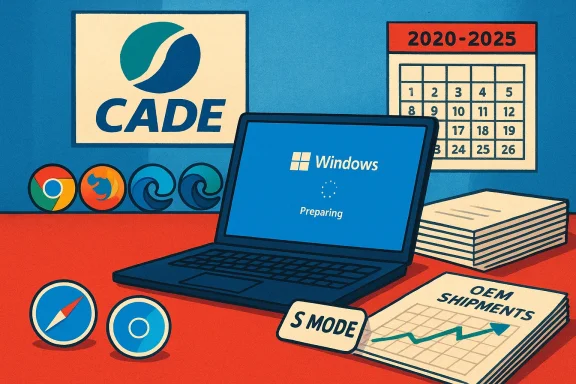
What CADE reportedly wants from OEMs
The regulator’s information requests are unusually granular. They demand:- Yearly unit sales from 2020 through 2025, broken down by operating system.
- Counts of devices sold under the Jumpstart program versus those sold outside it.
- Numbers of devices shipped with Windows in S mode (which restricts app installs to Microsoft Store).
- Full copies of Jumpstart contracts, including any penalties for non‑compliance and documentation of whether negotiations were possible or contracts were offered on a take‑it‑or‑leave‑it basis.
- Clarifications about what types of third‑party software (including but not limited to browsers) were permitted or prohibited from pre‑installation on Jumpstart devices.
- Estimates from OEMs of the financial or commercial impact they would suffer if they withdrew from the Jumpstart program.
Why Windows in S mode is a focal point
Windows in S mode appears repeatedly in the regulatory questionnaire for a simple reason: when a PC ships in S mode it only allows apps from the Microsoft Store, which can make it harder — or in some cases impossible without an explicit user action — to install and set a third‑party browser as the default. If Microsoft or Microsoft‑conditioned OEM configurations preferentially push devices into S mode as part of commercial deals, that could compound any preinstallation advantage by making post‑sale switching more difficult for average users.The legal theories at play
Tying and conditioning: commercial leverage vs. legitimate product packaging
At the heart of the inquiry are two competing narratives. Critics argue Microsoft used its market muscle in operating systems and enterprise productivity stacks to condition favorable OEM pricing or rebates on exclusive Edge preinstallation — a form of commercial tying that blocks rivals from the valuable channel of first‑run exposure. In practical terms, that would look like: “We’ll give you better Windows licensing economics if you ship our browser exclusively and keep it as the default.”Microsoft’s defenders are likely to frame any OEM arrangement as a normal commercial partnership: OEMs choose which software and configurations to ship based on consumer demand, supportability, and strategic co‑marketing. They will argue integration benefits — security, manageability, and support for platform services — justify default settings and preinstalls. The company can credibly say offering a consistent first‑boot experience across devices reduces fragmentation and lowers support costs for consumers and OEMs alike.
Dark patterns and user experience manipulation
Opera’s complaint and other complaints in recent years have also alleged user‑experience behaviors — UI prompts, warnings, or “friction” added when users try to download or switch to alternate browsers — that steer people toward Edge. These are often called dark patterns: design choices intentionally created to nudge users away from alternatives. If regulators find that product design choices combined with OEM preinstallation created significant competitive harm, they can treat the conduct as part of a broader exclusionary scheme.S mode, defaults, and effective choice
Antitrust scrutiny cares about foreclosure — the degree to which rivals were prevented from an essential route to market. Preinstallation is an essential distribution route for browsers because it supplies users with a working browser from the moment they power on a device. If Microsoft’s agreements or device configurations systematically denied preinstallation opportunities to rival browsers or made switching them inoperable, the result is a closed funnel: users never see or try alternatives and competition withers.OEM incentives and the practical mechanics of preinstallation
Why preinstallation matters to browser makers
Preinstallation is not merely marketing: it captures the initial user touchpoint and shapes default behavior. Evidence from past regulatory cases and industry experience shows that many users stick with default apps for long periods; a preinstalled browser, set as default, turns OEMs into gatekeepers of choice. For smaller browser vendors with constrained marketing budgets, OEM preinstallation can be the most reliable route to scale.How OEM contracts can encode exclusivity without an explicit “do not install” clause
Contracts can be subtle. Rather than an explicit ban on third‑party browsers, Microsoft could use:- All‑or‑nothing discounts — better pricing on Windows licenses or services contingent on reserving the browser slot for Edge.
- Minimum commitment thresholds — targets tied to default settings or first‑run behaviors.
- Default configuration templates — making the Edge‑centric setup the path of least resistance for OEMs during mass deployment.
- Co‑marketing or rebate mechanics — payments conditioned on OEMs adopting Microsoft’s recommended lineup.
What Microsoft might argue in its defense
- Integration and quality claims: Microsoft will stress the technical integration between Windows and Edge — features that are only available when Edge is used — and argue this improves user experience and security.
- OEM choice exists: The company may point out that OEMs can and do add third‑party software to PCs and that there is no formal prohibition on preinstalling rivals.
- Commercial bargaining is normal: Microsoft can present Jumpstart and similar programs as routine partnerships offering consumer value through pre‑configured features, support, or added services.
- Consumer opt‑out: Microsoft can emphasize that consumers are free to download and set alternative browsers after purchase, and that Windows includes mechanisms to change defaults (even if such mechanisms have been criticized as difficult to use).
Precedent and likely remedies
Historical context
This is not the first time browser preinstallation has attracted regulator attention. The Internet Explorer battles of the late 1990s and early 2000s culminated in major antitrust actions in multiple jurisdictions; those cases established that leveraging OS dominance to foreclose rivals can breach competition law. More recently, regulators in the EU and other jurisdictions have scrutinized platform defaults, UI design, and bundling in the context of app stores, browsers, and AI tools.Potential regulatory remedies
If CADE finds issues, possible remedies include:- Behavioral remedies: mandates requiring Microsoft to stop conditioning OEM discounts on exclusivity; banning contractual clauses that foreclose preinstallation of rival browsers.
- First‑run choice screens: requiring a neutral browser choice or default selection during initial device setup, restoring parity at the user’s first interaction.
- Technical interoperability: measures to ensure alternative browsers can register as defaults and be used for common flows (links, PDFs, email).
- Financial fines or disgorgement: penalties proportional to the harm or profits gained.
- Monitoring and compliance obligations: third‑party audits to verify OEM agreements and device configurations.
Risks, implications, and the global spillover
For Microsoft
- Legal and financial exposure: adverse findings could result in fines, injunctions, and forced changes to licensing practices.
- Market disruption: forced changes to OEM arrangements would change how Windows devices are built and shipped, potentially reducing Microsoft’s influence over the out‑of‑box experience.
- Reputational risk: renewed allegations of anti‑competitive behavior could attract wider regulatory scrutiny in other markets.
For OEMs
- Contract renegotiation: OEMs might see leverage to renegotiate terms that historically favored an Edge‑focused device configuration.
- Operational change: OEMs may need to adapt onboarding pipelines, preinstall scripts, and support infrastructure to allow alternatives by default.
- Short‑term commercial pain: if discount structures change abruptly, OEMs could face margin pressure.
For rival browser makers
- Opportunity: a successful regulatory outcome would reopen preinstallation channels and restore a route to scale for challengers.
- New compliance and partnership models: browser vendors will need to reimagine OEM deals and first‑boot experiences to capture users ethically while respecting new rules.
For consumers
- Choice restored: enforcement could make it easier for non‑Edge browsers to be present and visible at first boot, enhancing consumer choice.
- Potential short‑term confusion: changes to default screens and OEM setups could temporarily complicate the initial setup experience for some customers.
Strengths and weaknesses of the allegations
Notable strengths in the complaint and regulator’s approach
- Granularity of evidence sought: CADE’s detailed data requests — unit counts, contract terms, configuration breakdowns — indicate it’s seeking robust, empirical proof rather than relying on anecdote.
- Cross‑industry coalition: support from the Browser Choice Alliance amplifies the competitive claim and pools expertise and documentation from several browser vendors.
- Historical precedent: past rulings and settlements on bundling give regulators credible legal frameworks for evaluating alleged tying.
Potential weaknesses and uncertainties
- Proving causal foreclosure: it’s one thing to show Microsoft had advantageous deals; it’s another to prove those deals meaningfully prevented competitors from accessing customers or that customers were harmed.
- OEM heterogeneity: OEMs vary by region and business model; some may already preinstall third‑party software widely, which weakens a claim of uniform exclusion.
- Technical justification: if Microsoft can demonstrate compelling technical or security rationales for recommended defaults — and those rationales are supported by evidence — regulators may be less inclined to impose draconian remedies.
What to watch next
- OEM responses — the substance of OEM answers to CADE’s questionnaire will be revealing. If several OEMs report independent negotiations, no penalties for non‑compliance, or routine business rationales for shipping Edge, that will complicate an enforcement case.
- Contractual disclosures — copies of Jumpstart contracts, or lack thereof, will be central. Language that ties discounts to exclusive preinstallation will be damaging to Microsoft’s position.
- Technical evidence of dark patterns — repeated user‑level examples showing Microsoft’s UI discourages competitor installs could bolster the argument that consumers were steered.
- Broader regulatory interest — follow‑on inquiries in other jurisdictions would raise the stakes and suggest systemic concerns rather than a localized dispute.
- Microsoft’s public response — if Microsoft proactively changes OEM terms or issues commitments, that could blunt regulatory momentum or shape remedial outcomes.
Practical takeaways for Windows users and OEMs
- Consumers should be aware that default settings are not neutral: the browser they find on day one may have been selected for commercial reasons, not technical merit. Users who care about browser choice should explicitly evaluate and set their preferred browser during initial setup.
- OEMs should reassess contract transparency: even if a contractual model has been accepted for years, regulatory environments are shifting; greater openness and defensible rationales for preinstallation choices will reduce legal risk.
- Browser vendors should continue to document barriers: detailed logs, test cases showing friction in changing defaults, and systematic evidence of foreclosure will strengthen regulatory claims.
Conclusion
The Brazilian authority’s targeted information requests into the Jumpstart arrangements and alleged exclusive Edge preinstallation mark a critical moment for browser competition on Windows. The inquiry revives longstanding tensions between platform control, OEM economics, and consumer choice — tensions that regulators across the globe have wrestled with for decades. Whether CADE’s probe will result in a narrow transactional remedy, a sweeping behavioral change, or merely a public rebuke depends on what the OEMs disclose and whether a clear causal link between Microsoft’s commercial practices and meaningful market foreclosure can be proven.What’s clear already is that regulators are asking the right empirical questions: device‑by‑device sales, contractual penalties, and configuration details that show whether OEMs were coerced, incentivized, or free to choose. Those are not rhetorical queries; they are the raw materials of any enforceable antitrust finding. For Microsoft, the safest path is transparent cooperation backed by clear technical justifications for any default behavior. For rivals and regulators, the probe is a chance to test whether old patterns of platform advantage have become a permanent barrier to browser innovation — or whether legitimate product integration still justifies tightly curated first‑boot experiences.
If regulators do find exclusionary conduct, the fallout could reshape how Windows devices are packaged and sold worldwide — rehabilitating preinstallation as a contested battleground rather than a fait accompli, and returning true browser choice to the moment a user opens a brand‑new PC for the first time.
Source: Neowin Microsoft under fire for allegedly pushing OEMs to exclusively bundle Edge in Windows PCs
