

Brazilian businesses are becoming more digitally capable without becoming proportionately more cyber-resilient, creating a dangerous gap between the controls they say they have and the performance those controls can deliver during a real incident.
That is the central warning in the latest Digital Risks Index findings for Brazil: average cybersecurity maturity has risen to 58%, up from 53% in the previous assessment, yet the improvement should not be mistaken for operational readiness. A maturity score at this level suggests that many organizations have established policies, deployed security tools, and adopted compliance processes. It does not guarantee that those measures are consistently enforced, regularly tested, or able to withstand a fast-moving cyber crisis.
For Windows-centric organizations, this distinction is especially important. A business may run Microsoft Defender, use Microsoft 365, maintain Active Directory or Microsoft Entra ID, archive data in cloud storage, and tick the required compliance boxes. But if identity controls are weak, endpoint telemetry is not monitored, privileged access is not reviewed, backups are not recoverable, and senior leadership has never rehearsed a breach, then the organization is better described as equipped than prepared.
Brazil’s cyber landscape is therefore not defined by a total absence of defenses. It is defined by uneven execution. The greatest risk often appears in the space between documented policy and everyday behavior.
Cybersecurity maturity is useful because it offers a broad view of whether an organization has policies, processes, tools, responsibilities, and governance structures in place. It is a measure of organizational development. However, maturity is not synonymous with resilience.
Resilience is demonstrated under pressure. It is the ability to detect an intrusion early, contain it quickly, maintain critical business operations, preserve evidence, communicate honestly, meet legal obligations, and restore systems without introducing further damage.
An organization can score reasonably well on a maturity assessment while remaining highly vulnerable to ransomware, business email compromise, data theft, third-party compromise, insider misuse, or fraud enabled by artificial intelligence. That is particularly true where security controls exist in isolated pockets rather than as an integrated business capability.
The reported 44% current digital risk level, categorized as medium, should be interpreted carefully. “Medium” does not mean harmless. In a large company with critical infrastructure, high-value customer data, complex supply chains, or regulatory obligations, a medium aggregate risk level can still produce a severe crisis.
The issue is not merely whether a company owns the right technologies. It is whether it can answer several difficult operational questions:
Yet a five-point improvement does not erase the underlying structural problem. A score of 58% sits in an intermediate maturity range: organizations have started to develop the right components, but those components may not be continuously managed, measured, or reinforced.
A company may require multifactor authentication but allow exceptions for legacy accounts. It may use endpoint protection but fail to ensure every laptop, virtual machine, and server reports to the management console. It may maintain a vulnerability-scanning program but lack a process to prioritize remediation of internet-facing systems. It may back up critical data without regularly testing whether those backups are isolated and recoverable.
These are not failures of intent. They are failures of operational discipline.
Cybercriminals do not need every security control to fail. They need one exposed remote-access service, one reused password, one unpatched VPN appliance, one overly permissive service account, one compromised supplier connection, or one employee convinced by a convincing phishing message.
As threat actors increasingly automate reconnaissance and social engineering, the cost of finding that weak point falls. The attacker’s advantage is compounded when a business has incomplete asset inventories, fragmented logging, unclear ownership, or delayed escalation procedures.
A resilient operating model requires:
The financial estimates associated with major incidents are particularly striking. The reported average estimated value of a significant cyber incident reached US$31.99 million, while sectors with especially critical assets and complex regulatory exposure faced estimated crisis impacts ranging from US$70.87 million to US$98.43 million.
Those figures should be read as estimates rather than guaranteed outcomes for every organization. Incident costs vary dramatically according to business size, sector, recovery time, insurance coverage, legal obligations, data sensitivity, customer concentration, and whether operations can continue during remediation.
Even so, the broad message is difficult to dispute: cyber incidents have become material business events.
For this reason, the finding that 72% of respondents see reputational damage as more critical than financial loss is revealing. It reflects a modern reality: when a company loses trust, recovery cannot be measured solely by the expense of technical remediation.
The reputational question after an incident is often not simply, “Were you breached?” It becomes:
That gap matters because privacy compliance is not merely a legal documentation task. It requires organizations to know what data they hold, why they process it, where it moves, who has access to it, how long it is retained, and what happens when it is exposed.
For example, compliance becomes fragile when:
None of these actions alone proves LGPD compliance. Together, however, they turn privacy principles into enforceable security practices.
Businesses that cannot demonstrate sound governance may find themselves at a disadvantage even before a formal regulatory action begins. A prospective client may require evidence of incident response, data-handling controls, access management, vendor oversight, and disaster recovery. A lender or insurer may ask more probing questions about cyber exposure. A major partner may insist on contractual notification requirements that are stricter than a company’s own internal policies.
The result is a shift from compliance as a legal obligation to compliance as a commercial capability.
The reported finding that only 22% of participants have a proactive cybersecurity strategy for AI systems is therefore a major warning sign. If the remaining organizations have only basic, limited, or nonexistent AI management, then many are adopting powerful tools faster than they can govern them.
The threat is not that every phishing email will suddenly become flawless. The threat is volume, speed, and personalization. A criminal campaign can target finance teams, HR departments, executives, suppliers, and customers with messages that appear more credible than conventional scams.
This raises the importance of fundamentals:
A credible AI governance program should therefore cover more than a general “responsible AI” policy. It needs operational rules.
This is where the illusion of readiness becomes most visible.
An incident-response plan that exists only as a document is not a response capability. It is an assumption. During a cyberattack, teams must make decisions with incomplete information, competing priorities, commercial pressure, legal risk, and technical uncertainty. That environment cannot be simulated through policy review alone.
A scenario might begin with suspicious credential activity in Microsoft Entra ID, progress to unauthorized access to a cloud file repository, and then reveal potential theft of customer data. Participants should be required to decide what to do as evidence changes.
The exercise should involve:
Common findings include:
That approach is no longer viable.
A cyber incident affects many audiences simultaneously. Employees may be unable to access systems. Customers may notice service disruption. Suppliers may require updates. Regulators may need notification. Journalists may contact the company. Social media may amplify rumors before technical teams have established the full scope of the incident.
Effective incident communication is not about releasing every technical detail. It is about providing timely, accurate, audience-appropriate information while protecting the integrity of the investigation.
A strong crisis communications plan defines:
The most effective programs will focus on a small number of high-impact disciplines rather than chasing every new tool or trend.
A cybersecurity maturity score of 58% shows progress, but it also underscores how much work remains. The combination of uneven LGPD readiness, limited AI governance, inadequate incident simulation, and weak crisis communications creates a risk environment in which many businesses may discover their shortcomings at the worst possible moment.
The organizations best positioned to withstand the next major incident will not necessarily be those with the longest list of security products or the most polished compliance documentation. They will be the ones that know their critical assets, enforce their controls consistently, rehearse difficult decisions, govern AI deliberately, protect identities rigorously, and communicate with clarity when confidence is at stake.
In the modern Brazilian cyber landscape, readiness is not a statement of intent. It is a capability that must be tested, measured, and continuously improved.
That is the central warning in the latest Digital Risks Index findings for Brazil: average cybersecurity maturity has risen to 58%, up from 53% in the previous assessment, yet the improvement should not be mistaken for operational readiness. A maturity score at this level suggests that many organizations have established policies, deployed security tools, and adopted compliance processes. It does not guarantee that those measures are consistently enforced, regularly tested, or able to withstand a fast-moving cyber crisis.
For Windows-centric organizations, this distinction is especially important. A business may run Microsoft Defender, use Microsoft 365, maintain Active Directory or Microsoft Entra ID, archive data in cloud storage, and tick the required compliance boxes. But if identity controls are weak, endpoint telemetry is not monitored, privileged access is not reviewed, backups are not recoverable, and senior leadership has never rehearsed a breach, then the organization is better described as equipped than prepared.
Brazil’s cyber landscape is therefore not defined by a total absence of defenses. It is defined by uneven execution. The greatest risk often appears in the space between documented policy and everyday behavior.
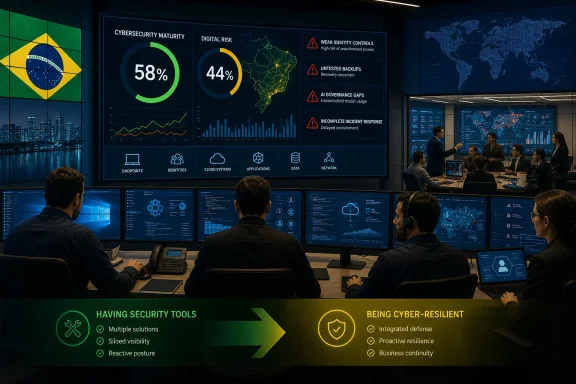 Overview: The Difference Between Maturity and Resilience
Cybersecurity maturity is useful because it offers a broad view of whether an organization has policies, processes, tools, responsibilities, and governance structures in place. It is a measure of organizational development. However, maturity is not synonymous with resilience.Resilience is demonstrated under pressure. It is the ability to detect an intrusion early, contain it quickly, maintain critical business operations, preserve evidence, communicate honestly, meet legal obligations, and restore systems without introducing further damage.
An organization can score reasonably well on a maturity assessment while remaining highly vulnerable to ransomware, business email compromise, data theft, third-party compromise, insider misuse, or fraud enabled by artificial intelligence. That is particularly true where security controls exist in isolated pockets rather than as an integrated business capability.
The reported 44% current digital risk level, categorized as medium, should be interpreted carefully. “Medium” does not mean harmless. In a large company with critical infrastructure, high-value customer data, complex supply chains, or regulatory obligations, a medium aggregate risk level can still produce a severe crisis.
The issue is not merely whether a company owns the right technologies. It is whether it can answer several difficult operational questions:
- Which assets are most critical to revenue, safety, customer service, and legal compliance?
- Who can access those assets, and under what circumstances?
- How quickly can suspicious activity be detected and investigated?
- Can the organization isolate compromised Windows endpoints, servers, cloud workloads, and user identities without shutting down essential operations?
- Has the company tested recovery from an attack that affects both production systems and backups?
- Can legal, technical, executive, customer service, human resources, and communications teams make decisions together under time pressure?
The 58% Maturity Score Is Progress, Not a Finish Line
A rise from 53% to 58% matters. It indicates that Brazilian organizations are investing more seriously in cybersecurity, data governance, and digital risk management. That progress is valuable, especially as more businesses move critical applications, collaboration platforms, customer records, financial systems, and industrial workflows online.Yet a five-point improvement does not erase the underlying structural problem. A score of 58% sits in an intermediate maturity range: organizations have started to develop the right components, but those components may not be continuously managed, measured, or reinforced.
The danger of control inconsistency
The phrase control inconsistency may sound abstract, but it describes some of the most common causes of preventable breaches.A company may require multifactor authentication but allow exceptions for legacy accounts. It may use endpoint protection but fail to ensure every laptop, virtual machine, and server reports to the management console. It may maintain a vulnerability-scanning program but lack a process to prioritize remediation of internet-facing systems. It may back up critical data without regularly testing whether those backups are isolated and recoverable.
These are not failures of intent. They are failures of operational discipline.
Cybercriminals do not need every security control to fail. They need one exposed remote-access service, one reused password, one unpatched VPN appliance, one overly permissive service account, one compromised supplier connection, or one employee convinced by a convincing phishing message.
As threat actors increasingly automate reconnaissance and social engineering, the cost of finding that weak point falls. The attacker’s advantage is compounded when a business has incomplete asset inventories, fragmented logging, unclear ownership, or delayed escalation procedures.
Security technology is not an operating model
Many organizations approach cybersecurity as a procurement exercise. They buy an endpoint detection platform, a cloud security product, an identity suite, a data-loss prevention tool, and an awareness-training subscription. Each purchase can be defensible on its own. But security products alone do not create a functioning defense program.A resilient operating model requires:
- Clear ownership for security decisions and risk acceptance.
- Accurate inventories of endpoints, identities, applications, data stores, and external suppliers.
- Defined minimum security baselines for Windows devices, servers, cloud environments, and mobile devices.
- Continuous monitoring that produces actionable alerts rather than unmanageable noise.
- A vulnerability-management process tied to asset criticality and real remediation deadlines.
- Incident-response procedures practiced by both technical and nontechnical teams.
- Board-level understanding of business exposure, not just a dashboard full of technical metrics.
Why Cyber Incidents Have Wider Consequences Than Downtime
A significant cyber incident is rarely confined to the IT department. Ransomware can stop operations. Data theft can trigger legal exposure. Fraud can disrupt payments and customer confidence. A breach involving personal data can place the organization under regulatory scrutiny. Public confusion can create reputational damage even before the full facts are known.The financial estimates associated with major incidents are particularly striking. The reported average estimated value of a significant cyber incident reached US$31.99 million, while sectors with especially critical assets and complex regulatory exposure faced estimated crisis impacts ranging from US$70.87 million to US$98.43 million.
Those figures should be read as estimates rather than guaranteed outcomes for every organization. Incident costs vary dramatically according to business size, sector, recovery time, insurance coverage, legal obligations, data sensitivity, customer concentration, and whether operations can continue during remediation.
Even so, the broad message is difficult to dispute: cyber incidents have become material business events.
Direct losses are only one part of the equation
The immediate costs of an incident are familiar:- Digital forensics and breach investigation.
- External legal counsel and regulatory work.
- Emergency IT recovery and security consulting.
- Business interruption and lost revenue.
- Customer support and notification activities.
- Ransom-related extortion demands.
- Replacement hardware, software, and infrastructure.
- Increased cyber insurance premiums.
- Potential sanctions, litigation, or contract disputes.
For this reason, the finding that 72% of respondents see reputational damage as more critical than financial loss is revealing. It reflects a modern reality: when a company loses trust, recovery cannot be measured solely by the expense of technical remediation.
Reputation now depends on response quality
Customers do not necessarily expect an organization to be invulnerable. They do expect competence, honesty, and a visible commitment to their interests when something goes wrong.The reputational question after an incident is often not simply, “Were you breached?” It becomes:
- Did the company detect the incident promptly?
- Did it protect customers and employees?
- Did it communicate clearly?
- Did it acknowledge uncertainty without speculation?
- Did it take practical steps to reduce harm?
- Did it demonstrate that accountability extended beyond technical teams?
LGPD Compliance Cannot Be Treated as a Paper Exercise
Brazil’s Lei Geral de Proteção de Dados, or LGPD, remains at the center of the country’s data-protection environment. The law has made privacy and security board-level concerns, but the reported level of full or institutionalized compliance—56%—suggests that many businesses are still struggling to make LGPD obligations operational.That gap matters because privacy compliance is not merely a legal documentation task. It requires organizations to know what data they hold, why they process it, where it moves, who has access to it, how long it is retained, and what happens when it is exposed.
Compliance must connect to technical reality
A company may have privacy notices, internal policies, vendor agreements, and appointed data-protection responsibilities. These are important building blocks. But they must be connected to the technology environment.For example, compliance becomes fragile when:
- Sensitive data exists in unmanaged file shares, employee devices, email inboxes, or collaboration sites.
- Former employees retain access to business systems.
- Administrative privileges are shared or poorly documented.
- Cloud applications are adopted without security and privacy review.
- Third parties process personal data without sufficient technical assurances.
- Security logs are missing, inaccessible, or retained for too short a period.
- Incident reporting processes are not aligned with legal and communications requirements.
None of these actions alone proves LGPD compliance. Together, however, they turn privacy principles into enforceable security practices.
Regulatory pressure is becoming more operational
The risk associated with LGPD is not limited to a theoretical possibility of sanctions. Data-protection expectations increasingly influence contracts, mergers and acquisitions, supplier assessments, insurance decisions, procurement processes, and customer relationships.Businesses that cannot demonstrate sound governance may find themselves at a disadvantage even before a formal regulatory action begins. A prospective client may require evidence of incident response, data-handling controls, access management, vendor oversight, and disaster recovery. A lender or insurer may ask more probing questions about cyber exposure. A major partner may insist on contractual notification requirements that are stricter than a company’s own internal policies.
The result is a shift from compliance as a legal obligation to compliance as a commercial capability.
AI Is Expanding Both the Attack Surface and the Governance Burden
Artificial intelligence has become central to the readiness problem. Generative AI and autonomous or semi-autonomous agents can help organizations automate workflows, analyze data, draft content, improve customer service, and accelerate software development. They can also amplify existing security and privacy weaknesses.The reported finding that only 22% of participants have a proactive cybersecurity strategy for AI systems is therefore a major warning sign. If the remaining organizations have only basic, limited, or nonexistent AI management, then many are adopting powerful tools faster than they can govern them.
Attackers are using AI too
Cybercriminals have always adapted to new technology. AI lowers the effort needed to create persuasive phishing messages, tailor fraudulent communications, translate scams across languages, analyze publicly available information, and generate realistic pretexts for impersonation.The threat is not that every phishing email will suddenly become flawless. The threat is volume, speed, and personalization. A criminal campaign can target finance teams, HR departments, executives, suppliers, and customers with messages that appear more credible than conventional scams.
This raises the importance of fundamentals:
- Phishing-resistant multifactor authentication.
- Least-privilege access controls.
- Strong identity governance.
- Rapid reporting of suspicious messages.
- Email authentication and anti-spoofing protections.
- Segmentation of administrative systems.
- Monitoring for unusual login patterns and privilege escalation.
- User education that reflects modern social-engineering tactics.
Internal AI use creates a separate category of risk
The institutional use of AI can create exposure even when there is no malicious attacker. Employees may submit confidential material into public AI services. Teams may use AI-generated code without appropriate review. Automated systems may make decisions based on flawed, biased, incomplete, or unlawfully processed data. Intellectual property can be exposed through poorly managed prompts, plugins, integrations, or external service providers.A credible AI governance program should therefore cover more than a general “responsible AI” policy. It needs operational rules.
A practical AI governance baseline
Organizations operating in Brazil should establish, at minimum:- An inventory of AI systems and use cases
The business cannot govern tools it does not know are being used. Include employee-facing assistants, customer-service bots, analytics tools, code-generation products, and AI features embedded in enterprise software. - Data classification rules for AI interactions
Employees need clear guidance on what may and may not be entered into AI systems, particularly when personal data, customer records, financial information, contracts, source code, or trade secrets are involved. - Vendor and contractual review
Organizations should understand how an AI provider handles prompts, inputs, outputs, retention, model training, data residency, and subcontractors. - Access and identity controls
AI services should be integrated with enterprise identity management where possible, rather than accessed through unmanaged personal accounts. - Human oversight for consequential decisions
Automated recommendations involving employees, customers, eligibility, pricing, risk, or compliance should not be treated as unquestionable outputs. - Logging, monitoring, and review
Security teams need visibility into AI integrations, API usage, unusual data movement, and high-risk workflows. - Incident procedures specific to AI misuse
A leak through an AI tool, a compromised automation agent, or an incorrect automated action may require a different response path than a conventional malware infection.
The Incident-Response Gap Is the Most Immediate Concern
The most troubling readiness data concerns practice. Only 30% of organizations reportedly conduct regular training or structured simulations for cyber incident response, while 45% conduct no incident-response training or cyber-crisis simulations at all.This is where the illusion of readiness becomes most visible.
An incident-response plan that exists only as a document is not a response capability. It is an assumption. During a cyberattack, teams must make decisions with incomplete information, competing priorities, commercial pressure, legal risk, and technical uncertainty. That environment cannot be simulated through policy review alone.
What a serious cyber exercise should test
A useful exercise does not simply ask the IT team whether it can restore a server. It tests coordination across the organization.A scenario might begin with suspicious credential activity in Microsoft Entra ID, progress to unauthorized access to a cloud file repository, and then reveal potential theft of customer data. Participants should be required to decide what to do as evidence changes.
The exercise should involve:
- Security operations and IT infrastructure teams.
- Legal and privacy leadership.
- Executive management.
- Corporate communications.
- Customer service and sales leadership.
- Human resources, where employee accounts or insider concerns are involved.
- Finance, procurement, and business-continuity teams.
- External incident-response, forensic, and insurance contacts where applicable.
Tabletop exercises must lead to change
A tabletop exercise becomes valuable only when its findings produce measurable improvements. After every simulation, organizations should document what failed, who lacked information, where decision rights were unclear, and which technical controls could not support the required response.Common findings include:
- No current list of critical applications and business owners.
- No reliable method to contact decision-makers outside business hours.
- Unclear authority to disable accounts or isolate systems.
- Missing access to emergency administrator accounts.
- Incomplete backup-recovery documentation.
- Conflicting statements between legal, technical, and communications teams.
- Uncertainty about vendor notification requirements.
- No approved customer communication templates.
- Insufficient evidence preservation procedures.
Crisis Communications Must Be Part of Cybersecurity
Only 19% of surveyed Brazilian companies reportedly have a structured communications process and stakeholder-engagement plan for cyber incidents. That figure reveals a persistent blind spot: many organizations still treat communications as an afterthought to technical containment.That approach is no longer viable.
A cyber incident affects many audiences simultaneously. Employees may be unable to access systems. Customers may notice service disruption. Suppliers may require updates. Regulators may need notification. Journalists may contact the company. Social media may amplify rumors before technical teams have established the full scope of the incident.
Silence is not always a safe strategy
Organizations sometimes avoid communications planning because they fear saying the wrong thing. That concern is understandable. Premature or inaccurate statements can create problems. But the absence of a plan often produces worse results: inconsistent messages, delayed escalation, unauthorized commentary, internal confusion, and a perception that the company is hiding information.Effective incident communication is not about releasing every technical detail. It is about providing timely, accurate, audience-appropriate information while protecting the integrity of the investigation.
A strong crisis communications plan defines:
- Who approves external statements.
- Who communicates with employees, customers, partners, regulators, and the media.
- What facts must be confirmed before disclosure.
- How the organization handles uncertainty.
- How support channels are staffed and updated.
- How false claims and misinformation are monitored.
- How executives receive briefings and escalation updates.
- How communication decisions are documented for legal and regulatory review.
From Risk Awareness to Operational Resilience
Brazilian organizations do not need to start from zero. The maturity improvement reflected in the latest findings shows that awareness, investment, and institutional attention are growing. The challenge now is to convert those efforts into consistent execution.The most effective programs will focus on a small number of high-impact disciplines rather than chasing every new tool or trend.
Priorities for the next stage of cybersecurity maturity
The path forward should include the following commitments:- Make identity the primary control plane. Protect privileged accounts, enforce strong multifactor authentication, eliminate shared administrator credentials, review access regularly, and monitor abnormal sign-in activity.
- Treat endpoint security as continuous management. Every Windows device, server, virtual machine, and remote endpoint should be inventoried, patched, protected, monitored, and capable of rapid isolation.
- Build recoverability, not just backup capacity. Maintain protected backups, test restoration under realistic conditions, and ensure recovery plans account for compromised identities and management infrastructure.
- Integrate privacy, security, and AI governance. Data protection cannot be separated from access management, software procurement, cloud architecture, and AI adoption.
- Measure response readiness through exercises. Run recurring tabletop simulations and technical recovery tests involving business leaders, not only IT personnel.
- Give communications a formal role in cyber crisis management. Reputational resilience must be designed before the incident, not improvised after public attention begins.
- Use meaningful metrics. Replace simplistic counts of purchased tools or completed policies with measures such as patching performance, phishing-resistant authentication adoption, mean time to detect, mean time to contain, recovery-test success rates, and exercise remediation closure.
- Create accountable executive governance. Boards and senior executives should receive clear reporting on business exposure, unresolved high-risk issues, incident readiness, third-party risk, and recovery capability.
Conclusion: Readiness Must Be Proven, Not Assumed
Brazil’s cybersecurity challenge is not a lack of awareness. It is the gap between knowing the risks and being able to respond effectively when those risks become real.A cybersecurity maturity score of 58% shows progress, but it also underscores how much work remains. The combination of uneven LGPD readiness, limited AI governance, inadequate incident simulation, and weak crisis communications creates a risk environment in which many businesses may discover their shortcomings at the worst possible moment.
The organizations best positioned to withstand the next major incident will not necessarily be those with the longest list of security products or the most polished compliance documentation. They will be the ones that know their critical assets, enforce their controls consistently, rehearse difficult decisions, govern AI deliberately, protect identities rigorously, and communicate with clarity when confidence is at stake.
In the modern Brazilian cyber landscape, readiness is not a statement of intent. It is a capability that must be tested, measured, and continuously improved.
References
- Primary source: FTI Consulting
Published: 2026-07-24T00:00:00+00:00