

Microsoft treating Windows like an embarrassment is a self-inflicted problem—and bringing back a predictable, annual Windows event would be one of the fastest, clearest ways to repair the damage.
Background: where Microsoft's Windows messaging went missing
Microsoft once had a dependable rhythm for talking about Windows. For years the company used the spring-summer window around Build and dedicated media events to outline the platform’s next steps, rally partners, and give both developers and enthusiasts a clear calendar moment to expect the big headlines. That cadence broke up over the last half-decade as Microsoft shifted Build toward cloud, Azure, and developer-platform messaging, and Windows announcements migrated to scattered, product-driven events. The result: no single, predictable “moment” in the year that the Windows community can mark on their calendars.The inconsistency is easy to document. Windows 11 was announced at a dedicated Microsoft event on June 24, 2021 after teases at Build 2021. Microsoft introduced Windows-focused hardware and a Windows-centric vision again at a May 20, 2024 event when it launched the Copilot+ PC category and an AI-forward set of platform features. Windows 10X was revealed at a Surface event in October 2019, not at a single annual Windows show. That patchwork scheduling—events happening in June, May, October, or whenever a product is ready—has left enthusiasts with no predictable “Windows Day.”
This matters beyond nostalgia. Platform ecosystems thrive on rhythm. Apple and Google have consistent calendar anchors—WWDC and I/O in May–June—so developers, journalists, OEMs, and fans all plan around them. The predictability builds anticipation, shapes roadmaps, and concentrates attention. Microsoft’s absence from that predictable slot has a practical cost: features arrive incrementally and often without a clear, company-wide narrative tying them together, which feeds confusion and negative sentiment.
Why an annual Windows event matters now
Reclaiming the narrative
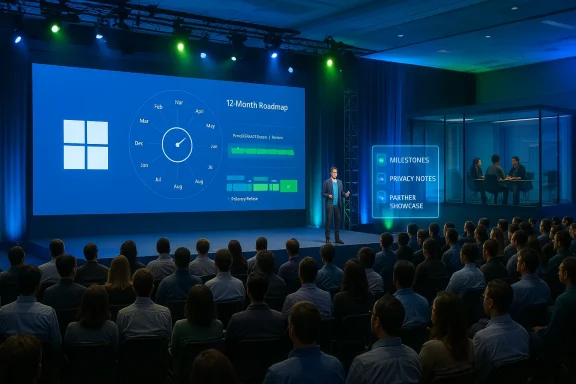
An annual Windows event would give Microsoft a single, visible stage to say: “Here’s where Windows is heading over the next 12 months.” That matters because today Windows often feels like a string of isolated releases—AI pushes, small feature updates, or device launches—rather than a coherent plan. A single event with a roadmap restores context and frames incremental updates as parts of a deliberate program. It also constrains speculation and leaks by giving Microsoft a definitive forum to own the messaging.Repairing trust after high-profile missteps
The Windows team has stumbled in ways that damaged public trust: controversial features with privacy implications (for example, the Recall feature), high-profile update compatibility issues, and patches rolled out under pressure. Those incidents make Microsoft’s silence worse: when users don’t know what’s coming, they fill the gap with worry. The Recall rollout and associated privacy backlash is a case in point—an announcement-heavy product that had to be reworked because of understandable user concerns. A yearly event plus transparent roadmapping could have set expectations earlier, allowed for more public vetting, and reduced the shock of surprise launches.Concentrating partner and hardware momentum
OEMs need a platform-level moment to align releases and marketing. Apple’s and Google’s developer events let hardware and software partners coordinate product cycles. Microsoft’s Copilot+ PC launch did bring partners to the foreground in 2024, but absent a predictable annual window, OEMs and Surface teams time products independently. A yearly Windows showcase would give Microsoft a standing stage for hardware partners (Lenovo, HP, Dell, Acer, Samsung) to display flagship Windows devices—without letting the hardware overshadow the platform narrative.What Microsoft broke—and what it can fix
The signal-to-noise problem
When platform updates are released with no framing, perception matters more than the actual code. Users saw months of AI feature drops and felt the company prioritized “Copilot” branding and novelty over stability and usability. That perception reached Microsoft’s leadership: in early 2026 the company publicly vowed to address “pain points” in Windows—a tacit admission that the outreach and product pacing were out of sync with user expectations. Making that pledge public is the first step, but it needs a recurring venue to translate words into accountable timelines.Engineering and PR must be coordinated, not at odds
Product marketing that commits to a roadmap must be matched by engineering timelines. The risk of a yearly Windows event is that Microsoft could promise too much too soon, and then repeat past mistakes where announcements outpace shipping readiness (a pattern visible in the Recall saga). But the counter-risk—silence and surprise releases—has shown larger damage to perception. The right balance is an event that commits to a set of priorities and deliverables with realistic timelines, testing windows, and clear opt-in previews for Insiders and enterprise customers.A practical blueprint: what a revived annual Windows event should look like
If Microsoft is serious about restoring enthusiasm and regaining control of the Windows narrative, the event must be engineered for credibility, clarity, and community.Timing and format
- Hold it annually in early July (mid-point between Build and the fall shipping season) so it can preview the next big H2 release cycle and set expectations for the coming 12 months. Why July? It sits after the spring developer rush and before the fall shipping window, and it gives partners time to ready hardware for the holiday cycle.
- Make it hybrid: a flagship, in-person show for press and partners plus a high-quality livestream for global audiences, with breakout sessions for developers, IT pros, OEMs, and gamers.
- Reserve a single high-energy keynote that frames the year, followed by modular streams (developers, IT, security, gaming, accessibility). This lets Microsoft be both bold and granular.
Agenda — headline items the event should deliver
- A clear 12-month roadmap for platform priorities, with measurable goals (performance SLAs, reliability targets, accessibility milestones).
- Feature readiness signals: a matrix showing which items are shipping in the next 90 days, which are in preview, and which are planned for later in the cycle. Prefer “preview” with realistic ship windows over vague “coming soon” messaging.
- Platform health metrics: adoption numbers, update success rates, crash telemetry improvements, and app compatibility stats. These should be high level and privacy-safe but measurable.
- Partner showcase: OEM spotlights and Surface refreshes, but explicitly labeled as hardware showcases—Windows remains the centerpiece.
- Security and privacy deep dive: explain how new features protect user data (e.g., Recall design changes, encryption, opt-in defaults). Handing this to engineering leads—not just marketing—builds credibility.
Concrete event components to rebuild trust
- A “platform dashboard” that Microsoft updates publicly—on a monthly cadence—showing progress against the roadmap items announced at the event.
- An expanded Insider engagement plan tied to the event timeline: larger preview rings for enterprise testers, clearer feedback channels, and public postmortems on controversial features.
- A vendor compliance scorecard: a summary of OEMs’ update support and driver compatibility performance, so enterprise buyers see which partners commit to long-term support.
Case studies: what worked and what failed
Copilot+ PC launch: big ambition, mixed reception
Microsoft’s May 20, 2024 Copilot+ PC announcement was a bold, coherent push—aimed at positioning Windows as the premier AI-ready platform for on-device models. The company outlined new hardware partners, on-device AI experiences (Recall, Cocreator), and a new category of devices designed for low-latency AI workloads. That kind of focused, platform-level proclamation is exactly what enthusiasts want: a clear thesis about where Windows is going. But rollout friction—privacy concerns around Recall and staggered feature availability across CPU architectures—tarnished the message and showed the limits of marketing without broad-based readiness. Microsoft’s blog and partner messaging set expectations; user and press reaction revealed gaps in privacy communication and cross-silicon parity.Recall: a cautionary tale in timing and communication
Recall’s concept—indexing local activity so users can “remember” what they’ve seen—was technically interesting, but privacy experts and users raised legitimate concerns about what snapshots might capture and how they’d be protected. Microsoft delayed and reworked Recall after feedback; the public debate illustrates why a predictable event plus extended preview windows are valuable. Announcing a feature in principle, then giving a long, publicized preview period to address privacy and usability concerns, would have reduced backlash and given Microsoft time to demonstrate safeguards.Patch and update missteps: when cadence matters
Windows 11’s 24H2 and subsequent update cycles included fixes and features—but also compatibility holds and emergency fixes (for example, Netflix or Ubisoft issues and out-of-band recovery patches). These operational incidents show why Microsoft must be transparent about update cadence and have a visible escalation plan. A yearly Windows event is a natural anchor: talk openly about testing, compatibility thresholds for major releases, and what enterprise administrators should expect.Counterarguments—and why they don’t outweigh the upside
“Microsoft already has Build and partner events—why add another?”
Build is important, but it’s a developer conference first and has intentionally pivoted toward Azure, cloud, and developer tooling. That makes it a poor stage for a broad consumer-and-partner-focused Windows platform reveal; Build’s agenda and audience have evolved. A dedicated annual Windows event would complement Build by serving consumers, OEMs, gamers, and enterprise customers with Windows-specific narratives that Build no longer prioritizes.“Promising a roadmap commits Microsoft to deadlines it may miss.”
Yes—but the alternative (no roadmap) ensures users only encounter surprises, which worsens trust. The right approach is conservative, transparent roadmapping: commit to priorities and realistic ship windows, show progress publicly, and be honest when timelines change. That builds credibility over time. The cost of silence has already been paid in user frustration; the price of commitment is disciplined communications and engineering alignment.“Microsoft’s strategic focus is Azure and AI—Windows is less important now.”
Windows is still central to the PC ecosystem, to gaming, and to OEMs. Even as Azure and Copilot integrations grow in importance, Windows is the OS underpinning those experiences. Neglecting platform-level storytelling handicaps Microsoft’s broader strategy because it fragments attention across product silos instead of presenting a unified Windows thesis that ties cloud, AI, hardware, and developer tools together. The Copilot+ launch showed how powerful that message can be when done well—and how damaging it is when follow-through is uneven.A recommended roadmap for Microsoft to follow publicly at the event
If Microsoft brings the Windows event back, the company should present a transparent, measurable five-point program that demonstrates both ambition and accountability.- Priority 1 — Ship stability and performance gains: measurable targets (e.g., reduce update restart time by X%, cut crash rates by Y%) with quarterly dashboards.
- Priority 2 — App and hardware compatibility: publish OEM and driver support commitments and a compatibility scoreboard for key enterprise apps and games.
- Priority 3 — Privacy-first AI: every announced AI feature must include a privacy design summary, opt-in defaults, and a public security review timeline.
- Priority 4 — Developer and store health: commit to clear app store policies, revenue-share transparency, and a timeline to improve legacy app modernization tooling.
- Priority 5 — Community & feedback: expand the Windows Insider roadmap with public voting and prioritized engineering responses for top issues.
How Microsoft should run the event in practice (a tactical checklist)
- Start with a short, honest state-of-Windows address: admit problems, show data, and state the goals.
- Reveal a prioritized 12-month roadmap with a clear “what ships when” table.
- Demonstrate 2–3 tangible features in working demos—no vaporware.
- Present a privacy and security session led by the engineers who built the features.
- Give partners a 15-minute OEM show-and-tell block, clearly labelled as “partner hardware”—not the main event.
- Close with an open Q&A on the livestream and dedicated post-event community AMA for Insiders and IT pros.
Final analysis: the risks, the gains, and the bottom line
Reviving an annual Windows event is not a cosmetic PR trick. It’s a structural change in how Microsoft communicates responsibility for the platform. The risks are real: public commitments create pressure, and past launch missteps (like the Recall backlash and compatibility holds) are cautionary. But the alternative—continued scattered announcements and an evaporating community of enthusiasts—has already done real damage to Windows’ standing.The gains from a predictable annual event are both tactical and strategic:
- Tactically, it concentrates attention and gives partners a fixed planning cadence.
- Strategically, it allows Microsoft to control narrative, show progress against measurable goals, and rebuild trust by publicly committing to fixes and timelines.
Conclusion
Windows doesn’t need theatrical gimmicks so much as dependable rhythms and accountable communication. Return the event, keep it honest, and make the year’s roadmap a public contract. Microsoft’s product teams already build groundbreaking technology—what’s missing is a reliable annual moment to explain why it matters, how it will arrive, and how users and partners can prepare. If Microsoft wants to rebuild fandom, it should start by stopping the awkward, apologetic silence and put Windows back where it belongs: onstage, every year, with a plan.
Source: Windows Central Microsoft needs to bring back the annual Windows event
