

The grassroots petition calling for Microsoft to “Bring Back Windows Phone” has quietly gained traction on Change.org, drawing the familiar glow of nostalgia and a fresh round of debate about whether a third mobile ecosystem could — or should — return. The petition, started by Σπύρος Κ. from Greece, frames the ask not as a revival of the past but as a reimagining of Windows Phone for today’s hardware and services, explicitly calling for modern hardware, deep Microsoft 365 and Copilot integration, and an updated Fluent-inspired UI. As of this writing the petition lists a modest but unmistakable number of supporters, a visible signal that a passionate niche still cares enough to ask. This is more than nostalgia: it’s a recurring theme in tech communities. From fan concepts that rework Live Tiles into modern widgets to hobbyist projects that boot Windows 11 on smartphones, the idea of a Windows-flavored mobile experience continues to surface. But the technical realities, commercial history, and current Microsoft strategy all make a wholesale comeback highly unlikely. This article examines the petition and its claims, explains the historical and technical context that produced the platform’s demise, assesses the practical options for any revival, and lays out the real-world obstacles that have to be solved if Windows Phone is ever to move past fan projects and into a sustainable product strategy.
However, the historical record, engineering realities, and Microsoft’s current focus make a full-fledged Windows Phone revival unlikely in the near term. The app-economy problem remains the primary barrier; runtime tricks and emulation (even Prism’s impressive improvements) are partial solutions that trade performance, battery life, and long-term stability for app compatibility. Microsoft’s own experiment with Android (Surface Duo) and the deprecation of WSA are practical reminders that compatibility layers and runtime-dependent strategies are risky unless backed by firm, long-term commitments. That said, several practical routes could deliver a Windows-flavored pocket computing experience that matters: enterprise-first pocket PCs, foldables with a Fluent-inspired shell, and premium niche hardware that leverages Microsoft’s services. Those paths are smaller, less headline-grabbing, and more likely to be executed with the discipline required to succeed.
Enthusiasts and petitioners will keep asking — and community prototypes will keep inspiring — but for a commercial resurrection to move from petition to product, the path must squarely solve the app-parity challenge, the carrier and modem problem, and the trust problem (multi-year support) that doomed Windows Phone the first time around. Until Microsoft publicly demonstrates that level of commitment, a return to the mobile OS game will remain one of the most compelling “what ifs” in modern tech history.
Source: Windows Central https://www.windowscentral.com/hard...vive-windows-phone-and-dozens-are-signing-up/
 Background
Where the petition sits in the conversation
Change.org’s “Bring Back Windows Phone” petition is one of several public efforts (and numerous private discussions) asking Microsoft to return to mobile as a platform rather than simply shipping mobile-first apps or devices that run Android. The petition explicitly emphasizes a reimagined OS — not a carbon-copy of Lumia-era software — and demands modern integration with Microsoft services and an updated UI. The page shows the petition’s starter, recent signers, and a target that suggests the organizer hopes to scale support into the hundreds or thousands. Mainstream coverage of the petition — and the perennial “what if” stories about Windows Phone — arrived fast, with outlets framing the petition as another instance of Windows Phone fandom refusing to let go. This story is the latest leaf in a long-running narrative: Microsoft bet on mobile hardware, acquired Nokia’s Devices & Services business in 2013 for roughly €5.44 billion to accelerate that play, and later wrote off much of the handset effort as strategic priorities shifted. The deal closed in April 2014.Why the nostalgia lingers
Windows Phone left a disproportionate emotional imprint relative to its market share. The platform’s tile-based UI — Live Tiles — and tight integration with Microsoft services offered a different posture from Android and iOS: glanceable, bold, and productivity-oriented. Fans still cite the UI’s clarity and the Continuum idea (a phone that becomes a PC when docked) as design concepts that were ahead of their time. Community experiments — ranging from concept mockups to full-on efforts to run desktop Windows on phone hardware — keep the conversation alive. Community experiments and trial installs are well-documented: hobbyists have repeatedly pushed Windows 11 or Windows-on-ARM images onto phones as technical proofs-of-concept, even when the result is impractical for daily use.What the petition says (and what it doesn’t)
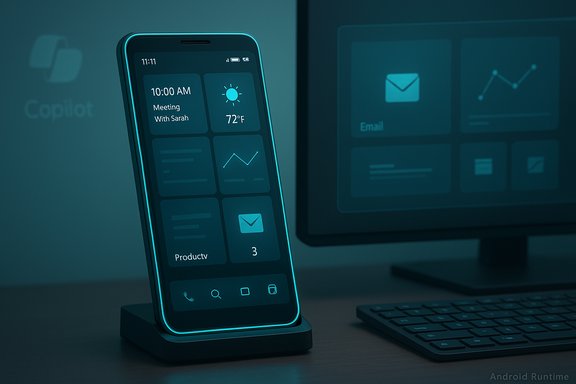
The petition’s pitch is a tidy blend of sentiment and prescription: bring back the core design DNA (Live Tiles reinterpreted), pair it with modern Microsoft services (Microsoft 365, Copilot), and make sure developer tooling and app compatibility are solved so users don’t get an empty store. That formulation contains three promises, each with its own technical and business burden:- Modern hardware and a polished UI: feasible for Microsoft or a deep-pocketed OEM to deliver.
- Seamless Microsoft 365 and Copilot integration: feasible and arguably the company’s strategic sweet spot.
- Developer support and app compatibility: historically the fatal weakness for Windows Phone and the single most expensive gap to close.
The strategic memory: why Windows Phone failed before
The Nokia bet and its aftermath
Microsoft’s decision to acquire Nokia’s Devices & Services business in 2013 was intended to accelerate Windows Phone’s adoption by combining hardware and software. The acquisition closed in April 2014 and transferred tens of thousands of Nokia employees to Microsoft. In short order the business proved unprofitable at scale in the face of Android and iOS dominance, and Microsoft booked write-downs and reorganizations that culminated in stepping back from first-party phone hardware. Those events are part of the canonical timeline that explains why Microsoft is cautious about re-entering the phone market.The ecosystem problem
The fundamental reason Windows Phone failed commercially is not simply UX; it’s the two-sided market economics of mobile platforms. Developers go where users are; users go where apps are. Windows Phone never reached the developer momentum needed to overcome that cycle — major apps were absent or late, and unique platform APIs created friction. Even brilliant UX won few converts when Instagram, Snapchat, and other mainstream apps were missing or poorly supported. Multiple retrospectives and industry analyses identify app parity and developer economics as the decisive factor. (This is exactly the problem the petition claims to fix.Microsoft’s explicit retreat
By late 2017 Microsoft had effectively declared that mobile as a first-party OS was no longer a strategic priority; feature updates slowed, projects were cancelled or retooled, and the company refocused on services and cross-platform apps. Windows 10 Mobile’s support officially ran out in January 2020, marking the platform’s formal end. The corporate memory and public statements from Microsoft leadership since then reinforce how costly the phone experiment became.Technical feasibility today: what changed — and what hasn’t
Windows on Arm and Prism emulation
The technical landscape for running full Windows experiences on small, energy-constrained devices has improved thanks to two threads: faster Arm silicon and much better emulation for x86/x64 apps on Arm Windows via Microsoft’s “Prism” emulation layer. Prism has substantially increased compatibility and has been updated to expose more x86 features under emulation, which reduces a key technical barrier to running PC-class apps on Arm silicon. That progress widens what’s possible for a Windows-like pocket PC, but emulation carries power and thermal costs that make sustained phone-like battery life an engineering challenge. Prism’s evolution is a real, measurable improvement — but it does not eliminate the fundamental tradeoffs of thermals, drivers, and radio integration.The Android-compatibility shortcut — and why it’s fragile
A practical path to app parity is running Android apps (either via a compatibility layer or via a certified Android fork). Microsoft tried this hybrid approach with Surface Duo (an Android device) and previously supported Android apps on Windows via the Windows Subsystem for Android (WSA) and the Amazon Appstore. WSA made Android apps accessible on Windows 11, but Microsoft announced the deprecation of WSA and the Amazon Appstore on Windows with support ending in March 2025 — demonstrating how fragile a runtime-dependent app strategy can be when the vendor withdraws support. Any revival that relies heavily on a compatibility layer must either secure a long-term runtime commitment or accept the fragility that sank WSA.Device-level engineering still matters
Even with modern SoCs and better emulation, a pocket device that runs desktop-class workloads must contend with thermal design, battery life, modem and radio stack integration, and carrier certification. The enthusiast demos that boot Windows 11 on a phone often reveal severe battery drain, missing drivers, and overheating — experimental proofs, not ship-ready designs. The hardware integration problem was one of the reasons Andromeda (Microsoft’s rumored Windows-based dual-screen device) was cancelled and why Microsoft shipped an Android-based Surface Duo instead of a Windows-powered phone.Business realities and organizational momentum
Leadership, focus, and product champions
Large product bets need senior-level champions and consistent multi-year investment. Microsoft’s public admissions — including CEO Satya Nadella’s comments that exiting the phone business was a difficult decision and a possible strategic regret — indicate internal awareness of what was lost, but regret alone doesn’t equal a strategic reversal. Leaders who could marshal a multi-year phones program have left or moved on (for example, Panos Panay departed Microsoft in 2023 and later joined Amazon), and organizational focus is now on AI, cloud, and hybrid experiences. A revived phone OS would need a durable champion and resource commitment that Microsoft has not signaled.Carrier economics, OEM partnerships, and distribution
Historically, carriers and OEMs were critical to mobile distribution and economics. Microsoft’s experience shows how fragile those relationships are; without carrier incentives, a new platform struggles to achieve scale. Any credible revival would likely need to begin niche-first — enterprise provisioning, dock-centric pocket PCs, or specialist hardware aimed at developers and productivity users — rather than a mass-market handset launch. This reduces early distribution risk but also constrains potential scale.The cost of app incentives
Even if Microsoft offered an Android compatibility layer or tooling to ease porting, it would need to create strong developer incentives — revenue guarantees, simple porting tools, or deep integrations that make the platform economically attractive. Past attempts to incentivize developers were insufficient to tip the balance. Convincing developers today would require not just marketing or tooling, but measurable adoption and monetization opportunities that are credible over years. That requires a multi-year commercial commitment and an update/support promise that developers can trust.Scenarios for “revival” — from least to most plausible
- Niche pocket PC / productivity-first device
- Microsoft or an OEM could ship a “pocket PC” that runs Windows 11 (or a variant) on Arm silicon, targets enterprise or pros, and emphasizes docked continuity over carrier-first phone features. This is the most plausible path: controlled distribution, premium pricing, and clear enterprise value. It reduces the need for a massive app base by leaning on web and cloud services, and on the Microsoft 365 ecosystem. Prism and improved Arm silicon make this technically feasible, but carrier features (voice, certified modems) complicate scale.
- Android-based Microsoft UX (Surface Duo model)
- Microsoft has already done this: the Surface Duo ran Android with Microsoft services at the foreground. It’s the lower-risk option because Android provides app parity. However, it’s not a true Windows Phone comeback — it’s a Microsoft-centric skin on Android, which many fans reject as the “true” Windows Phone spirit. The deprecation of WSA, meanwhile, highlights the risk of relying on runtime layers for ecosystem completeness.
- A full new Microsoft mobile OS with native app ecosystem
- This is the “classic” revival idea: new OS, modern APIs, developer incentives, and a global launch with carrier/OEM partners. Practically, this is the least likely path. The required long-term investment, distribution deals, and developer economics are costly, and Microsoft appears strategically focused elsewhere (cloud, AI, devices where Windows already dominates). The legacy reasons Windows Phone failed — app economy, distribution and update commitment — remain the same barriers today.
- Community-driven / hobbyist revival
- Short of an official comeback, enthusiasts will continue to create concepts, ports, and mods. These projects keep the ethos alive and can be technically impressive, but they’re not commercial products. They help explore what’s possible, highlight user needs, and occasionally influence design language, but they cannot replace the complex economics of a platform. Community projects that boot Windows 11 on phones are examples of this route.
Strengths of the idea — and where the petition gets it right
- Design differentiation matters. Live Tiles — or their modern equivalent — offered a glanceable information model that many users still prefer to notification-heavy home screens. A reimagined glance layer could be a genuine UI advantage if executed well.
- Microsoft’s services (Office, Teams, OneDrive, Copilot) give it an obvious integration angle that could deliver tangible productivity benefits on small devices.
- Hardware advances (Arm performance + Prism) lower the technical barrier for a capable Windows-like pocket device.
- A focused, enterprise-first product could sidestep the mass-app race and deliver real value to a commercial segment that already pays for Microsoft services.
Risks, unknowns, and unverifiable claims
- The petition’s implied claim that Microsoft “needs” a phone to succeed in AI is speculative. While a phone endpoint could be valuable for on-device agents, Microsoft’s current path — integrating Copilot into PCs, Office, Xbox, and cloud services — has significant reach without a first-party phone. Any claim that “Microsoft will never win in AI without a phone” is an opinion lacking public evidence that the company’s AI strategy requires a handset to succeed.
- The support statistics and sign counts on petitions fluctuate; the Change.org petition shows a snapshot of support (e.g., 135 supporters as listed on its page at the time checked), but petitions of this size historically have a limited effect on shifting the strategic choices of a company like Microsoft. Petition numbers and future growth are verifiable only via the petition page itself and can change at any time.
- Community technical experiments (running Windows 11 on phones) prove possibility but not product viability. Reports from those experiments routinely show battery, thermal, and driver gaps that make daily use impractical. Those practical limitations are replicable and have been observed in multiple community write-ups.
What a pragmatic Microsoft roadmap would look like (if it seriously tried)
If Microsoft were to entertain a revival in any meaningful way, the safe and pragmatic approach looks like a staged, evidence-driven program:- Ship UI and shell innovations across Windows 11 devices so designers and developers can test the interaction language on existing PCs and foldables.
- Target a niche device class first: a dock-first productivity pocket PC that emphasizes continuity with Windows on desktop, not a mass-market phone.
- Provide a supported Android runtime or a robust cloud-streaming strategy for apps — with contractual, multi-year support commitments so developers and customers can trust the runtime won’t be deprecated like WSA.
- Offer strong developer incentives and migration tooling: low-friction APIs, revenue-share assurances, and certified device profiles for a prioritized set of enterprise apps.
- Publicly commit to updates, privacy controls, and carrier/OEM partnerships: binding, measurable promises help reduce the distribution risk.
Final assessment — nostalgia vs. plausibility
The Change.org petition encapsulates a real sentiment: a dedicated group of users still believes a Windows-native mobile experience would be distinctive and valuable. The visual language and continuity goals that powered Windows Phone still have designers and users intrigued, and Microsoft’s own assets — Office, Copilot, Azure identity — could combine into a differentiated product.However, the historical record, engineering realities, and Microsoft’s current focus make a full-fledged Windows Phone revival unlikely in the near term. The app-economy problem remains the primary barrier; runtime tricks and emulation (even Prism’s impressive improvements) are partial solutions that trade performance, battery life, and long-term stability for app compatibility. Microsoft’s own experiment with Android (Surface Duo) and the deprecation of WSA are practical reminders that compatibility layers and runtime-dependent strategies are risky unless backed by firm, long-term commitments. That said, several practical routes could deliver a Windows-flavored pocket computing experience that matters: enterprise-first pocket PCs, foldables with a Fluent-inspired shell, and premium niche hardware that leverages Microsoft’s services. Those paths are smaller, less headline-grabbing, and more likely to be executed with the discipline required to succeed.
Conclusion
The petition to “Bring Back Windows Phone” captures a persistent and legitimate yearning for alternative mobile design and continuity experiences. It also serves as a reminder that platform markets are not won by nostalgia alone: they are won by ecosystems, distribution, developer economics, and long-term product discipline. Microsoft still has the design DNA, the services stack, and the technical primitives (Arm silicon, Prism emulation) to create novel pocket experiences — but doing so as a viable platform would require a multi-year, multi-stakeholder investment that Microsoft has shown no sign of committing to at the scale that made Windows Phone a contender a decade ago.Enthusiasts and petitioners will keep asking — and community prototypes will keep inspiring — but for a commercial resurrection to move from petition to product, the path must squarely solve the app-parity challenge, the carrier and modem problem, and the trust problem (multi-year support) that doomed Windows Phone the first time around. Until Microsoft publicly demonstrates that level of commitment, a return to the mobile OS game will remain one of the most compelling “what ifs” in modern tech history.
Source: Windows Central https://www.windowscentral.com/hard...vive-windows-phone-and-dozens-are-signing-up/
