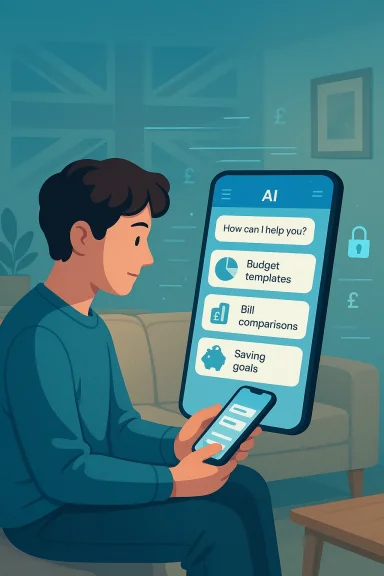
Britons are embracing AI for money management faster than many financial institutions expected, but the real story is not simply about convenience. It is about trust, privacy, and the changing psychology of asking for help with personal finances. A new Post Office-commissioned poll of 2,000 adults suggests that AI is now part of the mainstream conversation around saving, bills, and budgeting, even as many people remain cautious about sharing money worries with other humans. The result is a distinctly modern contradiction: people want speed and privacy, yet they also want reassurance that the advice they receive is safe and sensible.
Background — full context
The latest findings sit inside a wider shift in how people seek financial guidance online. According to the poll, 50% of Britons would now turn to AI for help with their finances, while independent blogs and podcasts, YouTube, and workplace conversations remain important sources of advice. The same research found that 13% would prefer AI over a human adviser, with 30% saying they would do so because they worry about being judged. That last figure may be the most revealing: for many people, AI is not just a productivity tool, but a low-friction substitute for a conversation they would rather not have.That preference makes sense in remains a difficult subject. The poll found that older adults were more uncomfortable discussing finances with friends than younger generations, with 29% of Boomers expressing discomfort compared with 18% of Gen Z and 17% of Millennials. Yet the younger cohort is also the most experimental. Gen Z respondents were more likely to use search engines and large language models such as ChatGPT or Google AI, and a fifth said LLMs were more helpful for money tips than a financial adviser or a bank. That does not mean younger users are rejecting traditional finance entirely; it means they are building a hybrid advice stack that blends algorithms, social media, expert brands, and human judgment.
The research also suggests that money habits in the U than stereotypes sometimes imply. More than half of respondents said they track monthly expenses, build an emergency fund, and avoid impulse purchases. But discipline does not equal ease. A third of those surveyed said they had found it difficult to save any money over the last 12 months, which helps explain why simple, reassuring, and always-available AI tools are gaining traction. People do not just want an answer; they want the feeling that progress is possible.
Post Office Financial Services Director Ross Borkett framed the trend as paal shift away from silence around money. His comments emphasised that people are increasingly willing to discuss finances with friends, family, colleagues, online forums, or AI, and that the important thing is not the channel but the habit: track outgoings, save regularly, and build securely. The company also used the poll to reinforce the appeal of its own savings accounts, which it describes as simple and flexible, with starting balances as low as £1. That marketing message matters because it positions AI not as a replacement for financial products, but as the new front door to them.
Why AI is becoming a money coach
The appeal of anonymity
One of the clearest findinat a significant share of people do not want a moral reaction when they ask for financial help. Thirty percent said they would prefer AI because they worry about being judged. That is a powerful insight because it suggests AI’s biggest advantage may not be intelligence at all, but social neutrality. A model does not sigh, interrupt, or look disappointed. For users who feel embarrassed about debt, overspending, or low savings, that matters.Speed beats scheduling
AI also wins because it is immediate. Traditional financial advice often requires appointmeng, or waiting for a bank response. AI can give a draft budget, a savings plan, or a bill-reduction checklist in seconds. That speed is especially attractive when the issue is small but urgent, such as trying to trim a grocery bill or decide whether a subscription is worth keeping. In practice, the convenience factor can be enough to get people to act.Advice without the social cost
The poll’s wider theme is that people are quietly assembling a no-awkwardness advice network. They will ask an AI tool, browse a blog, watch a video, or talk to a colleague before they will always speak to a professional. This is not necessarily a rejection of human expertise. It is a search for a less intimidating first step. In that sense, AI behaves like a digital practice run before the real conversation.Gen Z is normalising algorithmic money help
Search first, ask later
The youngest adults in the poll are the most comfortable using digital tools to start the moZ respondents were far more likely than Boomers to use search engines and large language models for financial help, and they were also more likely to rate those tools as useful. That suggests a genuine generational change in the default behaviour around advice-seeking. Instead of asking a parent, bank, or adviser first, many younger users ask a machine.LLMs as a practical first draft
This does not mean Gen Z trusts AI blindly. Rather, AI appears to function as a first draft generator. Users may ask for a budget framework, a comparison of saxplanation of a financial term, then refine the output with more specific questions. That kind of workflow fits the way large language models are best used: as conversational assistants that help people get oriented before making a decision.Established experts still matter
Even among younger groups, well-known money voices still have influence. The poll notes that Millennials and Boomers place primary trust in established savings experts like Martin s a useful point: AI is growing, but it has not displaced trusted brands. Instead, the market is becoming layered. People may use a model to explore a topic, then confirm the answer with a known expert or institution. That is a healthy behaviour if the confirmation step actually happens.Why privacy is central to financial AI
Personal data and personal shame
Money conversations are never just about arithmetic. They are about identity, status, relationships, and fear. That is why privacy matters so much. A perssharing their budget with an AI tool may still be reluctant to tell a partner, colleague, or adviser the same details. For many users, AI creates psychological space to be honest. It lowers the emotional barrier to disclosure.The hidden trade-off
But privacy also creates a new trade-off: the more comfortable people become with AI for finances, the more likely they are to share sensitive information with systems they do not fully understand. The poll itself shows that people wantafer socially, not necessarily because it is safer technically. That distinction matters. A user may perceive secrecy where the real issue is data handling, model retention, or vendor access.Trust is earned in the details
Financial tools do not get trust merely by sounding polite. They need clear explanations of what data is stored, what is used to generate recommendations, and what is never shared. Users may happily ask an AI how to reduce bills, but they are less ue answers if the tool is connected to real account data or spending history. In finance, transparency is not a nice-to-have. It is the product.Human advice is not disappearing
Colleagues are now part of the mix
One of the more interesting findings in the poll is that 27% of respondents were happy to talk to colleagues about their finances. That suggests a gradual normalisation of everyday money conversation in the workplace. It is not just a sign of AI growth; it is also evidence that money shame is weakening in some settings. Colleagues can be less intimidating than family, and sometimes more relevant than a generic online forum.Blogs, podcasts, and YouTube remain useful
The research also shows that independent blogs, podcasts, and YouTube are still part of the advice ecosystem. That matters because it proves AI is entering a crowded field rather than creating one from scratch. People are already used to asynchronous, self-serve advice. AI is simply the nexhaviour, with conversation added on top.The bank is still the bank
Traditional institutions still carry weight, especially when the advice involves regulated products, savings safety, or product terms. The poll indicates that people may turn to AI first, but not necessarily last. Banks and financial advisers retain their role where compliance, accountability, and product suitability matter moss not AI instead of humans, but AI before humans.What people are asking AI to do
Budgeting and bill reduction
The poll points to practical uses rather than glamorous ones. People want help saving money, reducing bills, and setting goals. That is the everyday, unsexy side of AI adoption, and it may be the most durable. Tools that can organise expenses, suggest ways to cut waste, or create a paydown plan are far moreeatedly than flashy one-off gimmicks.Behavioural nudges
AI can also act as a behavioural prompt. If someone asks for a savings strategy and receives a simple method like tracking outgoings, automating transfers, or using a rule-based budget framework, the tool is not just informing them; it is nudging them into action. That is important because many people do not fail financially for lack of information. They fail for lack of follow-rks like 40-30-20-10The article’s mention of the “40-30-20-10 method” is a reminder that people like simple structures they can remember without an app. AI may help popularise these frameworks by explaining them in plain language, adapting them to local circumstances, or turning them into personalised plans. That kind of accessibility is where AI can add real value: not inventing financial wisdom, but making it easier to use.
The promise of AI advice is also its danger
Confidence without competence
The biggest risk in financial AI is that the answers sound right even when they are incomplete, oversimplified, or wrong. Finance is full of edge cases: income variability, debt interest, household obligations, credit score effects, tax implications, and product terms. A chatbot can be helpful with general guidance, but it is not automatically equipped to spot the nuancndation safe for a specific person.Over-generalised advice
A model may tell users to build an emergency fund, cut discretionary spending, or automate savings, and those are sensible baseline suggestions. But if the user is already living close to the margin, the same advice may be unrealistic without a more careful look at income timing, debt burdens, or upcoming costs. Good advice is context-sensitive. That is the difference between a useful assistant and a digital slogan machine.Advice is not regulation
Another concern is that people may mistake conversational fluency for legitimacy. A well-written answer does not mean the advice is regulated, insured, or accountable. For high-stakes decisions, users still need to know whether a tool is merely informative or whether it is acting in a professional advisory capacity. AI can help people prepare for a conversation with a bank or adviser, but it should not pretend that preparation is the same thing as expert judgment.Why thnd building societies
The front door is changing
For financial institutions, the most important implication is that customer journeys are being rewritten. People may not begin on a bank homepage or in a branch. They may begin with a prompt: “How do I save more each month?” The first answer they trust may come from AI, not the institution. That means banks have to compete not just on rates and products, but on explainability and digital presence.Simple beats sophisticated
The Post Ofd simple savings products with low minimum balances is instructive. If customers are using AI to look for help, they are probably also looking for simplicity once they arrive at a product page. Complex terms, hidden conditions, and clunky onboarding are likely to lose out to cleaner propositions. In this environment, clarity is a competitive advantage.Education becomes acquisition
Financial literacy content may no longer be a side channel. It may become the first point of conversoviders, and advice brands that explain topics in plain language, and in a format AI can surface easily, are likely to benefit. The institutions that win may be the ones that make it easiest for both humans and machines to understand what they offer.The cultural shift is bigger than the technology
Money talk is getting less taboo
The poll’s most encouraging signal may be the broad willingness to discuss ns have long been stereotyped as private about money, but the numbers suggest that the silence is loosening. AI fits into that broader cultural shift because it offers a way to speak before one is ready to speak to a person. It is a bridge across embarrassment.AI as a rehearsal space
For many users, AI is best understood as a rehearsal room. It lets them test language, compare options, and ask basicling exposed. That is particularly valuable for younger adults just starting to manage bills, or older adults who want to check an idea before talking to family. The tool may not be the final authority, but it can reduce inertia.The quiet productivity story
There is also a less visible economic point here. If millions of people can make better savings decisions, reduce avoidable bills, and budget more consistently, the cumulative effect could bens in household financial resilience can translate into less stress, better planning, and more stable consumer behaviour. In other words, AI’s money impact may not come from dramatic wins, but from many small corrections.Strengths and Opportunities
The poll’s biggest strength is that it captures a real behavioural shift rather than a hypothetical one. People are already using AI, searc forums to get money help, and the data shows that this is now a normal part of the advice landscape. That creates opportunities for consumers, institutions, and educators alike. AI can reduce the intimidation of financial planning, make budgeting more approachable, and help users start conversations they might otherwise avoid.It also creates opportunities for better-designed financial products. If customers want simplicity, low entry points, and clear guidance, pund those expectations instead of fighting them. The Post Office’s emphasis on flexible savings and small starting deposits is a good example of product design aligned with user behaviour.
Other strengths and opportunities stand out:
- AI lowers the emotional barrier to asking for help.
- Younger users are already comfortable with machine-based guidance.
- Human and digital advice can complement each other.
- Regular tracking and emergency-fund habits remain strong.
- There is room for plain-language financial educatiat explain clearly may win trust faster.
- Workplace conversations can support healthier money habits.
- AI can help users turn abstract goals into practical steps.
Risks and Concerns
The risks are equally clear. Financial AI can be persuasive without being precise, and that is dangerous in a domain where small errors can become expensivnsitive information without understanding how it is stored or used. They may also over-trust a model ss confident. Those are not hypothetical concerns; they are the predictng advice feel frictionless.There is also a generatiadults lean heavily on LLMs while older adults stay with famitry could end up with uneven levels of financial confidenhaviour. Some users will cross-check advice carefully; othe where mistakes can affect debt, savings, and long-term stabilitters.
The main concerns are straightforward:
- AI may produce over-generalised guidance.
- Users may confuse helpfulness with correctness.
- Sensitive financial data may be shared too casually.
- People with the least margin may be given unrealistic tips.
- Institution trust can be weakened if advice feels impersonal.
- A false sense of privacy may encourage oversharing.
- AI may encourage action without adequate checking.
- Financial guidance without accountability remains a structural risk.
What to Watch Next
The next phase will be whether AI advice moves from curiosity to habit. If users keep returning to AI for budgeting, saving, and bill-cutting help, the technology will become a permanent part of the UK financial advice ecosystem rather than a novelty. Watch whether banks and savings providers begin to design their customer journeys for AI-assisted discovery, because that would be a sign the market has fully internalised tlso be important to see whether financial education becomes more embedded in everyday s start including clearer warnings, verification stmpare options, they could reduce some of the risk they cvenience-versus-safety tension will remain unresolved.Finallether the workplace becomes a more explicit setting for financialns. The fact that 27% of respondents are comfortable taggests employers may have a bigger role than before ink. That could lead to more support, more openness, and, ideally, more sus.
Britons are not turning to AI because they have stopped valuing human expertise. They are turning to it because it is fast, private, and emotionally easier to approach. That makes AI a powerful first step in financial decision-making, but not a substitute for judgment. The winners in this next stage will be the tools and institutions that combine convenience with clarity, and confidence with caution.
Source: mirror.co.uk One in ten Brits prefer using AI for money help - reason why might surprise you
Last edited: