

Steve Atwater’s short, clinical film-room dissection of Nik Bonitto’s key sack against the Las Vegas Raiders distills one high-impact sequence into a teaching moment: how alignment, deliberate stunt design, and rush technique combined to turn pressure into a game-altering play. The clip—presented in the Broncos’ “Between the Lines” series—does more than celebrate a highlight; it explains repeatable mechanics for coaches, clarifies why Denver’s pass rush is producing at an elite rate this season, and exposes the fragile assumptions that can turn a single great play into a misleading narrative if not tempered with data.
Steve Atwater’s Between the Lines segments are produced to be both fan-facing and pedagogical: short, visually clear videos that freeze key frames, add schematic overlays, and narrate the teachable elements of a play. The Bonitto sack clip follows that template—isolating pre-snap alignment, showing the stunt timing, and slowing contact to emphasize hand placement and finishing technique. The production choices intentionally merge broadcast highlight language with coaching detail to make the sequence accessible to non-coaches while still useful for position rooms.
This segment arrives amid a broader narrative about Denver’s pass rush this season. Team compilations and independent tracking show the Broncos producing pressure and takedowns at unusually high rates—one highlight reel stitched the team’s sacks as a ledger of disruption and noted 49 sacks through 11 games as a framing metric for the surge. That visual ledger and the team’s internal clips feed the same story: variety in pressure types, multiple contributors, and a deliberate schematic emphasis on stunts and interior push.
At the same time, the clip does not prove season-long dominance on its own. Highlight packages are inherently selective; they teach from success rather than measure consistency. Cross-verification with team totals and independent metrics does make the bigger claim plausible—Denver’s pressure metrics and sack totals put the team among the elite units this season—but durable conclusions require multi-game samples, rotational context, and opponent-adjustment tracking. Analysts and coaches should pair Atwater’s qualitative lessons with snap-by-snap analytics before treating the sack reel as a scouting dossier.
Steve Atwater’s film-room gift is the ability to convert an emotional highlight into a calm, teachable template; his Bonitto sack breakdown does exactly that. For coaches, it’s a practice plan in miniature. For analysts, it’s a signal that must be tested against the data. For fans, it’s both theater and instruction—the kind of short-form media that shows how inches of technique translate into game outcomes. When film and numbers point in the same direction, the narrative is credible; when they diverge, the tape is a cautionary lesson about highlight bias. The Bonitto clip sits squarely in the former category: a beautifully executed rush that matches a broader, measurable pattern of pressure—valuable, but not invincible.
Source: Denver Broncos Steve Atwater breaks down Bonitto's key sack vs. Raiders | Between the Lines
 Background / Overview
Steve Atwater’s Between the Lines segments are produced to be both fan-facing and pedagogical: short, visually clear videos that freeze key frames, add schematic overlays, and narrate the teachable elements of a play. The Bonitto sack clip follows that template—isolating pre-snap alignment, showing the stunt timing, and slowing contact to emphasize hand placement and finishing technique. The production choices intentionally merge broadcast highlight language with coaching detail to make the sequence accessible to non-coaches while still useful for position rooms.This segment arrives amid a broader narrative about Denver’s pass rush this season. Team compilations and independent tracking show the Broncos producing pressure and takedowns at unusually high rates—one highlight reel stitched the team’s sacks as a ledger of disruption and noted 49 sacks through 11 games as a framing metric for the surge. That visual ledger and the team’s internal clips feed the same story: variety in pressure types, multiple contributors, and a deliberate schematic emphasis on stunts and interior push.
The Play, Step by Step
Pre-snap alignment and protection stress
Atwater begins the breakdown by freezing the pre-snap look and calling out the blocking rules and front alignment. What the tape reveals is deliberate: Denver’s front sets an initial look that invites a particular protection assignment and narrows the quarterback’s clean-pocket window. The clip demonstrates that a simplified protection call—one that reduces blitz‑variance—creates the roughly 2.5–3.5 second timing window required for the offense’s timing concept to function. Where protection is clear, timing throws become feasible; when it breaks down, the same concept becomes a live-run or a sack.Route and quarterback timing (attacker context)
Although the segment centers on Bonitto’s rush, Atwater’s narration connects the pass-rush sequence to the offense’s timing. He shows the quarterback’s drop and the receiver stem that manipulate linebacker depth—two factors that buy or steal crucial tenths of seconds. The film-room emphasis is instructional: the offense’s timing concept required a predictable pocket; the pass rush created instability that collapsed the window.The rush: Bonitto’s technique and the stunt sequence
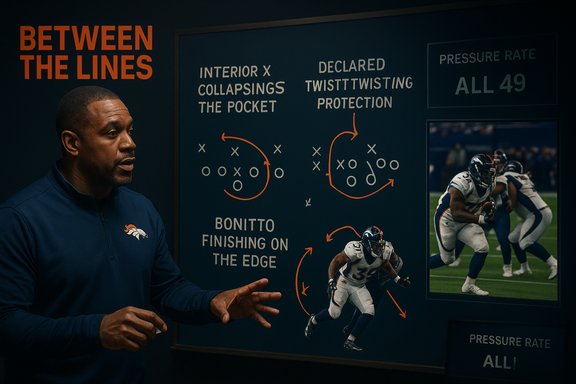
The sack itself is presented as the product of three interacting actors: the interior push that shortens the pocket, the declared stunt/twist that shifts protection responsibilities, and Bonitto’s finish on the edge. Atwater slows the tape to highlight:- Bonitto’s first step and his ability to bend the edge without overcommitting.
- The timing of a stunt or inside rush that forces the tackle to hesitate, creating the free lane.
- Hand usage and leverage at the point of contact that turn pressure into a takedown rather than a hit or hurry.
Why the Sack Was Not an Accident: Scheme, Stunts, and Interior Push
Scheme ingredients shown on tape
The clip identifies a few schematic truths that repeat across Denver’s pressure packages:- Hybrid fronts and personnel versatility that create matchup problems for tackles.
- Frequent use of twists and stunts to manipulate pass-protection windows.
- Sustained interior pressure that forces quarterbacks laterally or earlier than planned, allowing edges like Bonitto to capitalize.
The interior-to-edge dynamic
A critical point Atwater makes visually is the interior’s role in enabling the edge rush. When a defensive tackle collapses the pocket or occupies blocking attention, the quarterback is driven into a narrower corridor. That interior push increases edge efficiency: the quarterback has fewer escape options and often winds up in the path of outside pursuits. This inside-out interplay appears repeatedly in the Broncos’ season clips and is a central part of the tactical explanation for the team’s high pressure metrics.Impact on Game and Season: Tactical and Statistical Context
Immediate game impact
The Bonitto sack sequence is often highlighted as a momentum-turning play: a takedown that stalled a drive, flipped field position, or precipitated a punt. Atwater’s breakdown places the sack inside the drive context to avoid overstating a single event’s value. The segment explains how the loss of yards and clock pressure from the sack changes play-calling probabilities and can convert a neutral field position sequence into a net advantage for the defense.Broader statistical context
Team compilations and independent trackers show Denver among the leaders in pressure rate and sack totals. One team reel documented an “All 49” montage through 11 games, using the total as evidence that pressure production was not a fluke but a pattern. While different data providers vary in exact metrics due to methodological choices, the cross-provider agreement that Denver ranks high in pressure and sack metrics is robust. That statistical alignment gives Atwater’s film-room claims more weight: the tape matches the numbers.Translation to wins and identity
Sustained pressure gives teams margin: drives die earlier, turnovers become likelier, and opponents are forced into quicker, higher-variance passes. For Denver, repeated pressure plays have been used as an identity narrative in team communications and by independent analysts. But converting pressure into a sustained identity requires depth, rotation, and adaptability across opponents—all of which require broader sample sizes than a single highlight package provides. Atwater’s clip helps teach the mechanics but does not, on its own, prove season-long invulnerability.Strengths of Atwater’s Breakdown
- Clarity of teaching cues: The segment isolates a small number of repeatable elements (alignment, stunt timing, finishing technique) and shows them visually, which is the core purpose of team film-room content.
- Focus on fundamentals: Atwater emphasizes pad level, hand usage, and finishing—techniques that are teachable and reproducible in practice. These are the kinds of mechanical details that translate directly into coaching drills.
- Contextual framing: The breakdown situates the play in game context and links the sack to drive outcomes rather than presenting it as a standalone miracle. That framing reduces highlight bias.
- Production quality for learning: Multiple angles, freeze frames, and schematic overlays make the clip valuable not just as content but as a practical learning tool for position groups.
Risks, Fragilities, and What the Clip Doesn’t Prove
Small-sample risk
A single sack—or even a short sequence of sacks—cannot prove systemic superiority. The Between the Lines format is inherently selective; it teaches from success but does not measure consistency across all snaps. Analysts caution against extrapolating season-level conclusions from highlight reels alone.Opponents will adjust
Repeated schematic tendencies (stunts, certain alignments) invite countermeasures: quicker passing concepts, max-protect schemes, screen/rollouts, or personnel packages that hold the edge. What works when opponents are reactive becomes less reliable when offense coordinators design specific counters. The durability of Denver’s pressure surge depends on in-season adaptation.Injury and rotation concerns
Sustaining a relentless pass rush requires depth. High snap loads on the same core rushers increase injury risk and fatigue. A highlight reel may obscure the invisible cost: rotational usage that kept primary rushers fresh. Watching a sack montage doesn’t reveal minute-by-minute snap distribution or workload management.Editorial selection and measurement caveats
Team-produced captions and highlight descriptions sometimes compress or simplify yardage and context. For precision, analysts should cross-check official play-by-play and box score records; film-room attributions (e.g., that a particular stunt was "planned" vs. an on-field reaction) are coaching interpretations and should be labeled as such unless corroborated by coach comment or GPS/sync data.Practical Coaching Takeaways (How to Turn the Clip into Repeatable Practice)
- Watch full speed once to capture game context (down, distance, score).
- Replay from multiple camera angles and freeze pre-snap to confirm alignment and protection rules.
- Slow tape to contact-speed and evaluate hand placement, pad level, first step, and finishing technique.
- Chart assignment correctness: determine whether a sack was a result of an assignment failure or an executed stunt.
- Chip-and-release protection reps to simulate stunt timing.
- Contested-finishing drills for edge rushers focused on hip control and rip/club technique.
- Interior penetration timing drills between interior linemen and linebackers to reproduce inside-out pocket collapse.
- Situation scripting (two-play sequences) to practice timing concepts against anticipated stunt looks.
- Protection grade on scripted timing plays.
- Pressure rate and clean-pocket percentage.
- Sack rate and quarterback hurry-to-sack conversion.
- Snap counts and rotation cadence to monitor workload.
For Analysts and Statheads: What to Measure and Why
- Pressure Rate: Leading indicator of sack potential; a team with high pressure rate usually converts to sacks at some conversion rate.
- Clean-pocket percentage: The fraction of snaps where the QB has a stable pocket; high clean-pocket rates correlate with higher offensive efficiency.
- Sack Distribution: Which players and positions produce sacks—edge vs interior—matters for durability and opponent game-planning.
- Snap-by-snap context: down/distance and score situation moderate the value of a sack; a third-and-long sack is different in expected-value terms than a first-quarter early-down takedown.
Fan-Facing Notes: Where to Watch and How to Protect Your Privacy
The Broncos’ Between the Lines clips are hosted on the team’s site with programmatic advertising and typical cookie consent flows. Fans who value privacy can take pragmatic steps to reduce tracking while watching highlight clips:- Use a modern browser with strict tracking prevention (Edge, Firefox).
- Use an InPrivate/private session for one-off viewing.
- Disable third-party cookies or use reputable privacy extensions (uBlock Origin, Privacy Badger).
- Consider alternative official channels—team social platforms often re-post clips with different tracking trade-offs.
Final Assessment: Tactical Value Without Hubris
Steve Atwater’s breakdown of Nik Bonitto’s key sack against the Raiders is exemplary film-room work: concise, visual, and actionable. It translates a visually thrilling takedown into a checklist of teachable, repeatable elements—pre-snap clarity, interior pressure, timed stunts, and finishing mechanics. That educational clarity is the segment’s primary value.At the same time, the clip does not prove season-long dominance on its own. Highlight packages are inherently selective; they teach from success rather than measure consistency. Cross-verification with team totals and independent metrics does make the bigger claim plausible—Denver’s pressure metrics and sack totals put the team among the elite units this season—but durable conclusions require multi-game samples, rotational context, and opponent-adjustment tracking. Analysts and coaches should pair Atwater’s qualitative lessons with snap-by-snap analytics before treating the sack reel as a scouting dossier.
What to Watch Next (Indicators that the Rush Is Sustainable)
- Continued breadth of contributors: if sacks remain distributed across multiple defenders rather than concentrated in one player, the unit is less fragile.
- Stable pressure-to-sack conversion rate across several games: consistent conversion reduces the chance that early-season variance is inflating totals.
- Rotation and workload management: sustainable pass rush requires fresh legs; watch snap counts and substitution patterns.
- Opponent adjustments and Denver’s counters: if offensive coordinators begin scheming specific counters and Denver adapts successfully, that’s the mark of a system rather than a hot streak.
Steve Atwater’s film-room gift is the ability to convert an emotional highlight into a calm, teachable template; his Bonitto sack breakdown does exactly that. For coaches, it’s a practice plan in miniature. For analysts, it’s a signal that must be tested against the data. For fans, it’s both theater and instruction—the kind of short-form media that shows how inches of technique translate into game outcomes. When film and numbers point in the same direction, the narrative is credible; when they diverge, the tape is a cautionary lesson about highlight bias. The Bonitto clip sits squarely in the former category: a beautifully executed rush that matches a broader, measurable pattern of pressure—valuable, but not invincible.
Source: Denver Broncos Steve Atwater breaks down Bonitto's key sack vs. Raiders | Between the Lines
