

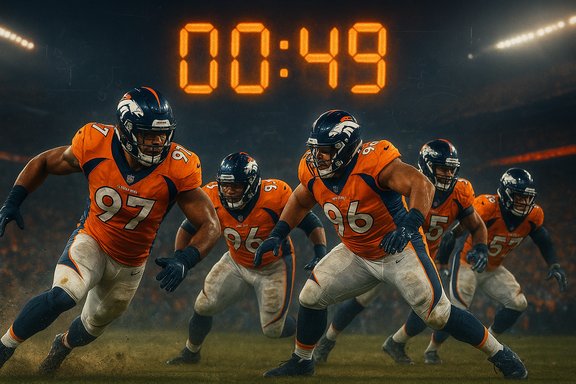
The Denver Broncos published a single reel that does more than celebrate a pass rush — it makes a case: through the first 11 weeks of the season the Broncos recorded 49 sacks, and the team’s official video “All 49 of the Broncos’ sacks from the first 11 weeks” stitches every takedown into a 90‑second ledger of disruption that explains, visually and viscerally, why Denver’s defense is the NFL’s marquee pressure machine right now.
The “All 49” compilation was posted on the Broncos’ official video hub as a fan‑facing highlight package that doubles as a tactical snapshot of a defense dominating opponents’ passing games. It runs the season’s sack ledger from Week 1 through Week 11 and frames the team’s surge in one compact visual narrative. The Broncos’ team total — 49 sacks in 11 games — is the immediate talking point: it places Denver on a historic pace and has drawn comparison to franchise highs and league records in headlines and analytics discussion. That quantity of sacks matters because sacks are among the most direct ways a defense reduces opponent scoring opportunity: they kill drives, flip field position, and increase turnover probability. But volume alone isn’t the full story — the clips in the Broncos’ reel show variety: edge wins, interior push‑ups, stunt‑driven takedowns, and quarterback hits that weren’t full sacks but clearly moved the needle on the play clock. The video is both a fan piece and a primary source for analysts trying to understand how Denver gets home so often. The team’s highlight packaging also raises the usual privacy and production questions about web distribution and data collection on team media pages — an angle worth noting for Windows users and privacy‑mindful fans.
Source: Denver Broncos WATCH: All 49 of the Broncos' sacks from the first 11 weeks of 2025
 Background / Overview
The “All 49” compilation was posted on the Broncos’ official video hub as a fan‑facing highlight package that doubles as a tactical snapshot of a defense dominating opponents’ passing games. It runs the season’s sack ledger from Week 1 through Week 11 and frames the team’s surge in one compact visual narrative. The Broncos’ team total — 49 sacks in 11 games — is the immediate talking point: it places Denver on a historic pace and has drawn comparison to franchise highs and league records in headlines and analytics discussion. That quantity of sacks matters because sacks are among the most direct ways a defense reduces opponent scoring opportunity: they kill drives, flip field position, and increase turnover probability. But volume alone isn’t the full story — the clips in the Broncos’ reel show variety: edge wins, interior push‑ups, stunt‑driven takedowns, and quarterback hits that weren’t full sacks but clearly moved the needle on the play clock. The video is both a fan piece and a primary source for analysts trying to understand how Denver gets home so often. The team’s highlight packaging also raises the usual privacy and production questions about web distribution and data collection on team media pages — an angle worth noting for Windows users and privacy‑mindful fans.What the footage actually shows
A catalogue of pressure types
Watching the full package as a single, continuous cut reveals three distinct sack‑types that recur across the season:- Edge speed and bend — classic outside rush wins where an outside linebacker or hybrid edge bends around the tackle, often with counter steps or a late swim/club to separate the QB from the pocket.
- Interior push and collapse — DT/3‑tech work that eats up the pocket, often credited as assisted sacks but shown on tape as the play‑killer; these are critical because they shorten the QB’s throwing window.
- Stunt and confusion — designed rotations and stunt combinations that free an unblocked rusher and convert pressure into takedowns.
Passage‑of‑play sequencing matters
The compilation also shows recurring game contexts where sacks appear: third‑and‑long, early down blitz packages, and late‑game pressure sequences. Several sacks come on plays immediately following an earlier pressure event — a pattern that suggests cumulative pocket stress, not just isolated winners. That rhythmic pressure is the kind of persistent negative play that forces offenses to alter play‑calls and accelerate decision timelines, and the video presents that arc clearly.Who’s making it happen: player breakdown and numbers
The public record and team materials identify a small group of consistent producers. The Broncos’ pass‑rush mix is multi‑actor: edge standouts, interior disruptors, and rotational role players all appear in the highlight reel.- Nik Bonitto — the edge rusher driving many of the highlight blows. He’s been the most discussed individual because of his historic pressure percentages and sack production, and his play is a frequent subject in the clips. Bonitto’s contract extension and early season surge have been widely covered; his pressure percentage and sack totals place him among the league’s elite rushers this season.
- Jonathon Cooper — a complementary edge who’s supplied timely sacks and pressures; he earned AFC Defensive Player of the Week honors during the stretch and is featured in the reel’s game‑closer sequences.
- Zach Allen and the interior group — interior push is visible across the clips; Allen’s ability to collapse pockets and generate pressures is a recurring motif. Interior pressure converts to edge sacks in multiple sequences.
Mechanisms behind the rush: scheme and analytics
Scheme ingredients shown on tape
The clips make a few schematic truths obvious:- Hybrid fronts and edge versatility: The Broncos often use multiple alignments and personnel that create matchup problems for tackles and tight ends. That versatility allows them to attack inside or outside depending on the opponent.
- Twist and stunt frequency: The highlight reel displays repeated stunt combinations and twist rushes that free a quarterback takedown; this suggests deliberate schematic emphasis rather than pure individual effort.
- Consistent interior threat: When the interior penetrates consistently — as several clips show — quarterbacks are forced outside into the waiting arms of the edge unit. These inside‑out dynamics are visible play‑by‑play.
What the numbers say
Advanced tracking confirms what the tape shows: Denver sits at or near the top of several pressure metrics. Next Gen Stats and independent analytics outlets report the Broncos among the leaders in pressure rate, quarterback pressures, and sack rate. Those statistics are not crisp across every data provider (providers use slightly different definitions and thresholds), but the agreement that Denver is among the elite units is robust. A few caveats on interpretation:- Pressure and sack metrics vary by provider methodology; some sites count assisted sacks differently, others calculate pressure rates by pass‑rush snaps. Small numerical differences do not change the larger conclusion: Denver is generating pressure at historically high rates this season.
- Sack totals, especially when taken as a pacing metric for seasonal records, are subject to regression — opponents adjust, and inflated early‑season rates can cool off. These are real possibilities worth tracking.
The durability question: can this keep up?
There are strong reasons to be optimistic and obvious reasons to temper expectations.- Reasons for optimism:
- Breadth of contributors — the sack reel is not built on a single player. Multiple defenders appear across the clips, making the production less fragile to one injury.
- Scheme adaptability — the personnel groupings and stunt frequency suggest a sustainable, repeatable system rather than random variance.
- Consistent pressure metrics — multiple analytics providers show elevated pressure rates that are coherent with the visual evidence.
- Reasons for caution:
- Small‑sample variance — 11 games is meaningful but not decisive for season‑long forecasting. Opposing coordinators will game‑plan more aggressively, throw quicker, and emphasize max‑protect packages when they must.
- Offensive adjustments — teams can and will alter deployment (quick game, rollouts, max protection) to blunt recurring pass‑rush patterns.
- Injury risk and depth — sustained pressure requires rotation and fresh legs; a key injury could reduce the edge threat even if the interior remains effective.
Tactical lessons from the clip for coaches and analysts
The team’s highlight reel is pedagogically useful; it provides a repeatable template of what to watch and what to practice. Practical takeaways include:- Prioritize play‑by‑play disruption rather than only focusing on takeaway plays — the Broncos frequently turn pressure into stalled drives.
- Practice coordinated stunt timing between interior linemen and outside rushers — multiple sacks in the reel were the direct result of well‑executed rotations.
- Measure sack production alongside pressure rate and clean‑pocket percentages — sacks are the visible outcome, pressure rate is the leading indicator.
Fan experience and privacy considerations
The Broncos’ highlight hub is ad‑supported and includes cookie preference controls. Fans who view team video pages should recognize that modern team media platforms often use programmatic advertising and tracking pixels to monetize highlights. The Broncos provide toggles to opt out of targeting cookies, but opting out reduces personalization rather than eliminating all ad impressions. Technical readers and Windows users who value privacy may prefer to:- Use a modern browser with tracking prevention enabled.
- Open the highlight in an InPrivate or private‑browsing window for single sessions.
- Consider reputable ad‑blocking or privacy extensions that block known trackers.
- Use official team channels (including social platforms) that re‑post highlights if they desire an alternative playback route.
What this means for Broncos narratives and the wider league
The clip — and the statistics behind it — have immediate narrative implications:- Broncos identity: The sack reel is a useful artifact for the claim that Denver’s identity is defensive disruption. When the defense creates repeated negative plays, the offense gains margin for error and coaches can run lower‑variance game plans.
- Market value for pass rushers: Individual players generating consistent pressure strengthen their negotiation positions and public reputations; that’s visible both on tape and in news cycles. Bonitto’s contract and the league chatter about his seasonal trajectory are directly tied to what the reel displays.
- Opponents’ planning: NFL coordinators will study such a compact visual ledger because it accelerates opponent scouting; the more obvious a team’s successful tactics become on public tape, the faster opponents will try to neutralize them.
Strengths, weaknesses, and verification notes
Notable strengths
- High‑quality evidence: the team’s reel compiles the plays in sequential order, making verification straightforward against official gamebooks and play‑by‑play logs. The 49‑sack figure is corroborated by multiple independent trackers and mainstream outlets.
- Tactical clarity: the highlights reveal the mechanics behind pressure rather than just the outcomes — useful for coaches and analysts.
- Distributed production: multiple players and the interior contribute, which reduces single‑point-of‑failure risk.
Potential risks or limits
- Highlight bias: team packages naturally select success — they do not show blown matchups, false starts, or the failures that contextualize play‑calling risks. Relying solely on the reel for scouting is a common error.
- Data provider variance: pressure and sack metrics vary across data providers; for precise historical comparisons or record‑pace claims, cite provider and timestamp. Some headlines comparing the pace to historical records depend on differing counting rules across eras. Treat record‑chasing projections as plausible but not guaranteed.
- Opponent adjustments: as the season progresses, opponents will identify the most disruptive concepts and respond accordingly; sustainable dominance requires continual schematic evolution.
How to watch (technical tips for Windows users)
- Prefer Microsoft Edge or Firefox with strict tracking prevention for default protection.
- Use InPrivate mode for single sessions to isolate cookies.
- If playback stutters, temporarily disable aggressive ad‑block rules that may block content delivery networks used by the team page.
- If privacy is paramount, check the team’s cookie‑preference center and toggle off “targeting” cookies prior to playback; that reduces personalized ad calls but may not block all measurement scripts.
Conclusion
The Broncos’ “All 49” sack reel is a compact, powerful piece of evidence that matches what multiple data providers and independent outlets report: Denver’s defense has been exceptionally disruptive through the first 11 weeks. The compilation visualizes why the team ranks at the top of pressure metrics and explains how a mix of edge speed, interior collapse, and coordinated stunts translates into frequent takedowns. But the highlight is only one piece of the analytical puzzle. Sound reporting and analysis pair the reel with box scores, pressure‑rate metrics, and provider‑specific methodologies before turning the early‑season pace into season‑long expectations. For fans and coaches, the video is a valuable study tool and a vivid reminder that disruptive defense is both an art and a science — one the Broncos have executed at an elite rate so far.Source: Denver Broncos WATCH: All 49 of the Broncos' sacks from the first 11 weeks of 2025
