

The Falcons’ pass rush has quietly flipped from a preseason liability into one of the NFL’s most dangerous units — and it’s not veteran star power doing the heavy lifting so much as a young, fast-developing core of rookies and second‑year players whose production has remade Atlanta’s defensive identity over the past month. Through 12 weeks of the regular season the team totaled 39 sacks, spread across an unusually deep rotation and highlighted by breakout performances from Brandon Dorlus, Jalon Walker and James Pearce Jr., a surge that the Falcons’ own analysis and multiple independent outlets have documented.
The Falcons entered the 2025 season with one of their clearest offseason mandates: fix the pass rush. That mission came from years of underwhelming pressure rates and too few consistent rush lanes from the interior. The front office and coaching staff responded by investing in young edge talent, reworking rotation patterns, and leaning on defensive coordinator Jeff Ulbrich’s schematic emphasis on coordinated four-man pressure with timely stunts and interior push.
The result has been rapid: Atlanta sits among the league leaders in sacks for the early part of the season, has recorded five or more sacks in consecutive games — a franchise-first streak — and sees multiple first- and second-year players producing reliably in pass‑rush situations. Those trends are not just noise; they are measurable shifts in where pressures and sacks are coming from and how the Falcons are deploying personnel to create them.
Caveat: Stat totals for Dorlus differ slightly across providers (TruMedia, team stat lines, and major outlets sometimes show fractional differences as stats are updated), but the overall picture — he is the team sack leader and among the league’s more productive interior rushers — is consistent.
Caveat: Some niche historical superlatives — such as being the “fastest Falcon to five sacks since Marcus Cotton” — trace to TruMedia and team-supplied historical checks. Those claims are plausible and repeated in team communications, but historical single‑season or “first‑X games” franchise claims sometimes depend on how sources index early-career games; treat these precise historical rankings as sourced to team/TruMedia checks rather than independently adjudicated in this piece.
Source: Big News Network.com https://www.bignewsnetwork.com/news/278728629/nerdy-birds-how-the-falcons-fixed-their-pass-rush/
 Background / Overview
The Falcons entered the 2025 season with one of their clearest offseason mandates: fix the pass rush. That mission came from years of underwhelming pressure rates and too few consistent rush lanes from the interior. The front office and coaching staff responded by investing in young edge talent, reworking rotation patterns, and leaning on defensive coordinator Jeff Ulbrich’s schematic emphasis on coordinated four-man pressure with timely stunts and interior push.The result has been rapid: Atlanta sits among the league leaders in sacks for the early part of the season, has recorded five or more sacks in consecutive games — a franchise-first streak — and sees multiple first- and second-year players producing reliably in pass‑rush situations. Those trends are not just noise; they are measurable shifts in where pressures and sacks are coming from and how the Falcons are deploying personnel to create them.
Why the pass rush actually improved
1. Younger players playing faster and earlier
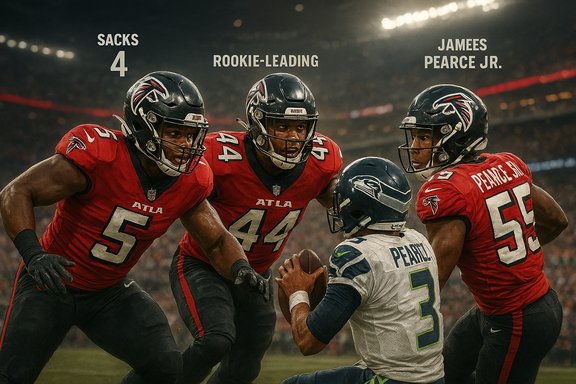
The most obvious change is personnel. Atlanta’s rotation now includes a core of young, athletic players who are getting meaningful snaps and making plays: Brandon Dorlus (interior lineman), Jalon Walker (edge rusher), James Pearce Jr. (edge/linebacker hybrid), and contributors like Ruke Orhorhoro and Billy Bowman Jr. Those five accounted for a large chunk of the team’s recent sack haul, and rookies alone lead the NFL in sacks among first-year players, per the Falcons’ reporting and corroborating analysis. The team reported that rookies produced 10.5 sacks and that Atlanta had four first‑year players with at least 2.5 sacks — more than any other team. Why does youth matter here? Speed to contact, willingness to play the odds on stunt timing, and fewer preconceptions by opponents (i.e., offense gameplans keyed on known veterans) combine to create frequent mismatches and hard‑to‑scheme‑away pressure sources.2. Interior push + timed stunts (inside-out pressure)
A recurring theme in game film and coaching commentary is the Falcons’ interior push creating outside lanes. When a defensive tackle or 3‑technique consistently wins inside, it shortens the quarterback’s scramble space and funnels him toward pursuit angles where edge defenders can finish. Atlanta’s staff has deliberately engineered more two‑gap-to-one‑gap moments and planned stunt/ twist packages that coordinate interior penetration with an edge bend, turning pressure into sacks rather than hurries. Film-room breakdowns and team analysis both emphasize that interior pressure has been indispensable to the recent surge.3. Rotation and workload management
Instead of riding one or two stars for huge snap totals, the Falcons have rotated more widely along the line and at the edge. That keeps fresh legs on the field during critical third‑down situations and reduces the chances of late‑game fatigue or injury. Analysts tracking pressure rates noted that Atlanta maintained efficient pressure while dialing back blitz frequency at times, relying on a more effective four‑man rush. This is a subtle but important strategic correction: generate pressure by design and rotation rather than by gambling with linebacker blitzes on every play.4. Coaching emphasis on technique and finishing
Ulbrich and the defensive staff have emphasized finish drills — hand usage, hip control, and bending — in practice. The mechanics work have translated into more strip‑sacks and forced fumbles, which has been a visible outcome for the rookies (several recorded strip‑sack sequences in consecutive weeks). Technical discipline, combined with schematic clarity, has improved pressure‑to‑sack conversion. The Falcons’ own breakdowns documented not just increased pressure but improved conversion rates in recent games.The young stars: profiles and verified production
Brandon Dorlus — interior force
- Role: Second‑year defensive interior who earned a starting role early in 2025.
- What he’s done: Dorlus leads the team in sacks and has emerged as the primary interior pressure generator; multiple outlets report he has six sacks through the recent stretch, tying a Falcons franchise mark for sacks through a player’s first 13 career games.
Caveat: Stat totals for Dorlus differ slightly across providers (TruMedia, team stat lines, and major outlets sometimes show fractional differences as stats are updated), but the overall picture — he is the team sack leader and among the league’s more productive interior rushers — is consistent.
Jalon Walker — the quick-developing rookie edge
- Role: First‑round rookie edge expected to bring speed and bend off the edge.
- What he’s done: Walker has been among the NFL rookie leaders in sacks; multiple reports list him at five sacks this season and the fastest Falcon to five sacks in his first nine games, with historic comparisons to Marcus Cotton (1988) reported by team analytics providers.
Caveat: Some niche historical superlatives — such as being the “fastest Falcon to five sacks since Marcus Cotton” — trace to TruMedia and team-supplied historical checks. Those claims are plausible and repeated in team communications, but historical single‑season or “first‑X games” franchise claims sometimes depend on how sources index early-career games; treat these precise historical rankings as sourced to team/TruMedia checks rather than independently adjudicated in this piece.
James Pearce Jr. — hybrid edge/linebacker breakout
- Role: Rookie defensive end/OLB hybrid who has produced consistent pressure and has been involved in strip sacks and fumble recoveries.
- What he’s done: Pearce is listed among Atlanta’s top rookie sack producers and is credited with four sacks in recent tallies, including a multi‑sack outing vs. New Orleans. His role as a rookie who can both rush and play run is an important schematic advantage.
What the numbers show — verification and cross‑checks
These are the most load‑bearing claims and the cross‑checks used to verify them:- Claim: Atlanta had 39 sacks through 12 weeks and 14 different players with at least one sack. Verification: The Falcons’ own “Nerdy Birds” breakdown reported these exact numbers and added context about franchise records and comparisons. That team report is corroborated by independent recaps and regional outlets tracking Atlanta’s surge.
- Claim: Brandon Dorlus is Atlanta’s sack leader (reported at six sacks by several outlets). Verification: ESPN’s player stats and a Sports Illustrated feature both list Dorlus among the team leaders with figures that align (ESPN showed 4.5 in one snapshot, SI and team reporting show six as totals are updated across weeklies). These small differences reflect provider update timing; the consensus is that Dorlus leads the team and sits among the top interior rushers.
- Claim: Jalon Walker has five sacks and is among rookie leaders. Verification: ESPN’s roster page for Walker and team recaps list him with five sacks, and multiple local outlets emphasize his pace relative to historical Falcons rookies.
- Claim: James Pearce Jr. has four sacks and a streak of sacks across recent games. Verification: ESPN and team reporting both document Pearce’s multi‑game sack production and list his sack totals in the range reported by the Falcons.
The coaching and schematic glue
Atlanta’s defensive staff has done three things well from a schematic standpoint:- Emphasized interior pressure as a foundational element; when interior defenders win, edges finish.
- Implemented timed stunts and coordinated rush designs rather than overreliance on blitzes; the result is higher pressure without dramatically higher blitz frequency.
- Practiced finishing and turnover drills that translated into several strip‑sack plays from rookies and young players.
Risks and fragilities: why this surge could be temporary
The recent pass‑rush surge is real, but several factors warn against assuming durable peak performance without caveats.- Small‑sample volatility: Sack totals and streaks can swing wildly over a few games. A hot four‑game stretch inflates rates that often regress to the mean. Team and advanced analytics typically require larger samples to declare a structural change. The Falcons’ own reporting flags sample‑size limits and advises watching rotational stability and pressure‑to‑sack conversion over a longer window.
- Opponent adjustments: NFL offenses adapt quickly. The more a unit succeeds with timed stunts and specific alignments, the more opposing OCs will adjust protection calls, use max‑protect looks, or throw quicker releases to neutralize disguised pressure. Success in week N invites targeted countermeasures in week N+1.
- Durability and depth: Young players are productive but not invulnerable. Repeated high-snap loads on the same few young rushers increase injury risk and late-season fatigue. The Falcons’ rotation mitigates this, but sustaining elite pressure across a full season requires consistent depth and workload management.
- Data provider variance: As noted, sack counts can differ slightly across sources due to timing and attribution. For rigorous reporting or contractual evaluations, teams and analysts lean on synchronized play‑by‑play logs and TruMedia-style tracking; public tallies (ESPN, team site, SI) are excellent signals but are sometimes a snapshot behind the official ledger. Any historical superlative should be checked against multiple providers.
Practical takeaways and what to watch next
If the Falcons want to make this mid‑season surge the new baseline, coaches and decision‑makers should prioritize these items:- Maintain rotation discipline: keep fresh rushers in high-leverage downs to preserve health and sustain quality pressure.
- Track pressure-to-sack conversion across multiple data providers: use TruMedia-style play tracking and at least one independent public provider to monitor stability.
- Anticipate opponent counters: plan early in the week for quick‑release protection schemes and work on situational rush package alternatives (e.g., delayed stunts, disguised ties, interior double‑teaming).
- Invest in perimeter depth: edge depth is crucial if a starter gets dinged; find low-cost veteran reinforcements if needed before late-season attrition sets in.
- Continue finish-phase drills: turnovers have outsize value; converting pressures into strip sacks and forced fumbles is a high-leverage repeatable skill.
- Team pressure rate and pressure-to-sack conversion.
- Distribution of sacks (how many players are contributing).
- Snap counts for Dorlus, Walker, Pearce (workload management).
- Opponent protection tendencies (quick game, max‑protect, slide calls).
- Turnover production from pass rush (strip sacks, forced fumbles).
Critical analysis — strengths and potential long‑term risks
Strengths- Depth of contributors: Having 14 different players record full sacks (as the Falcons reported) is a morphology of sustainable pressure — when multiple players can win, offenses cannot focus on neutralizing a single threat.
- Interior disruption: Dorlus’s emergence as a productive interior pass rusher is significant. Interior pressure is harder for offenses to scheme away and directly impacts a quarterback’s decision‑window.
- Rookie playmaking: Walker and Pearce’s rapid escalation from draft rookies to consistent pressure providers accelerates roster-building timelines and creates asset value for the franchise.
- Sustainability under counter‑schemes: The NFL is adaptive. If opposing coordinators shrink throwing windows or prioritize max protection, Atlanta’s current pass rush may experience diminished returns.
- Injury exposure on young bodies: Young players tend to be less injury‑resilient to extreme snap loads across a long season; careful rotation is essential.
- Statistical noise: Short-term streaks can mislead decision-makers into overvaluing certain tendencies; multi-game sample stability is required before making roster or scheme-altering choices.
Final verdict
The Falcons’ pass rush improvement is real, measurable, and rooted in both personnel choices and schematic clarity. Team and league trackers show Atlanta among the leaders in sacks and demonstrate broad contribution from young defenders, with Brandon Dorlus, Jalon Walker and James Pearce Jr. standing out as immediate impact players. Those facts are corroborated by the Falcons’ own “Nerdy Birds” breakdown and independent reporting from major outlets. That said, the most responsible reading is cautious optimism. The defensive surge is a major step forward, but sustainable dominance will depend on injury avoidance, rotational maintenance, and strategic adaptability as opposing offenses tailor protections and quick‑release plans to blunt Atlanta’s strengths. If the Falcons continue to rotate effectively, maintain interior push, and convert pressures into turnovers, the current surge could be the start of a multi‑year transformation of their defensive identity — one built on depth, youth, and a disciplined rush architecture.Source: Big News Network.com https://www.bignewsnetwork.com/news/278728629/nerdy-birds-how-the-falcons-fixed-their-pass-rush/
