

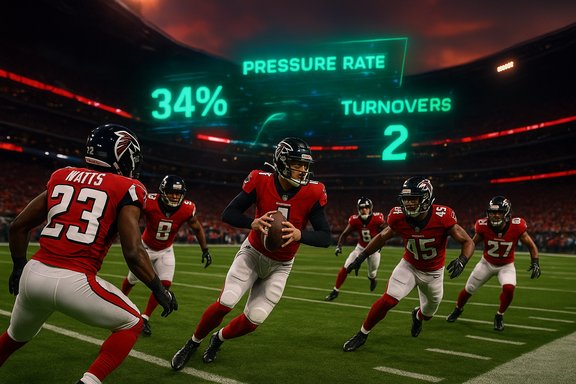
Atlanta’s rookie crop has not only earned snaps — they’ve forced opponents to account for them, shifted game-plan priorities and produced turnovers at a rate that has transformed what had been a quietly rebuilding defense into a disruptive, turnover-hungry unit early in the season.
The Atlanta Falcons entered the season with a clear defensive reset in progress, prioritizing speed, versatility and ball skills in the 2025 rookie class. That quartet — headlined by first-round edge James Pearce Jr. and third-round safety Xavier Watts, alongside fellow defensive backs Billy Bowman Jr. and edge Jalon Walker — has combined for meaningful playing time and measurable impact through the first third of the schedule. The team’s public reporting, which pulls on Stats LLC. and Next Gen Stats via internal tools, shows the rookies logging heavy defensive snaps and accounting for a notable slice of the Falcons’ tackles and turnover production. The Falcons’ internal analysis (presented in the team’s “Nerdy Birds” piece) reports a combined 548 defensive snaps for the rookie group, with Watts and Bowman taking up 68% of that workload among the defensive backs and Pearce and Walker forming a frequently used edge rotation. Those numbers frame a larger truth: Atlanta’s coaching staff trusts these rookies in high-leverage settings, not just mop-up minutes. That trust has been rewarded with forced turnovers, coverage plays and consistent pressure when the young pass rushers are on the field.
Source: Atlanta Falcons Nerdy Birds: Falcons rookies making an early impact
 Background
The Atlanta Falcons entered the season with a clear defensive reset in progress, prioritizing speed, versatility and ball skills in the 2025 rookie class. That quartet — headlined by first-round edge James Pearce Jr. and third-round safety Xavier Watts, alongside fellow defensive backs Billy Bowman Jr. and edge Jalon Walker — has combined for meaningful playing time and measurable impact through the first third of the schedule. The team’s public reporting, which pulls on Stats LLC. and Next Gen Stats via internal tools, shows the rookies logging heavy defensive snaps and accounting for a notable slice of the Falcons’ tackles and turnover production. The Falcons’ internal analysis (presented in the team’s “Nerdy Birds” piece) reports a combined 548 defensive snaps for the rookie group, with Watts and Bowman taking up 68% of that workload among the defensive backs and Pearce and Walker forming a frequently used edge rotation. Those numbers frame a larger truth: Atlanta’s coaching staff trusts these rookies in high-leverage settings, not just mop-up minutes. That trust has been rewarded with forced turnovers, coverage plays and consistent pressure when the young pass rushers are on the field. Why the early impact matters
Short-term: Opposing coordinators must adjust. Rookies who can change routes, contest catches and create negative plays alter how offenses distribute targets and plan protections. Xavier Watts’ interceptions and pass breakups have produced immediate schematic consequences, forcing quarterbacks to avoid his side and generating cleaner looks for Falcons pass rushers. Medium-term: Rookie production buys development time. When first-year players contribute at this level, the front office and coaching staff can afford to be patient with other developing pieces. The Falcons’ ability to extract production from their 2025 draft class reduces pressure to find instant-impact veterans and creates roster flexibility for trades, depth moves and situational signings. Long-term: Talent foundations. Early-career success from high-draft picks such as Pearce and productive mid-round finds like Watts suggests the franchise is building a young defensive core that could be scalable into a championship-contending unit if growth trajectories continue. Early turnovers, pressures and coverage metrics are leading indicators—if sustainable, they point to a foundational shift.Xavier Watts: From Notre Dame playmaker to Falcons turnover engine
Rookie profile and role
Xavier Watts arrived in Atlanta as a versatile defensive back with collegiate experience at Notre Dame. Drafted in the third round, he has been deployed primarily as a safety but in multiple alignments — slot coverage, deep-half responsibility and near-the-box run support — reflecting the Falcons’ intent to exploit his flexibility. Watts’ early stat line through game action shows him leading rookies in passes defensed and interceptions, and the Falcons credited him with multiple turnovers in the team’s early stretch. Those plays have not been cosmetic; they are game-altering moments that tilt win-probability on single possessions.What the numbers say
Through the initial weeks, team-sourced reporting lists Watts with two interceptions and four passes defensed, putting him at or near the top among rookies in those categories. Independent outlets tracking the league’s rookie leaders corroborate his turnover totals and highlight his early Defensive Rookie of the Month-type performance for September. These defensive plays — interception turnovers late in close windows and multiple pass breakups — are the kinds of proof points every defensive coordinator covets when grading film.Strengths and film traits
- Ball instincts: Watts routinely reads route concepts and takes aggressive angles to the catch point, turning contested plays into turnovers.
- Versatility: He’s been used in the slot, in the deep middle and as a near-box support player, allowing the Falcons to disguise coverage pre-snap.
- Tackle presence: Beyond splash plays, Watts has racked up tackles, demonstrating reliability on run support and limiting YAC on completions he doesn’t directly break up.
Risks and development tasks
- Rookie mistiming: Aggression can translate into overpursuit or missed assignment discipline when offenses deploy misdirection; coaching must temper his instincts with consistent gap-sound techniques.
- Volume durability: As Watts assumes full-time coverage responsibilities, workload management and physical conditioning will be necessary to avoid dropoffs late in games or midseason. This is a typical development vector for multiple-position safeties.
James Pearce Jr.: The quick-strike edge with a pass-rush profile
Rookie profile and role
Selected in the first round, James Pearce Jr. brings prototypical length, burst and straight-line speed from Tennessee. The Falcons have used him in a rotational role on the edge while deploying him in clear pass-rush situations where his speed-to-power conversion is designed to create pressure and collapse the pocket from the perimeter. The team’s analytics highlight his per-snap pressure creation — a rate on the order of nearly 18% in limited snaps — a signal that he is an efficient threat when he’s on the field.What the numbers say
Public stat lines show Pearce with early production: pressures, at least a half-sack and multiple quarterback disruptions in limited snaps. ESPN’s tracking and standard box scores confirm sack credits and tackle counts for smart rotation usage. The Falcons’ more granular Next Gen Stats pressure-rate figure — which cites nine pressures in 79 defensive snaps and a 17.6% pressure rate — is an advanced metric the franchise uses to explain his high-impact per-play productivity in passing downs. That Next Gen Stats figure is a team-cited stat and should be read as a specialized analytic measurement rather than a traditional box-score piece.Strengths and film traits
- Explosive first step: Pearce wins initial engagements with speed, creating pass-rush lanes before linemen can fully set.
- Length and gripping hands: His combination of reach and hand placement helps him separate from tackles on the edge.
- Situational effectiveness: Pearce’s snap usage emphasizes pass-rush situations where he converts opportunities into pressures at an elevated rate compared to many rookies.
Risks and development tasks
- Consistency and counter skills: Early explosiveness must be augmented with counter moves and bend at the waist to sustain production against NFL-caliber offensive tackles.
- Run-defense engagement: At 6'5", 243 lbs, Pearce can struggle with heavy-setting run-blocking schemes; consistent technique and strength training will be vital to reduce blocks-on-target and maintain gap integrity.
How the rookies fit the Falcons’ scheme
Coordinator-friendly traits
Head coach and defensive coordinator messaging has highlighted a willingness to play fast and trust instincts — a scheme profile that fits rookies rewarded for play speed and situational courage. Atlanta’s early defensive metrics — such as a low opposing completion percentage and strong coverage-success numbers — indicate the scheme has produced immediate team-wide benefits. Those metrics are drawn from Next Gen Stats and the team’s internal analyses, and they correlate with the rookies’ play types: aggressive coverage, contested catches and pressure generation.Rotational philosophy
The Falcons have not hoarded snaps for their highest-drafted rookies; instead, they employ rotation to maximize matchup advantages and reduce exposure to savvy offensive planning. Pearce and Walker operate as a two-man rotation on the edge, trading reps to keep pass-rush legs fresh. Watts and Bowman have been trusted for a majority of rookie defensive snaps in the secondary, indicating confidence in their coverage chemistry. Rotation minimizes the risk of missteps while expanding situational packages where each rookie can play to strengths.Advanced metrics, verification and a caution on proprietary data
The Falcons’ feature leans on advanced analytics tools such as Stats LLC. and Next Gen Stats, presented through a Copilot-driven analysis workflow. These tools provide near-real-time play-level data and derived metrics like pressure rate, coverage success rate and targeted completion percentage allowed when a particular player is in coverage. While these are powerful measures, they reflect proprietary methodologies and are often updated on different cadences than public box-score stats.- Verified claims: Watts’ interception totals and pass breakups have independent corroboration across national outlets and league stat tracking — those are verifiable with standard stat aggregators. Pearce’s sack and tackle credits are likewise corroborated by standard box scores.
- Team-sourced claims: The specific combined rookie-snap total (548 snaps), the 68% split between Watts and Bowman among DB snaps, and certain league-ranking comparisons derived from Stats LLC. are team-reported analytics and rely on proprietary filters; they are plausible and supported by the Falcons’ cited tools but are not always independently confirmed by public aggregators. Those should be interpreted as team-provided context rather than universally standardized league metrics.
Strengths — what’s working right now
- Turnover creation: Early interceptions and forced fumbles by the rookie group have produced short-term field-position advantages and swing plays. That turnover production is a high-variance, high-value trait for any young defense.
- Pass-rush efficiency: Pearce’s per-snap disruption is a valuable complement to the veteran pass-rush elements, allowing the Falcons to generate pressure without over-relying on blitz-heavy calls.
- Versatility and schematic fit: Watts’ ability to play multiple roles in coverage allows Atlanta to hide personnel and vary looks without losing communication integrity. That flexibility is a multiplier for a defense still discovering consistent personnel groupings.
- Confidence boost for coaching staff: Early rookie impact provides coaches the latitude to emphasize development and roll out creative packages that exploit young players’ strengths.
Risks, limitations and what could derail sustained production
- Injuries and attrition: Young players who play heavy snaps early carry a higher injury risk. A significant injury to any of the core rookie contributors would force the Falcons into immediate depth decisions.
- Regression to the mean: Turnovers and elevated pressure rates can be noisy. The league adjusts quickly; opposing offenses will game-plan specifically to counter newly impactful rookies, forcing the Falcons to adapt.
- Overreliance on rookie play: If Atlanta leans too heavily on first-year players without veteran stabilizers in the rotation, scheme integrity can suffer in late-game scenarios or against high-quality offensive lines.
- Data opacity: Some of the most flattering metrics cited by the team are proprietary; without public validation, they should be regarded as promising signals but not conclusive proof of sustainable elite performance.
Tactical adjustments opponents may make — and how Atlanta can respond
- Opponents will likely: (a) slide protection away from Pearce’s side on obvious passing downs, (b) test Watts with heavy route combinations and move him out of his comfort zone, and (c) run away from areas where rookie safety rotation is strongest.
- Atlanta’s counters should include: (a) mixing Pearce’s usage to include stunt and interior slants that neutralize slide protections, (b) creating disguised coverages to free Watts to attack and (c) rotating in veterans in run-heavy sequences to preserve rookie energy for passing downs. Each adjustment will require careful micro-management of snaps and role clarity.
Special teams and hidden value
Rookies often earn their first trust via special-teams snaps; early defensive starters have a wider margin to avoid those workhorse duties. The Falcons have balanced this dynamic carefully, ensuring that high-impact rookies game-manage their workload and remain available for critical defensive snaps. That early management is a sign of disciplined coaching and player-usage strategy.What this means for the rest of the Falcons’ season
If the rookies maintain even a portion of their early contributions, the Falcons’ defense could move from a middle-of-the-pack unit to one that creates enough turnovers and negative plays to consistently flip outcomes in close games. The immediate road test — a matchup with the Bills and Josh Allen under Monday Night lights — will reveal whether the young group can handle elite multidimensional attacks that stress both the pass and run. Continued success will also affect roster management decisions at the trade deadline and in free agency.Metrics to watch going forward
- Pressure rate per pass-rush snap (Pearce/Walker): a leading indicator of pass-rush value beyond sacks.
- Targeted completion percentage and passer rating allowed when Watts is the primary defender: reveals true coverage efficacy beyond superficial PBU counts.
- Snap-share evolution: tracking how the Falcons adjust rookie rotation will indicate coaching trust and sophomore-year planning.
- Turnover margin and defensive EPA per play: team-level metrics that determine whether rookie contributions translate to wins.
Verification summary and transparency
This article synthesizes the Falcons’ team-released analysis with independent reporting. Key, verifiable items include Xavier Watts’ interception totals, early-season passes defended and the on-field plays recognized by national outlets; those are corroborated by multiple independent reports. James Pearce Jr.’s early sack and pressure profile is visible in box-score stats and scouting reports, while advanced metrics cited by the team (pressure rate, combined rookie snap totals and certain league-ranking claims) originate from proprietary datasets (Stats LLC. and Next Gen Stats) and are therefore labeled as team-reported analytics. Readers should treat the advanced numbers as illuminating and context-rich, but expect minor methodology differences across independent public aggregators.Conclusion
Atlanta’s rookies — particularly Xavier Watts and James Pearce Jr. — are doing more than learning the playbook: they’re forcing opponents and the Falcons themselves to adjust. Early turnovers, efficient pass-rush bursts and coverage plays provide a compelling narrative: the Falcons drafted for modern NFL needs and are beginning to harvest those investments. That harvest is not without risk; proprietary metrics, small-sample variance and the normal hazards of rookie development all temper long-term certainty. Still, the combination of coaching trust, early production and the types of plays that move win probability suggest that these rookies will be central to Atlanta’s defensive identity as the season progresses. Continued monitoring of both traditional box-score stats and advanced metrics will be necessary to determine whether the 2025 class can sustain its impressive start and evolve from promising first-year contributors into the nucleus of a consistently elite defense.Source: Atlanta Falcons Nerdy Birds: Falcons rookies making an early impact
