

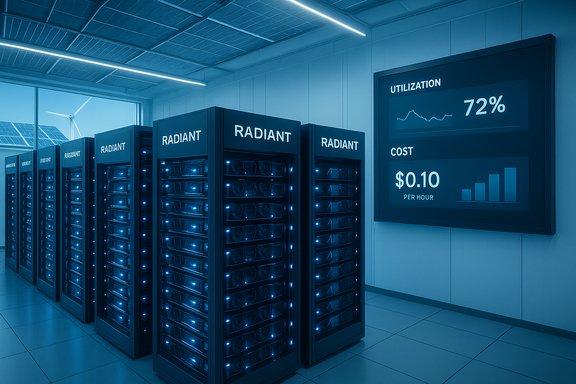
Brookfield Asset Management’s reported move to launch a cloud business aimed at lower-cost AI infrastructure marks a notable acceleration in the race to build the physical backbone of AI — and it signals that capital-rich infrastructure players are now prepared to compete directly with hyperscalers for the most lucrative, energy-intensive workloads. The plan, reported late December and carried into the new year, describes a Brookfield-led cloud unit called Radiant that would lease GPUs and other compute hardware inside Brookfield-owned data centers directly to AI developers, backed by a multi‑billion-dollar AI infrastructure program and strategic energy partnerships.
Background
Brookfield Asset Management is already well entrenched in the real-world pieces of the AI supply chain: energy generation, land and real estate, and digital infrastructure such as data centers. Over the past year the firm publicly announced a broad AI infrastructure strategy, signalling intentions to mobilize tens of billions in capital to build or acquire the physical assets that AI workloads consume — from power generation to rack-level GPU deployments. The new cloud push is described as a vertically integrated extension of that strategy: build the sites, secure the power, and operate a cloud service optimized for cost-effective, large-scale AI training and inference. Key financial milestones associated with the plan are two headline numbers that have appeared repeatedly in reporting: a $10 billion targeted equity commitment for an AI infrastructure fund (the seed for a broader $100 billion program of deployments and acquisitions) and the creation of Radiant as the commercial arm that will sell GPU capacity to customers. Brookfield is reported to have already secured substantial institutional support for the fund, including commitments from Nvidia and the Kuwait Investment Authority. Radiant is described as having priority access to capacity in new data centers financed by these vehicles, with initial projects reportedly planned in France, Qatar and Sweden.What Brookfield says it will build — and why it matters
A vertically integrated “AI factory” model
Brookfield’s playbook differs from the hyperscalers’ software-led cloud strategies. The firm’s strength is capital deployment: buying or developing land, underwriting generation and transmission, contracting on long-term energy supply, and building data centers at scale. By bundling those capabilities together with GPU leasing, Brookfield aims to offer a lower-cost AI stack that controls operating costs — notably energy and real estate — which are the two largest non-capex drivers of AI cloud pricing.The logic is straightforward: by controlling power (including on-site or contracted renewables, long-term power purchase agreements, and behind-the-meter solutions), Brookfield can stabilize or reduce the variable costs of running power-hungry GPUs. Add to that negotiated access to GPUs through partnerships with semiconductor vendors, and the firm can theoretically price GPU hours more aggressively than providers who do not have comparable power economics.
Radiant: GPU leasing and first call on capacity
Radiant is described as the Brookfield subsidiary that will operate the cloud-facing business, leasing GPUs installed in Brookfield-managed data centers. Reports indicate Radiant would get first dibs on capacity developed through Brookfield’s AI fund; if Radiant does not use the capacity itself, Brookfield will lease it to traditional cloud operators. This approach gives Brookfield optionality: it can run a managed service or become a landlord to hyperscalers depending on market demand and pricing dynamics.Verifying the core claims
- Radiant as the cloud business name, priority access to fund-backed data centers, and the intent to lease chips to AI developers are cited in multiple outlets and summarized from reporting originally published by The Information and redistributed by major wire services. The description of Radiant and its model is consistent across reporting.
- The $10 billion equity target and the broader $100 billion AI infrastructure program are both part of Brookfield’s publicly announced infrastructure initiatives and have been covered widely; reporting confirms the existence of a dedicated AI Infrastructure Fund intended to underwrite a substantially larger deployment of capital across data centers, energy and related assets. Specific investor names — notably Nvidia and the Kuwait Investment Authority — have been repeatedly mentioned as early backers.
- Brookfield’s emphasis on energy partnerships and onsite or firm renewable power is corroborated by prior public disclosures and press releases, including a reported strategic relationship with a fuel-cell partner and separate long-term renewable deals — details that speak to the firm’s ability to offer differentiated power economics. That capability is central to Brookfield’s rationale for entering cloud.
Why Brookfield’s entry is strategically important
Pressure on hyperscalers’ cost structure
Large-scale AI training and inference amplify the importance of power economics and facility-level efficiency. Hyperscalers such as AWS, Azure, and Google Cloud have established advantages in software services, global enterprise relationships, and long-track cloud SLAs, but their capital and energy footprints are large and visible. An entrant with deep control over energy and land could undercut pricing for raw GPU hours in specific geographies, creating a new competitive axis centered on infrastructure cost arbitrage rather than software feature parity.New supplier dynamics in the GPU market
Brookfield’s strategy assumes strong ties with GPU vendors; having a chipset partner or early commitments from Nvidia reduces supply risk and can enable competitive fleet deployment. If Brookfield can secure GPUs at favorable terms and co-design data center deployments with vendors, it can shorten time-to-market and increase utilization. This is significant because GPU supply, logistics, and procurement terms are central to cloud economics for AI workloads.Energy as a competitive moat
Brookfield’s renewable energy holdings and deals with power providers can be converted into competitive advantages: firm renewable supply (hydro, long-term PPA, fuel cells) reduces exposure to spot market price spikes and carbon pricing regimes. For enterprise and government customers demanding sustainable compute, Brookfield can offer both lower cost and greener credentials — a powerful combination for certain workloads and geographies.Risks, market frictions, and unanswered questions
Operational expertise vs. capital
Building data centers and managing energy assets is Brookfield’s core competency. Operating a high-performance cloud service with the software, networking, managed APIs, identity, metering, and billing systems that enterprise customers expect is a different discipline. Hyperscalers have decades of experience running multi-tenant platforms, global peering networks, and developer ecosystems. Brookfield will need to either build or buy those capabilities, and integration risk is real. This gap raises questions about whether Radiant will compete first on raw GPU pricing or target niche use cases (e.g., sovereign / regulated markets, dedicated AI factories) while outsourcing managed cloud features.Scale and utilization economics
GPU hardware economics require extremely high utilization to amortize capital costs. Hyperscalers achieve that through multi-vertical demand and deep enterprise sales teams. Brookfield’s flexibility to lease capacity either to Radiant or to hyperscalers gives it optionality, but hitting utilization thresholds quickly enough to service debt and yield target returns is nontrivial. Misjudging demand cycles could leave Brookfield with underutilized, capital-intensive assets.Supply chain and vendor dependency
The model depends heavily on securing GPUs — and in recent years GPU supply has been volatile and prioritized by large cloud customers. Even with early vendor commitments, Brookfield may face capacity backlogs or premium pricing if demand outstrips supply. Vendor alignment is crucial; a strained partnership or priority allocation to other customers could impair Radiant’s ability to deliver competitive pricing.Regulatory and geopolitical risk
Data centers sited in France, Qatar and Sweden — as one report suggested — are subject to diverse regulatory regimes on energy, data sovereignty, and foreign investment. Projects in the Middle East, in particular, can trigger complex diplomatic, corporate governance and compliance requirements for western customers. Brookfield will need strong local partnerships and clear governance frameworks to win sensitive workloads.Trust, enterprise relationships and managed services
Large enterprises and governments buy full-stack assurances — not just cheap hours. Security certifications, long-term SLA commitments, professional services, and ecosystem integrations (databases, identity, monitoring) matter. Hyperscalers have extensive ecosystems; Radiant will need to either interoperate seamlessly with those ecosystems or create migrations paths for customers — both of which cost time and money. Early customers may prefer to place high-value models and data with well-established cloud vendors until Radiant proves reliability over time.What this means for Windows and enterprise IT
The potential upside for Windows workloads
For Windows-centric organizations that run GPU-accelerated workloads (for example, Windows-based ML development environments, GPU-accelerated rendering, or Windows-hosted inference services), a lower-cost GPU cloud option could reduce TCO for AI initiatives. Radiant’s model could make it economically viable to host Windows Server-based AI inference close to the data, especially when combined with firm renewable energy and options for on-prem hybrid deployments.Windows admins and IT leaders should watch pricing, regional availability, and interoperability with Microsoft tooling (for example, Azure Arc, Windows Admin Center, Windows Server for containers). If Radiant supports standard APIs, container runtimes, and driver stacks compatible with Windows Server and NVIDIA drivers, migration headaches will be limited. If not, enterprises will need to evaluate the migration and support costs carefully.
Hybrid cloud and edge strategies
Brookfield’s model implicitly supports hybrid strategies: customers could colocate certain models in Radiant-enabled data centers while keeping latency-sensitive or regulated workloads on-premises. For Windows shops pursuing hybrid architectures, Radiant’s optionality to lease racks or provide managed GPU instances could become another tool in the hybrid playbook — provided integration with existing management tools is straightforward.IT teams should prioritize:
- Validating driver and runtime compatibility with Windows containers and ML frameworks.
- Assessing data egress costs and peering options to minimize network latency and cost.
- Ensuring security certifications and data protection standards meet regulatory needs.
How Brookfield could position Radiant in the market
Radiant’s go-to-market could take several rational forms:- Niche vertical focus: target regulated markets (government, defense, healthcare) where data sovereignty and energy assurances are premium differentiators.
- Wholesale GPU provider: sell rack-level or chip-hour capacity at lower prices to companies that want direct control over their hardware footprint.
- Managed AI cloud: build a full-stack service with developer-friendly APIs, prebuilt models, and marketplace integrations to attract enterprises away from hyperscalers.
- Landlord-to-hyperscaler: operate as a neutral capacity provider, leasing space and power while allowing hyperscalers to deploy their own stacks.
Tactical signals to watch next
- Official announcements: Look for a Brookfield or Radiant press release clarifying service tiers, pricing models, geographic rollout, and SLAs.
- Vendor partnerships: Any formal agreement with GPU vendors (Nvidia or others) that specifies supply commitments, joint engineering, or reference architectures will be a major de-risking signal.
- Power and PPA details: Contracts with renewable providers or fuel-cell suppliers, and any public PPAs, will validate Brookfield’s claim to superior power economics.
- Pilot customers and case studies: Early adopter case studies — especially from enterprise or government — will show whether Radiant can meet production demands and security requirements.
- Regulatory filings or local approvals in proposed host countries, which will reveal timelines and compliance posture.
Practical guidance for IT decision-makers
- Do not assume lower unit pricing will automatically reduce total cost of ownership. Evaluate migration costs, storage and network egress fees, and operational support.
- Treat Radiant as a potential additional vendor in multi-cloud strategies. Use workload portability (containers, Kubernetes) to maintain mobility between providers.
- Negotiate SLAs, audit rights, and data handling terms upfront when considering placement of sensitive models.
- Monitor supply assurances: ask for explicit GPU procurement guarantees or scheduled refresh commitments if GPU availability is material to workload timelines.
- Factor in geography and energy resilience: if Brookfield’s advantage stems from regional power deals, choose regions aligned with latency and compliance needs.
Conclusion
Brookfield’s pivot from infrastructure investor to potential cloud operator represents a structural shift in the AI infrastructure landscape. Backed by deep pockets, energy assets, and reported early vendor interest, Radiant could reshape pricing dynamics for GPU-heavy workloads and give enterprises and governments new options for hosting compute-intensive AI tasks. However, success is not guaranteed. The firm faces steep operational, supply-chain, and trust hurdles before it can wrest meaningful share from established cloud providers.For Windows-focused IT teams and enterprise architects, the immediate takeaway is strategic: a new supplier is likely to emerge with differentiated cost and energy profiles, but careful evaluation is essential. Radiant’s model may lower the entry cost for certain AI initiatives, but integration, support, and long-term viability will determine whether it becomes a mainstream alternative or a specialized complement to the hyperscale clouds. The next few quarters of formal announcements, pilot programs, and vendor deals will determine whether Radiant is a disrupter or an incremental new player in an already crowded market.
Source: SiliconANGLE Report: Brookfield Asset Management to launch cloud business focused on lower cost AI infrastructure - SiliconANGLE
