

Slack’s Slackbot has graduated from a handy workplace helper to a full‑fledged, context‑aware AI assistant that can draft content, schedule meetings and surface files from connected apps; BlackRock and a consortium of strategic partners have placed a multi‑billion‑dollar bet on AI data‑center capacity; and Microsoft’s Copilot is moving beyond chat into voice, vision and agentic actions that reshape how Windows 11 and enterprise productivity tools behave. This brief captures what changed, why it matters for IT teams and Windows users, and what to watch as these three lines of development collide across security, governance and everyday productivity.
The past month has been a concentrated sprint in AI productization: vendors are pushing assistants into the interfaces people use every day (Slack, Windows) while investors and infrastructure operators race to lock down the physical capacity that powers large models and enterprise AI services. Slack’s evolution reflects a broader shift toward “agentic” workplace platforms that stitch AI into collaboration contexts; BlackRock’s deal participation reflects a financial and strategic commitment to the infrastructure layer that underpins generative AI; and Microsoft’s Copilot moves show how OS vendors are integrating multimodal assistants directly into the desktop experience. Each development advances convenience and productivity — and each raises distinct operational, security and governance questions that IT leaders must manage carefully.
Practical takeaways:
There is no single “right” response — organizations must balance opportunity with control. The practical starting point is deliberate: pilot intelligently, log comprehensively, require explicit consent for connectors or agentic privileges, and treat on‑device AI runtime updates like any other system dependency. The tools are becoming more capable; the job now is to make them safely useful at scale.
Source: Computerworld Slackbot evolves, BlackRock bets big, Copilot advances | Ep. 6
 Background
The past month has been a concentrated sprint in AI productization: vendors are pushing assistants into the interfaces people use every day (Slack, Windows) while investors and infrastructure operators race to lock down the physical capacity that powers large models and enterprise AI services. Slack’s evolution reflects a broader shift toward “agentic” workplace platforms that stitch AI into collaboration contexts; BlackRock’s deal participation reflects a financial and strategic commitment to the infrastructure layer that underpins generative AI; and Microsoft’s Copilot moves show how OS vendors are integrating multimodal assistants directly into the desktop experience. Each development advances convenience and productivity — and each raises distinct operational, security and governance questions that IT leaders must manage carefully.Slackbot evolves into a workspace AI assistant
What’s new
Slack has turned its decades‑old Slackbot into an integrated AI assistant that can be summoned from a new button at the top of the Slack app, draft and edit content, schedule meetings by checking calendars, and answer questions using information drawn from Slack conversations, files and connected third‑party apps such as Google Drive, OneDrive and Salesforce. Slack described these capabilities at Salesforce’s Dreamforce event and in product update notes; independent coverage confirmed Slack is piloting the revamped assistant and that it will be able to operate across workspace content and permitted external integrations. Key features called out in the announcements:- Draft and refine messages, documents and canvases using workspace context.
- Summarize threads and surface relevant files from Slack and connected storage.
- Schedule meetings and generate meeting agendas by checking calendar availability.
- Admin and privacy controls to manage which AI features are enabled and what data they can access.
Technical notes and what Slack says about architecture
Slack’s public materials and reporting indicate the assistant uses third‑party large language models, with vendor‑hosted models operating inside a virtual private cloud (VPC) environment operated on Amazon Web Services. Slack has not disclosed model vendors or model family names; reporting refers generally to “third‑party large language models” hosted on AWS rather than an in‑house model. That means Slack handles data plumbing, context provisioning and workspace access, while the raw model execution can be done by external LLM providers hosted in a VPC. Treat the specific vendor and model‑level details as unverified unless Slack or the model providers publish them.Why this matters for IT and WindowsForum readers
Slack’s new assistant is important for organizations that rely on Slack as the hub of daily work because it converts conversational context into actionable automation. For Windows‑centric teams that rely on a mixed ecosystem (OneDrive, SharePoint, Google Drive, Salesforce integrations), Slackbot’s ability to reach across those systems reduces context switching — if and only if administrators manage access properly.Practical takeaways:
- Admins should review the new AI‑feature access controls in Slack’s admin settings and document which external connectors (Google Drive, OneDrive, Salesforce) are authorized.
- Update workspace retention and DLP policies to reflect how AI features may index or summarize conversation content.
- Pilot Slackbot in a controlled subset of teams to measure accuracy and to define escalation rules for AI‑generated content.
Strengths and immediate risks
Strengths:- Contextual summarization and agenda generation can save time in high‑communication teams.
- Integration with enterprise apps reduces manual search effort and speeds decision cycles.
- Data exposure via connectors and model inputs: while Slack limits initial access to workspace data, any expansion to web data or wider connectors will require clear governance and consent flows.
- Unclear model provenance and training data: without vendor disclosure, it’s difficult to audit model behavior for hallucinations or inadvertent leakage of PII.
- Admin fatigue: new granular AI controls add complexity to an already busy admin surface.
BlackRock and the $40 billion AI infrastructure push
The deal and its scale
A newly formed consortium that includes BlackRock, Nvidia, Microsoft and several sovereign and strategic partners has agreed to acquire Aligned Data Centers in a transaction reported at roughly $40 billion. The purchase is part of a larger Artificial Intelligence Infrastructure Partnership aiming to mobilize tens of billions of equity to accelerate purpose‑built data‑center capacity for AI workloads. Multiple independent news organisations reported the transaction and the consortium composition. The deal highlights that financial capital is now racing to control the physical infrastructure needed to host hyperscale AI compute. Why the size matters: AI training and inference at hyperscale consumes enormous power, land and specialized cooling capacity. Owning or long‑leasing “AI‑optimized” facilities lets cloud and enterprise customers secure predictable access to power‑dense, low‑latency sites without making the entire capital commitment themselves.What this means for the AI ecosystem
- Supply‑chain and capacity: The deal accelerates the consolidation of AI‑oriented data centers, making it easier for cloud providers and major AI buyers to secure capacity at predictable cost and scale.
- Capital flows into energy and utilities: Investors will also need to solve regional power and water constraints — not just compute racks — which shifts attention to energy procurement and grid partnerships.
- Enterprise leverage: Companies that can negotiate capacity contracts with consortium‑owned providers may secure advantageous terms; smaller enterprises may still rely on hyperscalers’ spot capacity.
Cross‑checks and credibility
Multiple outlets — Reuters, AP and the Financial Times — independently reported the acquisition terms and consortium membership, giving the story credibility beyond a single press release. The deal is large enough to trigger regulatory and power‑market scrutiny in several jurisdictions; expect antitrust and grid capacity questions in parallel with the acquisition close process.Strategic implications for enterprise IT
- Cost and contracting: Enterprises should begin considering how long‑term AI‑capacity availability might change procurement models (e.g., capacity as a managed service, colocation with guaranteed GPU allocations).
- Risk management: Heavy concentration of AI workloads in fewer owners brings operational and geopolitical risk (data sovereignty, energy availability).
- Vendor strategy: For organizations invested in Microsoft or Nvidia stacks, consortium‑owned facilities may lower latency and cost for Azure‑hosted AI workloads and increase integration options; organizations pursuing multi‑cloud neutrality should factor ownership concentration into risk assessments.
Microsoft Copilot: from chat to voice, vision and actions
What Microsoft announced and why it’s a big step
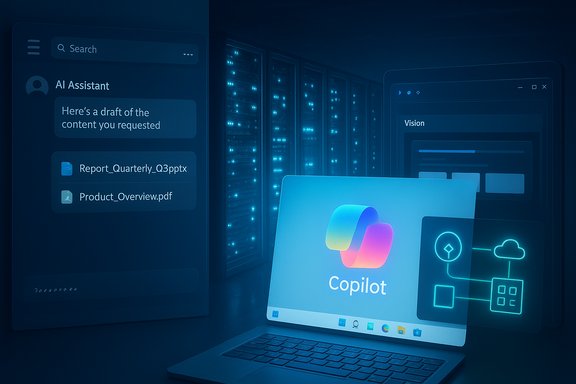
Microsoft’s October updates pushed Copilot deeper into Windows 11 and enterprise workflows: voice activation with “Hey, Copilot,” broader availability of Copilot Vision (which interprets on‑screen content), a taskbar integration that replaces or augments the Windows search box with an “Ask Copilot” entry, and Copilot Actions — experimental, agentic features that can perform tasks on behalf of users (with explicit permissions). Microsoft framed the move as “making every Windows 11 PC an AI PC,” bringing voice, vision and agentic automation into the OS experience. Microsoft’s own blog and major news outlets covered the announcement. Practical new abilities include:- Wake‑word voice interactions across Windows devices (“Hey, Copilot”).
- Copilot Vision that can analyze windows, screenshots and app content to provide step‑by‑step help or generate contextual answers.
- A taskbar “Ask Copilot” preview for Windows Insiders that gives one‑click access to Copilot features.
- Connectors for third‑party clouds and services that let Copilot ground answers on an organization’s documents and mailboxes.
On‑device AI and execution providers
A significant but less visible part of the story is Microsoft’s modular approach to on‑device AI: Windows now dispatches local model execution through ONNX Runtime with vendor‑specific Execution Providers (EPs) — for example Qualcomm’s QNN EP on Snapdragon Copilot+ devices, NVIDIA TensorRT‑RTX EP on RTX‑powered PCs, and vendor EP updates delivered via Windows Update. Those component updates (published as KBs) incrementally improve operator coverage, latency and stability for on‑device flows. This architecture is central to delivering responsive, private Copilot features while still allowing cloud fallbacks when needed. Community and vendor threads document recent EP updates and their practical effects, which system administrators should monitor.Why this matters: productivity, accessibility and risk
Strengths:- Accessibility gains from voice and vision could be transformational for users with mobility or visual impairments.
- Tighter OS integration reduces friction — Copilot can now act on local files, run workflows and span apps, not just answer chat prompts.
- The connector model (bringing Google Drive, OneDrive, mailboxes into Copilot’s grounding scope) enables richer, contextual responses for knowledge work.
- Authorization and least privilege: enabling agentic features requires robust consent models and administrative controls to prevent over‑privileged assistants.
- Data leakage potential: multimodal vision + connector combinations increase the attack surface for inadvertent exposure of sensitive documents or screenshots. Administrators must evaluate where Copilot retains context and what telemetry it sends.
- Local vs cloud tradeoffs: on‑device EP updates improve latency and privacy, but complexity grows for IT teams that must triage device, driver and firmware interactions across heterogeneous fleets.
Cross‑cutting analysis: where the three stories converge
Productivity vs governance: the perennial tradeoff
All three developments — Slack’s workspace assistant, BlackRock’s infrastructure bet, and Microsoft’s Copilot push — accelerate the adoption curve for agentic AI. That increases productivity potential but concentrates the same set of concerns:- Data governance: who can opt an assistant into a dataset, and how is that choice audited?
- Accountability: when assistants act on behalf of a user, what logs, approvals and rollback mechanisms exist?
- Supply chain: ownership of physical AI capacity (the BlackRock consortium) and control of runtime stacks (ONNX + EPs) changes leverage upstream and affects pricing and availability for downstream services.
Security and compliance: more moving parts
The combination of local execution providers, cloud connectors and third‑party model hosting means defenders must reason about:- Data-in‑transit and data‑at‑rest protections across many surfaces (Slack workspace, connectors, Copilot’s connectors, on‑device caches).
- Patch and update coordination: EP component updates (delivered in KBs) can change runtime behavior and must be validated in pilot fleets before broad rollout.
- Threat modeling for agentic capabilities: if an assistant gains the ability to schedule transfers, initiate code commits, or manipulate documents, defenders need role‑based approvals and anomaly detection.
Vendor lock‑in and portability
The BlackRock‑led infrastructure push and Microsoft’s push to integrate Copilot at OS level are both strategically rational for those vendors and their partners, but they also create potential lock‑in vectors:- Organizations deeply invested in Azure + Windows Copilot connectors may find cross‑cloud portability harder to achieve without additional data fabric and API adapters.
- Securing on‑prem or hybrid options requires negotiating for data egress and model portability clauses with cloud and colocation partners.
Practical guidance for IT teams and Windows administrators
- Inventory and classification: catalog which teams use Slack, what connectors are enabled, and which Slack workspaces contain regulated data.
- Pilot and measure: run controlled pilots for Slackbot and Copilot voice/vision features with clear KPIs (accuracy, time saved, false positives).
- Harden consent and least privilege: require administrators to opt in connectors on a per‑team basis and use allowlists for agentic actions.
- Monitor EP/component updates: treat ONNX EP and execution provider KBs like driver updates — validate on a test fleet before broad deployment.
- Log everything: ensure actions taken by assistants are auditable, with immutable logs for approvals, edits and outbound communications.
- Review vendor contracts: for AI infrastructure consumption or long‑term capacity commitments, verify SLAs around power, availability and compliance.
Notable strengths and potential risks — a closer look
Strengths to celebrate
- Real productivity gains: automating meeting agendas, summarizing threads and extracting action items are clear time savers.
- Improved accessibility: voice and vision will bring assistive features to many users who previously had limited access.
- Faster innovation cycles: infrastructure investments (the consortium deal) reduce the friction for scaling AI models and services.
Risks to mitigate
- Data leakage and model hallucinations: assistants that synthesize content from mixed sources can produce plausible but incorrect outputs; robust human review is still required.
- Concentration risk: when physical capacity and critical runtime stacks are controlled by a small number of consortia, outages, regulatory actions or geopolitical tensions can have outsized impact.
- Complexity tax: the new capabilities increase administrative and security overhead — small IT teams must decide whether the gains offset the extra governance burden.
- Exact model providers powering Slack’s new Slackbot: public reporting mentions third‑party LLMs hosted in AWS VPCs, but Slack has not published vendor names or model families for independent verification. Treat model provenance as a risk vector until vendors disclose or auditors validate.
Looking forward: what to watch in the next 90 days
- Regulatory and antitrust scrutiny for giant infrastructure deals: expect formal reviews and potential conditions on the Aligned acquisition as regulators examine market concentration.
- Copilot agentic features moving from preview to controlled production: watch the Windows Insider channels and enterprise deployment guidance for rollout dates and new administrative controls.
- Slack’s pilot expansion and connector roadmap: monitor which integrations are honored (Google Drive, OneDrive, Salesforce) and whether Slack publishes more detail about model hosting and governance.
- EP and runtime KBs (ONNX/QNN/TensorRT): these will keep arriving as vendors optimize on‑device performance — keep a change control process for them.
Conclusion
The past weeks show AI moving simultaneously at three different layers: the user surface (Slackbot, Copilot voice and vision), the runtime stack (ONNX runtime + execution providers, Copilot connectors) and the physical infrastructure (massive data‑center acquisitions). For Windows users and IT teams, this translates to immediate productivity opportunities but also a sharper set of responsibilities: governing connectors, validating model outputs, hardening agentic privileges and architecting for both resilience and portability.There is no single “right” response — organizations must balance opportunity with control. The practical starting point is deliberate: pilot intelligently, log comprehensively, require explicit consent for connectors or agentic privileges, and treat on‑device AI runtime updates like any other system dependency. The tools are becoming more capable; the job now is to make them safely useful at scale.
Source: Computerworld Slackbot evolves, BlackRock bets big, Copilot advances | Ep. 6
