

Bryson DeChambeau worked with Microsoft and sensor startup Sensoria in late 2016 on a prototype golf grip that used embedded pressure sensors to measure hand position and grip force, sending swing data to Microsoft’s cloud systems for real-time analysis. The project was never just about a gadget for one eccentric tour pro. It was an early, revealing example of where sports technology was headed: away from measuring only outcomes and toward instrumenting the body-club interface itself. For Windows and Microsoft watchers, the interesting part is not that a golfer wanted more numbers; it is that Microsoft saw a golf grip as another endpoint in its larger cloud-and-AI strategy.
Golf technology usually announces itself loudly. Drivers promise hotter faces, balls promise lower spin, launch monitors turn practice bays into radar labs, and televised broadcasts now speak the language of strokes gained and ball speed as casually as they once mentioned fairways hit. A pressure-sensing grip, by contrast, is almost comically modest: the technology disappears into the only part of the club the player actually touches.
That modesty is the point. DeChambeau’s Smart Grip prototype reportedly used eight pressure sensors embedded in the grip, with a small electronics module collecting data and feeding it into a Microsoft-connected application. The data could reveal where the hands sat on the grip, how hard they squeezed, and how those pressures changed through different swings and clubs.
The project arrived at a moment when Microsoft was trying to reposition itself from a company defined by Windows PCs into a company whose software and services could sit beneath everything. Azure was not just for enterprise databases and corporate dashboards; it could ingest signals from shoes, clubs, watches, machines, and industrial sensors. A golf grip made that pitch unusually tangible.
For DeChambeau, the appeal was obvious. He had already built his public identity around single-length irons, physics vocabulary, oversized grips, and an insistence that feel could be translated into repeatable inputs. For Microsoft, he was a useful partner because his curiosity made the experiment legible. The company did not need to convince anyone that DeChambeau would want data from his hands. The question was whether that data could become useful enough for everyone else.
The grip project fit neatly into that persona. Golf instruction has always cared about grip pressure, but it has usually treated it as metaphor. Teachers tell players to hold the club like a bird, a tube of toothpaste, or something else delicate enough to expose the absurdity of trying to quantify a sensation with language. DeChambeau’s Microsoft-backed prototype tried to turn that old teaching cliché into a data stream.
That is why the project was more interesting than a novelty training aid. Launch monitors measure the club and ball after the player has already acted. A grip sensor moves the measurement upstream, toward intent and tension. It asks whether the failure began before the downswing, before impact, before the ball ever had a chance.
This is where DeChambeau’s reputation helped and hurt. He made the idea credible because he was willing to chase marginal gains in public. But he also made it easy to dismiss as another Bryson eccentricity, the kind of thing ordinary golfers could laugh at before going back to blaming their slice on the driver.
Grip pressure sits in a messier category. It is biomechanical, psychological, and tactical at once. A player can squeeze tighter because of fear, because of fatigue, because of an awkward lie, because the club feels unstable, or because a swing change has introduced unfamiliar timing. The value of a sensorized grip is not merely that it can say “too much pressure.” It can show when pressure appears and whether that pattern repeats.
That timing matters. A golfer who tightens at address has a different problem from one who tightens at transition or just before impact. A player who adds pressure with the lead hand may be fighting a different miss than one who clamps down with the trail hand. Even if the device cannot prescribe the cure, it can make a hidden variable visible enough for a coach and player to discuss.
This is also why the Smart Grip concept had broader implications for Microsoft’s intelligent-systems pitch. Raw sensor readings are not the product. Pattern recognition is the product. The long-term promise was never simply a chart of hand pressure; it was a system that could compare swings, detect tendencies, and eventually connect grip behavior to shot outcomes.
That is where Azure entered the story. A pressure-sensing grip generates small but frequent signals, which become more valuable when they are stored across sessions and compared over time. The app can give immediate visual or audio feedback, but the cloud makes the practice history portable, persistent, and analyzable.
For Microsoft, this was the same story it was telling in manufacturing, healthcare, logistics, and professional sports. Put sensors close to the action. Move the data into cloud infrastructure. Apply analytics. Feed insights back to the human or system making the next decision. Golf simply provided a more relatable stage than a factory floor.
The company had already been pursuing sports partnerships as a way to humanize its enterprise technology. The lesson from the DeChambeau project was not that Microsoft wanted to become a golf equipment brand. It wanted to show that Azure could make sense of real-world signals quickly enough to matter in practice, coaching, and performance environments.
That distinction is important because it explains why the Smart Grip did not need to become a mass-market smash to be strategically useful. A prototype can still function as a proof of concept. It can show developers, partners, and potential customers that cloud-connected sensors are not theoretical. They can fit inside a golf grip and survive a tour player’s swing.
There is also the problem of interpretation. Golfers already drown in numbers. Add pressure maps to launch data, swing video, shot tracking, tempo apps, and wearable metrics, and the average player may end up with more anxiety than insight. A sensor that reveals inconsistency is only helpful if the player knows what to do next.
The best training technologies reduce complexity at the point of use. A launch monitor can tell a player that a 7-iron carried 162 yards with a certain launch and spin. That is easy to understand. A grip sensor might show a pressure spike in the trail hand at transition. That may be true, but it still requires translation into a drill, a feel, or a coaching intervention.
This is where the Smart Grip’s prototype status mattered. It pointed toward a future in which AI systems could interpret the data rather than merely display it. But in 2016, the consumer promise still depended heavily on a human coach or a highly motivated player. DeChambeau was both. Most golfers are neither.
That boundary reduces the commercial fantasy but clarifies the legitimate use case. The Smart Grip belongs on the range, in a fitting studio, in a coaching bay, or in a biomechanics lab. It is not supposed to whisper swing thoughts during a tournament round. Its value is in building patterns before competition, not automating decisions inside it.
This distinction matters for IT pros because sports technology often runs into governance before it runs into physics. The fact that data can be captured does not mean it can be used everywhere. Whether the environment is golf, healthcare, education, or the workplace, instrumentation creates a second-order question: who is allowed to see the data, and when does feedback become assistance?
In golf, the governing bodies make that question unusually explicit. In the enterprise, it tends to arrive through compliance, privacy law, labor policy, or procurement review. Microsoft’s sports experiments therefore mirror a broader reality of connected devices. The hard part is rarely collecting the signal. The hard part is deciding what the signal is allowed to do.
This was the period when nearly every industry was trying to decide whether connected sensors were a revolution or a buzzword. Smart thermostats, smart shoes, smart factories, smart cities, and smart medical devices were all competing for attention. A smart golf grip could have seemed trivial, but trivial examples often make infrastructure easier to understand.
The grip also exposed a central truth about IoT: the device is only as interesting as the workflow it improves. If the Smart Grip merely tells a player that grip pressure changed, it is a curiosity. If it helps a coach identify a repeatable flaw, it is a tool. If it can connect pressure patterns to ball flight and recommend a practice intervention, it becomes a platform.
That last step is the hardest. It requires not only sensors and cloud storage, but labeled data, expert interpretation, user trust, and a feedback loop that improves outcomes. Microsoft could supply the infrastructure. DeChambeau could supply a compelling use case. But the bridge from prototype to mass adoption required an ecosystem that golf was only beginning to build.
That strategy has only become more familiar. Microsoft now talks about AI copilots, cloud platforms, edge devices, and data pipelines with a confidence that was still forming in the mid-2010s. The Smart Grip looks quaint beside today’s AI branding, but its architecture was already pointing in that direction.
A sensor produces data. A cloud platform stores and processes it. An application turns it into feedback. Over time, machine learning may turn repeated feedback into prediction. That chain is now the default template for modern Microsoft product thinking, whether the endpoint is a laptop, a security agent, a Teams meeting, a factory robot, or a golf club.
The lesson is not that every object needs to become smart. In fact, the past decade has proven the opposite. Many smart products are bad because they add connectivity without improving the job. The Smart Grip remains interesting because grip pressure is a genuinely hidden variable. The device had a reason to exist beyond novelty.
His use of oversized grips, single-length irons, and unconventional setup choices also made grip pressure more than a minor detail. Larger grips can change how the hands interact with the club, how much the wrists release, and how secure the club feels under speed. A player trying to swing harder while preserving face control has every reason to care about pressure.
That does not mean the Microsoft-Sensoria prototype caused his later success. It would be irresponsible to draw that line. But it does mean the project was aligned with a real performance philosophy: isolate variables, measure them, and decide whether they help.
Golf culture often mocks that instinct until it works. Then it retroactively calls the same instinct vision. DeChambeau has lived on both sides of that reaction, and the Smart Grip is a small artifact from the earlier, more skeptical phase.
The most promising version of a smart grip would not simply show eight pressure lines moving through time. It would say that the player is tightening the trail hand during transition more than in their best swings. It would recommend a drill. It would compare the next five swings. It would know when to stop talking.
That is where modern AI could revive ideas that looked premature in 2016. Large-scale pattern recognition, natural-language coaching interfaces, and cheaper sensors make the concept more plausible now than it was then. A golfer might eventually ask a practice app why shots are leaking right and receive an answer that combines grip pressure, club path, face angle, and historical tendencies.
But that future depends on restraint. Coaching is not merely data delivery. It is prioritization. A good teacher knows which flaw to ignore for now because fixing it would break something more important. Any AI system that wants to enter that space must learn not only what changed, but what matters.
For professionals, that data may have competitive value. For amateurs, it may have commercial value. Equipment companies, coaches, app developers, broadcasters, insurers, and training platforms could all imagine uses for granular performance data. The more intimate the sensor, the more important the governance.
Microsoft’s enterprise customers already understand this dynamic. Telemetry can improve security, reliability, and productivity, but it can also create mistrust when users feel watched rather than helped. Sports technology faces the same bargain in a friendlier outfit. Players will share data if the benefit is clear, the boundaries are explicit, and the system does not punish them for being measured.
That is one reason the golf-grip example remains useful. It strips the privacy debate down to something almost tactile. The user is literally holding the sensor. The device can help, but only if the player believes the feedback serves the swing rather than someone else’s spreadsheet.
Golf makes the strengths and weaknesses of that pitch unusually visible. The swing is complex, individualized, and resistant to simple formulas. A model can find patterns, but a player still has to perform under pressure. The technology can narrow uncertainty; it cannot remove the human.
That is precisely why the Smart Grip was a better metaphor than Microsoft may have realized. The most valuable technology in high-skill domains does not replace expertise. It gives experts a new surface to inspect. It makes invisible timing, pressure, and deviation available for judgment.
For sysadmins and developers, the analogy is not hard to extend. Observability tools do not run the business by themselves. Security telemetry does not automatically create good incident response. AI code assistants do not eliminate architecture decisions. Measurement is the beginning of judgment, not the end.
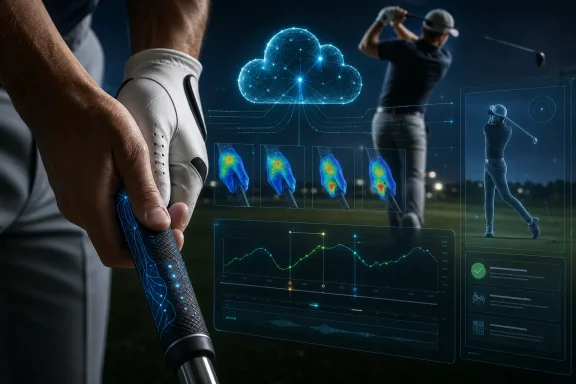 Microsoft Found a Cloud Story in the Smallest Part of the Club
Golf technology usually announces itself loudly. Drivers promise hotter faces, balls promise lower spin, launch monitors turn practice bays into radar labs, and televised broadcasts now speak the language of strokes gained and ball speed as casually as they once mentioned fairways hit. A pressure-sensing grip, by contrast, is almost comically modest: the technology disappears into the only part of the club the player actually touches.That modesty is the point. DeChambeau’s Smart Grip prototype reportedly used eight pressure sensors embedded in the grip, with a small electronics module collecting data and feeding it into a Microsoft-connected application. The data could reveal where the hands sat on the grip, how hard they squeezed, and how those pressures changed through different swings and clubs.
The project arrived at a moment when Microsoft was trying to reposition itself from a company defined by Windows PCs into a company whose software and services could sit beneath everything. Azure was not just for enterprise databases and corporate dashboards; it could ingest signals from shoes, clubs, watches, machines, and industrial sensors. A golf grip made that pitch unusually tangible.
For DeChambeau, the appeal was obvious. He had already built his public identity around single-length irons, physics vocabulary, oversized grips, and an insistence that feel could be translated into repeatable inputs. For Microsoft, he was a useful partner because his curiosity made the experiment legible. The company did not need to convince anyone that DeChambeau would want data from his hands. The question was whether that data could become useful enough for everyone else.
DeChambeau Was the Perfect Test Subject Because He Was Already the Product
Before he became a major champion and long-drive fascination, DeChambeau was marketed as golf’s resident scientist. That label was sometimes flattering and sometimes used as a polite way to call him odd, but it mattered commercially. His approach made technical experimentation part of the performance, not a distraction from it.The grip project fit neatly into that persona. Golf instruction has always cared about grip pressure, but it has usually treated it as metaphor. Teachers tell players to hold the club like a bird, a tube of toothpaste, or something else delicate enough to expose the absurdity of trying to quantify a sensation with language. DeChambeau’s Microsoft-backed prototype tried to turn that old teaching cliché into a data stream.
That is why the project was more interesting than a novelty training aid. Launch monitors measure the club and ball after the player has already acted. A grip sensor moves the measurement upstream, toward intent and tension. It asks whether the failure began before the downswing, before impact, before the ball ever had a chance.
This is where DeChambeau’s reputation helped and hurt. He made the idea credible because he was willing to chase marginal gains in public. But he also made it easy to dismiss as another Bryson eccentricity, the kind of thing ordinary golfers could laugh at before going back to blaming their slice on the driver.
The Real Innovation Was Measuring Pressure Before Measuring Performance
Most golf data systems are built around visible outcomes. Ball speed, launch angle, spin rate, carry distance, dispersion, attack angle, and club path are all downstream artifacts. They describe what happened, often with extraordinary precision, but they do not always explain what the player felt while making it happen.Grip pressure sits in a messier category. It is biomechanical, psychological, and tactical at once. A player can squeeze tighter because of fear, because of fatigue, because of an awkward lie, because the club feels unstable, or because a swing change has introduced unfamiliar timing. The value of a sensorized grip is not merely that it can say “too much pressure.” It can show when pressure appears and whether that pattern repeats.
That timing matters. A golfer who tightens at address has a different problem from one who tightens at transition or just before impact. A player who adds pressure with the lead hand may be fighting a different miss than one who clamps down with the trail hand. Even if the device cannot prescribe the cure, it can make a hidden variable visible enough for a coach and player to discuss.
This is also why the Smart Grip concept had broader implications for Microsoft’s intelligent-systems pitch. Raw sensor readings are not the product. Pattern recognition is the product. The long-term promise was never simply a chart of hand pressure; it was a system that could compare swings, detect tendencies, and eventually connect grip behavior to shot outcomes.
Azure Was the Caddie Microsoft Actually Wanted to Sell
The Smart Grip was easy to describe as a golf invention, but Microsoft’s strategic interest sat higher in the stack. Sensors in a club are hardware. The durable business, if one exists, is in storing, interpreting, and distributing the data those sensors produce.That is where Azure entered the story. A pressure-sensing grip generates small but frequent signals, which become more valuable when they are stored across sessions and compared over time. The app can give immediate visual or audio feedback, but the cloud makes the practice history portable, persistent, and analyzable.
For Microsoft, this was the same story it was telling in manufacturing, healthcare, logistics, and professional sports. Put sensors close to the action. Move the data into cloud infrastructure. Apply analytics. Feed insights back to the human or system making the next decision. Golf simply provided a more relatable stage than a factory floor.
The company had already been pursuing sports partnerships as a way to humanize its enterprise technology. The lesson from the DeChambeau project was not that Microsoft wanted to become a golf equipment brand. It wanted to show that Azure could make sense of real-world signals quickly enough to matter in practice, coaching, and performance environments.
That distinction is important because it explains why the Smart Grip did not need to become a mass-market smash to be strategically useful. A prototype can still function as a proof of concept. It can show developers, partners, and potential customers that cloud-connected sensors are not theoretical. They can fit inside a golf grip and survive a tour player’s swing.
The Consumer Golf Market Was Less Ready Than the Technology
The obvious question is why sensorized grips did not become as common as launch monitors or GPS watches. Part of the answer is practical. Golf grips wear out, get replaced, and are deeply personal. Embedding electronics inside them complicates cost, durability, fitting, feel, and rules compliance.There is also the problem of interpretation. Golfers already drown in numbers. Add pressure maps to launch data, swing video, shot tracking, tempo apps, and wearable metrics, and the average player may end up with more anxiety than insight. A sensor that reveals inconsistency is only helpful if the player knows what to do next.
The best training technologies reduce complexity at the point of use. A launch monitor can tell a player that a 7-iron carried 162 yards with a certain launch and spin. That is easy to understand. A grip sensor might show a pressure spike in the trail hand at transition. That may be true, but it still requires translation into a drill, a feel, or a coaching intervention.
This is where the Smart Grip’s prototype status mattered. It pointed toward a future in which AI systems could interpret the data rather than merely display it. But in 2016, the consumer promise still depended heavily on a human coach or a highly motivated player. DeChambeau was both. Most golfers are neither.
The Rules of Golf Were Always Going to Draw a Bright Line
Even if the technology worked beautifully, it was never going to be a simple on-course accessory. Golf’s rules have long been skeptical of artificial assistance during competition, and training aids that provide live performance feedback generally face strict limits in real play. That makes a smart grip more like a practice instrument than a legal secret weapon.That boundary reduces the commercial fantasy but clarifies the legitimate use case. The Smart Grip belongs on the range, in a fitting studio, in a coaching bay, or in a biomechanics lab. It is not supposed to whisper swing thoughts during a tournament round. Its value is in building patterns before competition, not automating decisions inside it.
This distinction matters for IT pros because sports technology often runs into governance before it runs into physics. The fact that data can be captured does not mean it can be used everywhere. Whether the environment is golf, healthcare, education, or the workplace, instrumentation creates a second-order question: who is allowed to see the data, and when does feedback become assistance?
In golf, the governing bodies make that question unusually explicit. In the enterprise, it tends to arrive through compliance, privacy law, labor policy, or procurement review. Microsoft’s sports experiments therefore mirror a broader reality of connected devices. The hard part is rarely collecting the signal. The hard part is deciding what the signal is allowed to do.
The Grip Was an IoT Device Wearing a Sports Costume
Seen from Redmond, the Smart Grip belongs to the Internet of Things era as much as to golf. It was a small connected object producing sensor data from a physical process. That data then moved into software for visualization, comparison, and potentially machine-learning analysis.This was the period when nearly every industry was trying to decide whether connected sensors were a revolution or a buzzword. Smart thermostats, smart shoes, smart factories, smart cities, and smart medical devices were all competing for attention. A smart golf grip could have seemed trivial, but trivial examples often make infrastructure easier to understand.
The grip also exposed a central truth about IoT: the device is only as interesting as the workflow it improves. If the Smart Grip merely tells a player that grip pressure changed, it is a curiosity. If it helps a coach identify a repeatable flaw, it is a tool. If it can connect pressure patterns to ball flight and recommend a practice intervention, it becomes a platform.
That last step is the hardest. It requires not only sensors and cloud storage, but labeled data, expert interpretation, user trust, and a feedback loop that improves outcomes. Microsoft could supply the infrastructure. DeChambeau could supply a compelling use case. But the bridge from prototype to mass adoption required an ecosystem that golf was only beginning to build.
Windows Users Saw the Same Strategy in a Different Outfit
For WindowsForum readers, the Smart Grip is a reminder that Microsoft’s most important consumer-facing experiments often sit outside Windows while still depending on the same developer and cloud logic. The company’s ambition was not to make every golfer use a Windows PC at the range. It was to make Microsoft services the invisible layer beneath connected experiences.That strategy has only become more familiar. Microsoft now talks about AI copilots, cloud platforms, edge devices, and data pipelines with a confidence that was still forming in the mid-2010s. The Smart Grip looks quaint beside today’s AI branding, but its architecture was already pointing in that direction.
A sensor produces data. A cloud platform stores and processes it. An application turns it into feedback. Over time, machine learning may turn repeated feedback into prediction. That chain is now the default template for modern Microsoft product thinking, whether the endpoint is a laptop, a security agent, a Teams meeting, a factory robot, or a golf club.
The lesson is not that every object needs to become smart. In fact, the past decade has proven the opposite. Many smart products are bad because they add connectivity without improving the job. The Smart Grip remains interesting because grip pressure is a genuinely hidden variable. The device had a reason to exist beyond novelty.
DeChambeau’s Later Career Made the Prototype Look Less Weird
In hindsight, the Smart Grip fits almost too neatly into the rest of DeChambeau’s career. His later transformation into one of golf’s most powerful drivers of the ball made clear that his experimentation was not just theater. He was willing to rebuild his body, equipment, and technique around measurable performance goals.His use of oversized grips, single-length irons, and unconventional setup choices also made grip pressure more than a minor detail. Larger grips can change how the hands interact with the club, how much the wrists release, and how secure the club feels under speed. A player trying to swing harder while preserving face control has every reason to care about pressure.
That does not mean the Microsoft-Sensoria prototype caused his later success. It would be irresponsible to draw that line. But it does mean the project was aligned with a real performance philosophy: isolate variables, measure them, and decide whether they help.
Golf culture often mocks that instinct until it works. Then it retroactively calls the same instinct vision. DeChambeau has lived on both sides of that reaction, and the Smart Grip is a small artifact from the earlier, more skeptical phase.
The Coaching Revolution Needed Better Interfaces, Not Just Better Sensors
A pressure-sensing grip also raises a design problem Microsoft knows well: expert systems fail when their interfaces overwhelm normal users. Golfers do not need another dashboard that makes them feel like they are operating lab equipment. They need a system that translates measurement into a small number of useful changes.The most promising version of a smart grip would not simply show eight pressure lines moving through time. It would say that the player is tightening the trail hand during transition more than in their best swings. It would recommend a drill. It would compare the next five swings. It would know when to stop talking.
That is where modern AI could revive ideas that looked premature in 2016. Large-scale pattern recognition, natural-language coaching interfaces, and cheaper sensors make the concept more plausible now than it was then. A golfer might eventually ask a practice app why shots are leaking right and receive an answer that combines grip pressure, club path, face angle, and historical tendencies.
But that future depends on restraint. Coaching is not merely data delivery. It is prioritization. A good teacher knows which flaw to ignore for now because fixing it would break something more important. Any AI system that wants to enter that space must learn not only what changed, but what matters.
Privacy Is Not Just for Phones and Laptops Anymore
The Smart Grip also belongs in a broader discussion about personal performance data. A golfer’s grip pressure may seem harmless compared with medical records or financial information, but it is still biometric-adjacent behavioral data. It can reveal stress, fatigue, habit, and skill.For professionals, that data may have competitive value. For amateurs, it may have commercial value. Equipment companies, coaches, app developers, broadcasters, insurers, and training platforms could all imagine uses for granular performance data. The more intimate the sensor, the more important the governance.
Microsoft’s enterprise customers already understand this dynamic. Telemetry can improve security, reliability, and productivity, but it can also create mistrust when users feel watched rather than helped. Sports technology faces the same bargain in a friendlier outfit. Players will share data if the benefit is clear, the boundaries are explicit, and the system does not punish them for being measured.
That is one reason the golf-grip example remains useful. It strips the privacy debate down to something almost tactile. The user is literally holding the sensor. The device can help, but only if the player believes the feedback serves the swing rather than someone else’s spreadsheet.
The Golf Gadget That Predicted Microsoft’s AI Sales Pitch
The DeChambeau-Microsoft grip project now reads less like an isolated curiosity and more like an early draft of Microsoft’s current AI argument. The company’s pitch today is that software should sit beside specialized work, observe context, and offer timely assistance. In 2016, that assistance came through sensor dashboards and cloud analytics. In 2026, it is more likely to be described as a copilot.Golf makes the strengths and weaknesses of that pitch unusually visible. The swing is complex, individualized, and resistant to simple formulas. A model can find patterns, but a player still has to perform under pressure. The technology can narrow uncertainty; it cannot remove the human.
That is precisely why the Smart Grip was a better metaphor than Microsoft may have realized. The most valuable technology in high-skill domains does not replace expertise. It gives experts a new surface to inspect. It makes invisible timing, pressure, and deviation available for judgment.
For sysadmins and developers, the analogy is not hard to extend. Observability tools do not run the business by themselves. Security telemetry does not automatically create good incident response. AI code assistants do not eliminate architecture decisions. Measurement is the beginning of judgment, not the end.
The Signal From Bryson’s Hands Still Carries
The concrete story is simple enough, but the implications are larger than the prototype.- Bryson DeChambeau’s Smart Grip project with Microsoft and Sensoria was a practice-focused prototype designed to measure grip pressure and hand position through embedded sensors.
- The system’s real significance was its cloud workflow, with sensor data moving into Microsoft-connected software for real-time feedback and longer-term analysis.
- The product’s biggest barrier was not whether grip pressure mattered, but whether ordinary golfers could turn another stream of data into better swings.
- The project anticipated today’s AI coaching pitch by treating hidden behavior as something software could observe, compare, and eventually interpret.
- The same governance questions that follow enterprise telemetry also follow sports sensors, especially when performance data becomes personal, competitive, or commercially valuable.
References
- Primary source: GolfWRX
Published: 2026-06-11T20:30:12.942925
Bryson DeChambeau, Microsoft develop pressure-sensing grip
Bryson DeChambeau, in a very Bryson DeChambeau move, joined forces with Microsoft and Seattle-startup Sensoria to work on a prototype “smart grip.” The grip is designed to analyze pressure applied throughout the swing. The grip’s eight embedded sensors return real-time pressure data. It’s... golfwrx.com
- Related coverage: mygolfway.com
Golf y Tecnología – Microsoft se une a DeChambeau y Sensoria para crear un grip inteligente - MyGolfWay - Plataforma Online del Sector del Golf - Online Platform of Golf Industry
24 Noviembre 2016 – El peculiar golfista profesional del PGA Tour Bryson DeChambeau ha trabajado durante ocho semanas con Microsoft y la startup Sensoria para crear un prototipo de ‘Smart Grip’, o grip inteligente, que analiza cuánta presión aplica el jugador sobre el palo de golf a través... www.mygolfway.com
- Related coverage: golfdigest.com
Could this Microsoft smart grip be the solution to your swing problems? | Golf News and Tour Information | Golf Digest
Could this Microsoft smart grip -- tested by Bryson DeChambeau -- be the solution to your swing problems? www.golfdigest.com
- Related coverage: caddiehq.com
What Golf Grips Does Bryson DeChambeau Use?
Bryson DeChambeau, golf’s most prominent scientist, uses JumboMax JMX UltraLite XL grips on every single club in his bag. It’s a core component of his unique, power-focused approach to the game. This article will break down the exact grips he uses, the deep reasoning behind his choice, and...www.caddiehq.com - Related coverage: digitaltrends.com
Improve your swing with these smart golf grips from Microsoft - Digital Trends
Microsoft is teaming up with Sensoria and professional golfer Bryson DeChambeau to develop the Smart Grip for your golf club. The grip measures pressure levels and relays the data to a tablet or computer.www.digitaltrends.com - Related coverage: si.com
- Related coverage: dnaofsports.com
Does Dechambeau Use A Baseball Grip? | DNA Of SPORTS
If you are looking for Does dechambeau use a baseball grip? or , click here! - DNA of SPORTSwww.dnaofsports.com - Related coverage: thegolfnewsnet.com
Bryson DeChambeau worked with Microsoft on a smart grip to track grip pressure
Bryson DeChambeau worked with Microsoft on a smart grip to track grip pressure and other other data including club movement thegolfnewsnet.com
- Related coverage: thediygolfer.com
Why Bryson uses Jumbo Golf Grips: Not for Distance!
Have you ever wondered why Bryson Dechambeau uses jumbo grips? Is it for consistency? Or generating power? Let's find out.www.thediygolfer.com
- Related coverage: windowsforum.com
Bryson DeChambeau Smart Golf Grip: Azure, Sensors, and Early AI Coaching | Windows Forum
Bryson DeChambeau worked with Microsoft and Seattle-area sensor startup Sensoria in late 2016 to build a prototype golf grip that measured hand pressure...windowsforum.com - Related coverage: theclubwasher.com
What Size Golf Grips Does Bryson DeChambeau Use? – The Club Washer
Bryson DeChambeau is known for his unique approach to golf, and one of the elements that really sets him apart is his choice of golf grips. You might be scratching your head, thinking, "Golf grips? Really?" But yes, in the world of precision and power, the size of your golf grips can... theclubwasher.com
