

Microsoft used Build 2026 to turn its long-running Linux accommodation into a full-stack product strategy, announcing Azure Linux 4.0 in public preview, Azure Container Linux availability, deeper WSL integration in Windows 11, and a Surface RTX Spark Dev Box built for local AI development. The practical message is blunt: Windows remains the front door, but Linux is increasingly the engine room. For developers, administrators, and anyone building AI systems, Microsoft is no longer merely tolerating Linux. It is packaging, tuning, and selling the path through it.
That is not the same thing as Microsoft becoming “a Linux company,” a phrase that makes for a catchy conference-week headline but obscures the more interesting shift. Microsoft is still very much a Windows, Azure, Microsoft 365, GitHub, and Copilot company. What changed at Build is that Linux stopped being the foreign body inside Microsoft’s ecosystem and became one of the load-bearing beams.
There was a time when Microsoft’s Linux posture could be summarized as grudging coexistence. Linux ran in the datacenter, Windows ran the desktop, and the two met through compatibility layers, management tools, and the occasional legal threat. That era ended years ago in practice, but Build 2026 gave the new reality a sharper commercial shape.
Azure Linux 4.0 is the clearest symbol. Microsoft has had Linux distributions before, including CBL-Mariner and earlier Azure Linux variants used as infrastructure underpinnings, especially around Azure Kubernetes Service. But Azure Linux 4.0 is being positioned as a broader server distribution for Azure workloads, not simply as a specialized container host hiding beneath managed services.
That matters because operating systems are not just bundles of packages. They are control planes for trust, patch cadence, compatibility, certification, support, and defaults. By shipping and maintaining its own Azure-first Linux, Microsoft is staking out the right to define the baseline underneath a growing class of cloud and AI workloads.
The company’s argument is straightforward enough: if Azure is where the workload lives, Microsoft can make Linux more predictable, more secure, and more integrated by building the distribution itself. That is a credible engineering claim. It is also a platform strategy.
The old Microsoft wanted developers to choose Windows Server. The new Microsoft wants developers to choose Azure, GitHub, Copilot, and Windows as the workstation interface — even if the workload underneath is Linux from top to bottom.
Microsoft’s pitch follows that playbook. Azure Linux is RPM-based, Fedora-derived, maintained in-house, and aimed at cloud and server workloads rather than desktop Linux users. Microsoft is emphasizing a trimmed package set, supply-chain transparency, Azure integration, and a baseline suitable for cloud-native and AI workloads.
The shift is subtle but important. Earlier Azure Linux incarnations could be understood as implementation details: a host OS for AKS, a controlled substrate for Microsoft services, a behind-the-scenes Linux for people who did not necessarily need to care that it existed. Azure Linux 4.0 asks customers to care.
That creates a new decision point for administrators. If you are running general Linux workloads in Azure, do you choose the vendor-neutral familiarity of Ubuntu, RHEL, SUSE, or Debian, or do you move closer to Microsoft’s preferred image? The answer will depend less on ideology than on support guarantees, available packages, compliance posture, vendor relationships, and whether Azure-native integration saves enough operational pain to justify another platform standard.
This is where Microsoft’s Linux push becomes both useful and uncomfortable. A first-party Linux can reduce friction for Azure customers. It can also tilt reference architectures, documentation, support scripts, and managed-service assumptions toward Microsoft’s own distribution over time.
That does not make Azure Linux a hostile act. But it does mean independent Linux vendors will be watching the defaults closely.
That is where much of the industry has been heading for years. The more applications move into containers, the less administrators want the host operating system to behave like a pet server full of handcrafted configuration. The ideal container host is boring. It boots, updates predictably, exposes the right kernel and runtime primitives, and otherwise gets out of the way.
Microsoft’s adoption of a container-focused Linux lineage also reveals how much of the modern OS battle has shifted upward. In the Windows-versus-Linux era, the server operating system itself was often the main event. In the Kubernetes era, the host is a substrate for orchestration, scheduling, observability, secrets, policy, and application delivery.
That does not make the host unimportant. It makes the host more strategic precisely because everyone wants to stop thinking about it. Whoever controls the default host image controls patch timing, supported runtimes, kernel features, security posture, and the assumptions that surround the platform.
Azure Container Linux therefore complements Azure Linux 4.0 rather than duplicating it. One is a broader server baseline for Azure workloads. The other is a locked-down host for container environments. Together, they give Microsoft a Linux answer at two layers of the stack: the VM and the cluster node.
This is not Microsoft dabbling. It is Microsoft rationalizing its infrastructure around a Linux continuum it can own, document, and support.
Windows Subsystem for Linux has been the center of that effort for years. WSL began as a compatibility story and became a developer workflow story. WSL 2, with its real Linux kernel architecture, changed the bargain: developers could run Linux environments on Windows with enough fidelity for serious work while keeping the Windows desktop, enterprise management stack, and application ecosystem.
At Build 2026, Microsoft pushed WSL deeper into its AI and agent strategy. The company discussed new WSL container capabilities, a command-line interface for controlling and running containers, APIs that let native Windows apps use Linux containers, and an “agent-native” direction for the OS. Strip away the marketing language and the product logic is clear: local AI workflows need Linux-compatible runtimes, GPU acceleration, container isolation, and tight editor-terminal-shell integration.
That is a very different Windows pitch from the one Microsoft made to developers a decade ago. The old pitch was that Windows itself was the target. The new pitch is that Windows is the workstation, orchestration surface, and productivity shell for work that may execute in Linux, in containers, in Azure, or inside AI-assisted development environments.
The addition of Linux-like command-line utilities implemented natively for Windows fits the same pattern. Developers accustomed to GNU-style tools expect a certain grammar from their machines. They want familiar commands, scriptable environments, and fewer pointless differences between local and remote systems.
For traditional Windows users, this may look like Microsoft importing alien habits into the OS. For developers, it looks more like Microsoft acknowledging that the Unix-like command line became the lingua franca of modern software engineering. Windows can either meet that expectation or keep losing high-end development mindshare to macOS and Linux laptops.
The modern AI stack is overwhelmingly Linux-first. CUDA, PyTorch, model-serving frameworks, distributed training tools, vector databases, container images, and research code all tend to assume Linux as the default runtime. Windows can participate, and Microsoft has invested heavily in making that participation real, but the center of gravity is not ambiguous.
That is why the Surface RTX Spark Dev Box is such an interesting Microsoft product. On the surface, it is a Windows developer machine built around Nvidia’s RTX Spark platform, with up to 128GB of unified memory and up to one petaflop of AI compute. Microsoft is positioning it for local model work, agentic pipelines, fine-tuning, and long-running developer experiments that would otherwise require cloud resources or compromise-laden laptops.
But the software stack tells the real story. The device is being presented with WSL 2, native GPU passthrough, full CUDA support, Visual Studio Code, GitHub Copilot, and developer-focused Windows settings. In other words, Microsoft’s premium AI development workstation is a Windows box that expects Linux runtimes to be part of the default experience.
That would have been almost absurd in the Ballmer era. In 2026, it is just practical.
There is also a business angle. If Microsoft can make Windows machines credible for local AI development, it protects the Windows workstation franchise from being bypassed by Linux workstations and Apple silicon Macs. If it can make those same workflows flow naturally into Azure, GitHub, and Copilot, it turns local AI development into another on-ramp for Microsoft’s cloud and developer services.
The Surface RTX Spark Dev Box is therefore not just hardware. It is a bridge product, designed to keep developers inside Microsoft’s orbit while giving them the Linux and Nvidia stack they actually need.
Still, underneath the buzzword is a real technical problem. If AI agents are going to run code, modify files, call tools, inspect repositories, test applications, and act semi-autonomously, they need containment. They need boundaries between the agent, the user’s data, the system, enterprise resources, and other workloads.
That is where Microsoft Execution Containers enter the picture. Microsoft is previewing MXC as an OS-level sandbox technology for Windows, framed as part of the same local AI development story as WSL, containers, and developer workstations. The idea is to give agent workflows a more controlled execution environment rather than letting them roam across the user’s machine like overprivileged automation scripts.
The details will matter enormously. Sandboxing is easy to market and hard to get right. Developers will want performance, filesystem access, GPU support, networking, repeatability, and debugging. Security teams will want isolation, policy enforcement, auditability, revocation, and integration with existing management tools.
If Microsoft gets this right, Windows could become a more credible host for local agent experimentation than its recent reputation suggests. If it gets it wrong, “agent-native OS” risks becoming another branding layer over the same old problem of too many processes with too much access.
WSL complicates and strengthens the story. Linux containers and runtimes give developers compatibility with the AI ecosystem. Windows-native sandboxing could give enterprises a more governable surface. The opportunity is not to pretend Windows and Linux are the same, but to make their boundary explicit, manageable, and useful.
The upside is obvious. A Microsoft-maintained Linux distribution for Azure could simplify support paths. A hardened, minimal OS image could reduce attack surface. Better WSL and container integration could make developer workstations easier to standardize. AI workstations with supported CUDA-through-WSL workflows could spare teams from one-off Linux desktop builds that IT departments often struggle to manage.
There is also value in having Microsoft own more of the stack when something breaks. Multi-vendor support chains are a familiar enterprise headache: the cloud provider points to the OS vendor, the OS vendor points to the container runtime, the application vendor points to the GPU driver, and the internal platform team gets stuck in the middle. A first-party stack can reduce that ambiguity.
But the lock-in question is not paranoia. It is basic platform hygiene. If Microsoft’s documentation, templates, managed services, and AI reference architectures increasingly assume Azure Linux, customers may find the easiest path and the portable path slowly diverging.
That divergence rarely happens with a dramatic announcement. It happens through defaults. It happens when the best-tested image is the house image, when the quickest support answer assumes the house distro, when the newest accelerator path lands there first, and when compliance guidance is written around Microsoft’s own baseline.
Enterprises should not reject Azure Linux because Microsoft made it. That would be cargo-cult skepticism. But they should evaluate it with the same discipline they apply to any platform dependency: exit options, package availability, lifecycle policy, support terms, vulnerability response, configuration management, and behavior outside the narrowest Azure happy path.
A Microsoft Linux can be good engineering and still increase Microsoft’s leverage. Those two things are not mutually exclusive.
Microsoft is unlikely to chase Red Hat, Canonical, SUSE, Debian, and Oracle Linux out of Azure. The marketplace, customer demand, enterprise contracts, ISV certifications, and hybrid-cloud realities all argue against that. Large organizations do not standardize on an operating system simply because a cloud provider has a shiny new default.
Red Hat still brings enterprise certifications, support relationships, and a long history in regulated environments. Ubuntu remains deeply embedded in cloud development and documentation culture. SUSE has its own enterprise footholds. Debian continues to matter wherever stability, openness, and community governance are paramount.
What Azure Linux changes is the center of gravity inside Microsoft’s own house. When Microsoft builds demos, internal services, AI templates, container paths, and Azure-native guidance, it now has a first-party Linux that can be the presumed baseline. That will not eliminate other distributions, but it may shape where the most seamless experience appears first.
This is the same competitive pressure hyperscalers exert throughout the stack. Managed databases do not kill self-managed databases, but they change the buying conversation. Serverless platforms do not eliminate Kubernetes, but they alter what “default” means. A house Linux distribution does not end the distro market, but it gives the cloud provider a stronger hand in defining normal.
The Linux ecosystem has survived worse than a Microsoft-maintained RPM-based cloud distribution. But vendors that depend on being the default Linux in Azure workloads should assume the default is now contested.
But applying that frame too neatly to Azure Linux and WSL misses how much the technology market has changed. Microsoft cannot extinguish Linux without extinguishing large parts of Azure, GitHub’s developer base, the AI tooling ecosystem, container infrastructure, and its own credibility with modern software teams. Linux is not a rival word processor or browser API that can be starved by platform control. It is a global infrastructure commons with too many stakeholders, too many licenses, and too much operational reality behind it.
The more realistic concern is not extinguishing. It is enclosure.
Microsoft does not need to kill Linux to benefit from shaping the most convenient Linux paths around Azure, GitHub, Copilot, Windows, and Surface. It can make the open ecosystem feel best when entered through Microsoft’s gates. That is subtler than the old monopoly playbook, and in many ways more durable.
This is also why Linux advocates should be careful not to argue themselves into irrelevance. If the response to every Microsoft Linux move is reflexive suspicion, Microsoft can fairly point to real developer benefits and dismiss the critics as nostalgic. The stronger critique is more specific: openness is not just source availability, but portability, governance, interoperability, and the absence of punitive friction when customers choose another path.
Microsoft’s Build 2026 Linux story should be judged on those terms. Does Azure Linux remain meaningfully open and usable beyond narrow Azure scenarios? Do WSL workflows respect standard Linux expectations? Do container tools interoperate cleanly? Do AI development paths let teams move between local machines, Azure, and other environments without hidden traps?
Those answers will matter more than any symbolic declaration that Microsoft has or has not become a Linux company.
But in strategic terms, this is how Windows survives as a serious developer platform. The alternative would be worse: a Windows desktop that insists on Windows-native purity while developers move their real work to Linux workstations, remote dev containers, cloud shells, and Macs. Microsoft tried variants of that posture before. The market answered.
WSL is one of the most important Windows features of the last decade because it lets Windows stop pretending. It says the developer world is heterogeneous, Linux matters, and the Windows desktop can still be valuable if it hosts that reality well. Build 2026 extends that compromise into AI hardware, local agents, container workflows, and Azure-native Linux.
That does not mean every Windows user needs WSL, Azure Linux, or an RTX Spark workstation. Most people will never touch these features directly. But the developer ecosystem shapes what platforms get apps, tools, frameworks, and attention. If Windows loses developers, ordinary users eventually feel the consequences.
The stronger Windows becomes as a host for Linux-based development, the less likely it is to become a consumer shell disconnected from serious engineering work. That is the real significance of Microsoft’s Linux push for Windows loyalists. It is not surrender. It is adaptation under pressure.
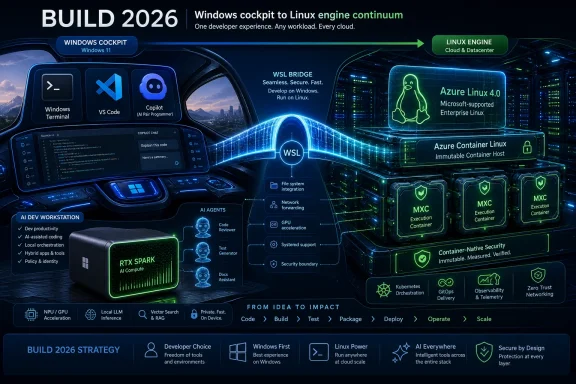
A developer writes code on Windows 11, using VS Code, Copilot, Windows Terminal, PowerShell, WSL, and Linux-like command-line tools. They run Linux containers locally through WSL, perhaps with GPU acceleration. They test agent workflows in sandboxes. They move workloads to Azure VMs running Azure Linux or to Kubernetes nodes using Azure Container Linux. They scale AI workloads in the cloud while preserving enough local capability to iterate without waiting on remote infrastructure.
That is the continuum Microsoft is trying to build. Windows is the cockpit. Linux is the runtime. Azure is the destination. GitHub and Copilot are the connective tissue.
The plan is coherent because it aligns with how developers actually work in 2026. The risk is that coherence becomes gravity, and gravity becomes lock-in. Microsoft wants to make the Microsoft path the smoothest path. Customers should welcome the smoothness without forgetting to measure the slope.
Once a team standardizes on WSL-backed local workflows, Azure Linux images, Microsoft-tuned container hosts, GitHub Copilot-assisted development, and Azure deployment templates, it gains speed. It also accumulates assumptions. Those assumptions become scripts, scripts become pipelines, pipelines become policy, and policy becomes institutional inertia.
That is not unique to Microsoft. Every platform strategy works this way. The reason it deserves attention here is that Microsoft is now extending its platform boundary into territory that many organizations historically treated as a hedge against Microsoft dependency.
Linux used to be, among other things, the alternative. In Microsoft’s 2026 strategy, Linux is increasingly part of the bundle.
That can be a net win if the bundle is open enough, well-supported enough, and portable enough. It can be a net loss if Microsoft uses integration as a one-way valve. The difference will not be settled by Build keynotes. It will be settled by release cadence, licensing, documentation, ecosystem participation, and the boring details of day-two operations.
That is not the same thing as Microsoft becoming “a Linux company,” a phrase that makes for a catchy conference-week headline but obscures the more interesting shift. Microsoft is still very much a Windows, Azure, Microsoft 365, GitHub, and Copilot company. What changed at Build is that Linux stopped being the foreign body inside Microsoft’s ecosystem and became one of the load-bearing beams.
 Microsoft No Longer Has to Pretend Linux Is Someone Else’s Platform
There was a time when Microsoft’s Linux posture could be summarized as grudging coexistence. Linux ran in the datacenter, Windows ran the desktop, and the two met through compatibility layers, management tools, and the occasional legal threat. That era ended years ago in practice, but Build 2026 gave the new reality a sharper commercial shape.Azure Linux 4.0 is the clearest symbol. Microsoft has had Linux distributions before, including CBL-Mariner and earlier Azure Linux variants used as infrastructure underpinnings, especially around Azure Kubernetes Service. But Azure Linux 4.0 is being positioned as a broader server distribution for Azure workloads, not simply as a specialized container host hiding beneath managed services.
That matters because operating systems are not just bundles of packages. They are control planes for trust, patch cadence, compatibility, certification, support, and defaults. By shipping and maintaining its own Azure-first Linux, Microsoft is staking out the right to define the baseline underneath a growing class of cloud and AI workloads.
The company’s argument is straightforward enough: if Azure is where the workload lives, Microsoft can make Linux more predictable, more secure, and more integrated by building the distribution itself. That is a credible engineering claim. It is also a platform strategy.
The old Microsoft wanted developers to choose Windows Server. The new Microsoft wants developers to choose Azure, GitHub, Copilot, and Windows as the workstation interface — even if the workload underneath is Linux from top to bottom.
Azure Linux 4.0 Turns an Internal Necessity Into a Customer-Facing Product
Azure Linux 4.0 is not arriving in a vacuum. Cloud providers have long preferred tightly controlled Linux images because the economics of hyperscale infrastructure reward minimalism, repeatability, and automation. Google has Container-Optimized OS. AWS has Amazon Linux. Red Hat, Canonical, SUSE, Debian, and others all occupy important places in the enterprise Linux universe, but hyperscalers like having a house distribution they can harden and tune to their own infrastructure.Microsoft’s pitch follows that playbook. Azure Linux is RPM-based, Fedora-derived, maintained in-house, and aimed at cloud and server workloads rather than desktop Linux users. Microsoft is emphasizing a trimmed package set, supply-chain transparency, Azure integration, and a baseline suitable for cloud-native and AI workloads.
The shift is subtle but important. Earlier Azure Linux incarnations could be understood as implementation details: a host OS for AKS, a controlled substrate for Microsoft services, a behind-the-scenes Linux for people who did not necessarily need to care that it existed. Azure Linux 4.0 asks customers to care.
That creates a new decision point for administrators. If you are running general Linux workloads in Azure, do you choose the vendor-neutral familiarity of Ubuntu, RHEL, SUSE, or Debian, or do you move closer to Microsoft’s preferred image? The answer will depend less on ideology than on support guarantees, available packages, compliance posture, vendor relationships, and whether Azure-native integration saves enough operational pain to justify another platform standard.
This is where Microsoft’s Linux push becomes both useful and uncomfortable. A first-party Linux can reduce friction for Azure customers. It can also tilt reference architectures, documentation, support scripts, and managed-service assumptions toward Microsoft’s own distribution over time.
That does not make Azure Linux a hostile act. But it does mean independent Linux vendors will be watching the defaults closely.
Container Linux Shows Microsoft Wants the Host to Disappear
Azure Container Linux, now generally available, tells the same story from another angle. It is not trying to be a general-purpose Linux server in the traditional sense. It is an immutable, container-optimized operating system designed to be a reliable host for Kubernetes and cloud-native workloads.That is where much of the industry has been heading for years. The more applications move into containers, the less administrators want the host operating system to behave like a pet server full of handcrafted configuration. The ideal container host is boring. It boots, updates predictably, exposes the right kernel and runtime primitives, and otherwise gets out of the way.
Microsoft’s adoption of a container-focused Linux lineage also reveals how much of the modern OS battle has shifted upward. In the Windows-versus-Linux era, the server operating system itself was often the main event. In the Kubernetes era, the host is a substrate for orchestration, scheduling, observability, secrets, policy, and application delivery.
That does not make the host unimportant. It makes the host more strategic precisely because everyone wants to stop thinking about it. Whoever controls the default host image controls patch timing, supported runtimes, kernel features, security posture, and the assumptions that surround the platform.
Azure Container Linux therefore complements Azure Linux 4.0 rather than duplicating it. One is a broader server baseline for Azure workloads. The other is a locked-down host for container environments. Together, they give Microsoft a Linux answer at two layers of the stack: the VM and the cluster node.
This is not Microsoft dabbling. It is Microsoft rationalizing its infrastructure around a Linux continuum it can own, document, and support.
Windows Is Becoming the Best Linux Workstation Microsoft Can Sell
The desktop side of the Build story is more paradoxical. Microsoft is not replacing Windows with Linux, nor is it turning Windows 11 into a Linux distribution. Instead, it is trying to make Windows the place where Linux developers can work without constantly feeling they are on the wrong machine.Windows Subsystem for Linux has been the center of that effort for years. WSL began as a compatibility story and became a developer workflow story. WSL 2, with its real Linux kernel architecture, changed the bargain: developers could run Linux environments on Windows with enough fidelity for serious work while keeping the Windows desktop, enterprise management stack, and application ecosystem.
At Build 2026, Microsoft pushed WSL deeper into its AI and agent strategy. The company discussed new WSL container capabilities, a command-line interface for controlling and running containers, APIs that let native Windows apps use Linux containers, and an “agent-native” direction for the OS. Strip away the marketing language and the product logic is clear: local AI workflows need Linux-compatible runtimes, GPU acceleration, container isolation, and tight editor-terminal-shell integration.
That is a very different Windows pitch from the one Microsoft made to developers a decade ago. The old pitch was that Windows itself was the target. The new pitch is that Windows is the workstation, orchestration surface, and productivity shell for work that may execute in Linux, in containers, in Azure, or inside AI-assisted development environments.
The addition of Linux-like command-line utilities implemented natively for Windows fits the same pattern. Developers accustomed to GNU-style tools expect a certain grammar from their machines. They want familiar commands, scriptable environments, and fewer pointless differences between local and remote systems.
For traditional Windows users, this may look like Microsoft importing alien habits into the OS. For developers, it looks more like Microsoft acknowledging that the Unix-like command line became the lingua franca of modern software engineering. Windows can either meet that expectation or keep losing high-end development mindshare to macOS and Linux laptops.
AI Makes Linux Less Optional Than Ever
The reason this Linux push feels more urgent in 2026 is AI. Microsoft can support Linux for cloud workloads out of pragmatic necessity, but AI development turns that necessity into a strategic imperative.The modern AI stack is overwhelmingly Linux-first. CUDA, PyTorch, model-serving frameworks, distributed training tools, vector databases, container images, and research code all tend to assume Linux as the default runtime. Windows can participate, and Microsoft has invested heavily in making that participation real, but the center of gravity is not ambiguous.
That is why the Surface RTX Spark Dev Box is such an interesting Microsoft product. On the surface, it is a Windows developer machine built around Nvidia’s RTX Spark platform, with up to 128GB of unified memory and up to one petaflop of AI compute. Microsoft is positioning it for local model work, agentic pipelines, fine-tuning, and long-running developer experiments that would otherwise require cloud resources or compromise-laden laptops.
But the software stack tells the real story. The device is being presented with WSL 2, native GPU passthrough, full CUDA support, Visual Studio Code, GitHub Copilot, and developer-focused Windows settings. In other words, Microsoft’s premium AI development workstation is a Windows box that expects Linux runtimes to be part of the default experience.
That would have been almost absurd in the Ballmer era. In 2026, it is just practical.
There is also a business angle. If Microsoft can make Windows machines credible for local AI development, it protects the Windows workstation franchise from being bypassed by Linux workstations and Apple silicon Macs. If it can make those same workflows flow naturally into Azure, GitHub, and Copilot, it turns local AI development into another on-ramp for Microsoft’s cloud and developer services.
The Surface RTX Spark Dev Box is therefore not just hardware. It is a bridge product, designed to keep developers inside Microsoft’s orbit while giving them the Linux and Nvidia stack they actually need.
The “Agent-Native” Windows Pitch Needs Sandboxes, Not Slogans
Microsoft’s Build messaging around agents was predictably grand. Every major platform vendor is now trying to describe its operating system, cloud, browser, productivity suite, and developer tools as agentic, a word that currently does more work in slide decks than in most production environments.Still, underneath the buzzword is a real technical problem. If AI agents are going to run code, modify files, call tools, inspect repositories, test applications, and act semi-autonomously, they need containment. They need boundaries between the agent, the user’s data, the system, enterprise resources, and other workloads.
That is where Microsoft Execution Containers enter the picture. Microsoft is previewing MXC as an OS-level sandbox technology for Windows, framed as part of the same local AI development story as WSL, containers, and developer workstations. The idea is to give agent workflows a more controlled execution environment rather than letting them roam across the user’s machine like overprivileged automation scripts.
The details will matter enormously. Sandboxing is easy to market and hard to get right. Developers will want performance, filesystem access, GPU support, networking, repeatability, and debugging. Security teams will want isolation, policy enforcement, auditability, revocation, and integration with existing management tools.
If Microsoft gets this right, Windows could become a more credible host for local agent experimentation than its recent reputation suggests. If it gets it wrong, “agent-native OS” risks becoming another branding layer over the same old problem of too many processes with too much access.
WSL complicates and strengthens the story. Linux containers and runtimes give developers compatibility with the AI ecosystem. Windows-native sandboxing could give enterprises a more governable surface. The opportunity is not to pretend Windows and Linux are the same, but to make their boundary explicit, manageable, and useful.
The Enterprise Upside Is Real, but So Is the Lock-In Question
For IT administrators, Microsoft’s Linux turn is not a culture-war story. It is a procurement, support, compliance, and operations story.The upside is obvious. A Microsoft-maintained Linux distribution for Azure could simplify support paths. A hardened, minimal OS image could reduce attack surface. Better WSL and container integration could make developer workstations easier to standardize. AI workstations with supported CUDA-through-WSL workflows could spare teams from one-off Linux desktop builds that IT departments often struggle to manage.
There is also value in having Microsoft own more of the stack when something breaks. Multi-vendor support chains are a familiar enterprise headache: the cloud provider points to the OS vendor, the OS vendor points to the container runtime, the application vendor points to the GPU driver, and the internal platform team gets stuck in the middle. A first-party stack can reduce that ambiguity.
But the lock-in question is not paranoia. It is basic platform hygiene. If Microsoft’s documentation, templates, managed services, and AI reference architectures increasingly assume Azure Linux, customers may find the easiest path and the portable path slowly diverging.
That divergence rarely happens with a dramatic announcement. It happens through defaults. It happens when the best-tested image is the house image, when the quickest support answer assumes the house distro, when the newest accelerator path lands there first, and when compliance guidance is written around Microsoft’s own baseline.
Enterprises should not reject Azure Linux because Microsoft made it. That would be cargo-cult skepticism. But they should evaluate it with the same discipline they apply to any platform dependency: exit options, package availability, lifecycle policy, support terms, vulnerability response, configuration management, and behavior outside the narrowest Azure happy path.
A Microsoft Linux can be good engineering and still increase Microsoft’s leverage. Those two things are not mutually exclusive.
Independent Linux Vendors Still Have Cards to Play
The obvious question is whether Azure Linux threatens the existing Linux ecosystem on Microsoft’s cloud. The answer is yes, but not in the cartoonish sense.Microsoft is unlikely to chase Red Hat, Canonical, SUSE, Debian, and Oracle Linux out of Azure. The marketplace, customer demand, enterprise contracts, ISV certifications, and hybrid-cloud realities all argue against that. Large organizations do not standardize on an operating system simply because a cloud provider has a shiny new default.
Red Hat still brings enterprise certifications, support relationships, and a long history in regulated environments. Ubuntu remains deeply embedded in cloud development and documentation culture. SUSE has its own enterprise footholds. Debian continues to matter wherever stability, openness, and community governance are paramount.
What Azure Linux changes is the center of gravity inside Microsoft’s own house. When Microsoft builds demos, internal services, AI templates, container paths, and Azure-native guidance, it now has a first-party Linux that can be the presumed baseline. That will not eliminate other distributions, but it may shape where the most seamless experience appears first.
This is the same competitive pressure hyperscalers exert throughout the stack. Managed databases do not kill self-managed databases, but they change the buying conversation. Serverless platforms do not eliminate Kubernetes, but they alter what “default” means. A house Linux distribution does not end the distro market, but it gives the cloud provider a stronger hand in defining normal.
The Linux ecosystem has survived worse than a Microsoft-maintained RPM-based cloud distribution. But vendors that depend on being the default Linux in Azure workloads should assume the default is now contested.
“Embrace, Extend, Extinguish” Is the Wrong Frame, but the Right Memory
Any discussion of Microsoft and Linux eventually collides with the phrase “embrace, extend, extinguish.” It is part of the company’s historical baggage, and Microsoft earned that baggage the hard way.But applying that frame too neatly to Azure Linux and WSL misses how much the technology market has changed. Microsoft cannot extinguish Linux without extinguishing large parts of Azure, GitHub’s developer base, the AI tooling ecosystem, container infrastructure, and its own credibility with modern software teams. Linux is not a rival word processor or browser API that can be starved by platform control. It is a global infrastructure commons with too many stakeholders, too many licenses, and too much operational reality behind it.
The more realistic concern is not extinguishing. It is enclosure.
Microsoft does not need to kill Linux to benefit from shaping the most convenient Linux paths around Azure, GitHub, Copilot, Windows, and Surface. It can make the open ecosystem feel best when entered through Microsoft’s gates. That is subtler than the old monopoly playbook, and in many ways more durable.
This is also why Linux advocates should be careful not to argue themselves into irrelevance. If the response to every Microsoft Linux move is reflexive suspicion, Microsoft can fairly point to real developer benefits and dismiss the critics as nostalgic. The stronger critique is more specific: openness is not just source availability, but portability, governance, interoperability, and the absence of punitive friction when customers choose another path.
Microsoft’s Build 2026 Linux story should be judged on those terms. Does Azure Linux remain meaningfully open and usable beyond narrow Azure scenarios? Do WSL workflows respect standard Linux expectations? Do container tools interoperate cleanly? Do AI development paths let teams move between local machines, Azure, and other environments without hidden traps?
Those answers will matter more than any symbolic declaration that Microsoft has or has not become a Linux company.
Windows Enthusiasts Should Read This as a Survival Strategy, Not a Surrender
For WindowsForum readers, the emotional temptation is to see these announcements as Windows giving ground. In a narrow sense, that is true. Microsoft is openly admitting that Windows alone is not the native center of modern cloud and AI development.But in strategic terms, this is how Windows survives as a serious developer platform. The alternative would be worse: a Windows desktop that insists on Windows-native purity while developers move their real work to Linux workstations, remote dev containers, cloud shells, and Macs. Microsoft tried variants of that posture before. The market answered.
WSL is one of the most important Windows features of the last decade because it lets Windows stop pretending. It says the developer world is heterogeneous, Linux matters, and the Windows desktop can still be valuable if it hosts that reality well. Build 2026 extends that compromise into AI hardware, local agents, container workflows, and Azure-native Linux.
That does not mean every Windows user needs WSL, Azure Linux, or an RTX Spark workstation. Most people will never touch these features directly. But the developer ecosystem shapes what platforms get apps, tools, frameworks, and attention. If Windows loses developers, ordinary users eventually feel the consequences.
The stronger Windows becomes as a host for Linux-based development, the less likely it is to become a consumer shell disconnected from serious engineering work. That is the real significance of Microsoft’s Linux push for Windows loyalists. It is not surrender. It is adaptation under pressure.
The Build 2026 Linux Map Is Finally Visible
Microsoft’s announcements can look scattered if viewed as separate product blurbs: a server Linux here, a container OS there, some WSL features, a pricey AI dev box, new sandboxing technology, and more command-line tools. The pattern becomes clearer when you trace the developer’s path.A developer writes code on Windows 11, using VS Code, Copilot, Windows Terminal, PowerShell, WSL, and Linux-like command-line tools. They run Linux containers locally through WSL, perhaps with GPU acceleration. They test agent workflows in sandboxes. They move workloads to Azure VMs running Azure Linux or to Kubernetes nodes using Azure Container Linux. They scale AI workloads in the cloud while preserving enough local capability to iterate without waiting on remote infrastructure.
That is the continuum Microsoft is trying to build. Windows is the cockpit. Linux is the runtime. Azure is the destination. GitHub and Copilot are the connective tissue.
The plan is coherent because it aligns with how developers actually work in 2026. The risk is that coherence becomes gravity, and gravity becomes lock-in. Microsoft wants to make the Microsoft path the smoothest path. Customers should welcome the smoothness without forgetting to measure the slope.
The Linux Push Has a Price Tag, Even Before the Hardware Does
The Surface RTX Spark Dev Box will almost certainly be expensive, but the larger price of Microsoft’s Linux strategy will not show up on a hardware invoice. It will show up in architectural commitments.Once a team standardizes on WSL-backed local workflows, Azure Linux images, Microsoft-tuned container hosts, GitHub Copilot-assisted development, and Azure deployment templates, it gains speed. It also accumulates assumptions. Those assumptions become scripts, scripts become pipelines, pipelines become policy, and policy becomes institutional inertia.
That is not unique to Microsoft. Every platform strategy works this way. The reason it deserves attention here is that Microsoft is now extending its platform boundary into territory that many organizations historically treated as a hedge against Microsoft dependency.
Linux used to be, among other things, the alternative. In Microsoft’s 2026 strategy, Linux is increasingly part of the bundle.
That can be a net win if the bundle is open enough, well-supported enough, and portable enough. It can be a net loss if Microsoft uses integration as a one-way valve. The difference will not be settled by Build keynotes. It will be settled by release cadence, licensing, documentation, ecosystem participation, and the boring details of day-two operations.
The Redmond Linux Era Comes With Homework
The practical readout from Build 2026 is not that everyone should rush to rebuild their environments around Azure Linux or buy Microsoft’s AI workstation. It is that Microsoft’s Linux strategy has matured enough that ignoring it is no longer an option for Windows and Azure shops.- Azure Linux 4.0 should be evaluated as a serious Azure server baseline, not dismissed as a branding exercise or assumed to be a drop-in replacement for established enterprise distributions.
- Azure Container Linux makes Microsoft’s preferred Kubernetes host strategy clearer, especially for organizations that want immutable infrastructure with fewer moving parts.
- WSL is becoming a core Windows developer subsystem for AI and container workflows, not merely a convenience feature for people who miss Bash.
- The Surface RTX Spark Dev Box signals that Microsoft expects high-end AI development to happen locally as well as in the cloud, with Linux runtimes embedded in the Windows experience.
- Enterprises should treat Microsoft’s Linux stack as both an opportunity for simplification and a new dependency surface that needs portability, lifecycle, and support analysis.
- Independent Linux vendors still matter, but they now compete not only on Azure availability, but against Microsoft’s ability to make its own Linux the path of least resistance.
References
- Primary source: ZDNET
Published: Thu, 04 Jun 2026 12:59:00 GMT

Microsoft continues its big Linux push at Build 2026
Microsoft is releasing a server Linux, a container Linux, and a Windows 11 built for Linux programmers. Here's why. www.zdnet.com
- Related coverage: windowscentral.com
- Related coverage: tomshardware.com

Microsoft Surface Laptop Ultra wields Nvidia's RTX Spark superchip with 128GB of RAM, 20 Arm CPU cores, and a Blackwell GPU — 15-inch mini-LED PixelSense Ultra display rounds out the powerful package
Microsoft + Nvidia = Mivida?www.tomshardware.com
- Official source: techcommunity.microsoft.com
Announcing Azure Linux 4.0: Purpose-Built for Azure, Now in Public Preview | Microsoft Community Hub
Today at Microsoft Build, we're announcing the public preview of Azure Linux 4.0 - Microsoft's first party Linux distribution, purpose-built for Azure. Azure... techcommunity.microsoft.com
- Related coverage: infoq.com

Microsoft Announces Azure Linux 4.0, Its First General-Purpose Server Linux Distribution
Microsoft announced Azure Linux 4.0 and Azure Container Linux at Open Source Summit. Azure Linux 4.0 is a Fedora-based general-purpose server distribution for Azure VMs, the first time Microsoft has offered a supported Linux beyond container hosting. Azure Container Linux is an immutable...www.infoq.com
- Related coverage: siliconangle.com

Microsoft announces Surface RTX Spark AI supercomputer development box - SiliconANGLE
Microsoft announces Surface RTX Spark AI supercomputer development box - SiliconANGLE siliconangle.com
- Related coverage: hothardware.com

Microsoft Surface RTX Spark Dev Box Puts 1 Petaflop Of Compute On Your Desk
NVIDIA's RTX Spark could be the catalyst that the Windows on Arm movement desperately needs, and the Surface RTX Spark Dev Box announced at Microsoft Build gives developers a powerful tool to help facilitate the movement.hothardware.com
- Related coverage: windowsreport.com
- Related coverage: securityonline.info

Microsoft Breaks Container Boundaries: Azure Linux 4.0 Drops as a Full General-Purpose Server OS
Microsoft releases Azure Linux 4.0 at the Open Source Summit, transforming its custom OS into a full general-purpose VM server distribution based on Fedora. securityonline.info
- Official source: news.microsoft.com

Microsoft Build Live
The home for real-time coverage of the news as it is announced from Microsoft Build, June 2-3, 2026. news.microsoft.com
- Official source: azure.microsoft.com
Azure Linux | Microsoft Azure
Explore Azure Linux, a Microsoft-built Linux distribution for Azure. Run secure and efficient workloads on virtual machines and containers.azure.microsoft.com
- Related coverage: tutos-informatique.com

Azure Linux 4.0 : Microsoft prépare sa distribution Linux
Microsoft annonce Azure Linux 4.0, une distribution Linux pensée pour Azure, les VM cloud et les développeurs sous WSL.www.tutos-informatique.com - Official source: blogs.windows.com
Build 2026: Furthering Windows as the trusted platform for development
Build is one of our favorite moments each year - a chance to connect with the global developer community and share what we’ve been building. Over the past year, we have connected with many developers pushing the boundaries of what’s possible on blogs.windows.com
- Related coverage: thetechportal.com

Microsoft introduces Surface RTX Spark Dev Box, GitHub Copilot app, Project Solara, and new AI models at Build 2026 - The Tech Portal
Microsoft unveiled a series of major AI-focused announcements at its Build 2026 developer conference, including the new Surface thetechportal.com
- Official source: microsoft.com
