

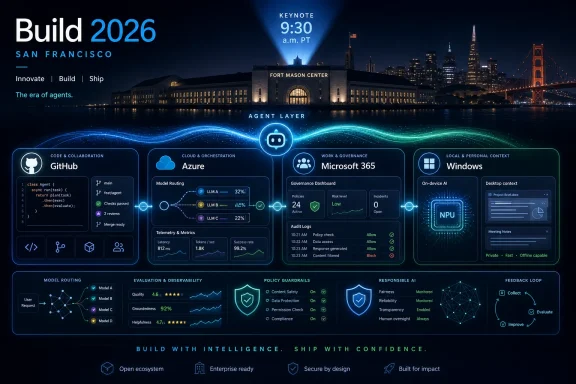
Microsoft Build 2026 opens June 2 at Fort Mason Center in San Francisco with Satya Nadella’s keynote scheduled for 9:30 a.m. Pacific, and the published agenda points to Copilot, AI agents, Azure AI Foundry, and Windows local AI rather than a Windows 12 reveal. That is not an accidental omission. It is Microsoft telling developers that the next platform fight is not over a new Start menu badge or a version number. It is over who owns the agent layer between users, applications, cloud infrastructure, and the operating system.
For decades, Build has carried a gravitational pull toward Windows. Even when Azure, .NET, Office, and GitHub took their turns in the spotlight, the Windows roadmap gave developers a familiar frame: new APIs, new shells, new deployment targets, new compatibility headaches. A Windows 12 announcement would have been the old kind of platform news.
Instead, Microsoft is using Build 2026 to argue that the platform has moved. Windows is still present, but it is no longer the headline act. The center of gravity is now Copilot, agents, model routing, governance, and the machinery needed to turn demos into managed enterprise systems.
That shift matters because it reframes what “the next Windows” even means. Microsoft does not need to call something Windows 12 if it can change the way developers build software on Windows 11, Azure, GitHub, Microsoft 365, and the browser all at once. The version number becomes less important than the control plane.
This is a subtle but consequential bet. Microsoft is asking developers to stop waiting for a monolithic operating-system reveal and start thinking about applications as agentic workflows that can run across cloud, edge, desktop, and enterprise data estates.
The word agent is doing a lot of work here. In Microsoft’s framing, agents are not just chatbots with better branding. They are software actors that can reason over context, call tools, perform tasks, coordinate with other agents, and operate inside policy boundaries set by an organization.
That is a much larger ambition than autocomplete. It reaches into DevOps, security operations, help desk automation, business-process orchestration, document handling, customer service, and desktop productivity. It also creates a new management problem: once agents can act, someone has to decide what they are allowed to touch.
This is why Build 2026 feels less like a product launch and more like a platform doctrine. Microsoft wants the developer community to internalize a new stack: build agents with GitHub and Microsoft Foundry, run them through Azure, govern them with Microsoft 365 and security controls, and surface them through Copilot and Windows.
The risk is that “agent” becomes the new “metaverse,” a word stretched so widely that it loses precision. Microsoft’s advantage is that it can attach the term to products developers already use. The question for Build is whether the company can show enough practical plumbing to make agentic development look like a workflow, not a slogan.
For developers, that abundance is exciting. For CIOs, it is a procurement and governance headache. A system that works well with one model in March may be cheaper or safer on another in June. A coding agent might need a frontier model for one task, a small local model for another, and a cheaper hosted model for routine classification.
Foundry is Microsoft’s attempt to make that mess feel like a Microsoft platform problem rather than an open-ended vendor-management crisis. The pitch is not simply “we have models.” It is “we can help you choose, route, observe, evaluate, secure, and pay for models inside the enterprise environment you already trust.”
That is why cost control is not a side issue. Token consumption has become the cloud bill nobody fully understands until the invoice arrives. Agentic systems make that harder because they may call models repeatedly, invoke tools, search data, generate intermediate reasoning artifacts, and run in the background.
At Build, expect Microsoft to emphasize evaluation, observability, routing, and policy as much as raw intelligence. The enterprise buyer has already heard that AI can write code and summarize documents. The harder question is whether a company can let hundreds of agents loose without creating an expensive, insecure, un-auditable shadow IT layer.
That is the logical evolution of AI-assisted development. The editor was the easiest place to start because the context was narrow and the payoff was immediate. But real software work does not live only in a file buffer. It crosses ticketing systems, build logs, test failures, infrastructure templates, package managers, security scanners, and deployment pipelines.
Copilot CLI’s general availability earlier this year fits that pattern. Once Copilot enters the terminal, it stops being merely a code-writing aid and becomes part of the operational loop. It can suggest commands, explain flags, interact with repositories, and potentially sit closer to the messy interface between developer intent and system state.
That also raises the stakes. A bad completion in a source file is annoying. A bad terminal action can delete data, alter infrastructure, leak secrets, or trigger a broken deployment. This is where agentic convenience and administrative caution collide.
Microsoft’s challenge is to make Copilot feel powerful without making it feel reckless. The company needs developers to trust agents enough to delegate work, while giving organizations enough hooks to monitor and constrain what those agents can do.
That is a more interesting story than it first sounds. If AI agents are going to help with real work, the local PC matters again. It has the user’s applications, files, window state, peripherals, authentication context, and hardware acceleration. It is also where privacy expectations are highest and where bad design becomes visible fastest.
Windows local AI sessions at Build point to this new role. Microsoft has been steadily building toward on-device inference through Copilot+ PCs, local models such as Phi Silica, Windows AI components, and runtime infrastructure that lets developers use neural processing units without becoming hardware specialists. The platform pitch is that AI should not always require a round trip to the cloud.
That matters for latency, cost, privacy, and resilience. A local summarizer, classifier, OCR tool, or intent detector does not need the same economics as a frontier cloud model. If Windows can provide predictable local AI primitives, developers get a new tier of compute that sits between traditional desktop APIs and Azure-hosted intelligence.
But Windows users have reason to be skeptical. Microsoft’s recent history with AI in Windows has included useful ideas, confusing branding, rough edges, and privacy-sensitive features that required painful public refinement. Local AI will succeed only if it feels like a capability users control, not another layer imposed on top of the desktop.
Yet the timing is revealing. Microsoft is trying to sell a future in which Windows becomes more context-aware, more assistive, and more deeply connected to Copilot and agents. That future requires trust at the interface level. If users feel the shell is rigid, promotional, or indifferent to their preferences, they will not welcome more intelligence layered into it.
A customizable Start menu is not an AI breakthrough. It is trust repair. It tells Windows users that Microsoft has at least heard the complaint that the desktop became less personal in the move from Windows 10 to Windows 11.
That matters because AI on the desktop will be judged by consent and control as much as capability. A model that can understand local context sounds helpful when the user is in charge. It sounds intrusive when it appears without clear boundaries.
Microsoft’s best Windows strategy in 2026 may not be a new version number. It may be proving that Windows 11 can become both more flexible and more intelligent without making users feel trapped in an experiment.
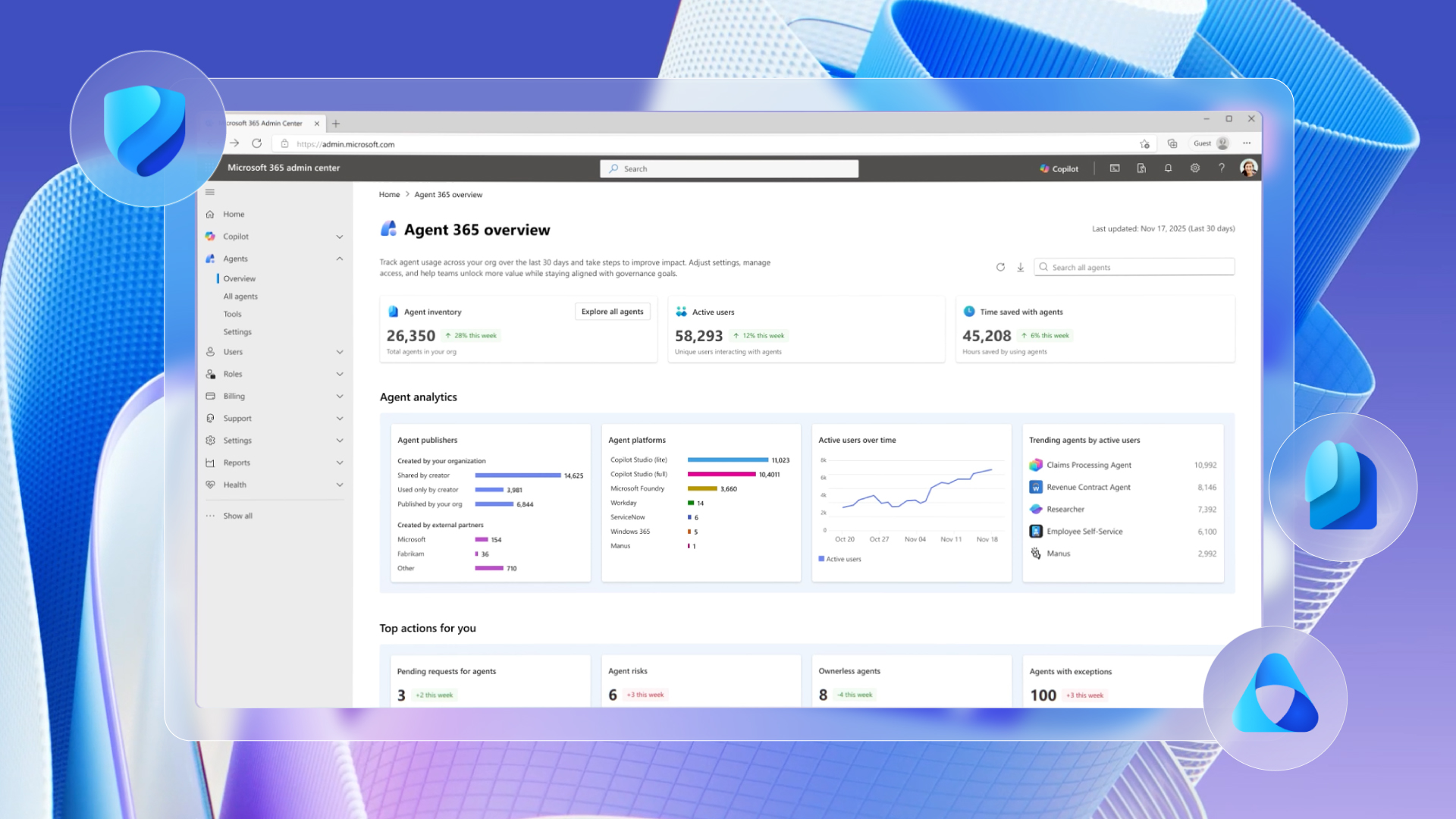
Microsoft Agent 365, now generally available, is meant to address that control problem. The pitch is that organizations need a way to manage agents across Microsoft 365 and beyond, including discovery, policy, access controls, lifecycle management, and security posture. In plain English: if workers and developers are going to create agents, IT needs inventory and brakes.
This is where Microsoft’s enterprise instincts give it an advantage. The company understands that many corporate customers are less interested in a magical AI assistant than in whether their compliance team can explain what the assistant did. Auditability is not glamorous, but it is the thing that turns pilot projects into production deployments.
The deeper implication is that Microsoft does not see agents as isolated app features. It sees them as a new class of digital identity. Agents will need permissions, owners, records, connectors, secrets, and retirement policies. They may need to be treated less like macros and more like service accounts with reasoning capabilities.
That should make sysadmins both relieved and nervous. Relieved because Microsoft is acknowledging the governance gap. Nervous because the existence of Agent 365 implies that agent sprawl is not hypothetical; it is the future Microsoft is preparing customers to manage.
The company’s preferred architecture is becoming clear. Use GitHub to plan, code, review, and automate. Use Copilot to assist and delegate. Use Azure AI Foundry to choose and run models. Use Microsoft 365 and Graph-connected data for enterprise context. Use Agent 365 and security tooling for governance. Use Windows for local AI and user-facing productivity.
That is an elegant story if you are already a Microsoft customer. It is also a lock-in story, though Microsoft will avoid that word. The more an organization relies on Microsoft’s identity, data graph, agent governance, model routing, and developer tooling, the harder it becomes to swap out any single piece.
To be fair, every major platform vendor is making the same move. Google, Amazon, Apple, OpenAI, Anthropic, and a crowd of developer-tool startups all want to own some part of the agent loop. The difference is that Microsoft can connect the loop from the developer’s terminal to the office worker’s inbox to the Windows taskbar to the Azure subscription.
That breadth is the company’s greatest strength and its greatest source of complexity. Developers may like powerful integrations, but they also fear opaque licensing, administrative friction, and product overlap. Microsoft will need to prove that its AI stack is coherent enough to build on, not merely vast enough to market.
But the Windows 12 rumor cycle may be looking for the wrong kind of change. Microsoft’s current strategy suggests that the next major Windows transition will arrive as a sequence of AI capabilities, runtime changes, hardware requirements, app integrations, and cloud-connected services rather than a single boxed-release moment.
That does not mean Windows 12 will never happen. It means Microsoft has little incentive to make Build 2026 about it. Windows 11 still gives the company a large installed base, an active Insider pipeline, a Copilot+ PC story, and a vehicle for iterative AI features. A new brand would create attention, but also fragmentation and expectation debt.
There is also a risk in launching a new Windows too early. Microsoft has spent years persuading users and enterprises to move to Windows 11, and Windows 10’s end-of-support transition remains a major operational concern for many organizations. Dropping a Windows 12 banner into that environment could create more confusion than momentum.
By contrast, an AI-first Build lets Microsoft talk about the future without forcing a migration narrative. It can tell developers that the platform is changing while telling IT departments that the operating system foundation remains familiar. That is less dramatic, but probably more commercially useful.
That is why the practical details matter. Developers and administrators need to know how agents authenticate, how they are monitored, how prompts and outputs are logged, how data boundaries are enforced, and how model choices affect cost and reliability. A keynote demo cannot answer all of that.
The strongest version of Microsoft’s Build story would show agents doing boring but valuable work. Not a cartoonish assistant booking a vacation, but a coding agent fixing a flaky test with trace context. Not a vague office helper, but an agent that can process a procurement request while obeying retention rules and access policies. Not “AI everywhere,” but AI in places where delegation saves time without creating chaos.
This is where Microsoft has an opportunity to separate itself from AI theater. Enterprises do not need more proof that models can generate fluent text. They need patterns for production: evaluations, rollback, least-privilege access, human approval, exception handling, cost ceilings, and incident response.
The more Build 2026 talks about those operational details, the more credible the AI-first message becomes. The less it does, the more it risks sounding like another round of platform exuberance ahead of the hard parts.
It also complicates debugging. Traditional software fails in ways that are often reproducible. Agentic systems can fail because the model misread context, chose the wrong tool, exceeded a budget, retrieved stale information, or produced a plausible but incorrect intermediate step. The stack trace is no longer the whole story.
Microsoft’s developer tooling will need to meet that reality. Observability for agents cannot simply mean logging the final answer. It has to include tool calls, model versions, prompts, policy decisions, retrieved context, user approvals, and cost. Without that, developers will be flying blind.
This is why Azure AI Foundry, GitHub Copilot, and Agent 365 belong in the same conversation. The developer experience, runtime environment, and governance plane are converging. Microsoft is trying to make that convergence feel native to its ecosystem before competitors define the defaults.
The danger is that developers may experience the new stack as another layer of abstraction that hides too much. Microsoft’s best move is to expose enough detail for serious builders while smoothing the path for teams that just want to ship. That balance has defined successful developer platforms for decades.
The threat model is not limited to a rogue model. Prompt injection, malicious documents, compromised connectors, poisoned retrieval sources, over-permissive tokens, and confused-deputy problems all become more serious when the AI system can take action. The more autonomous the agent, the more important the guardrails.
Microsoft knows this, which is why responsible AI and governance are prominent in the Build story. But the real test will come after the conference, when organizations start wiring agents into production workflows. Policy slides are easier than messy deployment realities.
Windows adds another dimension. Local AI can reduce cloud exposure, but it also puts more sensitive inference closer to user data. That may be good for privacy when designed well. It may be alarming when users do not understand what is happening on the device.
Administrators should approach Build 2026 with curiosity and caution. The right question is not whether agents are coming. They are. The question is whether Microsoft gives IT enough control to make them survivable at enterprise scale.
OpenAI wants agents close to ChatGPT and its API ecosystem. Anthropic wants them close to Claude and safety-oriented enterprise workflows. Google wants them tied to Workspace, Android, Chrome, and Cloud. Amazon wants them connected to AWS infrastructure and enterprise data. Apple will almost certainly frame its approach around device integration and privacy.
Microsoft’s answer is integration at industrial scale. GitHub for developers, Azure for infrastructure, Microsoft 365 for business context, Windows for the endpoint, Entra for identity, Defender and Purview for security and compliance, and Copilot as the user-facing brand. Few competitors can match that distribution.
But distribution is not destiny. Microsoft Teams had distribution and still became a source of user frustration in many organizations. Windows has distribution and still faces trust issues around ads, defaults, and unwanted prompts. Copilot has distribution, but developers and office workers will judge it by whether it saves time or simply occupies more screen space.
The default agent runtime will be earned through reliability, transparency, ecosystem support, and cost discipline. Microsoft has the pieces. Build 2026 is about convincing developers those pieces now form a platform.
That is why Windows 12 would almost be a distraction. A new OS brand would pull attention back toward shell changes, upgrade paths, hardware requirements, and compatibility matrices. Microsoft wants the conversation higher up the stack, where the same agent architecture can touch desktop apps, cloud services, repositories, and enterprise workflows.
For WindowsForum readers, the practical consequence is this: Windows remains important, but increasingly as an AI-capable endpoint in a larger Microsoft fabric. The PC is not being abandoned. It is being recruited.
That recruitment will show up in small ways before it shows up in grand ones. More local models. More Copilot entry points, hopefully better chosen than some earlier attempts. More APIs for local inference. More integration between Windows search, taskbar surfaces, and enterprise Copilot experiences. More pressure on hardware makers to ship NPUs that matter.
The next Windows story may therefore be less about a clean break and more about accumulation. Feature by feature, runtime by runtime, policy by policy, Microsoft is building an AI layer over the existing Windows base.
 Microsoft Makes the Missing Windows 12 the Point
For decades, Build has carried a gravitational pull toward Windows. Even when Azure, .NET, Office, and GitHub took their turns in the spotlight, the Windows roadmap gave developers a familiar frame: new APIs, new shells, new deployment targets, new compatibility headaches. A Windows 12 announcement would have been the old kind of platform news.Instead, Microsoft is using Build 2026 to argue that the platform has moved. Windows is still present, but it is no longer the headline act. The center of gravity is now Copilot, agents, model routing, governance, and the machinery needed to turn demos into managed enterprise systems.
That shift matters because it reframes what “the next Windows” even means. Microsoft does not need to call something Windows 12 if it can change the way developers build software on Windows 11, Azure, GitHub, Microsoft 365, and the browser all at once. The version number becomes less important than the control plane.
This is a subtle but consequential bet. Microsoft is asking developers to stop waiting for a monolithic operating-system reveal and start thinking about applications as agentic workflows that can run across cloud, edge, desktop, and enterprise data estates.
The Developer Conference Becomes an Agent Conference
The Build 2026 agenda is not coy about the theme. Sessions cluster around agentic applications, GitHub Copilot workflows, Azure AI Foundry, responsible AI, Windows local inference, model selection, and enterprise governance. That is not an AI track bolted onto a normal developer event. That is the event.The word agent is doing a lot of work here. In Microsoft’s framing, agents are not just chatbots with better branding. They are software actors that can reason over context, call tools, perform tasks, coordinate with other agents, and operate inside policy boundaries set by an organization.
That is a much larger ambition than autocomplete. It reaches into DevOps, security operations, help desk automation, business-process orchestration, document handling, customer service, and desktop productivity. It also creates a new management problem: once agents can act, someone has to decide what they are allowed to touch.
This is why Build 2026 feels less like a product launch and more like a platform doctrine. Microsoft wants the developer community to internalize a new stack: build agents with GitHub and Microsoft Foundry, run them through Azure, govern them with Microsoft 365 and security controls, and surface them through Copilot and Windows.
The risk is that “agent” becomes the new “metaverse,” a word stretched so widely that it loses precision. Microsoft’s advantage is that it can attach the term to products developers already use. The question for Build is whether the company can show enough practical plumbing to make agentic development look like a workflow, not a slogan.
Azure AI Foundry Is Where Microsoft Tries to Turn Model Chaos Into Platform Gravity
Azure AI Foundry is likely to be one of the most important names at Build 2026 because it answers a problem enterprises already have. The AI market has become a crowded model bazaar, with OpenAI, Anthropic, Mistral, DeepSeek, Meta, xAI, Cohere, and others competing on capability, cost, latency, context length, safety posture, and deployment model.For developers, that abundance is exciting. For CIOs, it is a procurement and governance headache. A system that works well with one model in March may be cheaper or safer on another in June. A coding agent might need a frontier model for one task, a small local model for another, and a cheaper hosted model for routine classification.
Foundry is Microsoft’s attempt to make that mess feel like a Microsoft platform problem rather than an open-ended vendor-management crisis. The pitch is not simply “we have models.” It is “we can help you choose, route, observe, evaluate, secure, and pay for models inside the enterprise environment you already trust.”
That is why cost control is not a side issue. Token consumption has become the cloud bill nobody fully understands until the invoice arrives. Agentic systems make that harder because they may call models repeatedly, invoke tools, search data, generate intermediate reasoning artifacts, and run in the background.
At Build, expect Microsoft to emphasize evaluation, observability, routing, and policy as much as raw intelligence. The enterprise buyer has already heard that AI can write code and summarize documents. The harder question is whether a company can let hundreds of agents loose without creating an expensive, insecure, un-auditable shadow IT layer.
Copilot Moves From Helpful Assistant to Development Surface
GitHub Copilot began as an astonishing autocomplete system. Then it became a chat companion. Then it became a coding agent. Build 2026 appears designed to push it further still: from something inside the editor to something that spans issues, pull requests, terminals, cloud resources, and multi-agent workflows.That is the logical evolution of AI-assisted development. The editor was the easiest place to start because the context was narrow and the payoff was immediate. But real software work does not live only in a file buffer. It crosses ticketing systems, build logs, test failures, infrastructure templates, package managers, security scanners, and deployment pipelines.
Copilot CLI’s general availability earlier this year fits that pattern. Once Copilot enters the terminal, it stops being merely a code-writing aid and becomes part of the operational loop. It can suggest commands, explain flags, interact with repositories, and potentially sit closer to the messy interface between developer intent and system state.
That also raises the stakes. A bad completion in a source file is annoying. A bad terminal action can delete data, alter infrastructure, leak secrets, or trigger a broken deployment. This is where agentic convenience and administrative caution collide.
Microsoft’s challenge is to make Copilot feel powerful without making it feel reckless. The company needs developers to trust agents enough to delegate work, while giving organizations enough hooks to monitor and constrain what those agents can do.
Windows Is Still in the Story, Just Not as a New Logo
The absence of Windows 12 does not mean Windows has disappeared from Build. It means Windows is being repositioned. The operating system is less a dramatic new package and more a local execution environment for AI, identity, security, and user context.That is a more interesting story than it first sounds. If AI agents are going to help with real work, the local PC matters again. It has the user’s applications, files, window state, peripherals, authentication context, and hardware acceleration. It is also where privacy expectations are highest and where bad design becomes visible fastest.
Windows local AI sessions at Build point to this new role. Microsoft has been steadily building toward on-device inference through Copilot+ PCs, local models such as Phi Silica, Windows AI components, and runtime infrastructure that lets developers use neural processing units without becoming hardware specialists. The platform pitch is that AI should not always require a round trip to the cloud.
That matters for latency, cost, privacy, and resilience. A local summarizer, classifier, OCR tool, or intent detector does not need the same economics as a frontier cloud model. If Windows can provide predictable local AI primitives, developers get a new tier of compute that sits between traditional desktop APIs and Azure-hosted intelligence.
But Windows users have reason to be skeptical. Microsoft’s recent history with AI in Windows has included useful ideas, confusing branding, rough edges, and privacy-sensitive features that required painful public refinement. Local AI will succeed only if it feels like a capability users control, not another layer imposed on top of the desktop.
The Start Menu Changes Are a Small Signal With a Bigger Meaning
The late-May Windows 11 Insider build that added deeper Start menu customization looks, at first glance, unrelated to the Build 2026 AI push. It is a conventional Windows quality-of-life improvement: more control over sections, sizing, visibility, and account presentation. For many users, it is also the sort of thing Windows 11 should have offered from the beginning.Yet the timing is revealing. Microsoft is trying to sell a future in which Windows becomes more context-aware, more assistive, and more deeply connected to Copilot and agents. That future requires trust at the interface level. If users feel the shell is rigid, promotional, or indifferent to their preferences, they will not welcome more intelligence layered into it.
A customizable Start menu is not an AI breakthrough. It is trust repair. It tells Windows users that Microsoft has at least heard the complaint that the desktop became less personal in the move from Windows 10 to Windows 11.
That matters because AI on the desktop will be judged by consent and control as much as capability. A model that can understand local context sounds helpful when the user is in charge. It sounds intrusive when it appears without clear boundaries.
Microsoft’s best Windows strategy in 2026 may not be a new version number. It may be proving that Windows 11 can become both more flexible and more intelligent without making users feel trapped in an experiment.
Agent 365 Is the Unsexy Product That Explains the Strategy
If Copilot is the demo and Foundry is the builder platform, Agent 365 is the governance story. It is also the part of Microsoft’s AI strategy that administrators should watch most closely. Enterprise AI does not fail only because models hallucinate. It fails because nobody knows which agents exist, what they can access, who owns them, or how their actions are logged.Microsoft Agent 365, now generally available, is meant to address that control problem. The pitch is that organizations need a way to manage agents across Microsoft 365 and beyond, including discovery, policy, access controls, lifecycle management, and security posture. In plain English: if workers and developers are going to create agents, IT needs inventory and brakes.
This is where Microsoft’s enterprise instincts give it an advantage. The company understands that many corporate customers are less interested in a magical AI assistant than in whether their compliance team can explain what the assistant did. Auditability is not glamorous, but it is the thing that turns pilot projects into production deployments.
The deeper implication is that Microsoft does not see agents as isolated app features. It sees them as a new class of digital identity. Agents will need permissions, owners, records, connectors, secrets, and retirement policies. They may need to be treated less like macros and more like service accounts with reasoning capabilities.
That should make sysadmins both relieved and nervous. Relieved because Microsoft is acknowledging the governance gap. Nervous because the existence of Agent 365 implies that agent sprawl is not hypothetical; it is the future Microsoft is preparing customers to manage.
Microsoft Wants Developers to Build on the Stack, Not Around It
Build conferences are always partly persuasion exercises. Microsoft does not merely announce tools; it tries to convince developers that the path of least resistance runs through its ecosystem. Build 2026 is no different, but the scope of the persuasion is wider.The company’s preferred architecture is becoming clear. Use GitHub to plan, code, review, and automate. Use Copilot to assist and delegate. Use Azure AI Foundry to choose and run models. Use Microsoft 365 and Graph-connected data for enterprise context. Use Agent 365 and security tooling for governance. Use Windows for local AI and user-facing productivity.
That is an elegant story if you are already a Microsoft customer. It is also a lock-in story, though Microsoft will avoid that word. The more an organization relies on Microsoft’s identity, data graph, agent governance, model routing, and developer tooling, the harder it becomes to swap out any single piece.
To be fair, every major platform vendor is making the same move. Google, Amazon, Apple, OpenAI, Anthropic, and a crowd of developer-tool startups all want to own some part of the agent loop. The difference is that Microsoft can connect the loop from the developer’s terminal to the office worker’s inbox to the Windows taskbar to the Azure subscription.
That breadth is the company’s greatest strength and its greatest source of complexity. Developers may like powerful integrations, but they also fear opaque licensing, administrative friction, and product overlap. Microsoft will need to prove that its AI stack is coherent enough to build on, not merely vast enough to market.
The Windows 12 Rumor Cycle Misses the Real Platform Shift
The fascination with Windows 12 is understandable. Windows versions are easy to talk about. They create clean narratives: before and after, supported and unsupported, old shell and new shell. They also give hardware makers and PC buyers a simple reason to care.But the Windows 12 rumor cycle may be looking for the wrong kind of change. Microsoft’s current strategy suggests that the next major Windows transition will arrive as a sequence of AI capabilities, runtime changes, hardware requirements, app integrations, and cloud-connected services rather than a single boxed-release moment.
That does not mean Windows 12 will never happen. It means Microsoft has little incentive to make Build 2026 about it. Windows 11 still gives the company a large installed base, an active Insider pipeline, a Copilot+ PC story, and a vehicle for iterative AI features. A new brand would create attention, but also fragmentation and expectation debt.
There is also a risk in launching a new Windows too early. Microsoft has spent years persuading users and enterprises to move to Windows 11, and Windows 10’s end-of-support transition remains a major operational concern for many organizations. Dropping a Windows 12 banner into that environment could create more confusion than momentum.
By contrast, an AI-first Build lets Microsoft talk about the future without forcing a migration narrative. It can tell developers that the platform is changing while telling IT departments that the operating system foundation remains familiar. That is less dramatic, but probably more commercially useful.
The Enterprise Audience Wants Proof, Not Poetry
Microsoft’s Build 2026 messaging lands in a market that has become more skeptical about AI. The first wave of enthusiasm produced experiments, pilots, and impressive demos. The second wave is asking harder questions about cost, accuracy, security, compliance, change management, and measurable productivity.That is why the practical details matter. Developers and administrators need to know how agents authenticate, how they are monitored, how prompts and outputs are logged, how data boundaries are enforced, and how model choices affect cost and reliability. A keynote demo cannot answer all of that.
The strongest version of Microsoft’s Build story would show agents doing boring but valuable work. Not a cartoonish assistant booking a vacation, but a coding agent fixing a flaky test with trace context. Not a vague office helper, but an agent that can process a procurement request while obeying retention rules and access policies. Not “AI everywhere,” but AI in places where delegation saves time without creating chaos.
This is where Microsoft has an opportunity to separate itself from AI theater. Enterprises do not need more proof that models can generate fluent text. They need patterns for production: evaluations, rollback, least-privilege access, human approval, exception handling, cost ceilings, and incident response.
The more Build 2026 talks about those operational details, the more credible the AI-first message becomes. The less it does, the more it risks sounding like another round of platform exuberance ahead of the hard parts.
Developers Are Being Asked to Change Their Mental Model
The agentic development pitch asks developers to think differently about software architecture. Instead of writing deterministic workflows from beginning to end, they may increasingly compose systems that include planners, tools, memory, retrieval, model selection, and guardrails. That is a genuine shift.It also complicates debugging. Traditional software fails in ways that are often reproducible. Agentic systems can fail because the model misread context, chose the wrong tool, exceeded a budget, retrieved stale information, or produced a plausible but incorrect intermediate step. The stack trace is no longer the whole story.
Microsoft’s developer tooling will need to meet that reality. Observability for agents cannot simply mean logging the final answer. It has to include tool calls, model versions, prompts, policy decisions, retrieved context, user approvals, and cost. Without that, developers will be flying blind.
This is why Azure AI Foundry, GitHub Copilot, and Agent 365 belong in the same conversation. The developer experience, runtime environment, and governance plane are converging. Microsoft is trying to make that convergence feel native to its ecosystem before competitors define the defaults.
The danger is that developers may experience the new stack as another layer of abstraction that hides too much. Microsoft’s best move is to expose enough detail for serious builders while smoothing the path for teams that just want to ship. That balance has defined successful developer platforms for decades.
Security Teams Inherit the Agent Era First
For security-minded readers, the agent push should trigger a familiar response: useful capability, expanded attack surface. Any system that can act on behalf of a user or organization becomes a target. Any agent that can read files, query business systems, invoke APIs, or write code needs boundaries.The threat model is not limited to a rogue model. Prompt injection, malicious documents, compromised connectors, poisoned retrieval sources, over-permissive tokens, and confused-deputy problems all become more serious when the AI system can take action. The more autonomous the agent, the more important the guardrails.
Microsoft knows this, which is why responsible AI and governance are prominent in the Build story. But the real test will come after the conference, when organizations start wiring agents into production workflows. Policy slides are easier than messy deployment realities.
Windows adds another dimension. Local AI can reduce cloud exposure, but it also puts more sensitive inference closer to user data. That may be good for privacy when designed well. It may be alarming when users do not understand what is happening on the device.
Administrators should approach Build 2026 with curiosity and caution. The right question is not whether agents are coming. They are. The question is whether Microsoft gives IT enough control to make them survivable at enterprise scale.
The Real Competition Is for the Default Agent Runtime
Microsoft’s Build 2026 posture also reflects a broader industry contest. The next platform battle is not just about who has the best model. It is about who provides the default place where agents are built, run, governed, discovered, and trusted.OpenAI wants agents close to ChatGPT and its API ecosystem. Anthropic wants them close to Claude and safety-oriented enterprise workflows. Google wants them tied to Workspace, Android, Chrome, and Cloud. Amazon wants them connected to AWS infrastructure and enterprise data. Apple will almost certainly frame its approach around device integration and privacy.
Microsoft’s answer is integration at industrial scale. GitHub for developers, Azure for infrastructure, Microsoft 365 for business context, Windows for the endpoint, Entra for identity, Defender and Purview for security and compliance, and Copilot as the user-facing brand. Few competitors can match that distribution.
But distribution is not destiny. Microsoft Teams had distribution and still became a source of user frustration in many organizations. Windows has distribution and still faces trust issues around ads, defaults, and unwanted prompts. Copilot has distribution, but developers and office workers will judge it by whether it saves time or simply occupies more screen space.
The default agent runtime will be earned through reliability, transparency, ecosystem support, and cost discipline. Microsoft has the pieces. Build 2026 is about convincing developers those pieces now form a platform.
The Fort Mason Message Is That Windows Is Becoming a Host for Agents
The venue detail matters less than the symbolism, but Build’s return to a physical developer gathering in San Francisco fits the moment. Microsoft wants proximity to the AI developer conversation, not just the Windows ecosystem. It wants to be seen as the place where agentic software gets industrialized.That is why Windows 12 would almost be a distraction. A new OS brand would pull attention back toward shell changes, upgrade paths, hardware requirements, and compatibility matrices. Microsoft wants the conversation higher up the stack, where the same agent architecture can touch desktop apps, cloud services, repositories, and enterprise workflows.
For WindowsForum readers, the practical consequence is this: Windows remains important, but increasingly as an AI-capable endpoint in a larger Microsoft fabric. The PC is not being abandoned. It is being recruited.
That recruitment will show up in small ways before it shows up in grand ones. More local models. More Copilot entry points, hopefully better chosen than some earlier attempts. More APIs for local inference. More integration between Windows search, taskbar surfaces, and enterprise Copilot experiences. More pressure on hardware makers to ship NPUs that matter.
The next Windows story may therefore be less about a clean break and more about accumulation. Feature by feature, runtime by runtime, policy by policy, Microsoft is building an AI layer over the existing Windows base.
The Signal Beneath the Keynote Hype
Build 2026 is likely to produce announcements, demos, and branding refinements, but the core message is already visible. Microsoft is prioritizing the agent platform over the operating-system spectacle.- Microsoft Build 2026 runs June 2–3 in San Francisco, with the keynote scheduled for 9:30 a.m. Pacific on June 2.
- The published agenda points toward AI agents, GitHub Copilot, Azure AI Foundry, responsible AI, Windows local AI, and model development rather than a Windows 12 launch.
- Azure AI Foundry is becoming the center of Microsoft’s model strategy because enterprises need routing, evaluation, governance, and cost control as much as they need raw model capability.
- GitHub Copilot is moving beyond the editor into terminals, repositories, pull requests, and agent-based workflows that touch more of the software lifecycle.
- Windows remains strategically important as a local AI runtime and user-context surface, even if Microsoft is not using Build to introduce a new Windows generation.
- Agent 365 shows that Microsoft expects agent sprawl to become an administrative reality, not merely a developer experiment.
References
- Primary source: Qoo Media
Published: 2026-06-01T07:10:09.643299
Loading…
www.qoo10.co.id - Related coverage: techradar.com
Windows 12 at Build 2026: What to expect
What Build 2026 signals about the future of the Windowswww.techradar.com
- Related coverage: tomsguide.com
Loading…
www.tomsguide.com - Official source: news.microsoft.com
Microsoft Build 2026
 news.microsoft.com
- Official source: build.microsoft.com
Loading…
build.microsoft.com - Related coverage: github.blog
Loading…
github.blog
- Official source: microsoft.com
Secure agentic AI for your Frontier Transformation | Microsoft Security Blog
Learn more about how Microsoft Agent 365 and Microsoft 365 E7 can help secure your Frontier Transformation.www.microsoft.com - Related coverage: aws.amazon.com
Loading…
aws.amazon.com - Official source: devblogs.microsoft.com
Loading…
devblogs.microsoft.com - Related coverage: infoq.com
Loading…
www.infoq.com - Official source: github.com
Loading…
github.com - Related coverage: elastic.co

Elastic at Microsoft Build 2026
To empower development teams to scale mountains of data, Elastic delivers open and flexible search, observability, and security solutions — built on Elasticsearch. Stop by booth F106 at the Festival P...www.elastic.co
- Official source: docs.github.com
Loading…
docs.github.com - Related coverage: veriland.co.uk
Loading…
veriland.co.uk - Related coverage: windowsforum.com
Loading…
windowsforum.com - Related coverage: itpro.com
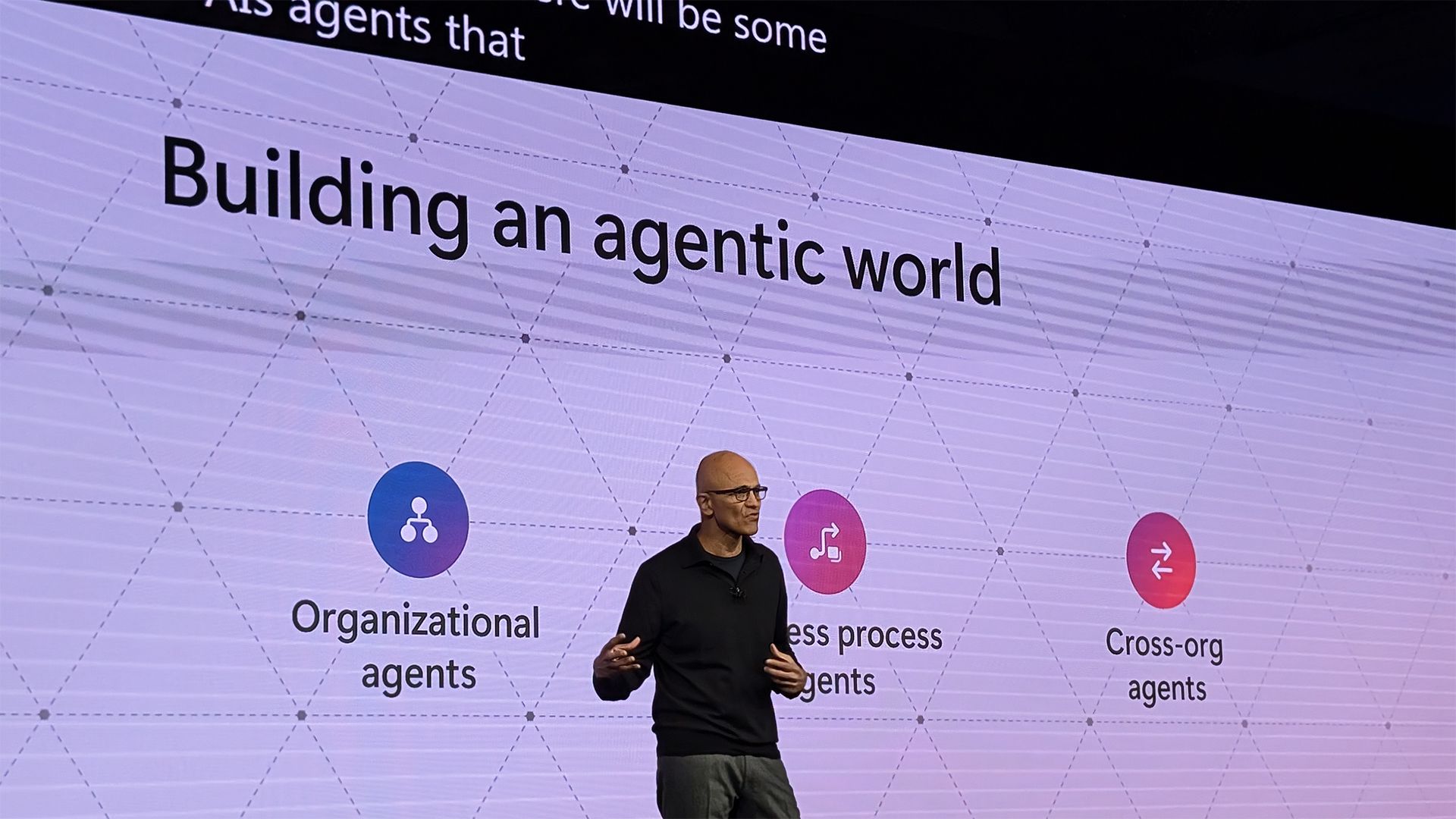
Microsoft CEO Satya Nadella talks up sovereign cloud credentials as firm announces general availability for Azure Local Disconnected, new capabilities for Foundry Local
As Microsoft hands more control to customers, Satya Nadella touts the tech giant’s growing sovereign ecosystem www.itpro.com
- Related coverage: windowscentral.com
A new Microsoft 365 'E7' subscription bundles Copilot and Agent 365
Microsoft adds a premium tier to 365 at $99 per user. Packed with AI features, experts still say the discount is slim and the value unclear. www.windowscentral.com
- Related coverage: tomshardware.com
Microsoft's vision of "AI-native" Windows is becoming real, update introduces agents that pilfer through your files — Latest Windows 11 Insider build includes experimental AI agents toggle that can perform tasks for you in the background
Microsoft states that agents read files in an isolated runtimewww.tomshardware.com
- Related coverage: licensingschool.co.uk
Loading…
www.licensingschool.co.uk - Related coverage: kleinloog.ch
Loading…
www.kleinloog.ch - Related coverage: notebookcheck.net

Windows 11 Insider Build 26300.8553 finally lets you customize the Start menu
Windows 11 Insider Preview Build 26300.8553 brings a modular Start menu with Small, Large, and Automatic size presets and new privacy tools to the Experimental channel. www.notebookcheck.net
- Official source: support.microsoft.com
Windows Copilot+ AI components - Microsoft Support
 support.microsoft.com
- Related coverage: pureinfotech.com
Loading…
pureinfotech.com - Related coverage: dataconomy.com

Windows 11 update adds major Start menu customization options
Microsoft is testing updates for Windows 11 that will enhance customization options for the Start menu and taskbar, with rollouts dataconomy.com