

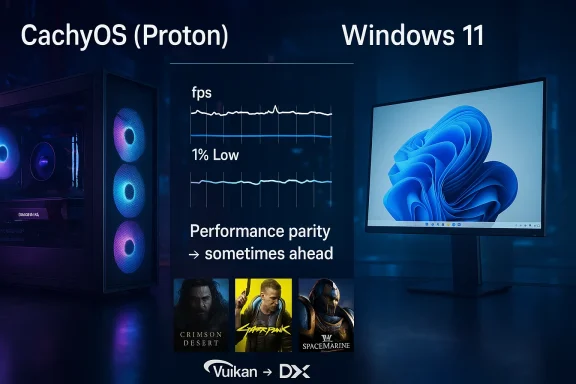
Linux gaming just scored one of its most eye-catching wins yet, and this time the headline is not about a niche indie title or a carefully cherry-picked benchmark. In a head-to-head comparison of more than 10 big-name games, CachyOS, an Arch-based Linux distribution tuned for performance, frequently matched or exceeded Windows 11 on the same AMD hardware. The results are especially striking because the games were not native Linux ports; they were running through Proton, the compatibility layer that has long been Linux gaming’s bridge to the Windows library.
That matters because the old assumption in PC gaming was simple: if you wanted the best frame rates, the broadest compatibility, and the fewest surprises, you installed Windows and called it a day. These new results suggest that, at least on certain AMD configurations and in the right software stack, Linux has moved from “good enough” to genuinely competitive — and in some cases, ahead. The shift is not absolute, and it is not universal, but it is no longer theoretical.
For years, Linux gaming existed in a frustrating middle ground. It offered open-source ideals, excellent customization, and strong general-purpose computing performance, but gaming support lagged behind Windows because most commercial titles were built for Microsoft’s platform first. Compatibility layers existed, but they were often slow, fiddly, and unreliable enough that enthusiasts treated them as experiments rather than everyday solutions.
That began to change in the late 2010s with Valve’s Proton initiative, which bundled Wine, DXVK, VKD3D-Proton, and other gaming-focused components into a more polished package. Proton did not simply help games launch; it steadily improved the practical reality of gaming on Linux by reducing the friction of setup, expanding compatibility, and enabling a growing percentage of the Windows catalog to run acceptably well. Over time, what had been a community workaround became a mainstream-enough layer for Steam Deck and desktop Linux users alike.
At the same time, the Linux ecosystem itself matured around gaming use cases. Distros such as CachyOS, Bazzite, and Nobara began shipping with performance-oriented kernels, tuned defaults, preconfigured gaming tools, and in some cases custom Proton builds. These distributions are not magical by themselves, but they reduce the number of missing pieces a user has to assemble manually. That can matter as much as raw kernel work, because gaming performance is often a sum of many small efficiencies rather than one giant breakthrough.
The reason these latest comparisons are grabbing attention is that they are not occurring in a vacuum. Linux gaming has been collecting incremental gains for several years, but benchmarks like this one suggest the gains are now large enough to affect real purchasing and platform decisions. In other words, the conversation is shifting from can Linux run my games? to which platform actually performs better for my hardware and my library?
The test setup itself is also important. Using an AMD Ryzen 5 5600X, a Radeon RX 6700 XT, 16GB of DDR4 memory, and a fast NVMe SSD is not exotic; it is a realistic gaming rig, not a lab-only monster. That makes the results more relevant to ordinary PC gamers, especially those already inclined toward AMD hardware because Linux tends to pair more naturally with open graphics drivers and the Mesa stack.
On Windows, the machine ran Windows 11 with AMD’s Adrenalin 26.3.1 drivers. On Linux, it used CachyOS with Mesa 26.0.3. That detail matters because gaming performance on Linux often depends less on the distro name and more on the exact driver and Mesa revisions in play. A few version bumps can alter shader compilation behavior, ray-tracing paths, and overall driver maturity.
The Ryzen 5 5600X also removes a lot of CPU-side ambiguity. It is a capable six-core Zen 3 chip with strong gaming performance and no special dependency on platform-specific scheduler tricks. If Linux wins here, the win is harder to dismiss as a weird edge case involving some unusual processor behavior.
A few practical implications follow from that:
The story repeated itself in other demanding games. Red Dead Redemption 2 reportedly averaged 85 FPS on Linux versus 81 FPS on Windows, while Cyberpunk 2077 climbed to 98 FPS on CachyOS compared with 91 FPS on Microsoft’s platform. These are especially notable because both titles are widely used as performance stress tests, and both can be sensitive to API behavior, driver quality, and shader compilation overhead.
In practical terms, this means Linux was not merely “close.” In several cases, it appeared smoother at the bottom end too. For gamers, that can matter more than a small average uplift, especially in open-world or combat-heavy titles where frametime spikes stand out.
The results also reinforce a broader point: Linux gaming is no longer living entirely on the margins of performance. It may still lose some titles, but the days of universal Windows dominance are not holding up under every benchmark.
That balance is actually healthy for interpreting the data. It suggests the Linux advantage is real but not automatic, and it probably depends on the game’s rendering pipeline, its anti-cheat setup, and how well it aligns with Proton’s current strengths. A fair reading is not “Linux always wins,” but rather Linux can now win often enough to be taken seriously.
Proton’s success rests on multiple layers of translation and optimization. Wine handles Windows application compatibility, while DXVK and VKD3D-Proton map DirectX workloads onto Vulkan. That stack has gotten better not only at getting games to launch, but at translating them efficiently enough that the overhead is often smaller than skeptics once believed.
Valve deserves enormous credit here, but so do the surrounding communities. Proton’s progress has been reinforced by Mesa updates, kernel work, gaming-oriented distros, and a culture of public testing. When a compatibility layer starts outperforming the native platform in select scenarios, it is a sign that the engineering stack has crossed a threshold.
That matters because performance gains are often cumulative. No single patch guarantees a win, but a tuned build, a fast graphics stack, and a sensible configuration can produce a result that looks surprisingly strong compared with stock Windows behavior. CachyOS is essentially betting that users want the distro to do more of that tuning work for them up front.
The distro’s gaming guide makes clear that it ships and recommends a curated package set, including cachyos-gaming-meta and cachyos-gaming-applications, and it explicitly frames proton-cachyos as a performance-oriented build. It also describes compatibility options such as
At the same time, an opinionated distro can also obscure what is doing the actual work. Is the gain coming from the kernel, from Mesa, from Proton, or from the game-specific configuration? The honest answer is usually “all of the above,” which is why reproducibility matters so much in this part of the Linux world.
It demonstrates that Linux gaming is not capped at some fixed performance ceiling. Instead, it is highly sensitive to distro policy, driver freshness, and compatibility-layer quality. That gives Linux a flexibility advantage, even if it also creates fragmentation.
This does not mean Nvidia is unusable on Linux, but it does mean the ceiling tends to be easier to reach with Radeon. The contrast is visible in many community comparisons, and it helps explain why AMD-based Linux benchmark results often look more favorable than Nvidia-based ones.
That is important when translating DirectX workloads through Vulkan. If the underlying Vulkan stack is strong, the compatibility layer has a much better chance of looking impressive. In a sense, Linux gaming’s progress is also a story about how far open graphics infrastructure has come.
The safest reading is that AMD + Linux is now a genuinely competitive combination, not a universally superior one. That is a big enough change on its own. It means Linux gaming is no longer defined by apology or compromise in every serious conversation.
For consumers, that opens the door to a more rational OS choice. If your library is mostly single-player or Proton-friendly, and your hardware is AMD-based, the old “Windows is automatically faster” assumption deserves scrutiny. The best platform may now depend more on your exact games than on the logo in the taskbar.
The consumer story may have the larger impact because gaming has historically been one of Windows’ strongest lock-in mechanisms. If that moat narrows, even by a little, the long-term consequences could be substantial. People are more willing to switch operating systems when the one thing keeping them pinned to Windows becomes less decisive.
That matters because the software stack in gaming is unusually sensitive to momentum. A driver improvement, a Proton update, or a kernel tweak can shift public perception in weeks, not years. Linux gaming has crossed into a phase where small technical advances can have outsized reputational effects.
There is also the problem of variability. A result from one AMD setup does not automatically predict outcomes on every GPU, CPU, monitor, or game profile. Small changes in driver version or Proton release can alter the picture, and that is before you account for differences in shader cache behavior, frame generation, or store launcher configurations.
So the real story is not that Linux has “won gaming.” It is that Linux has reached a point where it can win some benchmarks convincingly while remaining blocked by ecosystem policy in others. Those are very different realities, and both are true at once.
That is why Linux gaming needs not just faster numbers but fewer surprises. The progress shown here is meaningful precisely because it moves the platform closer to being a normal option rather than a hobbyist detour.
The market will also be shaped by where developers focus their optimization energy. If more games arrive with Vulkan-friendly engines, or if more studios test Linux-like compatibility paths during development, then the gap may continue to narrow without any single headline change. The ecosystem effect could matter more than any one benchmark result.
A few things are worth watching closely:
Source: TechSpot https://www.techspot.com/news/111908-linux-gaming-levels-up-cachyos-beats-windows-11.html
That matters because the old assumption in PC gaming was simple: if you wanted the best frame rates, the broadest compatibility, and the fewest surprises, you installed Windows and called it a day. These new results suggest that, at least on certain AMD configurations and in the right software stack, Linux has moved from “good enough” to genuinely competitive — and in some cases, ahead. The shift is not absolute, and it is not universal, but it is no longer theoretical.
 Background
For years, Linux gaming existed in a frustrating middle ground. It offered open-source ideals, excellent customization, and strong general-purpose computing performance, but gaming support lagged behind Windows because most commercial titles were built for Microsoft’s platform first. Compatibility layers existed, but they were often slow, fiddly, and unreliable enough that enthusiasts treated them as experiments rather than everyday solutions.That began to change in the late 2010s with Valve’s Proton initiative, which bundled Wine, DXVK, VKD3D-Proton, and other gaming-focused components into a more polished package. Proton did not simply help games launch; it steadily improved the practical reality of gaming on Linux by reducing the friction of setup, expanding compatibility, and enabling a growing percentage of the Windows catalog to run acceptably well. Over time, what had been a community workaround became a mainstream-enough layer for Steam Deck and desktop Linux users alike.
At the same time, the Linux ecosystem itself matured around gaming use cases. Distros such as CachyOS, Bazzite, and Nobara began shipping with performance-oriented kernels, tuned defaults, preconfigured gaming tools, and in some cases custom Proton builds. These distributions are not magical by themselves, but they reduce the number of missing pieces a user has to assemble manually. That can matter as much as raw kernel work, because gaming performance is often a sum of many small efficiencies rather than one giant breakthrough.
The reason these latest comparisons are grabbing attention is that they are not occurring in a vacuum. Linux gaming has been collecting incremental gains for several years, but benchmarks like this one suggest the gains are now large enough to affect real purchasing and platform decisions. In other words, the conversation is shifting from can Linux run my games? to which platform actually performs better for my hardware and my library?
The test setup itself is also important. Using an AMD Ryzen 5 5600X, a Radeon RX 6700 XT, 16GB of DDR4 memory, and a fast NVMe SSD is not exotic; it is a realistic gaming rig, not a lab-only monster. That makes the results more relevant to ordinary PC gamers, especially those already inclined toward AMD hardware because Linux tends to pair more naturally with open graphics drivers and the Mesa stack.
Why This Comparison Resonates
The headline is not merely that Linux did well. It is that Linux did well while emulating Windows games through a compatibility layer, and in several cases it did so with measurable gains in both average FPS and 1% lows. That combination is what makes the story feel bigger than a one-off win.- It challenges the idea that Windows is inherently the fastest gaming OS.
- It highlights the growing maturity of Proton and Mesa.
- It reinforces AMD’s stronger position in Linux gaming than Nvidia’s.
- It gives performance-minded users a reason to re-evaluate defaults.
- It shows that compatibility and performance are no longer mutually exclusive in every case.
The Benchmark Setup
The comparison centered on identical hardware, which is exactly what a credible platform test should do. The system used an AMD Ryzen 5 5600X, an RX 6700 XT, 16GB of DDR4 RAM, a 2TB NVMe SSD, a Corsair RM1000x PSU, and a Gigabyte X570 Aorus Elite motherboard. By keeping the hardware fixed, the test isolates the software side of the equation as cleanly as possible.On Windows, the machine ran Windows 11 with AMD’s Adrenalin 26.3.1 drivers. On Linux, it used CachyOS with Mesa 26.0.3. That detail matters because gaming performance on Linux often depends less on the distro name and more on the exact driver and Mesa revisions in play. A few version bumps can alter shader compilation behavior, ray-tracing paths, and overall driver maturity.
The Hardware Choice Matters
AMD is a particularly interesting test case for Linux because its GPU support on the open stack is generally stronger than Nvidia’s. Mesa’s RADV Vulkan driver, the AMDGPU kernel driver, and ongoing contributions from Valve and the broader ecosystem have made Radeon cards a practical choice for Linux gaming. This does not mean every AMD GPU is faster on Linux than on Windows, but it does mean AMD is the most plausible hardware partner for a performance-positive Linux story.The Ryzen 5 5600X also removes a lot of CPU-side ambiguity. It is a capable six-core Zen 3 chip with strong gaming performance and no special dependency on platform-specific scheduler tricks. If Linux wins here, the win is harder to dismiss as a weird edge case involving some unusual processor behavior.
Software Stack Differences
Linux gaming is rarely just “Linux.” It is a stack of layers: the distro, the kernel, Mesa, the compositor, the version of Proton, and often launch options or shader cache settings. The CachyOS result likely benefits from the distro’s performance-minded defaults and packaging, while Windows benefits from native game support and vendor driver integration.A few practical implications follow from that:
- Mesa can outperform vendor-provided Windows drivers in specific DirectX-to-Vulkan translation scenarios.
- Proton can sometimes reduce overhead compared with older expectations.
- 1% lows can improve even when average FPS gains are modest.
- Different titles may swing in opposite directions depending on how they stress shaders, memory, or API translation.
The Results in Context
The headline numbers are easy to understand, and they are precisely why this story travels so far. In Crimson Desert, Windows 11 reportedly averaged 59 FPS while CachyOS reached 63 FPS. In Warhammer 40,000: Space Marine 2, the gap widened significantly, with Windows at 68 FPS and CachyOS at 81 FPS. Those are not tiny cosmetic differences; they are the kind of margins players can feel during motion-heavy scenes.The story repeated itself in other demanding games. Red Dead Redemption 2 reportedly averaged 85 FPS on Linux versus 81 FPS on Windows, while Cyberpunk 2077 climbed to 98 FPS on CachyOS compared with 91 FPS on Microsoft’s platform. These are especially notable because both titles are widely used as performance stress tests, and both can be sensitive to API behavior, driver quality, and shader compilation overhead.
Why 1% Lows Matter
Average FPS can flatter a system that still feels uneven in play. That is why the reported gains in 1% lows are so important. Better low-frame-time behavior often translates into less hitching, smoother camera motion, and a more stable sense of responsiveness, even when the average number looks only moderately different.In practical terms, this means Linux was not merely “close.” In several cases, it appeared smoother at the bottom end too. For gamers, that can matter more than a small average uplift, especially in open-world or combat-heavy titles where frametime spikes stand out.
The results also reinforce a broader point: Linux gaming is no longer living entirely on the margins of performance. It may still lose some titles, but the days of universal Windows dominance are not holding up under every benchmark.
The Exceptions Still Count
The benchmark was not a one-way sweep. The First Descendant ran better on Windows, at 63 FPS versus 54 FPS on CachyOS, even with FSR 3 Native upscaling enabled. The Division 2 was effectively tied at 128 FPS average, though Windows had slightly steadier lows.That balance is actually healthy for interpreting the data. It suggests the Linux advantage is real but not automatic, and it probably depends on the game’s rendering pipeline, its anti-cheat setup, and how well it aligns with Proton’s current strengths. A fair reading is not “Linux always wins,” but rather Linux can now win often enough to be taken seriously.
Proton’s Growing Maturity
The single biggest reason this comparison matters is that the games were not native Linux builds. They were run through Proton, which has evolved from an experimental compatibility layer into a robust performance platform for a large chunk of the Windows catalog. That evolution is one of the most important stories in PC gaming over the last decade.Proton’s success rests on multiple layers of translation and optimization. Wine handles Windows application compatibility, while DXVK and VKD3D-Proton map DirectX workloads onto Vulkan. That stack has gotten better not only at getting games to launch, but at translating them efficiently enough that the overhead is often smaller than skeptics once believed.
From Compatibility to Performance
Early Linux gaming discussions focused on whether a game would boot. Today, the question is increasingly whether it can run well enough to be competitive with native Windows. That is a profound shift because the bottleneck moved from “does it work?” to “does it perform better or worse than the default platform?”Valve deserves enormous credit here, but so do the surrounding communities. Proton’s progress has been reinforced by Mesa updates, kernel work, gaming-oriented distros, and a culture of public testing. When a compatibility layer starts outperforming the native platform in select scenarios, it is a sign that the engineering stack has crossed a threshold.
Why Custom Proton Builds Help
CachyOS does not rely on stock settings alone. Its gaming guidance points to proton-cachyos, a custom Proton build that includes additional quality-of-life changes, selected patches, and compilation optimizations. The distro’s documentation also recommends gaming packages and tools like Gamescope, MangoHud, and launchers such as Steam, Lutris, and Heroic to create a more complete gaming environment.That matters because performance gains are often cumulative. No single patch guarantees a win, but a tuned build, a fast graphics stack, and a sensible configuration can produce a result that looks surprisingly strong compared with stock Windows behavior. CachyOS is essentially betting that users want the distro to do more of that tuning work for them up front.
Why CachyOS Keeps Appearing in Benchmark Headlines
CachyOS has become one of the more visible gaming-focused Linux distributions because it is not trying to be generic. It leans into performance tuning, modern CPU targets, and gaming-friendly defaults rather than pretending that one configuration should suit every user. That philosophy resonates in benchmarking, because a tuned distro can show what Linux is capable of when it is not held back by conservative defaults.The distro’s gaming guide makes clear that it ships and recommends a curated package set, including cachyos-gaming-meta and cachyos-gaming-applications, and it explicitly frames proton-cachyos as a performance-oriented build. It also describes compatibility options such as
proton-cachyos-slr, and even notes support strategies for anti-cheat-sensitive titles.The Value of Opinionated Defaults
An opinionated distro can be a real advantage for gaming because users do not always know which pieces matter. If the system comes with the right tools, graphics stack, and launch options, many of the hardest-to-debug bottlenecks are already addressed. That is especially useful for users migrating from Windows, who may not want to spend their first weekend reading forum posts about shader caches.At the same time, an opinionated distro can also obscure what is doing the actual work. Is the gain coming from the kernel, from Mesa, from Proton, or from the game-specific configuration? The honest answer is usually “all of the above,” which is why reproducibility matters so much in this part of the Linux world.
Why Not All Distros Will Match It
CachyOS is not necessarily a blueprint every distro can or should copy. Aggressive tuning can help one workload while hurting another, and the Linux ecosystem thrives on diversity rather than one-size-fits-all decisions. But the fact that a distro like CachyOS can show such results is a powerful proof of concept.It demonstrates that Linux gaming is not capped at some fixed performance ceiling. Instead, it is highly sensitive to distro policy, driver freshness, and compatibility-layer quality. That gives Linux a flexibility advantage, even if it also creates fragmentation.
AMD, Mesa, and the Hardware Story
The hardware combination in this comparison is probably the best possible case for Linux gaming right now: AMD CPU, AMD GPU, open graphics stack. That matters because the Linux graphics ecosystem is particularly strong around AMD support, and Mesa has matured into a first-class gaming driver stack. The result is that Linux often finds its best performance stories where AMD is involved.This does not mean Nvidia is unusable on Linux, but it does mean the ceiling tends to be easier to reach with Radeon. The contrast is visible in many community comparisons, and it helps explain why AMD-based Linux benchmark results often look more favorable than Nvidia-based ones.
Mesa as a Competitive Weapon
A lot of Windows users think of open-source graphics drivers as a compromise. In practice, Mesa has become a major competitive asset for Linux gaming. Its fast pace of development, tight integration with the kernel, and ongoing optimization work from multiple contributors make it a serious performance player, not just a compatibility shim.That is important when translating DirectX workloads through Vulkan. If the underlying Vulkan stack is strong, the compatibility layer has a much better chance of looking impressive. In a sense, Linux gaming’s progress is also a story about how far open graphics infrastructure has come.
The AMD Advantage Is Not Guaranteed
Still, the AMD advantage should not be overgeneralized. Performance can vary dramatically by title, by driver version, and by whether the game leans heavily on ray tracing, upscaling, or anti-cheat systems. Some titles will always favor the Windows-native path because that is where the developers optimized first.The safest reading is that AMD + Linux is now a genuinely competitive combination, not a universally superior one. That is a big enough change on its own. It means Linux gaming is no longer defined by apology or compromise in every serious conversation.
What the Mixed Results Say About the Market
The most interesting part of these results is not the wins themselves but the pattern. Linux is winning often enough to matter, losing often enough to stay honest, and tying often enough to prove parity is no longer fantasy. That creates a market dynamic Windows has not had to worry about much in the past: a credible alternative platform that can sometimes perform better on the same hardware.For consumers, that opens the door to a more rational OS choice. If your library is mostly single-player or Proton-friendly, and your hardware is AMD-based, the old “Windows is automatically faster” assumption deserves scrutiny. The best platform may now depend more on your exact games than on the logo in the taskbar.
Consumer vs. Enterprise Implications
For consumers, the gains are direct and immediate. Better gaming performance, stronger frametimes, and a more customizable desktop can all make Linux appealing to users who once stayed on Windows purely for gaming. For enterprises, the significance is subtler: it shows how mature the Linux desktop stack has become, even if most businesses are not choosing distributions based on game benchmarks.The consumer story may have the larger impact because gaming has historically been one of Windows’ strongest lock-in mechanisms. If that moat narrows, even by a little, the long-term consequences could be substantial. People are more willing to switch operating systems when the one thing keeping them pinned to Windows becomes less decisive.
Competition Changes Behavior
Benchmark headlines also shape vendor behavior. Microsoft, AMD, Valve, and Linux distro maintainers all have incentives to keep performance moving upward. A public comparison that shows Linux winning a few recognizable titles creates pressure to keep shipping improvements quickly and visibly.That matters because the software stack in gaming is unusually sensitive to momentum. A driver improvement, a Proton update, or a kernel tweak can shift public perception in weeks, not years. Linux gaming has crossed into a phase where small technical advances can have outsized reputational effects.
The Limits of the Story
It is tempting to read these results as the beginning of Windows’ gaming decline, but that would be overstating the case. Windows still owns the broadest developer support, the most predictable anti-cheat compatibility, and the safest path for gamers who do not want to think about translation layers at all. For many people, convenience still beats benchmark superiority.There is also the problem of variability. A result from one AMD setup does not automatically predict outcomes on every GPU, CPU, monitor, or game profile. Small changes in driver version or Proton release can alter the picture, and that is before you account for differences in shader cache behavior, frame generation, or store launcher configurations.
Anti-Cheat Remains a Real Barrier
The biggest non-performance obstacle is still compatibility with anti-cheat systems. Even if Linux can match or beat Windows in raw frame rates, that advantage is limited if a favorite multiplayer title refuses to cooperate. This is where Windows retains its practical upper hand for many users, especially competitive gamers who live in anti-cheat-heavy ecosystems.So the real story is not that Linux has “won gaming.” It is that Linux has reached a point where it can win some benchmarks convincingly while remaining blocked by ecosystem policy in others. Those are very different realities, and both are true at once.
Benchmarks Are Not Experiences
A benchmark is a snapshot, not a life. It measures a specific scene, a specific run, and a specific stack of software decisions. Players, meanwhile, care about launch reliability, alt-tabbing, controller support, overlays, update behavior, voice chat, and the ability to keep their game library working after a patch.That is why Linux gaming needs not just faster numbers but fewer surprises. The progress shown here is meaningful precisely because it moves the platform closer to being a normal option rather than a hobbyist detour.
Strengths and Opportunities
The biggest strength in this story is that Linux is now demonstrating credible, repeatable gaming performance on mainstream AMD hardware. That opens real opportunities for users, distro maintainers, and vendors who want to challenge Windows’ default status in PC gaming.- Performance parity or advantage in selected titles on AMD hardware.
- Better 1% lows in multiple games, which improves perceived smoothness.
- Proton maturity that turns compatibility into a practical advantage.
- CachyOS packaging that reduces setup friction for users.
- Open graphics stack momentum through Mesa and AMDGPU.
- More choice for consumers who want to leave Windows behind.
- Community-driven innovation that can move faster than larger vendor cycles.
Risks and Concerns
For all the optimism, there are still meaningful constraints that can keep Linux gaming from becoming universally dominant. Compatibility and consistency remain the main friction points, and a great benchmark can still coexist with a poor user experience for certain titles or hardware combinations.- Anti-cheat incompatibility still blocks many multiplayer games.
- Per-game variability makes blanket recommendations risky.
- Driver/version sensitivity means gains may disappear after updates.
- Nvidia users may not see the same uplift as AMD users.
- Fragmentation across distros and Proton builds can confuse newcomers.
- Benchmark cherry-picking can distort the bigger picture if overread.
- Support burden remains higher for users who want to troubleshoot edge cases.
Looking Ahead
The next phase of Linux gaming will likely be less about dramatic breakthroughs and more about steady compression of the remaining gaps. If Proton keeps improving, Mesa keeps advancing, and gaming distros keep smoothing the setup experience, then Linux will continue to win more of the battles that once seemed out of reach. The question is no longer whether Linux can be fast; it is whether the ecosystem can make fast consistent.The market will also be shaped by where developers focus their optimization energy. If more games arrive with Vulkan-friendly engines, or if more studios test Linux-like compatibility paths during development, then the gap may continue to narrow without any single headline change. The ecosystem effect could matter more than any one benchmark result.
A few things are worth watching closely:
- Whether more games repeat these Linux wins on similar AMD hardware.
- How quickly Proton and Mesa updates change results from month to month.
- Whether anti-cheat vendors expand support for Linux-friendly configurations.
- How Nvidia responds if Linux performance momentum keeps building.
- Whether mainstream distros adopt more gaming-first defaults inspired by CachyOS.
Source: TechSpot https://www.techspot.com/news/111908-linux-gaming-levels-up-cachyos-beats-windows-11.html
