

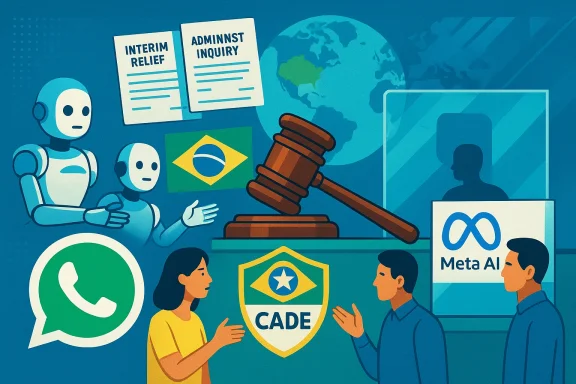
Brazil’s competition authority has taken the brakes off a change that would have shut rival AI assistants out of WhatsApp, issuing interim measures that suspend Meta’s October 2025 Business Solution Terms and preserve third‑party AI access for Brazilian users while a full inquiry proceeds. The decision — published as an administrative inquiry and immediate interim relief — is the latest front in a transatlantic regulatory push that already forced Italy to block the same policy and prompted EU scrutiny. The rulings pause a globally scheduled January 15, 2026 enforcement that would have effectively left Meta’s own Meta AI as the principal in‑app assistant across WhatsApp’s massive user base.
WhatsApp’s Business Solution Terms update, published in October 2025, introduced an explicit prohibition on “AI providers” using the WhatsApp Business API to distribute general‑purpose conversational assistants when those assistants are the provider’s primary product. The stated exception preserves AI used incidentally as part of customer‑service or transactional workflows, but the effect would have been to stop open‑ended assistants such as ChatGPT, Microsoft Copilot, Perplexity and numerous regional startups from operating via WhatsApp’s business channel. Meta set a January 15, 2026 enforcement date and offered a 90‑day migration window for developers and users.
Regulators in Europe and Brazil pushed back. Italy’s competition authority (AGCM) imposed precautionary measures on December 24, 2025, ordering Meta to suspend the exclusionary terms in Italy. Shortly thereafter, Brazil’s Administrative Council for Economic Defense (CADE) opened an administrative inquiry and issued interim relief on January 12, 2026, suspending the terms across Brazil pending full investigation. Those interventions produced operational carve‑outs: Meta informed developers that AI providers need not cease responding to users whose numbers carry Italian or Brazilian country codes, even though the restrictions went into effect elsewhere.
Why this matters immediately is straightforward: WhatsApp is not a fringe distribution channel in Brazil. Multiple market estimates place WhatsApp’s active footprint in Brazil well into the hundreds of millions; industry research and market trackers put the user base in the 140–150 million range and show near‑ubiquitous installation and daily usage among smartphone owners. That concentration makes access to WhatsApp a critical distribution and training channel for conversational AI services that rely on messaging contexts and conversational volumes to refine models and grow user engagement.
CADE frames the case under classic doctrines against leveraging market power: a dominant platform may not lawfully use control over an essential distribution channel to distort adjacent markets unless the conduct is strictly necessary and proportionate. The agency argued that a less restrictive set of remedies is plausible and that the total exclusion of third‑party assistants — while permitting Meta’s own assistant to remain — raises strong competitive concerns at a formative stage of AI markets. That reasoning mirrors the EU/Italian approach to platform self‑preferencing in adjacent digital services.
Regulators and competition agencies treated those claims as merit defenses better explored during a full proceeding, not a threshold reason to deny interim relief. CADE and Italy’s AGCM concluded that the prima facie indicators of exclusionary leveraging — including a pattern where Meta initially allowed third‑party bots, then introduced Meta AI with privileged in‑app prominence, and then moved to exclude competitors entirely — justified urgent, reversible measures to prevent irreversible market foreclosure. In short: infrastructure and design arguments can matter, but they do not automatically justify complete exclusion where less restrictive alternatives exist.
But competition authorities flagged two weaknesses:
For developers, marketers and policymakers, the episode is a clear warning: distribution channels owned by dominant platforms are strategic assets not easily replicated, and policies that alter access to those channels can reshape nascent industries. The ultimate legal outcome will matter enormously for the architecture of the AI ecosystem: whether the market remains contestable with multiple assistants distributed across diverse channels, or whether a handful of vertically integrated platforms control the primary interfaces to billions of users.
The next chapters — CADE’s full inquiry, potential judicial challenges, and the European proceedings — will decide whether regulators can shape access rules that preserve contestability while allowing platforms to manage legitimate operational constraints. Until final rulings are issued, third‑party AI providers gain breathing room in Brazil and Italy, but the long arc of this dispute promises to define the rules of platform competition in the AI era.
Source: PPC Land Brazil blocks Meta's WhatsApp AI chatbot ban in surprise move
 Background
WhatsApp’s Business Solution Terms update, published in October 2025, introduced an explicit prohibition on “AI providers” using the WhatsApp Business API to distribute general‑purpose conversational assistants when those assistants are the provider’s primary product. The stated exception preserves AI used incidentally as part of customer‑service or transactional workflows, but the effect would have been to stop open‑ended assistants such as ChatGPT, Microsoft Copilot, Perplexity and numerous regional startups from operating via WhatsApp’s business channel. Meta set a January 15, 2026 enforcement date and offered a 90‑day migration window for developers and users. Regulators in Europe and Brazil pushed back. Italy’s competition authority (AGCM) imposed precautionary measures on December 24, 2025, ordering Meta to suspend the exclusionary terms in Italy. Shortly thereafter, Brazil’s Administrative Council for Economic Defense (CADE) opened an administrative inquiry and issued interim relief on January 12, 2026, suspending the terms across Brazil pending full investigation. Those interventions produced operational carve‑outs: Meta informed developers that AI providers need not cease responding to users whose numbers carry Italian or Brazilian country codes, even though the restrictions went into effect elsewhere.
Why this matters immediately is straightforward: WhatsApp is not a fringe distribution channel in Brazil. Multiple market estimates place WhatsApp’s active footprint in Brazil well into the hundreds of millions; industry research and market trackers put the user base in the 140–150 million range and show near‑ubiquitous installation and daily usage among smartphone owners. That concentration makes access to WhatsApp a critical distribution and training channel for conversational AI services that rely on messaging contexts and conversational volumes to refine models and grow user engagement.
CADE’s action: what it ordered and why
The administrative move and its legal logic
CADE’s Office of the Superintendent‑General launched an administrative inquiry into Meta on January 12 and issued a preventive measure suspending application of the new WhatsApp Business Solution Terms pending a thorough probe. In its public notice, CADE explained the measure aims to “preserve competition conditions” while it assesses whether the contractual changes could close markets, exclude competitors, and unduly favor Meta’s proprietary AI service. The agency’s action rests on prima facie findings that WhatsApp’s position in Brazil is dominant and that the new terms could foreclose third‑party AI providers from a market‑defining channel.CADE frames the case under classic doctrines against leveraging market power: a dominant platform may not lawfully use control over an essential distribution channel to distort adjacent markets unless the conduct is strictly necessary and proportionate. The agency argued that a less restrictive set of remedies is plausible and that the total exclusion of third‑party assistants — while permitting Meta’s own assistant to remain — raises strong competitive concerns at a formative stage of AI markets. That reasoning mirrors the EU/Italian approach to platform self‑preferencing in adjacent digital services.
What CADE actually ordered (and what is unclear)
- CADE suspended the enforcement of the new WhatsApp Business Solution Terms for Brazil while it investigates.
- The agency stated it will gather evidence, notify parties, and decide whether to open a formal administrative proceeding.
- Several outlets and secondary reports have stated CADE’s interim order included daily fines for non‑compliance (reported figures of R$250,000 per day circulate in media summaries), but the public CADE notice does not display the full interim decision text with penalty details in its English summary; that element appears in some journalistic accounts and should be treated as reported rather than definitively established absent the official docket extract. Readers should treat the specific fine number as reported by press coverage pending confirmation from the full CADE decision text.
What Meta said — and how regulators responded
Meta’s central defense is operational and commercial. The company told regulators that the WhatsApp Business API was built for predictable enterprise messaging — order confirmations, appointment reminders, transactional support — not open‑ended conversational assistants that generate long, high‑volume sessions and unpredictable content. Meta argued those third‑party bots imposed undue infrastructure, moderation and support burdens on WhatsApp’s Business Platform and that providers were effectively “free‑riding” on Meta’s infrastructure without paying for the resources consumed. Meta characterized the October change as a business decision to protect paid commercial messaging investments rather than an anticompetitive maneuver.Regulators and competition agencies treated those claims as merit defenses better explored during a full proceeding, not a threshold reason to deny interim relief. CADE and Italy’s AGCM concluded that the prima facie indicators of exclusionary leveraging — including a pattern where Meta initially allowed third‑party bots, then introduced Meta AI with privileged in‑app prominence, and then moved to exclude competitors entirely — justified urgent, reversible measures to prevent irreversible market foreclosure. In short: infrastructure and design arguments can matter, but they do not automatically justify complete exclusion where less restrictive alternatives exist.
The competitive and technical stakes
Why distribution on WhatsApp matters to AI
- Scale and data: access to tens or hundreds of millions of users provides rapid feedback loops and training data for personalization, contextual understanding and safety‑related improvements. The quantity and quality of conversational signals gathered through in‑app interactions can materially accelerate model development and user‑experience tuning. Exclusive access to such signals confers a learning advantage that rivals cannot easily replicate.
- Habit formation and switching costs: integrating an AI assistant into the primary messaging hub where users already communicate creates a sticky experience. As users form habits with an integrated assistant, network effects and behavioral inertia increase switching costs for later entrants. Regulator interventions cited the risk that an exclusionary policy at this formative stage could entrench a single provider.
- Distribution economics: smaller AI startups often rely on low‑friction channels — a WhatsApp contact, a messenger integration — to reach users without the overheadd of native apps, broad platform distribution, or paid marketing. Removing that channel sharply raises customer acquisition costs and can kill nascent competitors.
Meta’s infrastructure argument — real problem, overstated remedy?
Meta’s technical claim is not inherently implausible. Conversational assistants can produce high token counts, long threads, media payloads, and unpredictable content types that increase moderation burdens and rate pressure. Platforms have legitimate rights to design their APIs and manage load and abuse risks.But competition authorities flagged two weaknesses:
- Proportionality: regulators asked whether Meta’s infrastructure constraints required a global, categorical ban, or whether targeted technical controls (rate limits, message quotas, differentiated service tiers, explicit paid throughput for high‑volume integrations, authenticated account linkages, signed sessions, or stricter content‑safety pipelines) could address the operational burdens without excluding competitors completely. CADE emphasized the “least restrictive means” principle.
- Timing and prior conduct: Meta’s announced sequence — allowing third‑party bots, launching Meta AI, then imposing exclusionary terms — strengthens the inference that the policy could be a design to advantage an affiliated product rather than a neutral infrastructure optimization. Regulators noted Meta’s own ability to continue offering Meta AI while cutting off rivals is a salient factor in assessing likely competitive effects.
Operational complexity and the immediate market effects
Dual policy footprints and geographic fragmentation
With Italy and Brazil exempted by regulatory orders, Meta now faces a bifurcated enforcement regime: the Business Solution Terms apply globally in most jurisdictions, but not to phone numbers registered in Italy or Brazil. That creates several near‑term operational and enforcement headaches:- Developer complexity: AI providers now must implement geofencing logic tied to phone‑number country codes, manage divergent behavior and support policies, and test cross‑border user flows.
- Arbitrage risk: regulatory carve‑outs create potential circumvention pathways where users or providers exploit Brazilian or Italian registrations to deliver services that remain blocked elsewhere. Meta can choose additional technical controls to limit such workarounds, but doing so risks further regulatory pushback and could implicate other legal obligations.
- Data flows and model training: providers who keep Brazilian access retain conversational logs and engagement signals that feed model refinement. That continuing data inflow may be competitively significant if the exemption persists over months or years.
Impact on AI providers and businesses
- Small startups: many relied on WhatsApp as a zero‑install, low‑friction distribution channel. The initial policy threatened to sever a go‑to market route for consumer assistants; CADE’s order preserves that lifeline at least for Brazil. Maintaining access in a top‑tier market matters for growth, investor confidence and model development.
- Big players: OpenAI and Microsoft publicly signaled they would withdraw in response to the global ban; the regulatory carve‑outs allow those vendors to maintain operations in exempted territories if they choose. However, maintaining patchwork integrations at scale is operationally costly and may diminish the incentive to invest in WhatsApp as a primary channel.
- Advertisers and marketers: firms building customer‑facing AI experiences on WhatsApp avoid sudden disruption in Brazil. Nevertheless, the case highlights broader exposure for any business whose operations depend on platform access: unilateral policy changes by gatekeepers can destroy business models overnight unless regulated. CADE’s intervention does not prevent future restrictions if ultimately justified; it only forestalls immediate foreclosure.
Legal and regulatory landscape: comparisons and precedent
Italy and the EU track
Italy’s AGCM acted first among national regulators to block the terms on proportionality and foreclosure grounds, and the European Commission opened its own proceedings aimed at gatekeeper behavior in AI distribution. Those European moves provided a template for CADE’s reasoning, particularly the notion that dominant platforms have a “special responsibility” to avoid exclusionary conduct that can harm contestability. CADE explicitly invoked similar principles as it weighed interim measures. The coordinated enforcement pattern underscores how national regulators use cross‑jurisdictional findings to inform domestic emergency relief.U.S. antitrust context — different lens, different result
Notably, a U.S. federal judge dismissed the FTC’s broader monopolization claim against Meta’s social networks in late 2025, finding sufficient competition from other large platforms in the social media space. That divergence highlights how market definition and dominance analyses vary with the product scope and geography. WhatsApp’s near‑ubiquity in Brazil yields a very different competitive posture than Facebook’s position in U.S. social feeds. The result is legal fragmentation that forces global platforms to navigate distinct local rules rather than a single global standard.What to watch next: scenarios and timelines
Short term (weeks to months)
- CADE’s formal administrative inquiry will gather evidence, solicit Meta’s submissions and take testimony from affected AI providers and market participants. The authority may open a full administrative proceeding or dismiss the inquiry after review. Interim relief remains in force while CADE proceeds.
- Meta may seek judicial review of CADE’s interim measure or attempt to negotiate limited operational workarounds (rate limits, payment tiers, authenticated integrations) that address infrastructure concerns without full exclusion. Any such technical fixes will be scrutinized for whether they are genuinely proportionate or function as covert barriers.
- Other national regulators in Latin America and elsewhere will watch closely; Brazil’s action could catalyze similar inquiries in markets where WhatsApp is dominant. Coordinated investigations increase pressure on gatekeepers to justify access restrictions.
Medium to long term (months to years)
- If regulators ultimately find abuse of dominance, CADE and AGCM could impose remedies ranging from structural fixes (mandatory interoperability or data‑access rules) to behavioral remedies (non‑discrimination obligations, transparent enforcement thresholds). Remedies may shape how platforms design APIs and monetize business messaging.
- If Meta successfully defends its policy on operational necessity grounds, the case could set a precedent allowing gatekeepers more latitude to restrict third‑party AI access on platformed messaging services. That outcome would accelerate vertical consolidation and favor incumbent platform‑integrated assistants.
- Regardless of the final ruling, litigation and administrative proceedings will likely run for many months and produce guidance (or ambiguity) about how competition law applies to nascent AI markets. The results will influence business strategies, developer investments and regulatory frameworks globally.
Practical takeaways for technology teams, marketers and policymakers
- For AI startups: preserve user relationships and data ownership wherever possible. Relying on platform channels for primary distribution is a brittle strategy; diversify channels and build authenticated account models that can survive policy churn. Learn to design fallback experiences and prioritize portable identity and export tools for users.
- For platform engineers: if infrastructure strain is the legitimate problem, implement transparent, verifiable technical measures that regulators and partners can audit: rate limits, paid throughput tiers for high‑volume assistants, session signing, stronger abuse detection and formalized support contracts. Proportionality and transparency matter for defending policy choices.
- For advertisers and brands: the case is a reminder to treat platform access as a strategic dependency risk. Regulatory relief can be temporary and slow; contingency planning is necessary when your customer‑facing stack sits on third‑party gatekeepers.
- For policymakers: the pandemic of platform self‑preferencing in adjacent services demonstrates a need for clearer rules on access, non‑discrimination and data use in multisided markets. Interim measures are a powerful tool to prevent irreversible foreclosure while investigations run, but long‑term legal frameworks must balance innovation incentives with contestability.
Strengths and limitations of the available evidence
- Confirmed facts: CADE publicly announced an administrative inquiry and interim relief in mid‑January; Italy’s AGCM imposed precautionary measures in late December; the EU opened formal proceedings tied to WhatsApp’s new terms; and Meta implemented the Business Solution Terms with a planned January 15 enforcement date. These events are documented in competition‑authority announcements and reputable press coverage.
- Corroborated market facts: independent market trackers and research services consistently report WhatsApp’s high penetration in Brazil (roughly 140–150 million users and very high daily usage among smartphone owners), supporting the CADE assertion that WhatsApp is an essential distribution channel in the country. Those penetration figures appear in Statista and market reports.
- Reported but not fully verified items: certain specific numbers in media summaries — notably the exact daily penalty figure of R$250,000 tied to CADE’s interim order — appear in several press accounts and aggregators but are not clearly published in CADE’s English summary notice. The precise operational claims by Meta about three system failures caused by third‑party bots and the exact internal metrics behind “infrastructure burden” are Meta’s submissions to regulators and, while reported by secondary outlets, should be treated as company claims that warrant independent technical verification. These items are flagged where cited and require consultation of the official CADE order and Meta’s formal filings for definitive confirmation.
Conclusion
CADE’s interim measure is more than a national tweak: it is a marker that competition authorities are ready to treat platform distribution as a core competitive battleground for AI services. The Brazilian decision — echoing Italy’s earlier move and sitting alongside EU inquiries — preserves third‑party AI access to a large and consequential market while regulators weigh whether Meta’s policy is a legitimate capacity management step or an exclusionary tactic that would entrench Meta AI at the expense of rivals.For developers, marketers and policymakers, the episode is a clear warning: distribution channels owned by dominant platforms are strategic assets not easily replicated, and policies that alter access to those channels can reshape nascent industries. The ultimate legal outcome will matter enormously for the architecture of the AI ecosystem: whether the market remains contestable with multiple assistants distributed across diverse channels, or whether a handful of vertically integrated platforms control the primary interfaces to billions of users.
The next chapters — CADE’s full inquiry, potential judicial challenges, and the European proceedings — will decide whether regulators can shape access rules that preserve contestability while allowing platforms to manage legitimate operational constraints. Until final rulings are issued, third‑party AI providers gain breathing room in Brazil and Italy, but the long arc of this dispute promises to define the rules of platform competition in the AI era.
Source: PPC Land Brazil blocks Meta's WhatsApp AI chatbot ban in surprise move
