

CAEVES says its new AI-powered Deep Storage™ platform for Microsoft Azure will turn long-forgotten archives from cost centers into “AI-ready” assets — promising up to 70% lower TCO, semantic search across millions of files, and integration with Microsoft 365 Copilot so archived content can be queried directly in an enterprise Copilot environment. These claims, announced in a company press release and echoed across trade outlets and the vendor’s own site, position CAEVES as a storage-and-AI bridge for enterprises wrestling with sprawling, unstructured archives and the operational friction of legacy tape and archive systems.
Legacy archives are a well-known headache for enterprises: the majority of corporate data is unstructured (documents, emails, images), and a large portion is created once and rarely accessed again — the so-called “dark data” problem. CAEVES’s pitch is simple: keep the low-cost economics of deep, cold storage while adding an AI indexing and retrieval plane so that data can be searched, semantically queried, and used by modern AI services such as Microsoft 365 Copilot without mass rehydrations or costly migrations. The vendor frames the product as a cloud-native solution that deploys inside a customer’s own Azure environment and integrates with Microsoft identity, governance, and AI services. CAEVES has published a product presence for the offering on the Azure Marketplace and on its corporate site, and several industry outlets have republished the company’s announcement in early November 2025. The vendor says the product will be available via the Microsoft Azure Marketplace starting November 18, 2025, with pre-launch webinars and demonstrations scheduled ahead of general availability.
However, headline numbers such as “70% TCO reduction” and “50× faster search” are vendor assertions that require reproducible benchmarks and transparent assumptions. Technical teams should insist on pilot tests that use representative datasets and query mixes, validate permission enforcement via Entra ID and Azure RBAC, and map expected data flows for accurate network-cost modeling. Microsoft’s published storage redundancy guarantees and bandwidth pricing pages are useful anchors when evaluating CAEVES’s claims about durability and egress costs, but final economics will always be customer-specific. For enterprises with heavy archive burdens and strict compliance requirements, CAEVES could be a practical option to explore — provided procurement teams demand measurable evidence, clear governance controls, and contractual protections that make the vendor’s promises auditable and repeatable in production environments.
Source: FinancialContent https://markets.financialcontent.co...s-ai-powered-deep-storage-on-microsoft-azure/
 Background / Overview
Legacy archives are a well-known headache for enterprises: the majority of corporate data is unstructured (documents, emails, images), and a large portion is created once and rarely accessed again — the so-called “dark data” problem. CAEVES’s pitch is simple: keep the low-cost economics of deep, cold storage while adding an AI indexing and retrieval plane so that data can be searched, semantically queried, and used by modern AI services such as Microsoft 365 Copilot without mass rehydrations or costly migrations. The vendor frames the product as a cloud-native solution that deploys inside a customer’s own Azure environment and integrates with Microsoft identity, governance, and AI services. CAEVES has published a product presence for the offering on the Azure Marketplace and on its corporate site, and several industry outlets have republished the company’s announcement in early November 2025. The vendor says the product will be available via the Microsoft Azure Marketplace starting November 18, 2025, with pre-launch webinars and demonstrations scheduled ahead of general availability. What CAEVES claims — the headline promises
CAEVES’s press materials (and the company website) lead with a handful of measurable-sounding claims. These are the points likely to catch procurement and architecture teams’ attention:- “Up to 70% lower Total Cost of Ownership (TCO) compared with traditional archive and tape systems.”
- Search performance improvements (claimed 50× faster) than conventional archive search engines.
- AI-powered indexing and semantic search that enables natural-language queries and research-driven workflows across millions of archived files.
- Integration with Microsoft 365 Copilot and Azure AI services, enabling archived content to feed enterprise Copilot search and in-house LLM training pipelines while keeping data inside the customer’s Azure tenancy.
- Data durability and availability claims tied to Azure infrastructure, citing Microsoft’s storage durability (the press materials reference Azure’s platform durability). Independent Microsoft documentation shows Azure storage redundancy options with very high durability guarantees depending on the replication option chosen.
- Elimination of egress fees within Microsoft Azure, a point phrased in the press release as a cost-efficiency advantage. The operational meaning of this claim requires careful unpacking against Microsoft’s published bandwidth and transfer pricing.
How the product is positioned and how it reportedly works
Architecture and deployment model
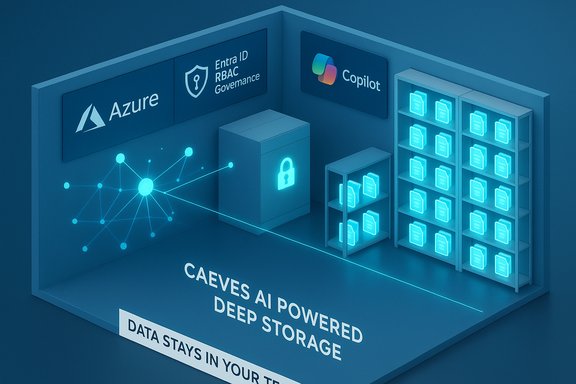
CAEVES positions Deep Storage as a platform that is deployed within the customer's Azure subscription, not as a separate SaaS that moves sensitive archives into an external vendor tenancy. That design choice has visible advantages for governance: compute and storage remain under the enterprise’s control, and identity and access management can be grounded in Azure Entra ID (formerly Azure AD). CAEVES’s product pages and the Marketplace listing emphasize in-tenant deployment and “no customer data leaves your Azure tenant.” Technical elements presented by CAEVES and observed on the Marketplace listing include:- Containerized indexing and AI services (e.g., using Azure Container Apps or equivalent) to build embeddings, semantic indexes, and metadata mappings.
- Object storage as the durable layer (Azure Blob / Data Lake) with multi-tiered lifecycle and immutable archive features.
- Connectors for legacy archive systems and file shares to absorb existing repositories without disruptive migrations.
- Hooks into Microsoft AI services (Azure OpenAI/Fabric/Foundry and Microsoft 365 Search/Copilot) for retrieval-augmented generation (RAG) and Copilot integration.
Security, governance and identity
CAEVES highlights integration with Azure Entra ID and role-based permissions so index access and retrieval respect the enterprise’s existing permission model. This is an important capability: preserving RBAC across indexing and retrieval workflows is necessary to prevent unauthorized exposure when archived documents surface in AI-driven search answers. CAEVES’s messaging repeatedly emphasizes that permission ground-truth remains in the customer’s Microsoft environment.Data access and egress
The vendor’s claim about “elimination of egress fees within Microsoft Azure” is framed as a cost advantage: because CAEVES operates in the customer’s Azure tenant and serves data to Azure-hosted AI and Copilot services within the same region/account, there is no outbound internet egress and therefore no public egress charges. That is technically plausible — Microsoft’s bandwidth pricing confirms data transfers between services in the same Azure region or availability zone are typically free, and Azure’s public pricing pages list the scenarios where charges apply (inter-region and internet egress). However, vendor claims that egress fees are “eliminated” should be validated against the customer’s specific topology (regions used, cross-region replication, third-party consumers of the data, and network paths). Microsoft’s bandwidth pricing page remains the authoritative reference for where transfer costs apply.Verifying the claims: what is independently corroborated and what is vendor-provided
A responsible procurement evaluation needs to separate vendor assertions from independently verifiable technical facts.Independently corroborated facts
- CAEVES has published a product presence and marketing materials describing an Azure-native Deep Storage offering and an Azure Marketplace listing is present for “CAEVES Intelligent Deep Storage.” Marketplace entries and vendor site pages verify the company’s positioning and planned availability on Azure Marketplace.
- Azure storage durability and redundancy claims cited by CAEVES are consistent with Microsoft’s published redundancy and durability documentation: Azure provides multi‑nine durability guarantees depending on the selected redundancy model (LRS, ZRS, GRS, GZRS, RA‑variants). Enterprises can select redundancy and availability SLAs appropriate to their compliance and availability needs.
- The general pattern CAEVES is following — bringing indexing and RAG capabilities to object stores and integrating with Copilot and Azure AI services — is a widely adopted architectural pattern in 2025. Multiple vendors and system integrators are packaging similar capabilities to connect cold/object stores to enterprise copilots and model pipelines. That pattern is confirmed by Microsoft partner ecosystem posts and industry coverage.
Vendor claims that require independent validation
- 70% lower TCO: This is a vendor-provided headline figure. TCO comparisons depend on assumptions about baseline costs (tape maintenance, data center power and facilities, personnel, retrieval patterns, egress, compression/deduplication rates, retention policies). Enterprises should request CAEVES to produce a reproducible TCO model with the vendor’s assumptions and, ideally, third-party validation or a customer reference with transparent billing data.
- 50× search speed improvement: Search performance depends heavily on the index architecture, query patterns, dataset characteristics (file types, compression), and the baseline archive system used in the comparison. Ask the vendor for benchmark details: dataset sizes, file types and formats, query mixes, and whether metrics are median or worst-case. Without that context, “50×” is a marketing metric rather than a repeatable benchmark.
- Elimination of egress fees: As noted above, egress fees depend on topology. CAEVES’s in-tenant model can avoid internet egress charges for internal Azure-to-Azure access in the same region, but cross-region replication, third-party access (outside Azure), or cross-cloud usages would still generate transfer costs per Microsoft’s published bandwidth pricing. Customers should map expected data flows and request a network/transfer cost analysis from CAEVES and Microsoft.
Early deployments and target industries
CAEVES cites early traction across regulated and archive-heavy industries including financial services, insurance, manufacturing, healthcare, energy, and media — sectors where long retention windows and discovery obligations make archives both expensive and legally consequential. The company argues that these verticals benefit from in-place search and AI-driven indexing more than they do from wholesale migration to analytics-optimized data lakes. Independent coverage and the CAEVES site repeat those target verticals; however, publicly disclosed customer case studies with measurable before/after data are not abundant at launch, so buyers should ask for references and anonymized metrics.Strengths and potential benefits
Strengths
- In-tenant deployment reduces governance friction. Keeping storage and indexing components inside the customer’s Azure tenancy keeps identity, audit logs, and compliance controls under the enterprise’s control — a plus for regulated environments.
- Tight Microsoft integration is practical. The platform’s integration points to Microsoft 365 Copilot, Azure AI services, and Microsoft Graph map to technologies many enterprises already use, easing integrations for search-driven assistant workflows.
- Avoids costly rehydration and migration in common scenarios. If the platform does allow practical “in‑place” semantic search and RAG workflows, organizations can extract value from archives without expensive migration to analytic lakes or repeated cold-to-hot transfers. CAEVES presents that as a core economic driver.
- SaaS-like procurement through Azure Marketplace. Availability via Azure Marketplace simplifies procurement, billing and contract management for Azure-first customers, and can make proof-of-concept trials faster to run.
Business benefits claimed
- Recover hidden IP and intelligence in historical data.
- Reduce archive management costs and eliminate legacy maintenance contracts.
- Shorten eDiscovery and compliance timelines by surfacing archived content quickly.
- Use historical data to improve model training, analytics, and Copilot context without creating shadow data copies.
Risks, caveats and what to validate before buying
- Claimed cost and performance multipliers need reproducible benchmarks. Ask for raw data: workload traces, query mixes, dataset compositions, and the exact configurations used in any comparative tests. Without reproducibility, headline multipliers remain marketing.
- Permissions and leakage risks are real when indexing unstructured data. Indexing systems can inadvertently surface PII or regulatory-protected content unless indexing rules, redaction policies, and permission filters are carefully enforced. Validate that CAEVES can apply Entra ID/RBAC at query time, not just at index time, and that audit trails log all retrievals.
- Cross-region replication and multi-cloud scenarios will change economics. If your compliance or disaster recovery strategy requires cross-region copies, inter-region transfer charges can appear. Clarify where CAEVES will store replicated copies and how that affects egress and cross-region billing.
- Model-contamination and data governance for AI training. If archived content is used for model training — especially for generative models — ensure that data lineage, consent, and IP ownership are addressed. Enterprises must define acceptable reuse policies and model-training boundaries. CAEVES asserts compatibility with model training pipelines, but governance controls are the buyer’s responsibility.
- Operational complexity of indexing at petabyte scale. Index upkeep (re-indexing, incremental updates, handling deletions and retention removals) can be non-trivial at very large scales. Request operational runbooks, SLAs, and failover procedures.
- Vendor maturity and references. CAEVES is a young company (founded in 2025 according to its materials). Early products from startups can offer innovation but also potential immaturity in edge-case behaviors. Seek references and pilot contracts with clear exit and data-retrieval clauses.
Practical checklist for IT decision-makers evaluating CAEVES
- Define the exact business case. Is the goal eDiscovery acceleration, analytics, Copilot augmentation, or cost reduction? Different objectives change success criteria.
- Request a TCO model from CAEVES with transparent assumptions. Validate the model against your real storage counts, retention windows, and retrieval profiles.
- Ask for reproducible benchmarks. Get the dataset topology and query mix used to claim “50×” speeds and run a pilot workload against your archive snapshot.
- Verify identity and access controls. Confirm Entra ID/RBAC enforcement, audit logging, and role separation for indexing and retrieval.
- Map data flows and network costs. Determine whether your expected usage will generate inter-region or internet egress charges. Use Microsoft’s bandwidth pricing page to estimate transfer costs for your design.
- Examine retention and deletion semantics. Ensure the platform respects legal holds, retention policies, and secure deletion requirements.
- Contractual protections. Include performance SLAs, security attestations, support timelines, and data-export guarantees in any agreement. Marketplace procurement can simplify some contractual elements, but do not skip technical addenda.
The broader market context — why this matters now
Enterprises are moving from a world where archives were “store and forget” towards one where every historical artifact can be a data asset if surfaced correctly. Microsoft’s growing emphasis on making the Azure stack a first-class foundation for enterprise copilots and retrieval-augmented workflows means tools that connect archived object stores to AI services are increasingly strategic. CAEVES joins a crowded market of startups and established vendors that offer indexing, retrieval and RAG tooling built for cloud object stores and enterprise copilots. The differentiator for buyers will be: who can provide auditable, permission-aware, scalable retrieval that fits into existing governance and cost models? CAEVES’s in‑tenant approach and Azure Marketplace presence align it to this trend, but adoption will hinge on measurable results and strong enterprise references.Conclusion — cautious optimism, careful validation
CAEVES’s AI-powered Deep Storage is an appealing concept for organizations sitting on long-lived archives: keep the low-cost economics of archival storage while enabling AI-driven search and Copilot integration without wholesale rehydration. The vendor has established an Azure Marketplace presence and published claims of dramatic cost and search-speed improvements, and the architectural approach — in-tenant deployment plus AI indexing — aligns with how many enterprises want to consume Copilot-era intelligence.However, headline numbers such as “70% TCO reduction” and “50× faster search” are vendor assertions that require reproducible benchmarks and transparent assumptions. Technical teams should insist on pilot tests that use representative datasets and query mixes, validate permission enforcement via Entra ID and Azure RBAC, and map expected data flows for accurate network-cost modeling. Microsoft’s published storage redundancy guarantees and bandwidth pricing pages are useful anchors when evaluating CAEVES’s claims about durability and egress costs, but final economics will always be customer-specific. For enterprises with heavy archive burdens and strict compliance requirements, CAEVES could be a practical option to explore — provided procurement teams demand measurable evidence, clear governance controls, and contractual protections that make the vendor’s promises auditable and repeatable in production environments.
Source: FinancialContent https://markets.financialcontent.co...s-ai-powered-deep-storage-on-microsoft-azure/
