

CAEVES’s announcement that its Intelligent Deep Storage™ is generally available for Microsoft Azure promises to turn long‑forgotten enterprise archives into instantly searchable, AI‑ready assets while cutting storage bills “by up to 70%”—a bold, practical pitch aimed squarely at organizations wrestling with exploding unstructured data, legacy archives, and the rising cost of keeping cold data accessible for modern analytics and Copilot‑driven workflows.
Enterprise file and archive estates have become a chronic operational and economic burden. Tens to hundreds of petabytes of documents, images, and application binaries sit in tiered or tape archives where they are costly to maintain and effectively invisible to knowledge workers and AI systems. CAEVES positions Intelligent Deep Storage™ as a software‑defined, Azure‑native layer that combines cost‑optimized object tiering with a continuous indexing and retrieval plane so archived files remain discoverable and usable without the traditional “rehydration” delays and forklift migrations associated with legacy archive systems.
The vendor’s key headline claims from the February 4, 2026 release are clear and crisp:
Key architectural elements CAEVES highlights:
However, headline performance and TCO multipliers remain vendor assertions until validated by independent, reproducible tests in customer environments. Durable, secure indexing at multi‑petabyte scale is achievable, but it requires disciplined governance, careful topology planning, and clarity about the costs of index compute and lifecycle operations. Enterprises should treat CAEVES as a strong candidate for solving archive accessibility problems—with the caveat that the buyers must run thorough pilots, demand concrete test artifacts, and contractually protect data extraction and governance controls.
CAEVES’s Intelligent Deep Storage positions itself neatly at the intersection of cost containment and AI enablement for Microsoft‑centric enterprises: the approach is pragmatic, the marketplace availability is real, and the Copilot integration path is aligned with Microsoft’s connector model. But the product’s value for any specific organization will be determined by reproducible pilot results, governance enforcement at scale, and contractual clarity around costs and data portability. Enterprises looking to reclaim value from their archives should plan a measured, metrics‑driven evaluation that tests CAEVES’s promises against real data, real queries, and the company’s operational practices before committing production workloads.
Source: The AI Journal CAEVES Launches Intelligent Deep Storage™ for Microsoft Azure | The AI Journal
 Background / Overview
Enterprise file and archive estates have become a chronic operational and economic burden. Tens to hundreds of petabytes of documents, images, and application binaries sit in tiered or tape archives where they are costly to maintain and effectively invisible to knowledge workers and AI systems. CAEVES positions Intelligent Deep Storage™ as a software‑defined, Azure‑native layer that combines cost‑optimized object tiering with a continuous indexing and retrieval plane so archived files remain discoverable and usable without the traditional “rehydration” delays and forklift migrations associated with legacy archive systems. The vendor’s key headline claims from the February 4, 2026 release are clear and crisp:
- Up to 70% lower total cost of ownership (TCO) compared with legacy archive systems.
- Up to 50× faster search across multi‑petabyte datasets.
- Historical data AI‑ready in under 30 minutes (deployment/activation).
- 99.99% data durability on Azure infrastructure (tied to Azure redundancy and durability options).
What CAEVES says the product does
Core architecture and deployment model
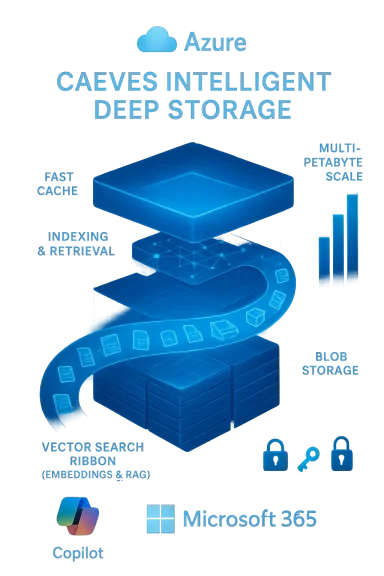
CAEVES describes Intelligent Deep Storage as software that runs entirely within a customer’s Azure tenant. The platform uses transparent tiering to native Azure Blob storage as the durable layer while running an indexing, caching and retrieval plane in containerized services provisioned inside the same subscription. This in‑tenant stance is deliberate: CAEVES emphasizes that no customer data leaves your Azure environment, which simplifies governance and keeps identity, audit, and encryption control with the enterprise.Key architectural elements CAEVES highlights:
- File/SMB semantics and standard access protocols preserved so legacy applications can continue to operate.
- Automatic tiering to Azure Blob lifecycle tiers (Hot → Cool → Cold → Archive) with metadata and file‑level access preserved.
- Containerized indexing and AI services to create semantic indexes, embeddings, and search vectors for RAG (retrieval‑augmented generation) and Copilot use.
- CAEVES Copilot Connector™ to expose historical data securely into Microsoft 365 Copilot and Microsoft Search while respecting tenant permissions.
Integration with Microsoft 365 Copilot and Microsoft AI
CAEVES’s Copilot Connector surfaces archived content to Microsoft 365 Copilot and search experiences, enabling natural‑language queries and RAG workflows across historical data. Microsoft’s Copilot connector model supports both synced and federated connectors; CAEVES appears to offer an approach that keeps the source data under tenant control while making content searchable for Copilot, consistent with Microsoft’s connector architecture. This alignment matters: federated/synced connector models determine where indexes live and how permissions are enforced during runtime.Verifying the claims: what’s provable and what needs independent testing
Availability and marketplace presence
CAEVES’s general availability and Azure Marketplace listing are verifiable through the press release and the vendor’s public site and marketplace presence; independent coverage from trade outlets echoed that availability and the stated launch dates. For procurement and trial purposes, the Marketplace listing simplifies provisioning and consumption inside existing Azure agreements.Durability and platform guarantees
CAEVES ties its durability statement to Azure infrastructure. Azure Storage provides documented redundancy options (LRS, ZRS, GRS, GZRS, RA‑variants) with multi‑nine durability figures; choosing the appropriate redundancy setting in a storage account is how enterprises achieve the desired durability level. In short, durability claims that reference Azure are reasonable, but the precise SLA depends on the chosen redundancy options and tier. CAEVES’s statement that data durability is provided “on Azure infrastructure” is a correct, verifiable framework—enterprises must still choose the storage replication mode that meets their regulatory and SLA needs.Performance (50× faster search) and cost savings (up to 70% lower TCO)
These are vendor performance and TCO claims that require reproducible benchmarks and transparent baseline comparisons. Trade reposts repeated the numbers, but independent, workload‑representative benchmarks were not published alongside the press material at the time of writing. In practical procurement terms, take these multipliers as promising marketing metrics that should be validated via:- A pilot on representative datasets and query mixes.
- Disclosure of the baseline systems used for comparison (what legacy archive was measured, which indexing engine, what network topology).
- Raw performance traces and cost‑model inputs (storage tiers, egress assumptions, indexing compute costs).
Technical strengths and practical benefits
- In‑tenant deployment: Preserves tenant sovereignty over identity, keys, and logs—important for compliance and regulated industries. CAEVES emphasizes this as a differentiator versus off‑tenant SaaS archive offerings.
- Open data architecture: By layering indexing on top of standard Azure Blob objects and preserving metadata, CAEVES avoids proprietary storage formats and makes long‑term portability easier. This reduces vendor lock‑in risk compared with black‑box archive appliances.
- Copilot‑ready indexing: Making archived content available for Copilot and RAG workflows is a clear productivity win where enterprises want historical context to inform Copilot answers or to enrich in‑house model training sets—provided governance is enforced. Microsoft’s connector model supports both synced and federated patterns that CAEVES can leverage.
- Rapid onboarding: CAEVES advertises a deploy‑in‑under‑30‑minutes onboarding experience via the Microsoft Marketplace, which can accelerate proofs‑of‑concept and reduce friction for trialing the product.
Risks, governance and operational caveats
No vendor product removes the need for rigorous validation. Below are the practical risks and controls every IT and legal team should demand before wide adoption.Permission leakage and index governance
Indexing archived content can surface sensitive information faster—but it can also amplify the risk of unauthorized exposure if permission enforcement is mishandled. The critical question is whether CAEVES enforces Azure Entra ID (RBAC) constraints at query time against the authoritative identity store rather than solely at index time. Index‑time permission snapshots can become stale; query‑time enforcement is necessary to avoid leakage. Buyers should require documentation and pilot evidence showing RBAC checks, audit trails, and join‑back verification to source permissions.Model contamination and intellectual property
Using archived content to feed model training or Copilot context raises IP and privacy questions. Enterprises should define explicit policies about what archived content is allowed for training, whether PII or regulated content is excluded, and how lineage is tracked. CAEVES may provide connectors, but governance design (what to include/exclude in embeddings) is the customer’s responsibility. Ask for features that support granular filtering, redaction, and lineage tagging.Billing, network topology and egress
CAEVES’s argument that running inside the customer’s Azure tenant reduces egress charges is technically plausible: intra‑region traffic in Azure often avoids public egress billing, and consumption through Azure Marketplace simplifies billing aggregation. However, cross‑region replication, hybrid consumers, or third‑party consumers outside Azure can reintroduce transfer costs. Confirm the precise deployment topology that CAEVES requires and model any cross‑region replication or multi‑cloud access that could trigger egress fees.Index scale, maintenance and operational overhead
Indexing billions of objects and keeping indexes consistent with lifecycle actions (deletes, retention lifts, legal holds) is non‑trivial. At very large scales, reindex operations, incremental updates, retention‑driven purges, and disambiguation of duplicates all impose operational and compute costs. Validate how CAEVES handles:- Incremental vs full reindex strategies.
- Handling of retention and legal hold changes.
- Operational runbooks for index rebuilds and disaster recovery.
How CAEVES compares to adjacent market approaches
The market is converging on two patterns for bringing archives to AI workflows:- Bring indexing and vector search to object stores and keep data in place (the path CAEVES follows).
- Move selected data into purpose‑built AI data platforms or unified storage fabrics that combine high throughput with built‑in vector engines (products from established scale‑out vendors follow this path).
A practical evaluation checklist for IT decision‑makers
Before procurement, run a structured evaluation that addresses both the vendor’s claims and your enterprise constraints. At minimum, require the following:- Business case clarity
- Define the primary objective (TCO reduction, eDiscovery acceleration, Copilot augmentation, or model training input). Different goals change success criteria.
- Reproducible benchmarks
- Request the exact dataset snapshot, query mixes, and test harness CAEVES used to produce “50×” or “70%” claims; run the same tests in your environment.
- Permissions and audit
- Demonstrate Entra ID/RBAC enforcement at query time, show audit logs for indexing and retrieval, and require proof of tamper‑resistant logs.
- TCO model transparency
- Obtain a line‑item TCO that includes storage tiering, index compute, Azure storage costs, snapshot retention, and expected egress (if any).
- Exit and data extraction guarantees
- Contractually require documented export paths for your data and indexes, including timelines and fees for bulk export.
- Legal and privacy controls
- Ensure features for redaction, exclusion lists, and training‑consent controls are available and verifiable.
- Pilot runbook
- Run a pilot with representative data for a minimum of 30 days covering reindex frequency, query latency at p50/p95/p99, and concurrent users.
- SLA and commercial protections
- Demand SLAs for availability, durability (mapped to chosen Azure redundancy), and documented incident response and RTO/RPO targets.
Realistic deployment scenarios and examples
- Legal/eDiscovery: Firms with long retention windows can surface custodial evidence quickly without mass tape rehydrates; Copilot‑enabled search can accelerate discovery workflows if permission controls and audit trails are validated.
- Manufacturing and engineering: CAD and design archives often sit in NAS silos; CAEVES’s SMB semantics and in‑place indexing can permit engineers to locate historical designs without copying terabytes to production storage.
- Finance and compliance: For regulated records, the combination of tenant‑based deployment and Azure’s redundancy options can provide the durability and control needed—but legal holds and retention enforcement must be enforced end‑to‑end.
Final assessment — strengths, limitations, and recommendation
CAEVES Intelligent Deep Storage™ addresses a very real pain point: the mismatch between storage economics and data usability. Its Azure‑native, in‑tenant architecture and Copilot connector are credible technical choices for enterprises invested in Microsoft ecosystems. The product’s promise to keep data “cheap, deep, and easy… but never dark” is compelling in both language and engineering intent. The vendor’s marketplace availability and documented deployment paths reduce procurement friction and accelerate proofs‑of‑concept.However, headline performance and TCO multipliers remain vendor assertions until validated by independent, reproducible tests in customer environments. Durable, secure indexing at multi‑petabyte scale is achievable, but it requires disciplined governance, careful topology planning, and clarity about the costs of index compute and lifecycle operations. Enterprises should treat CAEVES as a strong candidate for solving archive accessibility problems—with the caveat that the buyers must run thorough pilots, demand concrete test artifacts, and contractually protect data extraction and governance controls.
Quick starter plan for teams that want to pilot CAEVES
- Define success metrics (TCO delta, query latency p50/p95/p99, eDiscovery speedups).
- Select a representative dataset (≥1–5 PB if available, or a scaled subset that reflects file mix and retention).
- Deploy CAEVES from the Azure Marketplace into a sandbox subscription and enable the Copilot Connector in test mode.
- Run parallel benchmarks against your current archive/search stack using identical queries and access patterns.
- Validate permission fidelity by running red‑team scenarios: index exposure checks, role changes, and legal‑hold enforcement.
- Review the TCO worksheet with CAEVES, including storage, index compute, network, and operational labor.
- Negotiate exit terms, export timelines, and support SLAs before expanding to production.
CAEVES’s Intelligent Deep Storage positions itself neatly at the intersection of cost containment and AI enablement for Microsoft‑centric enterprises: the approach is pragmatic, the marketplace availability is real, and the Copilot integration path is aligned with Microsoft’s connector model. But the product’s value for any specific organization will be determined by reproducible pilot results, governance enforcement at scale, and contractual clarity around costs and data portability. Enterprises looking to reclaim value from their archives should plan a measured, metrics‑driven evaluation that tests CAEVES’s promises against real data, real queries, and the company’s operational practices before committing production workloads.
Source: The AI Journal CAEVES Launches Intelligent Deep Storage™ for Microsoft Azure | The AI Journal
