

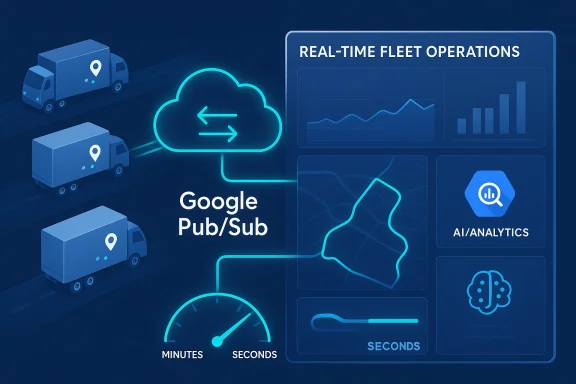
CalAmp’s new Google Pub/Sub integration for Telematics Cloud is a timely move for a market that increasingly lives or dies on latency. Announced as generally available for DataHub customers, the integration gives fleets a direct path to stream enriched telematics data into Google Cloud in real time, reducing the friction that comes with batch-based delivery and hand-built pipelines. The strategic signal is bigger than the feature itself: CalAmp is positioning its cloud layer as an event-driven data source for AI, analytics, and operational response. Google Cloud’s own Pub/Sub architecture is built for asynchronous, low-latency messaging and real-time data systems, which makes the pairing technically logical and commercially important.
Telematics has always been about turning movement into insight, but the industry has changed dramatically in the last few years. What used to be a retrospective reporting function is now expected to behave like a live operations platform. Fleets no longer want to ask where a vehicle was an hour ago; they want to know what is happening now, what to do next, and how quickly they can act on it.
That shift has been accelerated by three overlapping pressures: tighter delivery windows, rising operating costs, and the push to use AI on operational data. In that environment, data freshness is not just a technical detail. It becomes a business constraint. A delay of minutes can undermine routing decisions, disrupt dispatching, weaken customer communication, and reduce the value of predictive models.
CalAmp has been steadily framing its Telematics Cloud as more than a device-management layer. The company describes the platform as an enterprise-grade IoT data service with support for AWS, Azure, Google Cloud, and Kafka, which suggests a strategy centered on interoperability rather than vendor lock-in. The March 26 announcement fits that pattern neatly: Google Pub/Sub is being added as another first-class delivery option rather than treated as an afterthought.
Google Pub/Sub itself is a strong fit for this kind of workload. Google describes it as an asynchronous, scalable messaging service for streaming analytics, real-time event distribution, and data streaming from applications or IoT devices. It supports push and pull delivery, per-key ordering, and native integrations into tools like BigQuery and Dataflow, which makes it attractive for fleets that want both immediate response and downstream analytics.
For CalAmp customers, the practical meaning is straightforward: telematics data can now move more directly from vehicle, trailer, or asset into Google Cloud-based workflows without the extra machinery that often surrounds custom integrations. That matters because the complexity of integration often becomes the hidden cost of cloud modernization. The feature is simple to describe, but the operational implications are substantial.
The integration is designed to continuously stream enriched telematics data into Google Cloud. That phrase is doing a lot of work. It implies the data is not merely raw GPS pings, but information that has already been normalized, enriched, or contextualized by CalAmp before it reaches the customer’s cloud environment. For enterprises, that is often more valuable than raw telemetry because it reduces the amount of transformation needed before the data can feed dashboards, alerting, or machine learning pipelines.
The company’s executives framed the launch in terms of operational urgency. Paul Washicko described the capability as driven by transportation customers who want immediate access to operational data for analytics and AI on Google Cloud, while Ali Ghulamali emphasized scalable, reliable high-volume delivery using Pub/Sub’s messaging infrastructure. The wording matters because it places the integration at the intersection of product, platform, and customer demand rather than as a speculative feature addition.
The result is a more event-driven model for telematics operations. Instead of waiting for a nightly export or periodic sync, enterprises can use the stream as it arrives. That has downstream consequences for dispatching, exception management, customer notification, and model training.
For telematics, the appeal is obvious. Fleet events often need to fan out to multiple destinations: route optimization, alerting, billing, maintenance analytics, compliance reporting, and AI feature stores. Pub/Sub can help act as the middle layer that distributes the same event stream to many systems without creating duplicate integrations for each one. That reduces architectural sprawl, which is often the hidden tax in enterprise IoT projects.
That decoupling also supports resilience. If one downstream service is temporarily unavailable, the messaging layer can preserve the event flow rather than forcing the source system to stall. Google highlights features such as cross-zone replication, per-message receipt tracking, and at-least-once delivery, all of which are relevant when data continuity matters.
The strategic implication is broader than telemetry. CalAmp is effectively saying that its data can enter the customer’s cloud-native operations stack without special treatment. That is how vendors move from being device suppliers to being infrastructure enablers.
The most obvious use case is dispatch and route response. If a delay or incident appears in the stream as soon as it happens, the fleet can reroute drivers, update customers, and adjust ETAs faster. A second use case is asset visibility. Continuous streaming can help operations teams track trailers, cargo, and vehicles with less dependence on periodic synchronization.
There is also an organizational benefit. A real-time stream creates a shared operational truth that multiple teams can use simultaneously. Dispatch, analytics, customer support, and engineering can all work from the same source of events rather than reconciling different extracts.
If telematics data arrives faster, it can be used sooner in predictive maintenance, route optimization, utilization analysis, and operational forecasting. It can also improve the recency of features feeding machine learning systems. In industries with volatile conditions, older data can bias models toward yesterday’s reality instead of today’s operational state.
This is where CalAmp’s architecture becomes interesting. The company is not claiming to provide an AI platform itself. Instead, it is supplying a better data runway for customers that already have AI ambitions inside Google Cloud. That is a classic enterprise software move: enable the ecosystem rather than replace it.
The wider market trend is clear. Vendors that can reduce the cost of moving operational data into cloud analytics platforms will be better positioned than those that force customers to build custom bridges. In a world where enterprises want to experiment faster, integration speed can become competitive advantage.
This matters because large transportation and logistics organizations rarely run on a single clean stack. They often have a mix of legacy systems, data warehouses, third-party SaaS, and internal apps. A telematics platform that can connect cleanly to multiple back ends is easier to adopt and easier to justify to procurement, architecture, and security teams.
Google Pub/Sub also benefits from being a well-documented cloud-native service with native integrations and clear operational patterns. Google describes the service as supporting streaming analytics, real-time event distribution, and native delivery into BigQuery and Cloud Storage, which means it can sit inside a broader cloud data architecture rather than acting as an isolated point-to-point link.
For enterprise IT, that simplifies governance. Standardizing on a recognizable cloud messaging service usually makes it easier to apply IAM, monitoring, retention, and reliability policies. It also makes the telematics data easier to audit and operationalize across departments.
This is important because telematics buyers now compare platforms on more than device coverage and maps. They also evaluate integration depth, data usability, and the speed with which the platform can support automation. If a competitor offers similar tracking features but weaker cloud connectivity, that can become a meaningful disadvantage in enterprise sales.
CalAmp’s broader platform messaging already emphasizes support for commercial and government organizations, fleet visibility, compliance, and enterprise-grade security. The new Pub/Sub integration strengthens that story by making the cloud path more direct. That may not win every deal, but it improves the company’s posture in cloud-first procurement cycles.
The competitive question is not whether telematics vendors can move data. They all can. The real question is whether they can move it in a way that is fast enough, clean enough, and standardized enough to become part of a customer’s operating system.
For consumer-facing services built on top of fleet or asset data, the value is indirect but important. Faster access to location and status events can improve customer notifications, estimated arrival times, and service transparency. This is often where telematics value is most visible to end users, even if they never see the underlying architecture.
That split helps explain why the launch announcement emphasizes both decision-making and operational response. It is not just about back-end data movement. It is about creating a better experience across the chain, from dispatcher to driver to customer.
The most durable advantage here may be trust. When data is reliable and timely, teams are more likely to use it in core decisions rather than treating it as supplemental reporting. That is where infrastructure turns into business capability.
The timing is favorable as well. Enterprises are still trying to rationalize data estates that grew too complicated during the cloud rush. Any vendor that can reduce integration friction while improving real-time usefulness has a credible pitch. In this sense, CalAmp is selling simplification, not just speed.
Another concern is scope. The announcement is strong on data delivery, but it says less about concrete customer outcomes, reference deployments, or measured performance gains. That does not weaken the feature, but it does mean buyers will want proof. Operational value is always easier to promise than to quantify.
The second thing to watch is whether CalAmp expands the model further into downstream cloud services. Pub/Sub is useful as a transport layer, but the true value comes when it connects cleanly to analytics, orchestration, and AI pipelines. Google Cloud’s broader data stack makes that possible, and customers will likely push for more prebuilt patterns around it.
CalAmp’s Google Pub/Sub integration is therefore more than a product update. It is a statement about where telematics is going: away from delayed reporting and toward live, cloud-native operational intelligence. If fleets adopt that model at scale, the winners will be the vendors that make the transition feel invisible, reliable, and immediate.
Source: The Manila Times CalAmp Adds Google Pub/Sub Integration to Telematics Cloud, Accelerating Data Delivery for Google Cloud Customers
 Background
Telematics has always been about turning movement into insight, but the industry has changed dramatically in the last few years. What used to be a retrospective reporting function is now expected to behave like a live operations platform. Fleets no longer want to ask where a vehicle was an hour ago; they want to know what is happening now, what to do next, and how quickly they can act on it.That shift has been accelerated by three overlapping pressures: tighter delivery windows, rising operating costs, and the push to use AI on operational data. In that environment, data freshness is not just a technical detail. It becomes a business constraint. A delay of minutes can undermine routing decisions, disrupt dispatching, weaken customer communication, and reduce the value of predictive models.
CalAmp has been steadily framing its Telematics Cloud as more than a device-management layer. The company describes the platform as an enterprise-grade IoT data service with support for AWS, Azure, Google Cloud, and Kafka, which suggests a strategy centered on interoperability rather than vendor lock-in. The March 26 announcement fits that pattern neatly: Google Pub/Sub is being added as another first-class delivery option rather than treated as an afterthought.
Google Pub/Sub itself is a strong fit for this kind of workload. Google describes it as an asynchronous, scalable messaging service for streaming analytics, real-time event distribution, and data streaming from applications or IoT devices. It supports push and pull delivery, per-key ordering, and native integrations into tools like BigQuery and Dataflow, which makes it attractive for fleets that want both immediate response and downstream analytics.
For CalAmp customers, the practical meaning is straightforward: telematics data can now move more directly from vehicle, trailer, or asset into Google Cloud-based workflows without the extra machinery that often surrounds custom integrations. That matters because the complexity of integration often becomes the hidden cost of cloud modernization. The feature is simple to describe, but the operational implications are substantial.
What CalAmp Actually Announced
The announcement centers on general availability, which matters as much as the feature name. GA indicates that this is not a preview or pilot-only capability; it is ready for production customers who want to stream telematics data into Google Cloud through Pub/Sub today. CalAmp also says the integration is available to all CalAmp Telematics Cloud DataHub customers, which suggests a broad rollout rather than a narrowly scoped partner test.The integration is designed to continuously stream enriched telematics data into Google Cloud. That phrase is doing a lot of work. It implies the data is not merely raw GPS pings, but information that has already been normalized, enriched, or contextualized by CalAmp before it reaches the customer’s cloud environment. For enterprises, that is often more valuable than raw telemetry because it reduces the amount of transformation needed before the data can feed dashboards, alerting, or machine learning pipelines.
Why “real time” matters here
Real-time streaming is not just an architecture choice. It is a business promise. CalAmp says the integration reduces delays associated with batch processing and minimizes the need for custom-built data pipelines that are costly to maintain and scale. That is a direct answer to one of the most persistent pain points in fleet technology: the gap between collecting data and doing something useful with it.The company’s executives framed the launch in terms of operational urgency. Paul Washicko described the capability as driven by transportation customers who want immediate access to operational data for analytics and AI on Google Cloud, while Ali Ghulamali emphasized scalable, reliable high-volume delivery using Pub/Sub’s messaging infrastructure. The wording matters because it places the integration at the intersection of product, platform, and customer demand rather than as a speculative feature addition.
The result is a more event-driven model for telematics operations. Instead of waiting for a nightly export or periodic sync, enterprises can use the stream as it arrives. That has downstream consequences for dispatching, exception management, customer notification, and model training.
Why Google Pub/Sub Is a Strategic Fit
Pub/Sub is not just a data transport layer. Google Cloud positions it as a foundation for real-time data systems, with native support for streaming into BigQuery, Cloud Storage, and Dataflow. It is designed for asynchronous communication, decoupled publishers and subscribers, and high availability at scale. That makes it a natural landing zone for data that needs to flow into many different consumers at once.For telematics, the appeal is obvious. Fleet events often need to fan out to multiple destinations: route optimization, alerting, billing, maintenance analytics, compliance reporting, and AI feature stores. Pub/Sub can help act as the middle layer that distributes the same event stream to many systems without creating duplicate integrations for each one. That reduces architectural sprawl, which is often the hidden tax in enterprise IoT projects.
The technical value of decoupling
One of the biggest advantages of Pub/Sub is that it decouples producers from consumers. A vehicle event can be published once and then processed by multiple subscribers independently. This is especially useful when some systems need immediate action while others can tolerate slight lag for deeper analysis.That decoupling also supports resilience. If one downstream service is temporarily unavailable, the messaging layer can preserve the event flow rather than forcing the source system to stall. Google highlights features such as cross-zone replication, per-message receipt tracking, and at-least-once delivery, all of which are relevant when data continuity matters.
The strategic implication is broader than telemetry. CalAmp is effectively saying that its data can enter the customer’s cloud-native operations stack without special treatment. That is how vendors move from being device suppliers to being infrastructure enablers.
Fleet Operations Gain the Most
Fleets are the clearest winners because they live in a world where seconds matter and exceptions are expensive. When a shipment is delayed, a vehicle deviates from route, or a trailer changes status, the organization often needs to react immediately. CalAmp says the integration helps transportation and logistics organizations eliminate data delays and respond to in-transit events in real time, and that claim aligns with the operational reality of modern fleet management.The most obvious use case is dispatch and route response. If a delay or incident appears in the stream as soon as it happens, the fleet can reroute drivers, update customers, and adjust ETAs faster. A second use case is asset visibility. Continuous streaming can help operations teams track trailers, cargo, and vehicles with less dependence on periodic synchronization.
Where the latency savings show up
Latency in fleet systems is often cumulative. There is device delay, transmission delay, cloud ingestion delay, and then application delay. Even if each step seems acceptable on its own, the aggregate can become too slow for real operational response. Moving from batch to streaming reduces that chain of waiting.There is also an organizational benefit. A real-time stream creates a shared operational truth that multiple teams can use simultaneously. Dispatch, analytics, customer support, and engineering can all work from the same source of events rather than reconciling different extracts.
- Faster exception response
- Better route execution
- More timely customer updates
- Improved asset visibility
- Reduced dependence on nightly batch jobs
AI and Analytics Are the Real Prize
The announcement repeatedly references AI and analytics, and that is where the integration becomes more than plumbing. Google Cloud has been aggressively positioning Pub/Sub as a front door for real-time data systems, including streaming into BigQuery and other analytics environments. For customers building AI workflows, the quality of input data often matters more than the sophistication of the model.If telematics data arrives faster, it can be used sooner in predictive maintenance, route optimization, utilization analysis, and operational forecasting. It can also improve the recency of features feeding machine learning systems. In industries with volatile conditions, older data can bias models toward yesterday’s reality instead of today’s operational state.
Operational AI needs fresher signals
Many organizations talk about AI as if it were just a model layer. In practice, AI systems are only as good as their pipelines. A telematics event that arrives 20 minutes late may still be useful for reporting, but it is often too stale for intervention. Real-time ingestion narrows that gap and makes the system useful for both inference and feedback loops.This is where CalAmp’s architecture becomes interesting. The company is not claiming to provide an AI platform itself. Instead, it is supplying a better data runway for customers that already have AI ambitions inside Google Cloud. That is a classic enterprise software move: enable the ecosystem rather than replace it.
The wider market trend is clear. Vendors that can reduce the cost of moving operational data into cloud analytics platforms will be better positioned than those that force customers to build custom bridges. In a world where enterprises want to experiment faster, integration speed can become competitive advantage.
Enterprise Architecture and Integration Strategy
For enterprise buyers, the most important part of the announcement may be the architecture flexibility. CalAmp says the Google Cloud option now sits alongside AWS, Microsoft Azure, and Apache Kafka-based environments. That tells us the company is not making a single-cloud bet; it is expanding the menu of supported integration endpoints.This matters because large transportation and logistics organizations rarely run on a single clean stack. They often have a mix of legacy systems, data warehouses, third-party SaaS, and internal apps. A telematics platform that can connect cleanly to multiple back ends is easier to adopt and easier to justify to procurement, architecture, and security teams.
Reducing custom connector debt
One of the most expensive things in enterprise software is custom integration code that no one wants to own later. The announcement explicitly argues that the new pipeline minimizes the need for custom-built data pipelines that are costly to maintain and scale. That is a meaningful value proposition because integration debt tends to worsen over time.Google Pub/Sub also benefits from being a well-documented cloud-native service with native integrations and clear operational patterns. Google describes the service as supporting streaming analytics, real-time event distribution, and native delivery into BigQuery and Cloud Storage, which means it can sit inside a broader cloud data architecture rather than acting as an isolated point-to-point link.
For enterprise IT, that simplifies governance. Standardizing on a recognizable cloud messaging service usually makes it easier to apply IAM, monitoring, retention, and reliability policies. It also makes the telematics data easier to audit and operationalize across departments.
- Easier cloud alignment
- Lower custom code burden
- Better support for hybrid stacks
- More flexible downstream analytics
- Cleaner governance and access control
Competitive Positioning in Telematics
CalAmp is not the only company trying to sell the future of connected fleet data, but this release helps it sharpen its message. The market increasingly rewards vendors that can deliver usable data, not just collected data. By aligning with Google Cloud Pub/Sub, CalAmp is signaling that it wants to participate in modern cloud data flows rather than just sit upstream of them.This is important because telematics buyers now compare platforms on more than device coverage and maps. They also evaluate integration depth, data usability, and the speed with which the platform can support automation. If a competitor offers similar tracking features but weaker cloud connectivity, that can become a meaningful disadvantage in enterprise sales.
How rivals may respond
Competitors are likely to emphasize their own cloud integrations, whether through native connectors, APIs, or partnerships with hyperscalers. But the actual distinction will come down to how much transformation work the customer must still do after the data lands. The less friction, the better.CalAmp’s broader platform messaging already emphasizes support for commercial and government organizations, fleet visibility, compliance, and enterprise-grade security. The new Pub/Sub integration strengthens that story by making the cloud path more direct. That may not win every deal, but it improves the company’s posture in cloud-first procurement cycles.
The competitive question is not whether telematics vendors can move data. They all can. The real question is whether they can move it in a way that is fast enough, clean enough, and standardized enough to become part of a customer’s operating system.
Consumer, Government, and Enterprise Impact
Most of the immediate benefit will accrue to enterprises, but the impact is not limited to large fleets. CalAmp’s platform serves commercial and government organizations as well, and real-time cloud delivery can improve incident response, compliance workflows, and asset visibility across those segments. Government users in particular may care less about experimental AI and more about reliable operational telemetry and auditability.For consumer-facing services built on top of fleet or asset data, the value is indirect but important. Faster access to location and status events can improve customer notifications, estimated arrival times, and service transparency. This is often where telematics value is most visible to end users, even if they never see the underlying architecture.
Enterprise vs. consumer priorities
Enterprise buyers will focus on scale, governance, and integration. They will ask whether the pipeline can handle volume, whether it can be monitored, and whether it fits their existing cloud posture. Consumer-oriented services, by contrast, care about perceived responsiveness and service quality.That split helps explain why the launch announcement emphasizes both decision-making and operational response. It is not just about back-end data movement. It is about creating a better experience across the chain, from dispatcher to driver to customer.
The most durable advantage here may be trust. When data is reliable and timely, teams are more likely to use it in core decisions rather than treating it as supplemental reporting. That is where infrastructure turns into business capability.
Strengths and Opportunities
CalAmp’s move has several strengths that could compound over time if the company executes well. The most important is that the integration maps to a real enterprise pain point rather than an abstract product trend. Real-time streaming into a major cloud platform is the kind of feature that buyers can immediately understand and tie to operating results.Key advantages
- Lower latency for operational decision-making
- Less custom integration work for customer IT teams
- Better fit for Google Cloud-native analytics stacks
- Expanded platform choice alongside AWS, Azure, and Kafka
- Stronger AI readiness through fresher event data
- Improved scalability for high-volume fleet operations
- More consistent data delivery across dashboards and applications
The timing is favorable as well. Enterprises are still trying to rationalize data estates that grew too complicated during the cloud rush. Any vendor that can reduce integration friction while improving real-time usefulness has a credible pitch. In this sense, CalAmp is selling simplification, not just speed.
Risks and Concerns
The biggest risk is that real-time streaming raises expectations faster than organizations can absorb them. A fleet that receives live events still needs people, processes, and automation rules to act on those events. Without operational maturity, more data can simply mean more noise. That is a common failure mode in telemetry-heavy environments.Key concerns
- Alert fatigue if too many events are treated as urgent
- Integration complexity if downstream systems are not cloud-ready
- Governance challenges around permissions and data access
- Reliability expectations that may be hard to meet at scale
- Potential vendor dependency if the pipeline becomes mission-critical
- Implementation lag between availability and customer adoption
Another concern is scope. The announcement is strong on data delivery, but it says less about concrete customer outcomes, reference deployments, or measured performance gains. That does not weaken the feature, but it does mean buyers will want proof. Operational value is always easier to promise than to quantify.
What to Watch Next
The next phase will determine whether this becomes a meaningful platform lever or simply another integration checkbox. The best indicator will be how quickly customers use the Google Pub/Sub path in real deployments, especially in organizations already invested in Google Cloud analytics and AI. If adoption is real, CalAmp may have found a way to make its telematics data more central to customer workflows.The second thing to watch is whether CalAmp expands the model further into downstream cloud services. Pub/Sub is useful as a transport layer, but the true value comes when it connects cleanly to analytics, orchestration, and AI pipelines. Google Cloud’s broader data stack makes that possible, and customers will likely push for more prebuilt patterns around it.
Signals that matter
- Customer adoption from existing DataHub users
- New reference architectures on Google Cloud
- Integration patterns with BigQuery and Dataflow
- Evidence of lower implementation time
- Measured reductions in response latency
- Expansion to additional cloud-native event workflows
CalAmp’s Google Pub/Sub integration is therefore more than a product update. It is a statement about where telematics is going: away from delayed reporting and toward live, cloud-native operational intelligence. If fleets adopt that model at scale, the winners will be the vendors that make the transition feel invisible, reliable, and immediate.
Source: The Manila Times CalAmp Adds Google Pub/Sub Integration to Telematics Cloud, Accelerating Data Delivery for Google Cloud Customers
