

Microsoft Moves the Cluster Boundary Out of the Developer’s Way
Kubernetes was supposed to hide infrastructure complexity, but the cluster has often become the new unit of friction. Inside a cluster, services discover one another, policies can be applied consistently, and teams can treat pod-to-pod traffic as a native part of the platform. Across clusters, the abstraction typically thins out fast.
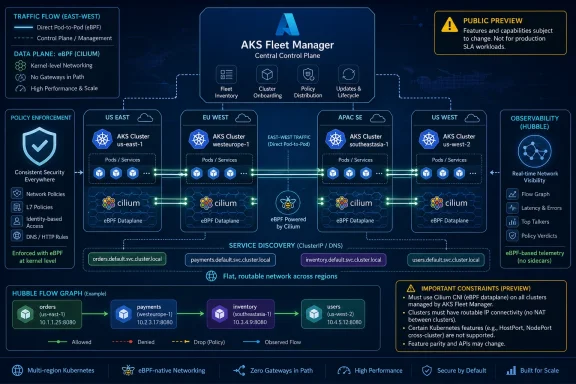
Microsoft’s new preview tries to make that boundary less visible. Cross-cluster networking for Azure Kubernetes Fleet Manager extends east-west connectivity across multiple Azure Kubernetes Service clusters using Cilium, Azure CNI powered by Cilium, and Advanced Container Networking Services. The pitch is simple: pods and services in one cluster should be able to talk to pods and services in another cluster as if they were nearby, while the platform keeps enough separation for governance and blast-radius control.
That is a significant shift in what Fleet Manager is being asked to do. Azure Kubernetes Fleet Manager has already been positioned around multi-cluster operations: joining clusters into a fleet, propagating workloads, and staging updates. Networking, however, is harder to abstract than deployment orchestration because the failure modes are less polite. Packets do not care about your org chart.
The preview suggests Microsoft now sees multi-cluster networking as a first-class part of AKS fleet operations, not an add-on pattern left for customers to assemble themselves. That matters because the organizations most likely to run fleets are also the least willing to accept experimental hand wiring in production. They are splitting clusters for regions, regulation, tenancy, lifecycle isolation, and resilience; they do not want every split to become an application rewrite.
The Old Multi-Cluster Tax Was Paid in Gateways, Scripts, and Meetings
Anyone who has operated more than a couple of Kubernetes clusters knows the tax Microsoft is describing. The moment services need to cross cluster boundaries, teams usually fall into a menu of compromises: ingress controllers, private endpoints, service meshes, VPNs, peered networks, DNS conventions, custom failover logic, or an internal platform service that exists mostly to hide the mess.
None of those approaches is inherently wrong. Gateways are useful. Service meshes can be powerful. VPNs and private routing are often required by policy. But each added layer tends to make the platform less Kubernetes-native from the developer’s point of view. A service that was once addressed by a familiar name inside a namespace becomes an endpoint managed by another team, protected by a separate policy plane, and observable through a different dashboard.
That is why Microsoft’s emphasis on “no proxies or gateways required” is not just marketing language. It is a claim about operational shape. The company is arguing that, for supported AKS fleet scenarios, cross-cluster traffic can be made direct enough and managed enough that platform teams do not need to build a parallel network product around Kubernetes.
The preview leans on Cilium’s eBPF-based dataplane for routing, policy, and observability. In practical terms, eBPF lets network behavior run efficiently inside the Linux kernel without forcing every packet through traditional userspace proxies. That has made Cilium one of the more important cloud-native networking projects, especially as Kubernetes users demand stronger policy and visibility without accepting old-school network appliance complexity.
Microsoft’s bet is that customers do not want to become Cilium Cluster Mesh operators just to use Cilium-style multi-cluster connectivity. They want the capability, but they want Azure to own the lifecycle: certificates, component deployment, configuration updates, and integration with the rest of AKS. That is the difference between a feature and a platform commitment.
Cilium Gives Microsoft an Open-Source Engine With Enterprise Optics
The choice of Cilium is unsurprising, but still important. Cilium has become one of the default answers to the question of how Kubernetes networking evolves beyond basic overlay assumptions. It brings eBPF-based networking, identity-aware policy, and Hubble-powered observability into a model that cloud providers can integrate without pretending they invented every layer themselves.
For Microsoft, Cilium also solves a credibility problem. Azure networking has to serve conservative enterprises, but Kubernetes platform teams increasingly prefer open-source-native building blocks. By building this feature on Cilium and Kubefleet, Microsoft can present Fleet Manager as a managed implementation of ecosystem machinery rather than a proprietary island.
That positioning matters for customers who are wary of cloud lock-in but still want managed operations. The preview does not make cross-cloud Kubernetes magically portable, and nobody should read it that way. The feature is tied to AKS prerequisites and Azure networking assumptions. But using Cilium as the dataplane means the conceptual model is familiar to teams already watching or using Cilium elsewhere.
There is also a strategic angle. Microsoft has spent years trying to make Azure a credible home for Linux and Kubernetes workloads, even as Windows remains its historical center of gravity. AKS features like this are part of that longer campaign. The customer being courted here is not a Windows desktop admin; it is the platform engineering team deciding whether Azure can host serious, distributed, cloud-native systems without forcing a pile of bespoke infrastructure.
Fleet Manager becomes the control plane wrapper around that ambition. It is not just “manage many clusters.” It is “make many clusters feel like a coherent substrate.” Networking is the hardest and most valuable part of that statement.
The Preview Is Powerful Because It Is Narrow
The details in Microsoft’s documentation keep the announcement from floating away into cloud keynote vapor. Cross-cluster networking is a preview feature, and it comes with meaningful constraints. Clusters need Azure CNI powered by Cilium, Advanced Container Networking Services, Kubernetes version requirements, and a flat network design across the participating clusters. Overlay networking with tunnels is not supported.
Those limitations are not incidental. They reveal the engineering trade-off behind the product. Microsoft is not trying to route arbitrary Kubernetes clusters across arbitrary networks and call it seamless. It is offering a managed cross-cluster model when the underlying network is already shaped in a way that allows direct pod routing.
That is a reasonable first move. The alternative would be to support every possible topology, then spend years debugging customer environments that look like a history of corporate mergers rendered as route tables. By requiring a flat network, Microsoft narrows the blast radius of the preview and protects the performance story it wants to tell.
There are other limits that administrators will notice. A cross-cluster network profile can support up to 255 member clusters, and a member cluster can participate in only one cross-cluster network at a time. Self-managed Cilium multi-cluster cannot run alongside the managed version. Advanced Container Networking Services controls the Cilium version and enabled features, which means customers gain managed consistency but give up some low-level tuning.
That is the shape of a cloud platform trade. You surrender a measure of control in exchange for a supported path. For many enterprises, especially those trying to standardize AKS at scale, that will be attractive. For teams that already run highly customized Cilium deployments, it may feel too prescriptive.
Global Services Are the Developer-Facing Prize
The most developer-visible part of the feature is global service discovery. Microsoft describes a model in which a Kubernetes Service can become global through annotation, allowing endpoints across joined clusters to be discovered and used for transparent load balancing and failover. This is the sort of small interface change that can hide a very large platform change.
A developer should not need to know whether a service endpoint lives in cluster A or cluster B for every call. In mature platform environments, that decision should be policy-driven, health-aware, and operationally visible. If a service can be exposed globally without forcing each application team to adopt a different client library or hard-code regional endpoints, the platform has absorbed complexity in the right place.
The documentation adds an important nuance: namespace-level opt-in is part of the managed Cilium multi-cluster behavior. That is a good sign. Global service sharing should not be something that happens accidentally because a single service annotation was copied into the wrong manifest. Cross-cluster reachability is powerful, and power needs friction in the right places.
The practical use cases are easy to imagine. A shared secrets service might live in a dedicated cluster while tenant clusters consume it. Stateless application clusters might call stateful services in a separate operational domain. A regional workload might fail over to healthy endpoints elsewhere without every application author learning the topology of the fleet.
But “as if local” should not be mistaken for “identical to local.” Cross-region latency still exists. Failure domains still exist. DNS and service discovery behavior still needs to be understood. The feature can reduce application complexity, but it cannot repeal distributed systems.
Security Policy Has to Travel With the Packet
The security story is more than a checkbox because cross-cluster networking changes what a cluster boundary means. Historically, separate clusters have given teams a convenient isolation unit. They are not perfect walls, but they are understandable walls. Once pods can communicate directly across clusters, policy has to become just as portable as connectivity.
Microsoft’s answer is unified policy enforcement through Cilium and Advanced Container Networking Services. The idea is that network policy can apply across the cross-cluster network rather than stopping at the edge of each AKS cluster. In theory, identity-aware policy follows workloads as they communicate across the fleet.
That is the right direction. Without it, cross-cluster networking would risk becoming a shadow network that bypasses the controls platform teams already use inside clusters. A managed feature that makes traffic easier but governance weaker would be a nonstarter for serious AKS estates.
The harder question is operational clarity. Security teams will want to know where policies are authored, how conflicts are resolved, how audit trails are exposed, and what happens during partial failure. If a cluster is disconnected from the fleet, does enforcement degrade safely? If a global service is withdrawn, how quickly does policy and discovery state converge? These are the questions that separate a clean demo from a production platform.
Observability is therefore not a secondary capability. Multi-cluster networking without flow visibility is an outage generator. Microsoft’s integration of Cilium telemetry and Hubble-style flow visibility through Advanced Container Networking Services is essential because administrators need to see not only that traffic failed, but where the cross-cluster model decided to send it and which policy allowed or denied it.
Resilience Is the Real Enterprise Sales Pitch
Microsoft frames resilience as a major driver, and that is probably where this feature will get its earliest serious attention. Multi-cluster AKS is not just an architectural preference; it is often the result of business requirements. A company may need regional failover, sovereign separation, tenant isolation, or lifecycle independence between teams that cannot all upgrade at the same pace.
Cross-cluster networking gives those organizations a way to make separation less painful. Instead of choosing between one large cluster that is easier to network and many clusters that are easier to govern, Fleet Manager is trying to let customers keep multiple clusters while regaining some of the service model of one.
That is a compelling compromise. Large clusters can become blast-radius risks. Many small clusters can become operational noise. A managed fleet network lets platform teams draw boundaries for governance and resilience while still offering developers a service fabric that feels coherent.
This is also where Microsoft’s update orchestration story connects. Fleet Manager already supports staged updates across clusters. If networking components are tied into AKS release validation and Fleet Manager update runs, Microsoft can offer a more coordinated lifecycle than customers might manage on their own. In a fleet world, upgrades are not just about whether one cluster survives; they are about whether the cross-cluster fabric remains stable while members move through versions.
Still, public preview status matters. Microsoft explicitly treats previews as opt-in and not intended for production use in the same way as generally available services. The feature is promising, but conservative operators should test it under failure, upgrade, and latency scenarios before redesigning production topology around it.
The Cost of Simplicity Is Azure-Shaped Architecture
There is a subtle but important lock-in story here. Microsoft is using open-source components, but the managed capability is deliberately Azure-shaped. It depends on AKS, Azure CNI powered by Cilium, Advanced Container Networking Services, Fleet Manager, and Azure networking assumptions such as flat or peered virtual networks.
That does not make it bad. Managed cloud services are valuable precisely because they integrate deeply with a provider’s infrastructure. But customers should be clear-eyed: this is not a generic multi-cloud Kubernetes networking product. It is an Azure Kubernetes fleet networking product built on open-source foundations.
For many enterprises, that distinction is acceptable. If the AKS estate is large enough, the most expensive lock-in may already be operational inertia, not APIs. A managed Azure-native feature that reduces toil could be worth more than a theoretical portability layer that nobody has the staff to operate.
For others, especially those running clusters across multiple clouds or on-premises environments, the preview may be only part of the story. They may still need service mesh, global load balancing, private connectivity, or external traffic management outside the Fleet Manager model. Cross-cluster networking can simplify east-west AKS traffic, but it is not a universal answer to hybrid architecture.
The smart read is that Microsoft is strengthening AKS as a cohesive platform rather than trying to replace every networking layer customers already use. The feature should be judged on whether it makes AKS fleets easier to operate, not whether it dissolves the complexity of every distributed system on Earth.
Platform Teams Get the Abstraction They Have Been Building by Hand
The most interesting audience for this feature is the platform engineering group. These teams have spent the last several years building internal developer platforms that hide Kubernetes complexity behind templates, golden paths, and paved-road services. Multi-cluster support is where many of those platforms become fragile.
A single-cluster developer experience is relatively easy to package. Multi-cluster experience is much harder because every assumption becomes conditional. Where is the service running? Which cluster has the current version? Which region is healthy? Which network policy applies? Which dashboard shows the traffic?
Fleet Manager’s cross-cluster networking is valuable if it lets platform teams encode those answers into infrastructure rather than documentation. The goal is not to let every developer think about fleets. The goal is to let most developers avoid thinking about fleets while still benefiting from regional distribution, capacity flexibility, and controlled failover.
That is why the announcement’s language about abstracting infrastructure details from developers lands. It is not a luxury; it is the entire point of modern platform engineering. Developers should understand service behavior and failure modes, but they should not need a map of every VNet peering relationship to ship a feature.
The risk is abstraction leakage. When cross-cluster connectivity fails, someone has to debug it. The more seamless the happy path, the more important it becomes that the unhappy path is visible, documented, and supportable. Microsoft’s observability claims will be tested hardest during partial outages, version transitions, and misconfigured policies.
Public Preview Is the Right Time to Be Skeptical
The announcement has the cadence of a strategic milestone, but administrators should treat it like an engineering preview. That means building test fleets, validating prerequisites, and forcing uncomfortable scenarios before treating the feature as a foundation.
The first area to test is topology. Flat networking sounds simple until it meets existing enterprise IP plans. Many organizations have overlapping ranges, inherited address spaces, segmentation rules, and security appliances that were never designed with direct pod routing across clusters in mind. If the network substrate is messy, Fleet Manager cannot make it clean by declaration.
The second area is policy. Cross-cluster policy enforcement must be predictable enough that security teams can reason about it. That includes both intended access and denied access. A global service that works in a demo is useful; a global service that can be safely constrained by identity, namespace, and application role is production material.
The third area is operational lifecycle. Customers should test what happens when clusters are added, removed, upgraded, disconnected, or rolled back. A fleet network is a living system. The question is not whether it can be created, but whether it can be changed safely.
The fourth area is cost and ownership. Advanced Container Networking Services is not merely a background detail; it is part of the prerequisite stack. Enterprises will want to understand pricing, support boundaries, and which team owns which part of the service when traffic crosses from application space into managed fleet networking.
The Real Announcement Is That AKS Fleets Are Becoming the Unit of Design
Microsoft’s preview says something larger about where Kubernetes operations are going. The cluster is no longer the obvious unit of design for mature cloud-native estates. It is increasingly a scheduling, governance, and failure-domain unit inside a larger fleet.
That is a meaningful evolution. Early Kubernetes adoption often focused on getting one cluster right. Then organizations standardized cluster creation. Then they built multi-cluster deployment pipelines. Now the hard problem is making those clusters behave like an intentional system without erasing the reasons they were separated in the first place.
Fleet Manager is Microsoft’s answer to that progression. Workload propagation and update orchestration were necessary early pieces. Cross-cluster networking fills a more difficult gap because applications rarely become resilient just because deployment YAML can land in several places. They also need to communicate, discover, fail over, and remain observable.
This is where Azure’s enterprise instincts show. Microsoft is not telling customers to run one giant cluster. It is not telling them to abandon separation. It is saying separation can be managed at the fleet layer, while developers interact with a more continuous service environment. That is a very Microsoft kind of cloud platform move: absorb complexity into a managed control plane, then sell the reduction in operational variance.
Competitively, it also keeps AKS in the conversation with organizations that are standardizing around platform engineering rather than raw Kubernetes primitives. The winning managed Kubernetes service is not the one with the most knobs. It is the one that turns common enterprise patterns into supportable defaults without making experts feel trapped.
The Fleet Network Becomes the New Place to Draw the Map
The concrete lesson from this preview is that AKS administrators should start thinking about fleet networking as an architectural layer, not a late-stage integration chore. Microsoft’s implementation is still in preview, but the direction is clear enough to influence planning.
- Microsoft has made cross-cluster networking for Azure Kubernetes Fleet Manager a public preview feature built around managed Cilium multi-cluster capabilities.
- Participating AKS clusters need Azure CNI powered by Cilium and Advanced Container Networking Services, with network topology constraints that favor flat, directly routable pod networks.
- The feature is aimed at east-west traffic, global service discovery, unified policy enforcement, and observability across AKS clusters rather than general internet-facing ingress.
- The managed model reduces the need to operate Cilium multi-cluster components manually, but it also means customers accept Azure’s versioning, prerequisites, and support boundaries.
- Public preview status should keep production teams cautious until they validate failure behavior, policy enforcement, upgrades, and IP architecture in their own environments.
- The strategic direction is unmistakable: Microsoft wants AKS customers to design around fleets, not isolated clusters stitched together after the fact.
Cross-cluster networking for Azure Kubernetes Fleet Manager is not the end of Kubernetes networking complexity, but it is a serious attempt to move that complexity into a managed layer where Azure can own more of the lifecycle. The preview’s constraints are real, and its production readiness still has to be proven by customers with ugly networks and unforgiving uptime targets. But the direction is right: as Kubernetes estates spread across clusters and regions, the platform that wins will be the one that makes the fleet feel deliberate rather than accidental.
References
- Powering multi-cluster workloads with seamless cross‑cluster networking for Azure Kubernetes Fleet Manager Microsoft Azure · 2026-05-22T17:30:08.699428