

Sean McCormack’s playbook for modern IT leadership is deceptively simple: know the business, master your time, and push technology where it actually touches people. As CIO of First Student — the North American student-transportation giant rolling out its HALO platform across tens of thousands of vehicles — McCormack has turned those three rules into an operational model that mixes disciplined calendar control, frontline empathy, and aggressive but pragmatic AI adoption. The result is a technology agenda that reads more like operations leadership than an abstract tech manifesto: measurable safety gains, higher hiring throughput, and a product-first approach to connecting drivers, depots, districts and parents at scale. This feature unpacks that model, weighs its strengths and blind spots, and draws practical lessons for other CIOs who must balance daily firefighting with strategic transformation.
First Student is the largest student-transportation provider in North America and has been building an integrated technology stack under the HALO banner — an in-house platform that combines telematics, routing, driver tablets, AI cameras, analytics and operations tooling. The company publicly describes HALO as a unified system being rolled out across its fleet and positions the program as central to safety and operational efficiency improvements.
Sean McCormack joined First Student with a background that spans high-volume e-commerce, automotive connected services and industrial operations. That pedigree matters: managing a fleet of school buses is less about microservices and more about reliability, field usability and embedding tools into human workflows — which is exactly where McCormack places his emphasis.
The TechTarget interview that prompted this story lays out McCormack’s day-to-day priorities: strategy and board communications; active project governance; frequent stakeholder one-on-ones; monthly “go-sees” in the field; aggressive calendar control; vendor diligence; and a visible AI and innovation agenda. Taken together, these tradecraft elements are coherent and repeatable; they’re an operating system for a CIO whose remit is to scale technology around people and processes rather than to chase point-product novelty.
There are three clear benefits to this approach:
For leaders tempted to skip the field in favour of dashboards: the point is practical, not romantic. Dashboards show outcomes; fieldwork explains cause. A CIO who combines both builds remedies that stick.
McCormack told interviewers that First Student is running AI camera systems in production and plans to scale them widely. That combination — in-house platform plus fielded AI sensors — is a textbook example of applying AI as an operational multiplier rather than as a standalone experiment. It also highlights two linked truths:
For any technology leader looking to replicate this model, the path is practical: get into the field, schedule your priorities, anchor pilots to measurable business outcomes, and build governance from day one. The payoff is not just efficiency — it is the conversion of technology from a cost center into an operational platform that improves safety, reliability and service for the people who depend on it most.
Source: TechTarget Inside a CIO's mind: Mastering time and knowing the business | TechTarget
 Background / overview
First Student is the largest student-transportation provider in North America and has been building an integrated technology stack under the HALO banner — an in-house platform that combines telematics, routing, driver tablets, AI cameras, analytics and operations tooling. The company publicly describes HALO as a unified system being rolled out across its fleet and positions the program as central to safety and operational efficiency improvements. Sean McCormack joined First Student with a background that spans high-volume e-commerce, automotive connected services and industrial operations. That pedigree matters: managing a fleet of school buses is less about microservices and more about reliability, field usability and embedding tools into human workflows — which is exactly where McCormack places his emphasis.
The TechTarget interview that prompted this story lays out McCormack’s day-to-day priorities: strategy and board communications; active project governance; frequent stakeholder one-on-ones; monthly “go-sees” in the field; aggressive calendar control; vendor diligence; and a visible AI and innovation agenda. Taken together, these tradecraft elements are coherent and repeatable; they’re an operating system for a CIO whose remit is to scale technology around people and processes rather than to chase point-product novelty.
Why “know the business” is a strategic advantage
The case for operational empathy
McCormack’s single most persistent theme is that a CIO must be fluent in the business they serve — whether that’s manufacturing lines, e-commerce distribution, or, in his case, student transportation. He deliberately learns the business by reading its history, listening to business-unit briefings, and doing frontline work himself when necessary. That translates into a technology strategy that “reads back” what stakeholders told him they needed — and that’s why his strategy gained fast traction at First Student.There are three clear benefits to this approach:
- It reduces the chance of building elegant-but-irrelevant tooling that fails adoption.
- It focuses IT metrics on business KPIs (uptime, safety incidents, driver on-time rates) instead of technical vanity metrics.
- It shortens the feedback loop between product teams and frontline users, enabling iterative improvement.
“Go-sees” are not theatre — they are data collection
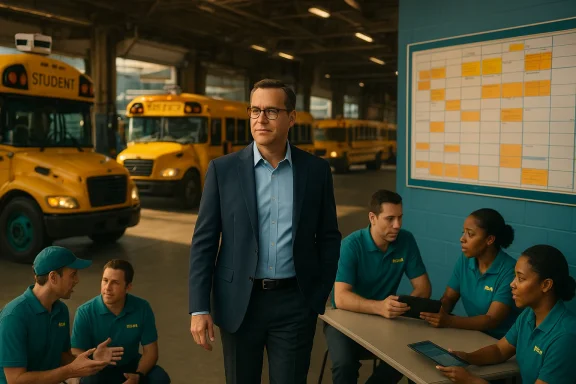
Monthly field visits — McCormack’s “go-sees” — are framed not as symbolic gestures but as primary research. Speaking with drivers, depot managers and trainers surfaces operational friction that does not show up in board decks: poor audio on driver tablets, confusing in-vehicle UI patterns, or routing exceptions that require manual overrides. Those insights inform product design priorities and change management plans.For leaders tempted to skip the field in favour of dashboards: the point is practical, not romantic. Dashboards show outcomes; fieldwork explains cause. A CIO who combines both builds remedies that stick.
Time mastery: the CIO’s underrated weapon
A calendar-first leadership model
One of McCormack’s most quoted practices is his maniacal approach to calendar control. He treats tasks as calendar commitments rather than a floating to-do list, leaving structured blocks for preparation, follow-up, and emergencies. The technique has three advantages:- It creates visible commitments to stakeholders (a scheduled review is harder to ignore than an item on a list).
- It forces prioritization; calendar space is finite and costly.
- It protects personal capacity by reserving time for unplanned work and preventing evening spillover.
Protecting deep work and preventing burnout
McCormack credits disciplined scheduling with a healthier work-life balance: aim to work bounded hours, do fitness to manage stress, and block family and recovery time. That discipline scales: when senior leaders show that they respect boundaries, it signals healthy norms across the organization and reduces the cultural pressure to be “always on.”The AI agenda: practical, scaled, and pragmatic
HALO and AI in the bus
First Student’s HALO platform bundles telematics, routing, driver training, predictive maintenance and AI-powered cameras. Public communications from the company emphasize HALO’s ambition to provide end-to-end visibility and safety tools for districts, drivers and families; the company also highlights measurable safety improvements in early deployments.McCormack told interviewers that First Student is running AI camera systems in production and plans to scale them widely. That combination — in-house platform plus fielded AI sensors — is a textbook example of applying AI as an operational multiplier rather than as a standalone experiment. It also highlights two linked truths:
- Sensory-scale matters: AI value grows when models have consistent, high-quality inputs (video, telematics, incident logs).
- Orchestration matters: rolling out AI in vehicles is an ops problem as much as a model problem — you need deployment, bandwidth, local compute, and robust lifecycle management.
Targeted agentic features: hiring, driver support, and Copilot
McCormack describes concrete, production AI use cases at First Student:- A recruiting assistant (“Olivia”) that helps screen and schedule applicants during seasonal hiring surges.
- AI cameras for in-cabin and external monitoring to support safety and coaching.
- Copilot-style productivity tools rolled out across teams for drafting, triage and knowledge work.
- Early experiments with voice AI for driver callouts and customer support.
Verifying the big claims — what’s solid, what needs caution
Any CIO profile that includes numbers and product rollouts must be checked against public records. Two key claims merit special attention.- Fleet and HALO rollout: First Student’s public materials and press notices identify a fleet in the mid‑tens of thousands and describe HALO as a company-wide platform being installed across the fleet. Those corporate statements are documented on the company site and in press releases.
- AI camera counts and specific deployment milestones: McCormack (in the source interview) mentions AI cameras on a subset of vehicles and a plan for broader deployment. Company press covers HALO’s fleet-wide ambition, but precise interim counts (for example, “6,000 vehicles today”) may not be reproducible in independent filings or public press at the same level of granularity. If you are budgeting or benchmarking, treat numerical rollout milestones quoted in interviews as operational guidance from leadership but seek program-level telemetry and vendor install logs for procurement or audit purposes. Where numeric precision matters — compliance reporting, vendor billing, or safety certification — ask for an auditable install register and a runbook for camera data retention and access.
Strengths: what McCormack gets right
- Business-first framing. McCormack frames IT investment in operational KPIs (safety, hiring throughput, route reliability) rather than abstract tech features. That alignment reduces the classic “IT vs. business” friction and improves adoption velocity.
- Field-informed product development. Monthly “go-sees” and depot-level briefings turn anecdote into product requirements, lowering the friction between engineers and drivers.
- Calendar discipline as leverage. Treating time as a scarce, scheduled resource scales decision‑making and protects for contingencies — a simple but often overlooked lever.
- Pragmatic AI adoption. The focus on high-volume, human-in-the-loop use cases (recruiting automation, driver aides, Copilot productivity tools) matches the best practice of anchoring pilots to measurable outcomes before scaling.
Risks and where to be cautious
- Data governance and privacy. Cameras and voice agents capture personal data in a sensitive context: minors on school buses. That raises immediate privacy, retention, access control, and regulatory questions. Implement strict data minimization, short retention windows, and tamper-evident audit logs for camera footage. Also define clear policies for parent and district access, redaction, and use in disciplinary proceedings.
- Vendor lock and portability. As HALO integrates sensors, telematics, analytics and agent layers, the platform becomes a strategic asset — and potentially a single point of vendor dependence. Negotiate export formats, portability clauses, and fallbacks into contracts to avoid operational risk if a partner fails to deliver.
- Over-automation in high-touch workflows. Automation of recruiting and scheduling (e.g., an “Olivia” bot) can accelerate hiring but risks alienating candidates if it removes empathy or creates opaque rejection paths. Keep escalation options and preserve human review gates for edge cases.
- Agentic AI cost and observability. Agent-based workflows (Copilots, voice agents) can create unpredictable inference costs and complex failure modes. Budget for monitoring, cost alerts, and an SLO-driven lifecycnts. Use human-in-the-loop thresholds for decisions with legal or safety impact.
- Security posture at the edge. Vehicles are distributed endpoints with intermittent connectivity, physical access, and local compute. Harden device firmware, use strong identity for agents, and ensure OTA updates are signed, rate‑limited and reversible.
Practical checklist for CIOs who want to emulate this model
- Map the real friction points
- Conduct depot-level interviews and a short “shadowing” program.
- Prioritize workflows with the highest time or cost density.
- Schedule the work you want done
- Move to a calendar-first model for strategic commitments.
- Reserve daily emergency slots and a weekly deep-work block.
- Pilot AI where it reduces measurable cycles
- Start with read-only or assistive modes.
- Track concrete KPIs (time to hire, calls avoided, incidents reduced).
- Build governance from day one
- Explicitly define data retention, export formats, audit logs, and access control.
- Treat agent identities as first-class: lifecycle, revocation, and least privilege.
- Prepare vendor escape and portability plans
- Insist on exportable telemetry and canonical schemas outside any single product.
- Design for human fallbacks
- Maintain clear escalation paths for any automated candidate rejection, safety alert, or operational override.
- Instrument and measure
- Invest early in observability for model outputs, cost monitoring, drift detection, and a human verification pipeline.
- Invest in adoption and retraining
- Offer microcredentials and on-the-job runtimes to reskill staff whose workflows change.
How to question the numbers — and what to ask operational teams
When a leader announces that “AI cameras are on X vehicles,” procurement and audit teams should request:- A device register with timestamps, locations, and firmware versions.
- Ingest and storage telemetry: where footage lands, how long it’s retained, and access logs.
- Model governance artifacts: model versions, training-data provenance, and human-override rates.
- Security attestations for the device supply chain and update mechanisms.
- Cost breakdowns: per-vehicle incremental operating costs (connectivity, storage, compute).
The broader lesson for modern CIOs
Sean McCormack’s pattern isn’t a marketing slogan — it’s a pragmatic engineering and leadership stack: blend disciplined time management with relentless business immersion, then apply technology in high-leverage spots while building governance that scales. That stack answers two contemporary CIO questions:- How do I preserve operational continuity while experimenting with AI? Answer: pick high-frequency operational pain points, pilot with human oversight, and instrument everything.
- How do I make IT matter in the boardroom? Answer: report business KPIs, not engineering outputs.
Conclusion
Modern CIOs must be both conductors and frontline workers: steering a complex orchestra of vendors, models and field operations while keeping a direct line into the real-world workflows that determine success. Sean McCormack’s leadership at First Student shows how a calendar-first, business-centric approach can make that dual role sustainable. HALO — with telematics, AI cameras and embedded operational tooling — is an instructive case: it demonstrates that when AI is deployed as an enabler of operational reliability and human workflows, it stops being an interesting experiment and becomes a durable competitive capability.For any technology leader looking to replicate this model, the path is practical: get into the field, schedule your priorities, anchor pilots to measurable business outcomes, and build governance from day one. The payoff is not just efficiency — it is the conversion of technology from a cost center into an operational platform that improves safety, reliability and service for the people who depend on it most.
Source: TechTarget Inside a CIO's mind: Mastering time and knowing the business | TechTarget
