

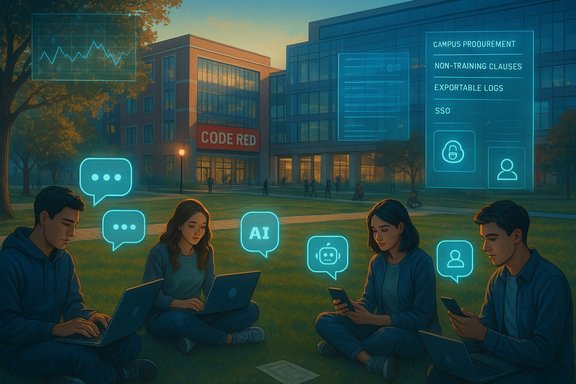
OpenAI’s ChatGPT has quietly become the dominant student-facing AI on campus, with reported education-tier deals and usage telemetry that suggest adoption at a scale large enough to reshape procurement and Microsoft’s competitive calculus — a development Brad Sams and Paul Thurrott unpacked on Petri’s First Ring Daily and framed as a tactical “code red” moment with material consequences for Microsoft’s pricier Copilot positioning.
Over the last academic year, universities shifted from banning public AI tools to negotiating institution-wide licenses, a change driven by student behavior and by pragmatic IT governance. The headline figures circulating in multiple rounds of reporting — roughly 700,000 ChatGPT seats sold to about 35 U.S. public universities and more than 14 million ChatGPT interactions across a sample of campuses in a single month — are repeatedly cited in coverage and were central to the Petri First Ring Daily discussion. Those numbers are reported as purchase-order and campus-telemetry aggregates, and they serve as the load-bearing claims that explain why campuses are moving quickly to centralize AI access.
Petri’s hosts framed the situation as part tactical (engineering triage at OpenAI, refocusing on reliability and grounding) and part symbolic (a market-shifting moment reminiscent of previous “code red” industry scrambles). The practical upshot for Windows admins and procurement teams is simple: distribution and price-driven adoption among students can outpace enterprise integrations designed around governance, and that imbalance influences what tools become default for large populations on campus.
Yet distribution alone is not destiny. The winners in this next phase will be the vendors who combine model advances with demonstrable auditability, clear contract terms (non-training guarantees, exportable logs), predictable pricing over renewal cycles, and integrations that respect both productivity and privacy needs. Campus IT leaders and Windows administrators must insist on those contractual protections, pilot with measurable KPIs, and redesign pedagogy to preserve academic integrity while capturing the pedagogical benefits of AI.
Petri’s reporting — and the First Ring Daily discussion in particular — should be read as a practical wake-up call: the technology is here and scaling quickly, but the operational, fiscal, and governance choices made now will determine whether campuses extract long-term educational value or inherit long-term risk.
Source: Petri IT Knowledgebase First Ring Daily: Fixed Sideways - Petri IT Knowledgebase
 Background / Overview
Over the last academic year, universities shifted from banning public AI tools to negotiating institution-wide licenses, a change driven by student behavior and by pragmatic IT governance. The headline figures circulating in multiple rounds of reporting — roughly 700,000 ChatGPT seats sold to about 35 U.S. public universities and more than 14 million ChatGPT interactions across a sample of campuses in a single month — are repeatedly cited in coverage and were central to the Petri First Ring Daily discussion. Those numbers are reported as purchase-order and campus-telemetry aggregates, and they serve as the load-bearing claims that explain why campuses are moving quickly to centralize AI access.Petri’s hosts framed the situation as part tactical (engineering triage at OpenAI, refocusing on reliability and grounding) and part symbolic (a market-shifting moment reminiscent of previous “code red” industry scrambles). The practical upshot for Windows admins and procurement teams is simple: distribution and price-driven adoption among students can outpace enterprise integrations designed around governance, and that imbalance influences what tools become default for large populations on campus.
What Petri’s First Ring Daily Actually Reported
The core claims
- OpenAI has sold substantial education-tier ChatGPT licenses — reporting commonly points to ~700,000 seats tied to about 35 public U.S. university systems, with vendor statements suggesting a larger global footprint described as “well over a million” in some vendor remarks.
- Campus telemetry from a sample of institutions recorded millions of monthly interactions (commonly cited: 14 million uses in September 2025 for a 20-campus sample), showing high-frequency usage among a subset of power users.
- The pricing and packaging of OpenAI’s edu/enterprise offerings were deeply discounted in large system deals, materially lowering the per-seat barrier for mass rollouts on campuses and accelerating adoption.
- Microsoft’s Copilot, while functionally deeper inside Microsoft 365 (tenant grounding, Purview, audit tooling), has not captured the same student mindshare — a product-differentiation problem compounded by pricing and familiarity advantages on ChatGPT.
Tone and implications in the episode
Brad Sams and Paul Thurrott treated the reporting as an operational and strategic inflection: OpenAI’s reported internal memo to prioritize ChatGPT’s core experience, and a scramble to shore up latency, grounding, and reliability, signals that the market is moving from “research-era” headline metrics to product-era expectations. Petri emphasized the practical consequences for Windows and enterprise IT — delayed integrations, slower rollouts of peripheral experiments, and a renewed premium on deterministic, auditable behaviors over raw model capability.Parsing the Numbers: What’s Verifiable and What Needs Caution
Confirmed patterns and strong indicators
- Multiple reporting threads and the Petri summary point to systemwide deals (e.g., California State University deployments) that can individually account for hundreds of thousands of seats, explaining how aggregated figures reach the hundreds-of-thousands or more. Institutional procurement records and public announcements exist for some major deals, which corroborates the broad pattern of rapid campus licensing.
- Campus telemetry samples used by reporters are credible directional evidence: high aggregate call volumes and concentrated “power-user” behavior are real operational signals that matter for pedagogical impact and infrastructure planning. Telemetry samples are not, however, a full census of all licensed use.
Caveats and unverifiable elements
- The headline “>700k” figure and vendor language claiming a global higher-ed total “well over a million” are derived from a mixture of purchase orders, vendor statements, and aggregated reporting. Purchase orders cited in journalism are persuasive but often redacted, behind paywalls, or partial; vendor statements are helpful but must be treated as vendor-provided claims until validated by procurement documents or FOIA-able records. Treat these totals as strong directional evidence rather than fully audited counts.
- Telemetry aggregates (e.g., 14M interactions across 20 campuses in a month) are meaningful at scale but heavily skewed by usage distribution — a small cohort of users typically produces a disproportionate share of calls. Therefore, total interactions do not equate to uniform ongoing usage by all licensees. Institutional decisions should rely on local telemetry breakdowns (active-user counts, median calls/user, task mix) rather than headline totals alone.
Why Price and Distribution Beat Integration in the Student Market
Students adopt tools based on friction and familiarity. ChatGPT’s long consumer footprint, ease of access (web and app), and the momentum of students who already used the consumer product create a natural uptake advantage when institutions provide sanctioned access at low or zero marginal cost.- Low per-seat pricing in large vendor deals reduces budget friction for procurement teams, enabling systemwide rollouts that rapidly normalize use. The combination of familiarity + affordability explains why ChatGPT quickly became the de facto student assistant in many reported deployments.
- Microsoft’s Copilot advantages (deep embedding in Office apps, tenant-aware data controls, Purview integration) matter most inside staff and faculty workflows where data grounding and auditability are mission-critical. Those advantages are less visible to students who often work in ad-hoc, browser-based workflows outside the Office envelope.
Technical and Product Implications for Microsoft, OpenAI, and Campus IT
For Microsoft
- Short-term: Expect pressure to rethink Copilot pricing and distribution tactics for education markets. The company’s deep platform advantages (Windows integration, Graph context, Purview) are strategic but must be paired with accessible student-facing entry points or education-tier pricing to regain mindshare.
- Mid-term: Microsoft may accelerate internal model development or third-party model integration strategies to manage costs, diversify supply, and lower reliance on high-cost external models. That transition would require architectural work in Azure, Copilot routing, and tenant-aware fallbacks.
For OpenAI
- The organization appears to be shifting engineers toward reliability, latency improvements, and grounding mechanisms — a product-first triage that sacrifices some experimental features in favor of stability. That trade-off can consolidate the consumer edge by improving everyday experience across large user bases.
- Risk: large discounts to education buyers create short-term adoption wins but raise questions about sustainability at renewal; campuses must prepare for possible price escalations at contract renewals.
For Campus IT and Procurement
- Governance: contracts must insist on non-training clauses, retention windows, exportable logs, audit rights, and data residency guarantees. Marketing promises about non-training or carbon neutrality need contractual backing and external auditability to be meaningful.
- Operational controls: require SSO/SCIM provisioning, role-based admin consoles, DLP rules, and telemetry export to SIEM. Pilot with measurable KPIs (active users, median calls, academic integrity incidents) before broad rollouts.
Practical Checklist for Campus Rollouts (Actionable Steps)
- Negotiate explicit non-training contract language and a verifiable retention policy for prompts and uploads.
- Require audit logs and exportable telemetry on a set cadence (monthly snapshots at minimum).
- Insist on SSO/SCIM provisioning and role-based admin controls for identity lifecycle management.
- Implement DLP and workload classification to route sensitive workloads to tenant-bound Copilot instances or local/private compute.
- Run a time-boxed pilot (30–90 days) across representative cohorts and capture pedagogy outcomes, cost-per-active-user, and integrity incidents.
- Redesign assessment strategies to emphasize process evidence and disclosure rather than rely solely on detection tools.
- Build an exit plan with migration support, exportable user lists, and documented off-ramps for vendor switch scenarios.
- Budget for renewal contingencies — assume initial per-seat discounts may rise on renewal and require multi-year financial planning.
Risks, Trade-offs, and Unanswered Questions
Risks
- Vendor lock-in and data governance: Large seat counts tied to vendor platforms create exit difficulties if non-training guarantees are vague or absent. Institutional procurement must insist on contractual remediations.
- Fiscal exposure: Attractive initial pricing can create a renewal cliff. Institutions that scale early must model 3–5 year spend scenarios and include escalation clauses in budgets.
- Academic integrity and pedagogy: Rapid normalization of AI requires rethinking assignments and assessments. Detection alone won’t fix integrity issues; process-based assessments and explicit disclosure rules are necessary.
Trade-offs
- Speed vs. control: Quick deployments democratize access but increase governance burdens and privacy risk.
- Familiarity vs. integration: Student-friendly consumer assistants win rapid adoption; tenant-integrated copilots win governance and enterprise use cases. The pragmatic campus architecture may require both.
Unanswered questions (flagged for follow-up)
- What exact global number of higher-ed seats is auditable via procurement records versus vendor statements? The public reporting aggregates credible samples but lacks a full-audit census. This should be validated with primary procurement documents where the number matters.
- How will renewal pricing behave for system-wide contracts that were sold with steep discounts? Early indicators suggest escalation risk; campuses must secure multi-year protections.
- To what degree will OpenAI’s product triage (focusing on latency, grounding, reliability) change the competitive balance with Google Gemini and Microsoft Copilot over the 6–12 month horizon? Monitor release notes, independent benchmarks, and vendor renewal terms for signal.
Competitive Landscape: Microsoft vs. OpenAI vs. Google
- OpenAI: consumer brand familiarity, low-friction edu packaging, large aggregated adoption among students when discounts are applied. Strength: distribution; Weakness: governance ambiguity unless contractually secured.
- Microsoft: deep platform embedding (Windows, Office, Graph, Purview), enterprise-grade governance. Strength: tenant grounding, auditability; Weakness: weaker consumer mindshare among students and pricing that can be perceived as higher for ad-hoc student use.
- Google: Gemini’s benchmark gains and integrated Workspace distribution make it a credible challenger; distribution across Search and Android remains a powerful channel. Watch Google’s educational partnerships and Workspace for Education push.
What Windows Administrators and IT Leaders Should Watch Next
- Renewal clauses and pricing escalators in education contracts — these will determine long-term fiscal exposure.
- Model training guarantees and auditable non-training language — procurement must require verifiable proofs, not marketing assertions.
- Independent benchmarks and third-party evaluations that measure task-specific performance and latency under realistic workloads — these will matter more than synthetic leaderboard results.
- Insider and preview releases (Microsoft Insider channels, OpenAI product notes) that reveal product triage effects: latency, grounding, and agent behavior changes. These will be the earliest signals of capability shifts.
Conclusion: A Product-First Moment with Governance as the Deciding Factor
The Petri First Ring Daily discussion captured a real, consequential shift: the generative-AI race is moving from headline capabilities to the day-to-day realities of product performance, latency, reliability, and governance. ChatGPT’s rapid institutional adoption on campuses — enabled by aggressive edu packaging and deep consumer familiarity — has created a distribution advantage that Microsoft’s deeper platform integration does not automatically overcome. That advantage matters because students drive behavioral norms on campuses, and behavioral norms can become procurement defaults.Yet distribution alone is not destiny. The winners in this next phase will be the vendors who combine model advances with demonstrable auditability, clear contract terms (non-training guarantees, exportable logs), predictable pricing over renewal cycles, and integrations that respect both productivity and privacy needs. Campus IT leaders and Windows administrators must insist on those contractual protections, pilot with measurable KPIs, and redesign pedagogy to preserve academic integrity while capturing the pedagogical benefits of AI.
Petri’s reporting — and the First Ring Daily discussion in particular — should be read as a practical wake-up call: the technology is here and scaling quickly, but the operational, fiscal, and governance choices made now will determine whether campuses extract long-term educational value or inherit long-term risk.
Source: Petri IT Knowledgebase First Ring Daily: Fixed Sideways - Petri IT Knowledgebase
