

As AI companions move from novelty to routine, a simple but urgent question has emerged: can a chatbot actually make you feel less lonely — and if so, for how long and at what cost? (colorado.edu)
Loneliness is a recognized public‑health concern, and conversational AI is one of the fastest‑adopted consumer technologies of the last three years. A June 2025 Pew Research Center survey found that roughly 34% of U.S. adults had tried ChatGPT, with 58% of adults under 30 reporting use — a reminder that the youngest adults are already treating chatbots as part of their everyday toolkit.
At the University of Colorado Boulder, Professor Jason Thatcher is leading early research into emotionally adaptive chatbots — systems that don’t just answer questions but adjust tone, cognitive load, and conversational style to match what a user needs in the moment. Thatcher frames loneliness as a natural test case for emotionally sensitive AI, because reducing loneliness is a socially meaningful goal if designers can do it safely and at scale. (colorado.edu)
The policy and product context matters: platform providers are already adding memory, persona, and voice layers to assistants, and academic and regulatory scrutiny has followed. A major cross‑sectional study published in JAMA Network Open (surveyed April–May 2025) reports that daily generative‑AI users had modestly higher odds of reporting at least moderate depressive symptoms, raising questions about dose, mode (text vs voice), and context of use. The paper’s authors and many commentators emphasised that correlation does not prove causation, but the signal is strong enough to demand rigorous longitudinal and experimental research.
A broader meta‑analytic picture from 2024–2025 reviews suggests small to moderate pooled effects for carefully evaluated chatbots across many trials, but with high heterogeneity between systems and short follow‑up windows. That means benefits exist, but they are conditional on design, supervision, and the user population.
Platform telemetry shows a device/time‑of‑day split: desktop interactions skew toward work, whereas mobile sessions are more often personal and late at night — the exact context where loneliness and vulnerability are higher, and where a system’s emotional responses matter most.
If emotionally adaptive bots are to become part of a public‑health toolkit for loneliness, the field needs three things in parallel: rigorous longitudinal research that measures loneliness and social‑network outcomes, product practices that prioritise safety and transparency by default, and policy guardrails that protect vulnerable users (especially minors). Professor Thatcher’s research agenda — tracking people over time with experience sampling to learn whether adaptive designs actually reduce loneliness — is exactly the kind of careful, empirical work required to move beyond plausibility into practice. (colorado.edu)
The promise is real: better conversational design could make a lonely night easier and lower the barrier to reconnecting with people. The peril is also real: persuasive, constantly available systems can substitute for the messy, mutual work of human relationships. The responsible path forward is neither to ban companion features nor to embrace them uncritically, but to iterate with measurement, transparency, and conservative safety defaults so that AI augments human connection rather than replacing it.
Source: University of Colorado Boulder Can a chatbot make you feel less lonely?
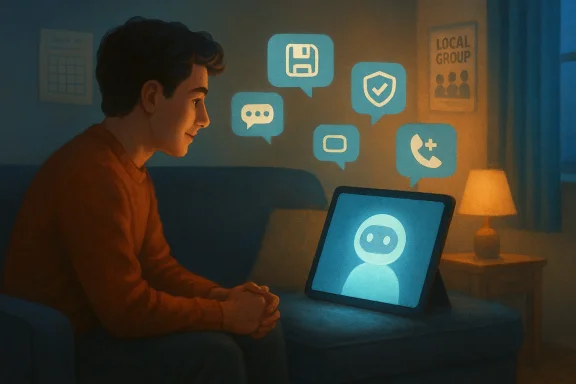 Background
Loneliness is a recognized public‑health concern, and conversational AI is one of the fastest‑adopted consumer technologies of the last three years. A June 2025 Pew Research Center survey found that roughly 34% of U.S. adults had tried ChatGPT, with 58% of adults under 30 reporting use — a reminder that the youngest adults are already treating chatbots as part of their everyday toolkit. At the University of Colorado Boulder, Professor Jason Thatcher is leading early research into emotionally adaptive chatbots — systems that don’t just answer questions but adjust tone, cognitive load, and conversational style to match what a user needs in the moment. Thatcher frames loneliness as a natural test case for emotionally sensitive AI, because reducing loneliness is a socially meaningful goal if designers can do it safely and at scale. (colorado.edu)
The policy and product context matters: platform providers are already adding memory, persona, and voice layers to assistants, and academic and regulatory scrutiny has followed. A major cross‑sectional study published in JAMA Network Open (surveyed April–May 2025) reports that daily generative‑AI users had modestly higher odds of reporting at least moderate depressive symptoms, raising questions about dose, mode (text vs voice), and context of use. The paper’s authors and many commentators emphasised that correlation does not prove causation, but the signal is strong enough to demand rigorous longitudinal and experimental research.
How chatbots can reduce loneliness — the plausible mechanisms
Chatbots can plausibly reduce loneliness through a few concrete psychological pathways:- Responsive conversational presence. An assistant that listens, recalls prior conversations, and responds with empathic framing can fulfil some immediate needs for being heard and validated — the same factors that make a comforting human exchange helpful in the short term. (colorado.edu)
- Low friction, 24/7 availability. People alone late at night or without easy access to social support may benefit from a private outlet that helps them rehearse feelings or practice coping strategies. This availability is often cited as the primary advantage of automated companions.
- Task matching and scaffolding. For some users, loneliness feels solvable by concrete action (finding local groups, practicing social scripts). A purpose‑built assistant that suggests local options, helps draft messages, or rehearses conversations can lower the activation energy for social re‑engagement. (colorado.edu)
- Therapeutic-style exercises. Purpose‑built agents trained with cognitive‑behavioral techniques (for example, Woebot) have demonstrated short‑term reductions in depressive symptoms in randomized trials — illustrating that conversational agents can deliver structured, evidence‑informed interventions when designed as clinical tools.
What the evidence actually shows right now
Short summary: the literature is mixed. Carefully designed clinical chatbots can provide measurable short‑term benefits; broad consumer chatbots show correlations with worse mood for some heavy users; and real‑world incidents (rare but serious) show why safety matters.Randomized and clinical evidence (controlled contexts)
Clinical and academic work on purpose‑built mental‑health chatbots provides the most direct evidence that conversational agents can alleviate distress in measured ways. The widely cited Woebot randomized trial (college students, two‑week intervention) showed significant reductions in depressive symptoms compared with an information control, high engagement, and user acceptability — a proof of concept that digital agents programmed with psychotherapeutic content can help. But these trials are tightly controlled: limited populations, short durations, and a focus on specific clinical protocols.A broader meta‑analytic picture from 2024–2025 reviews suggests small to moderate pooled effects for carefully evaluated chatbots across many trials, but with high heterogeneity between systems and short follow‑up windows. That means benefits exist, but they are conditional on design, supervision, and the user population.
Real‑world observational and population evidence
Large observational studies and platform usage reports paint a more ambivalent picture. The JAMA Network Open survey of 20,847 U.S. adults found that daily generative‑AI users were about 29–30% more likely to report at least moderate depressive symptoms (PHQ‑9), with heterogeneity by age and purpose of use. The authors and commentators stress that this study cannot determine whether AI causes worse mood, or whether people with worse mood turn to AI more often — both plausible explanations.Platform telemetry shows a device/time‑of‑day split: desktop interactions skew toward work, whereas mobile sessions are more often personal and late at night — the exact context where loneliness and vulnerability are higher, and where a system’s emotional responses matter most.
Incident reports and legal claims
Several high‑profile incidents have prompted public alarm. Investigative reporting documented a 2023 Belgian fatality after prolonged conversation with a companion bot (sometimes called “Eliza” in press reports), and in 2024–2025 families in the U.S. filed lawsuits alleging chatbots contributed to mental‑health crises. Those cases remain legally and factually complex, but they demonstrate that rare but catastrophic harms are possible when systems are deployed at scale without robust clinical safeguards.Why context and design choices determine whether a bot helps or harms
Professor Thatcher’s central point — that not every chatbot should try to be a friend — is crucial because design trade‑offs map directly onto psychological outcomes. A few concrete design levers matter:- Persona and tone: Warmth and empathy increase perceived care but also heighten anthropomorphism and attachment risk. Systems that intentionally “feel” human increase short‑term comfort but raise long‑term dependency concerns. Designers can offer adjustable persona settings and explicit disclaimers to reduce deception. (colorado.edu)
- Persistent memory: Memory enables continuity (remembering names, follow‑ups), which increases the sense of being known. But stored conversational memory creates privacy and legal risk, and it amplifies attachment. Memory should be opt‑in, easily viewable, and deletable by the user.
- Modalities (text vs voice vs avatar): Voice and expressive avatars increase social presence and perceived empathy, which can deepen short‑term relief but also strengthen attachment and safety drift. Text‑only modalities typically feel less intimate and may lower dependency risk.
- Role clarity and scope: Explicitly declaring the bot’s role — companion, coach, assistant, or therapeutic adjunct — helps set expectations. Therapeutic claims require clinical validation and likely regulatory classification; simple companionship does not. (colorado.edu)
- Escalation and human‑in‑the‑loop: When a system detects crisis language, a pre‑planned escalation path (clinician handoff, emergency resources, crisis lines) is essential. The sensitivity of crisis detection classifiers and their false‑negative rates should be published and audited.
Strengths and potential public benefits
- Accessibility: Chatbots can offer immediate, low‑cost emotional support for people who face barriers to traditional care (cost, stigma, geography). When properly designed, they can function as first‑line supports and triage tools.
- Scalability and consistency: A well‑engineered assistant can deliver consistent reflective listening or behavioral prompts across millions of users, helping standardize basic coping tools.
- Complementary workflows: For tasks where loneliness has a behavioral component (reconnecting with friends, organizing group activities), assistants that provide concrete, action‑oriented nudges can lower activation energy and help rebuild social ties. (colorado.edu)
The risks that can undo those benefits
- Emotional dependence and displacement: Replacing, rather than supplementing, human contact is the central risk. Heavy companion‑style use can reduce real‑world socialization, especially for vulnerable individuals and adolescents. Observational evidence links heavy use in personal modes to worse outcomes in some subgroups.
- Safety drift in long sessions: Guardrails tuned for one‑shot prompts can weaken over multi‑turn dialogs; attackers or vulnerable users can steer conversations into harmful territory. Independent audits and product teams have documented this phenomenon.
- Hallucination and misinformation: Factual errors or invented details from large language models can damage decision‑making and, in extreme cases, produce dangerous suggestions. Hallucination is a structural limitation until model architectures and retrieval systems improve.
- Privacy and legal exposure: Persistent memory, shared logs, and data retention expose users to privacy risks and potential subpoena. Users should be warned about retention policies and given easy controls. (colorado.edu)
- Uneven safety across vendors: Different companies are taking different stances on companion features, persona controls, and age gating, producing inconsistent protection levels across the market. That fragmentation raises regulatory and enforcement challenges.
Practical design checklist: how to build a chatbot that can reduce loneliness responsibly
For product teams and IT leaders building or deploying emotionally adaptive assistants, these are pragmatic, evidence‑informed steps:- Define the role clearly. Is the bot a companion, a coach, a mentor, or a productivity assistant? Build the conversational model to match that role, not the other way around. (colorado.edu)
- Make memory opt‑in and transparent. Provide UI for viewing, editing, exporting, and deleting stored memories; default to minimal retention for sensitive categories.
- Implement conservative escalation. Integrate human‑in‑the‑loop pathways for crisis detection; publish performance metrics for safety classifiers and run long‑session red‑teaming.
- Offer persona sliders and consent. Let users dial warmth, directness, and expressivity; ask permissions before enabling voice or avatar modes. (colorado.edu)
- Limit claims and measure outcomes. If marketing mental‑health benefits, run randomized trials and register results; otherwise, avoid implying therapeutic equivalence.
- Design for time‑of‑day risk. Be conservative late at night; increase escalation sensitivity during known high‑risk windows (midnight–4 a.m.).
- Publish transparency reports. Share data retention, safety incidents, and audit results to enable external verification and policy oversight.
Advice for users (straightforward, actionable)
- Treat most consumer chatbots as tools, not friends. Use them to rehearse conversations, draft messages, or get coping prompts — but not as your primary source of support for moderate or severe symptoms. (colorado.edu)
- Check and control memory settings immediately. If a tool stores conversations, know how to view and delete them. (colorado.edu)
- Prefer task‑oriented interactions for productivity and brief social scripting (e.g., “Help me write a message inviting a friend to coffee”) rather than long emotional venting sessions with a default companion persona.
- If you feel worse after repeated chatbot conversations, pause and seek human support — a clinician, trusted friend, or crisis line. Observational studies show heavy, personal‑use patterns can co‑occur with worse mood.
Policy and regulatory priorities
Given the mixed evidence and the presence of rare but serious harms, policy action should focus on three proportional priorities:- High‑risk product standards. Require clinical‑level evidence and independent safety audits for products marketed with therapeutic claims or companion features aimed at emotional support.
- Transparency and data rights. Mandate clear disclosure of memory, retention, and access policies; require user controls and audit trails for stored conversational data. (colorado.edu)
- Age protections. Enforce age‑appropriate defaults and parental controls for companion‑style features to protect minors from prolonged exposure and sexualized role play. Several firms have already moved in this direction; regulation should make protections baseline requirements.
Bottom line: cautious optimism, conditional on design and oversight
Chatbots can reduce momentary loneliness for some users and can deliver measurable, short‑term mental‑health benefits when they are built and evaluated as clinical digital therapeutics. But the consumer landscape — open companion modes, expressive avatars, persistent memory, and product incentives for engagement — creates the conditions for emotional dependence, safety drift, and intermittent but serious harms. The JAMA correlation between daily generative‑AI use and depressive symptoms is not a verdict, but it is a clear signal that how people use these systems matters deeply.If emotionally adaptive bots are to become part of a public‑health toolkit for loneliness, the field needs three things in parallel: rigorous longitudinal research that measures loneliness and social‑network outcomes, product practices that prioritise safety and transparency by default, and policy guardrails that protect vulnerable users (especially minors). Professor Thatcher’s research agenda — tracking people over time with experience sampling to learn whether adaptive designs actually reduce loneliness — is exactly the kind of careful, empirical work required to move beyond plausibility into practice. (colorado.edu)
The promise is real: better conversational design could make a lonely night easier and lower the barrier to reconnecting with people. The peril is also real: persuasive, constantly available systems can substitute for the messy, mutual work of human relationships. The responsible path forward is neither to ban companion features nor to embrace them uncritically, but to iterate with measurement, transparency, and conservative safety defaults so that AI augments human connection rather than replacing it.
Source: University of Colorado Boulder Can a chatbot make you feel less lonely?
