

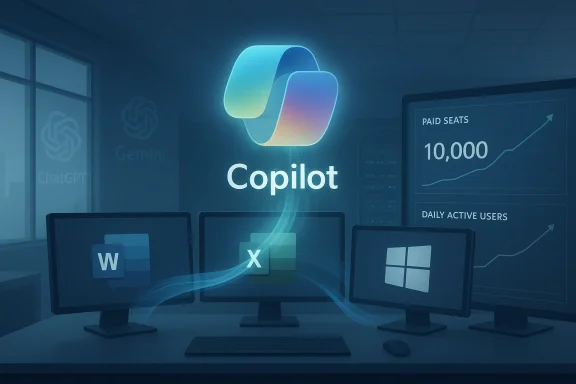
Microsoft’s Copilot is losing the user-choice battle even as Microsoft doubles down on building it into everything from Windows to Word, raising a stark question for enterprises and investors alike: can seat counts and licensing wins be converted into daily habits before competitors win the imagination — and workflow — of knowledge workers?
Background
Microsoft’s AI strategy has been built around embedding “Copilot” experiences across its software stack: Microsoft 365 Copilot in Office apps, GitHub Copilot for developers, a standalone Copilot consumer app, and operating‑system integrations in Windows. That distribution play promised an easy path from procurement to regular use — sell seats to IT, bake Copilot into the tools people already open every day, and watch engagement follow.Recent market signals complicate that vision. Independent survey data shows Copilot losing ground as a primary platform among paid AI users in the United States, while OpenAI’s ChatGPT remains the dominant choice and Google’s Gemini has surged. At the same time, Microsoft reports growth in seat counts and headline engagement multipliers — metrics that look strong on paper but that can mask a thorny conversion problem: licenses do not automatically become habits.
This is not just a product story; it’s a finance and operations story too. Microsoft’s capital spending on AI infrastructure has ballooned as it equips data centers with GPUs and other short‑lived assets. That investment amplifies the stakes: if Copilot’s seats don’t become sticky daily drivers, Microsoft still carries the cost of running the underlying AI fabric while monetization lags.
What the numbers are saying
- Recon Analytics’ independent survey data shows a meaningful decline in Copilot’s share as the “primary platform” among U.S. paid AI subscribers, dropping from nearly one in five to roughly one in nine over six months. At the same time, ChatGPT retained the majority share and Gemini strengthened its position.
- Microsoft publicly reports tens of millions of paid “seats” for various Copilot products and has highlighted rapid year‑over‑year multipliers — daily active users rising “10x” in some Microsoft 365 Copilot metrics, and seat additions up north of 160% year‑over‑year for paid Copilot licenses.
- Alphabet’s Gemini app has reported explosive consumer growth, with monthly active user counts in the hundreds of millions following a recent model release and broad product integration across Google services.
- Microsoft disclosed capital expenditures in the most recent quarter that reached the tens of billions, with roughly two‑thirds directed at short‑lived compute assets — largely GPUs and CPUs — which are explicitly allocated to AI services, including Copilot.
Why “licenses ≠ habits” — the workplace conversion gap
The core problem
Enterprise IT often buys what they can manage and secure: broad licenses, single‑pane administration, predictable contracts. But worker choice frequently defeats procurement intentions. When employees can freely choose tools or bring their own preferred assistants, they habitually gravitate to the interface and capabilities that feel fastest, clearest, and least frictioned.Survey evidence reveals a consistent pattern: in organizations where multiple assistants are available, employees disproportionately select ChatGPT (and increasingly Gemini) over Copilot. That’s not just a loss of preference; it’s a loss of time, analytics, and long‑term customer lifetime value for Microsoft.
Why users switch
Several practical factors drive this behavior:- Perceived product cohesion. When “Copilot” appears as a feature, a Windows icon, and a separate app, users can feel the brand is fragmented. A coherent, single‑experience product tends to win user attention.
- Interface familiarity and speed. ChatGPT built its brand on a clean, fast conversation window. For many users, that simplicity outcompetes deep but clumsy integrations that require clicking through menus.
- Cross‑platform reliability. Users who interact across mobile, web, and desktop expect consistent behavior. Tools that are best‑in‑class on phone or web tend to win habitual usage.
- Workflow fit. When assistants deliver immediate, reliable outputs for specific tasks (code snippets, summarizations, drafting), users pick the tool that does that task best with minimal setup.
- Plugin and extension ecosystems. A popular, extensible assistant with a rich plugin marketplace or API encourages end‑users and teams to build habit‑forming automations.
Branding and integration: a double‑edged sword
Microsoft’s strategy — proliferate Copilot experiences everywhere — comes with a branding paradox. On one hand, ubiquity increases exposure: Copilot in Word, Copilot in PowerPoint, Copilot on the taskbar — each placement creates another opportunity to be used. On the other hand, ubiquity without a clear, single product identity can create user confusion.- When employees see multiple “Copilot” touchpoints, they may not instinctively understand which one to open for a given task.
- Messaging inconsistency (is Copilot an app, a feature, or an OS assistant?) reduces mental models: people form quick mental shortcuts about tools; mixed signals slow that process.
- Integrations that feel like checkboxes — “added” without a simplified, discoverable UX — produce low‑depth interactions that never become habitual.
Product and UX friction: common failure modes
Even when Copilot features are present, adoption can stall because of everyday frictions:- Slow load times or rate limits on desktop features break flow, especially compared to nimble web chat experiences.
- Context loss between apps — for example, when a user wants Copilot to use an email thread to draft a memo but must re‑attach or re‑prompt — creates cognitive overhead.
- Mixed quality of outputs across domains undermines trust: users quickly learn which assistant reliably summarizes legal language versus who performs better at creative brainstorming.
- Security and compliance guardrails in enterprise deployments can be overly restrictive, making Copilot less convenient than consumer alternatives that workers privately favor.
Microsoft’s defense: seats, DAUs, and product breadth
Microsoft has leaned into raw scale and enterprise penetration as its competitive defense:- Seat counts. Microsoft reports millions of paid seats across Copilot variations. For many IT leaders, seat count reduces procurement friction: it’s easier to buy broad access than to negotiate narrow licenses.
- Reported engagement multipliers. Microsoft cites large year‑over‑year increases in daily active users and conversations per user in specific reports — statistics that indicate deepening usage for some customers.
- Enterprise commitments. Big deployments with tens of thousands of seats at single organizations demonstrate that some customers are buying in at scale.
The investor lens: heavy capex, long ROI horizon
Microsoft’s capital expenditures have surged, with a large portion funneled into GPUs and other AI‑centric hardware. That investment is logical: AI services are compute‑intensive, and capacity constraints directly limit revenue from consumption‑based cloud offerings.But this creates two related urgencies:
- Microsoft must ensure that first‑party AI products — Copilot included — generate usage that monetizes the incremental compute capacity.
- Investors will scrutinize whether capacity expansion yields proportional growth in high‑margin revenue streams, or whether Microsoft is left carrying AI infrastructure costs while competitors convert consumer mindshare into subscription revenue.
Competitive pressure: ChatGPT and Gemini’s momentum
ChatGPT remains the public face of conversational AI for many users: a simple, consistent chat experience, early mover advantage, and a rich ecosystem of integrations. Meanwhile, Google’s Gemini has scaled rapidly through productized integrations across Search, mobile, and a standalone app that now counts in the hundreds of millions of monthly users.These dynamics matter in two ways:
- Consumer habits bleed into work: employees who prefer ChatGPT or Gemini in their personal lives are likely to reach for the same assistants at work when policies allow it.
- Competitors are iterating fast: rapid model updates, new modes, and cost optimizations lower the bar for switching. A tool that felt marginal a few months ago can feel compelling after a new model or mobile experience launches.
Enterprise risks and governance considerations
Enterprises face real operational and security tradeoffs in how they enable assistants:- Allowing multiple assistants introduces data sprawl and potential leakage points. Workers copying sensitive content into an uncontrolled assistant can violate compliance policies.
- Locking down Copilot extensively to meet security requirements can degrade the user experience to the point where employees prefer external tools.
- The right balance — secure by default, but frictionless for approved workflows — is hard to calibrate, particularly as assistants gain access to tenant‑specific data and knowledge bases.
Where Microsoft can realistically move the needle
Microsoft’s path to improving Copilot adoption is multi‑pronged. The company can’t only rely on distribution; it must convert exposure into preference.Key levers include:
- Unify the brand experience. Present Copilot as a single, discoverable assistant across contexts, with consistent triggers and a shared state so users know where to go and what to expect.
- Fix onboarding and discoverability. Contextual templates, one‑click prompts, and guided tours for common business scenarios turn seats into habits more effectively than feature checklists.
- Prioritize reliability and speed. For knowledge workers, latency is adoption kryptonite. Optimizing for fast, accurate responses in high‑value workflows pays back quickly.
- Provide workflow‑first product thinking. Ship out‑of‑the‑box automations for email triage, meeting summaries, sales followups, and code review so the assistant is immediately useful.
- Align pricing and customer telemetry. Measure daily active usage and task completion, and tie part of corporate renewals to demonstrated productivity gains rather than pure seat counts.
Recommendations for corporate buyers and IT leaders
If you run or advise an IT organization, here are pragmatic steps to get ROI from Copilot and avoid the “procured but unused” trap:- Define 3–5 high‑value tasks where an AI assistant should add measurable time savings or quality improvements.
- Start with pilot squads, instrument usage, and measure task completion rates and time saved rather than vanity metrics like installs.
- Configure governance policies that permit these pilots to use Copilot freely while isolating more sensitive data flows.
- Bake Copilot into existing workflows with templates and macros so usage is a click away — don’t expect habits to form from passive availability.
- Train managers and provide role‑specific playbooks; adoption is social, and champions accelerate usage inside teams.
- Reassess tool choices at renewal, focusing on daily engagement and productivity impact rather than seat counts alone.
What could go wrong for Microsoft
- Ongoing fragmentation. If Copilot continues to look like many different things, user confusion will persist and switching will favor simpler competitors.
- Infrastructure inefficiency. If large GPU investments are not leveraged by corresponding paid consumption, Microsoft’s margins could be pressured.
- Regulatory or enterprise distrust. Any high‑profile data incident or unclear data governance in Copilot integrations could slow deployments and renewals.
- Competitors’ rapid improvements. ChatGPT and Gemini are not standing still; improvements in model quality, latency, and integrations could widen the habit gap further.
Why this matters beyond Microsoft
The Copilot story is a broader case study in AI productization: distribution alone does not guarantee dominance. The market is telling a simple lesson to platform owners and enterprise software vendors — embedding AI everywhere must be matched by coherent product design, frictionless workflows, and tangible productivity gains.For IT managers, vendors, and investors, this episode highlights a recurring theme in enterprise software adoption: the buyer (IT) and the user (employee) are different stakeholders. Successful products close that gap by making life easier for employees while meeting IT’s management and compliance needs.
Final assessment: a convertible asset — if Microsoft can execute
Microsoft’s Copilot effort is not failing; it’s a massive, strategic program with real adoption wins, large seat counts, and clear enterprise endorsements. But its current trajectory shows friction between procurement success and worker preference.- On the positive side, Microsoft has scale, deep integration points, and significant investment in infrastructure that can deliver powerful, tenant‑aware AI experiences.
- On the negative side, branding fragmentation, UX frictions, and rising consumer competitors are eroding the pathway from seats to daily habit.
Microsoft’s next few renewal cycles will be the crucible. Those cycles will reveal whether Copilot is a platform people truly want to use every day — or whether it will remain a pervasive but passive presence collecting seats without delivering habitual value. The answer will shape not only Microsoft’s AI returns but the broader economics of how enterprise software adapts in the generative AI era.
Quick checklist for IT decision‑makers evaluating Copilot now
- Confirm concrete productivity targets before buying seats.
- Pilot with measurable KPIs (time saved, tasks automated).
- Require discoverability improvements and onboarding playbooks from vendors.
- Instrument and report actual daily active usage at the team level.
- Maintain a multi‑assistant governance policy that prevents uncontrolled data leakage.
Source: Bez Kabli Microsoft Copilot hits roadblocks as users drift to ChatGPT and Google’s Gemini
