

Oracle’s sudden prominence in the AI-era cloud conversation—fueled by bold product claims, multicloud deals, and a headline-grabbing backlog—has prompted a provocative prediction: that Oracle will overtake Amazon Web Services, Microsoft Azure, and Google Cloud to become the top cloud for AI by 2031. The claim is a mix of corporate strategy, market momentum, and speculative forecasting. This article pulls apart that thesis, summarizes the arguments and evidence, and evaluates the technical, commercial, and operational realities that will determine whether Oracle can genuinely unseat the hyperscaler incumbents over the next six years.
The conversation about a re‑ranking of cloud leaders centers on how the cloud market has been reshaped by generative AI and high‑performance inference workloads. Where scale and raw infrastructure once decided the “cloud throne,” the race now prizes guaranteed GPU/accelerator capacity, low-latency inference close to enterprise data, integrated AI data stacks, and predictable commercial terms for long-running AI projects. Those shifting selection criteria have allowed vendors with tailored product narratives and enterprise relationships to punch above their revenue weight.
Oracle’s case rests on several linked assertions:
This is a meaningful product differentiation. Enterprises that must protect regulated or proprietary data—financial services, healthcare, government—prefer to keep data within controlled platforms rather than route it to third‑party LLM hosts. If Oracle successfully combines strong in‑database inference with easy integration to enterprise apps, that capability will be attractive to a segment of large customers.
These technical claims are compelling on paper and in demo environments; however, they rely on specialized HW/SW configurations. The real-world performance premium depends on workload fit, system tuning, and customer willingness to adopt Oracle’s stack. Performance proofs should be validated in customer benchmarks and independent tests rather than vendor presentations alone.
RPO/backlog matters because the AI era often requires firms to reserve GPU capacity months in advance. If Oracle’s backlog reflects diversified, multi‑year commitments from many enterprise customers, it could be a structurally valuable advantage. If the backlog is concentrated in a small number of very large deals, it’s a less durable signal. The convertibility of RPO into recurring operating revenue—and the timing of that conversion—remains the critical metric.
This multicloud operator approach is an important commercial tactic: it removes a key objection for enterprises already locked into other clouds, and it allows Oracle to be present in the commercial playbooks of large customers—even if they prefer to run apps on Azure or AWS.
However, becoming the top overall cloud for AI—outranking AWS, Microsoft, and Google in absolute AI cloud market share by 2031—requires scaling beyond a differentiated enterprise niche into broad developer mindshare, global capacity parity, and sustained margin strength. The incumbent hyperscalers still hold decisive advantages in global reach, developer ecosystems, and diversified monetization strategies. Oracle can close important gaps and materially grow its AI cloud business, but an outright dethroning of the big three by 2031 is an ambitious stretch that depends on flawless execution and favorable external conditions.
For CIOs and Windows IT professionals, the short‑term takeaway is pragmatic: evaluate Oracle as an important option for enterprise inference and governed AI, require independent benchmarks for performance claims, and design multicloud procurement and capacity strategies that hedge against delivery risk. In the unfolding cloud‑AI era, competition benefits enterprise buyers: more specialized choices, better pricing, and a clearer emphasis on operational SLAs and governance. The race to be the top AI cloud is not a single sprint; it’s a long campaign of capacity, contracts, and consistent execution.
Source: AOL.com Prediction: Oracle Will Surpass Amazon, Microsoft, and Google to Become the Top Cloud for Artificial Intelligence (AI) By 2031
 Background
The conversation about a re‑ranking of cloud leaders centers on how the cloud market has been reshaped by generative AI and high‑performance inference workloads. Where scale and raw infrastructure once decided the “cloud throne,” the race now prizes guaranteed GPU/accelerator capacity, low-latency inference close to enterprise data, integrated AI data stacks, and predictable commercial terms for long-running AI projects. Those shifting selection criteria have allowed vendors with tailored product narratives and enterprise relationships to punch above their revenue weight.Oracle’s case rests on several linked assertions:
- It can deliver superior in‑database AI capabilities (vector search, in‑database inferencing and agents) that remove the need to move sensitive data to third‑party LLMs.
- Its Exadata platform and Exadata X11M claim significant performance advantages for analytic and AI workloads, helping Oracle sell constrained but high‑value use cases.
- Oracle has accumulated very large remaining performance obligations (RPO) / backlog from multi‑year reserved capacity deals, signaling future contracted revenue and enterprise commitments.
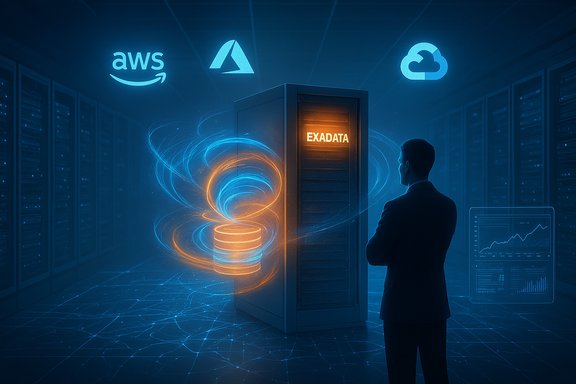
- Multicloud operator deals (Oracle‑operated Exadata/Database inside Azure, AWS, Google) and partnerships reduce friction for customers and extend Oracle’s reach beyond OCI.
The core evidence: what Oracle has actually done
AI‑native database and the inference thesis
Oracle has explicitly repositioned the database as an AI substrate. Recent product messaging and releases emphasize an “AI Database” that embeds vector search, semantic indexes, and agentic capabilities directly in the database engine to support retrieval‑augmented generation (RAG) and low‑latency inference without heavy ETL. Oracle’s argument: most enterprise AI value will come from inferencing on proprietary data (not training giant models), and placing inference near the data reduces cost, latency, and risk.This is a meaningful product differentiation. Enterprises that must protect regulated or proprietary data—financial services, healthcare, government—prefer to keep data within controlled platforms rather than route it to third‑party LLM hosts. If Oracle successfully combines strong in‑database inference with easy integration to enterprise apps, that capability will be attractive to a segment of large customers.
Exadata X11M and performance claims
Oracle’s Exadata X11M and Exadata accelerations claim double‑digit performance gains for analytics and substantial improvements in AI vector processing versus previous generations. The company has coupled those hardware/software claims with multicloud availability—for example, Exadata stacks operating inside hyperscaler datacenters. That enables Oracle to pitch high performance even for customers that run mixed‑cloud estates.These technical claims are compelling on paper and in demo environments; however, they rely on specialized HW/SW configurations. The real-world performance premium depends on workload fit, system tuning, and customer willingness to adopt Oracle’s stack. Performance proofs should be validated in customer benchmarks and independent tests rather than vendor presentations alone.
Backlog / RPO and reserved capacity sales
Oracle’s earnings cycles have recently reported unusually large RPO/backlog figures tied to multi‑year AI and infrastructure commitments. These headline numbers have prompted market speculation that Oracle has captured sizeable reserved‑capacity deals that will convert to predictable revenue streams over time. In short: Oracle claims sales momentum—customers signing for capacity and long contracts.RPO/backlog matters because the AI era often requires firms to reserve GPU capacity months in advance. If Oracle’s backlog reflects diversified, multi‑year commitments from many enterprise customers, it could be a structurally valuable advantage. If the backlog is concentrated in a small number of very large deals, it’s a less durable signal. The convertibility of RPO into recurring operating revenue—and the timing of that conversion—remains the critical metric.
Multicloud operator model and hyperscaler placement
Oracle’s strategy has shifted from “own the stack” to also offering Oracle‑operated database services inside other hyperscalers. By co‑locating Exadata/Autonomous Database inside Azure, AWS and Google datacenters and managing them as Oracle services, Oracle reduces the migration friction for customers who otherwise might see OCI as a blocker. That strategy expands Oracle’s addressable market without requiring customers to move everything to OCI.This multicloud operator approach is an important commercial tactic: it removes a key objection for enterprises already locked into other clouds, and it allows Oracle to be present in the commercial playbooks of large customers—even if they prefer to run apps on Azure or AWS.
Strengths that could support Oracle’s rise
- Enterprise DNA and relationships. Oracle has decades of enterprise footprint and long‑standing relationships with large customers that value stability, security, and compliance. Those ties matter for regulated AI use cases.
- Database‑centric differentiation. Embedding AI in the database reduces data movement and improves governance—an attractive proposition for many enterprise workloads.
- Multicloud operator route. Offering Oracle‑operated services inside other hyperscalers collapses a major barrier for customers considering Oracle for mission‑critical AI.
- Targeted performance hardware. Exadata X11M and OCI’s AI accelerators create a performance story for workloads where latency, throughput, and inference costs are decisive.
- Large RPO/backlog. If durable and diversified, Oracle’s reported backlog provides forward visibility and contractual leverage to build out operational capacity against committed demand.
Risks and structural hurdles
While Oracle’s momentum is real on several fronts, there are clear obstacles that make a 2031 top‑cloud outcome uncertain and, to many analysts, unlikely.1) RPO convertibility and concentration risk
Large RPO numbers can be deceptive. They’re a forward contractual reflection—not recognized revenue. If Oracle’s backlog is concentrated (a few huge deals), conversion to recurring revenue is riskier and slower, particularly if customers delay deployment or opt for a different infrastructure for production. Observers have repeatedly warned that RPO spikes require careful scrutiny for concentration and timing.2) Scale and global footprint
The current hyperscaler leaders (AWS, Microsoft, Google) each enjoy vastly larger global footprints, broader service catalogs, and deeper partner ecosystems. For many AI projects—especially global training jobs or latency‑sensitive apps requiring regional presence—this scale matters. Oracle must invest heavily in capex and regional capacity to match that geographic breadth. That’s expensive and time‑consuming.3) GPU/silicon supply and capacity timing
AI workloads depend on GPU/accelerator availability. Hyperscalers are vertically integrating custom silicon and long supply chains to secure accelerators. Oracle will need sustained supplier relationships and significant capex to assure customers of continuous capacity. Any delay or shortage can hurt customer trust and revenue conversion.4) Margin pressure and capex intensity
Competing for AI workloads is capital‑intensive. Heavy investment in GPU clusters, datacenter expansion, and network capacity can depress margins for years. Analysts have cautioned that large capex could slow Oracle’s path to higher profitability even if revenue grows. Sustained margin pressure can limit reinvestment capacity for additional growth.5) Enterprise sales reach and developer mindshare
Microsoft and Google have strong developer ecosystems (Azure tooling, GitHub, Vertex AI, BigQuery) and seat‑based monetization (Office/Copilot) that directly tie users into their platforms. AWS’s massive partner ecosystem and market ubiquity are hard to displace. Oracle must expand developer mindshare, partner programs, and hosted model ecosystems to avoid being pigeonholed as only a database vendor.6) Vendor lock‑in concerns
Oracle’s performance story often depends on using Exadata or Oracle’s database stack—approaches that raise vendor lock‑in concerns. Many enterprises now prefer polyglot, open approaches to avoid strategic dependence on any single vendor. Oracle’s embrace of multicloud mitigates this partially, but lock‑in perceptions remain a real procurement hurdle.What the prediction gets right — and what it overreaches
The prediction that Oracle will become the top cloud for AI by 2031 identifies real tectonic shifts:- AI changes the value equation for cloud providers by elevating GPU capacity, data governance, and productized AI services. Oracle’s focus on inference‑near‑data and enterprise governance is strategically sensible.
- Reserved capacity and long contracts matter more now; Oracle’s reported backlog is a significant commercial asset if it converts to recognized revenue.
- Supplanting AWS, Microsoft, and Google assumes Oracle will solve hard problems at scale (global capacity, developer ecosystems, pricing competitiveness) far faster than history suggests is feasible. The incumbents have scale advantages, diverse monetization levers, and entrenched enterprise relationships that are not easily displaced.
- The hypothesis depends on sustained, diversified backlog conversion and repeatable enterprise wins; both are uncertain and can be undermined by capacity delays, concentrated contracts, or margin shocks.
Practical guidance for IT buyers, Windows administrators, and CIOs
Organizations planning AI deployments should construct their cloud strategy to balance risk, performance, and governance.- Prioritize workload fit:
- Reserve mission‑critical, data‑sensitive inference for platforms that guarantee data residency and integrated governance—Oracle may be compelling here.
- Plan for capacity diversification:
- Use multi‑cloud reserved capacity for training/inference to avoid single‑vendor shortages; insist on contractual SLAs tied to GPU availability and time‑to‑production.
- Insist on convertibility metrics:
- When evaluating vendor backlog claims, require contract terms that clarify revenue recognition timing, onboarding milestones, and remedies if capacity isn’t delivered.
- Benchmark with independent testing:
- Validate vendor performance claims (Exadata, vector search acceleration) through third‑party or in‑house benchmarks before committing. Vendor demos are necessary but not sufficient.
- Mind developer experience:
- Factor in the ecosystem: model marketplaces, SDKs, managed model hosting, and integration with analytics pipelines (e.g., Vertex AI, Bedrock, Azure AI) when selecting primary hosts.
Three plausible scenarios through 2031
- Conservative conversion (most likely): Oracle consolidates a profitable niche for enterprise, regulated inference workloads and becomes a top‑five AI cloud provider but remains behind the big three in total market share. Its RPO converts steadily but not fast enough to overtake AWS/Azure/GCP.
- Accelerated rise (plausible under conditions): Oracle converts diversified backlog, invests successfully in global capacity, and wins large verticals (finance, healthcare, government) where governance and in‑database AI are decisive. In this case Oracle’s share expands materially and it rivals the top three in specific AI workload categories (inference, RAG).
- Execution strain (risk case): Capacity constraints, concentrated backlog, and margin pressure slow conversion; larger hyperscalers further deepen integration of AI into apps and developer tooling, leaving Oracle with a valuable but limited enterprise niche.
Critical caveats and unverifiable claims
- Any firm prediction that Oracle will outright surpass AWS, Microsoft, and Google in overall AI cloud market share by 2031 is speculative. It depends not only on Oracle’s execution, but on several exogenous factors: global GPU supply chains, hyperscaler strategic responses, macroeconomic capex cycles, and regulatory shifts across regions. These variables are difficult to predict with confidence. Treat the 2031 top‑cloud claim as a scenario, not a forecast.
- Some vendor performance claims (e.g., “70x faster” benchmarks, or precise percentages of throughput improvements) come from vendor presentations. Those should be validated with independent benchmarks and real customer deployments before being used as procurement justification. Vendor demos often optimize ideal conditions that do not represent heterogeneous production environments.
Conclusion: a reasoned verdict
Oracle has assembled a credible and strategically coherent playbook for AI workloads: embed inference in the database, offer Exadata performance optimizations, sell reserved capacity with long contracts, and reduce migration friction via multicloud operator services. For regulated, data‑sensitive, and latency‑sensitive enterprise AI workloads, Oracle’s offering is compelling and may capture disproportionate share of that category.However, becoming the top overall cloud for AI—outranking AWS, Microsoft, and Google in absolute AI cloud market share by 2031—requires scaling beyond a differentiated enterprise niche into broad developer mindshare, global capacity parity, and sustained margin strength. The incumbent hyperscalers still hold decisive advantages in global reach, developer ecosystems, and diversified monetization strategies. Oracle can close important gaps and materially grow its AI cloud business, but an outright dethroning of the big three by 2031 is an ambitious stretch that depends on flawless execution and favorable external conditions.
For CIOs and Windows IT professionals, the short‑term takeaway is pragmatic: evaluate Oracle as an important option for enterprise inference and governed AI, require independent benchmarks for performance claims, and design multicloud procurement and capacity strategies that hedge against delivery risk. In the unfolding cloud‑AI era, competition benefits enterprise buyers: more specialized choices, better pricing, and a clearer emphasis on operational SLAs and governance. The race to be the top AI cloud is not a single sprint; it’s a long campaign of capacity, contracts, and consistent execution.
Source: AOL.com Prediction: Oracle Will Surpass Amazon, Microsoft, and Google to Become the Top Cloud for Artificial Intelligence (AI) By 2031
