

Fifteen years after the phrase “death panels” was hurled into the American health-care debate, Canada’s evolving experience with Medical Assistance in Dying (MAID) has revived the phrase — not as a tidy political taunt but as a serious, uncomfortable policy question about how a publicly funded health system balances autonomy, compassion, capacity and the protection of vulnerable people.
In 2016, after a Supreme Court decision dismantled a blanket criminal prohibition, the Canadian Parliament passed federal legislation — Bill C‑14 — to create a statutory framework for what is officially called Medical Assistance in Dying (MAID). That law established strict eligibility criteria and reporting requirements that applied across provinces and territories while leaving delivery to provincial health systems. Subsequent legal and legislative changes widened access: Bill C‑7 in 2021 removed the requirement that death be “reasonably foreseeable” for some applicants and set in motion reviews and transition mechanisms for other contested cases. More recently, Parliament moved to postpone the planned expansion that would allow MAID where the sole underlying condition is a mental disorder, extending the temporary exclusion until March 17, 2027. Those legal milestones are the scaffolding. The concrete numbers from federal monitoring show what the program looks like in practice: in 2024 Health Canada recorded 22,535 MAID requests and 16,499 MAID provisions; since legalization in 2016 there have been 76,475 reported MAID provisions. The rapid growth of MAID seen in earlier years has slowed — the year‑over‑year increase between 2023 and 2024 was 6.9% — and the majority of MAID recipients remain people whose natural death was assessed as reasonably foreseeable (Track 1). Those numbers are the fiscal and policy facts that complicate an easy narrative. They are also the basis for the Washington Examiner column that resurrected Sarah Palin’s 2009 “death panel” warning and demanded an apology after examples surfaced of health‑care workers in Canada raising MAID with patients who had not requested it. The column draws a line from Palin’s rhetorical claim about government control of care to real cases in which patients — disabled, mentally ill, elderly and veterans — said they were offered MAID during routine interactions with the system. Those disclosures have catalyzed public alarm and parliamentary reviews. Many of those incidents are documented in mainstream Canadian reporting and in parliamentary testimony.
This line of critique bundles several claims; each must be considered separately with evidence and caution.
In policy terms, the debate must proceed with precise data, robust oversight, and an eye toward system capacity — because the hard truth is that words like “death panels” resonate because they compress a real anxiety about who decides what we value and how much society is prepared to pay to sustain people whose lives are frail, chronically disabling, or profoundly lonely. The verified Canadian numbers and documented cases should not be used only to score ideological points; they must be used to reform a set of practices and institutions so that dignity, choice and protection are not mutually exclusive.
Source: Washington Examiner Where does Sarah Palin go for her apology on death panels?
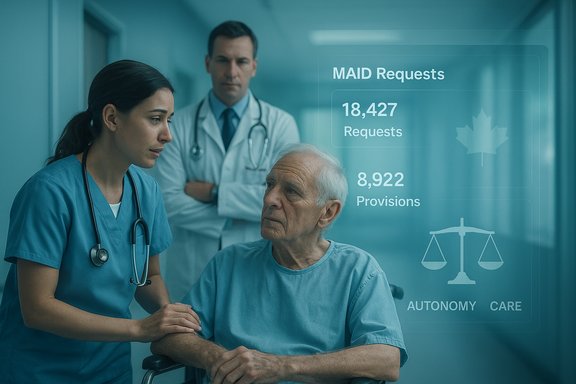 Background and overview
In 2016, after a Supreme Court decision dismantled a blanket criminal prohibition, the Canadian Parliament passed federal legislation — Bill C‑14 — to create a statutory framework for what is officially called Medical Assistance in Dying (MAID). That law established strict eligibility criteria and reporting requirements that applied across provinces and territories while leaving delivery to provincial health systems. Subsequent legal and legislative changes widened access: Bill C‑7 in 2021 removed the requirement that death be “reasonably foreseeable” for some applicants and set in motion reviews and transition mechanisms for other contested cases. More recently, Parliament moved to postpone the planned expansion that would allow MAID where the sole underlying condition is a mental disorder, extending the temporary exclusion until March 17, 2027. Those legal milestones are the scaffolding. The concrete numbers from federal monitoring show what the program looks like in practice: in 2024 Health Canada recorded 22,535 MAID requests and 16,499 MAID provisions; since legalization in 2016 there have been 76,475 reported MAID provisions. The rapid growth of MAID seen in earlier years has slowed — the year‑over‑year increase between 2023 and 2024 was 6.9% — and the majority of MAID recipients remain people whose natural death was assessed as reasonably foreseeable (Track 1). Those numbers are the fiscal and policy facts that complicate an easy narrative. They are also the basis for the Washington Examiner column that resurrected Sarah Palin’s 2009 “death panel” warning and demanded an apology after examples surfaced of health‑care workers in Canada raising MAID with patients who had not requested it. The column draws a line from Palin’s rhetorical claim about government control of care to real cases in which patients — disabled, mentally ill, elderly and veterans — said they were offered MAID during routine interactions with the system. Those disclosures have catalyzed public alarm and parliamentary reviews. Many of those incidents are documented in mainstream Canadian reporting and in parliamentary testimony. How big is MAID in Canada — verified figures and context
A reliable conversation about policy needs precise numbers. The Sixth Annual Report on Medical Assistance in Dying (covering calendar year 2024) is Health Canada’s official, detailed account of requests, outcomes, demographics, reasons cited, and system performance. It reports that:- Health Canada received 22,535 MAID requests in 2024; 16,499 people received MAID that year.
- Health Canada records 76,475 MAID provisions in aggregate since the 2016 legislation.
- Most MAID recipients are older people near the end of life (median age for Track 1 reported at 78.0 years in 2024). Cancer is the most commonly cited underlying condition for Track 1 cases.
- Track 2 cases (where death was not reasonably foreseeable) remain a small share (4.4%) but draw disproportionate scrutiny because they often involve long‑standing disabilities, chronic conditions, and different patterns of suffering.
- The federal monitoring system now collects more disaggregated data (race, Indigenous identity, disability) and reports that the sources of suffering leading people to request MAID are multifactorial — loss of meaningful activities, loss of independence, emotional distress, inadequate symptom control, and perceived burden on family or caregivers all appear in the data. Isolation and loneliness are cited more frequently in Track 2 cases. Health Canada specifically analysed these drivers and found that isolation or loneliness is never the sole reported source of suffering in MAID cases and is typically accompanied by other sources.
Documented incidents: when MAID is raised unprompted
Public outrage and parliamentary hearings did not spring from numbers alone; they were driven by credible, traceable individual experiences. Several central cases that received broad coverage:- A retired corporal and former Paralympian, Christine Gauthier, told a parliamentary committee that a Veterans Affairs Canada caseworker had suggested MAID when she asked the department for help installing a wheelchair ramp. That disclosure prompted an internal VAC investigation; the minister acknowledged at least four instances tied to a single employee. The case became part of wider hearings about whether veterans were being offered MAID instead of services.
- In Montreal, a woman living with spina bifida reported being told about MAID twice by hospital staff during unrelated treatment; she described the experience as dehumanizing. Canadian broadcast reports covered her complaint and hospital responses.
- In Vancouver a woman who went to an emergency psychiatric assessment center seeking help for suicidal ideation said a clinician asked, “Have you considered MAID?” while describing long waits and system overload. Vancouver Coastal Health later apologised for distress caused and said the exchange took place as part of a clinical assessment; critics and advocates argued that mentioning MAID in a suicide‑crisis context was profoundly inappropriate.
- Other episodes documented in reporting and parliamentary debate include allegations that MAID was discussed with patients who were not seeking end‑of‑life care — an elderly patient recorded a hospital staffer offering MAID and several veterans reported similar unsolicited offers when asking for supports like home care or mental‑health assistance. Parliamentary records and media stories document these complaints and subsequent investigations.
Policy design: safeguards, monitoring, and the case for incrementalism
The Canadian MAID framework is deliberately layered:- A federal Criminal Code framework sets eligibility and basic safeguards (witness requirements, capacity standards, waiting periods that have been modified, and mandatory reporting).
- Provinces and territories are responsible for implementing MAID within their health systems, including provider training, pharmacy access, facility policies, and integration with palliative and mental‑health services.
- Health Canada publishes annual, disaggregated monitoring reports and has required improved data collection on identity, disability, and socio‑economic context.
- Reporting reveals instances where MAID is raised inappropriately or when the health system is so stressed that MAID is mentioned as a pragmatic alternative to scarce services. Parliamentary committees and provincial officials have acknowledged such incidents and moved to tighten training and oversight for staff who interact with vulnerable populations.
- The Track 2 pathway (non‑reasonably foreseeable death) and the unresolved question of MAID for people whose only condition is a mental disorder intensify ethical complexity. Parliament responded to expert committee recommendations by legislatively postponing the mental‑illness expansion until 2027 to allow more time for system readiness and to design safeguards. That measured pause is important, but it is itself a policy admission that the system is not yet equipped to handle certain classes of requests safely.
Risks, incentives and the “death‑panel” critique
The Washington Examiner piece — and other critics — use the phrase “death panels” to warn about systemic incentives under publicly funded care: if governments and health systems face constrained budgets and long waits, will MAID become a cost‑effective release valve that targets the elderly, disabled, or mentally ill?This line of critique bundles several claims; each must be considered separately with evidence and caution.
- Systemic cost‑cutting as a driver of MAID uptake.
- There is no credible evidence showing that governments or courts have mandated MAID to reduce costs across identifiable populations. Health Canada’s monitoring shows most MAID requests cite loss of function, independence, dignity, pain and emotional distress as proximate causes — not a stated financial calculus. The data also show most MAID recipients received palliative care and reported multiple, complex sources of suffering. That does not erase the risk that under‑resourced systems create pressure points; it does, however, constrain the claim that MAID is officially being used as a cost‑saving purge.
- Coercion and unsolicited offers.
- The documented cases of clinicians or bureaucrats mentioning MAID to people who were seeking care and not asking for MAID prove that inappropriate behavior happens. Federal and provincial responses — internal investigations, apologies, revised guidance and training — confirm the issue is taken seriously. Those incidents validate concerns about coercion risk even while they remain a minority of interactions. The policy response must focus on transparency, sanctions for misconduct, and clearer boundaries in clinical practice.
- The slippery slope: more permissive criteria lead to broader applications.
- The Canadian experience shows a legal trajectory from a narrow end‑of‑life focus to wider eligibility. Many opponents of MAID feared such an arc; advocates argued for autonomy and stringent safeguards. The correct public policy posture is to track whether expansions produce measurable harm or new types of vulnerability and to be prepared to recalibrate rules based on data. Parliament’s delay of the mental‑illness expansion to 2027 is an example of that incrementalist posture.
- Health‑system pressure and alternative care gaps.
- Canada’s long waits for many medically necessary services — median waits measured in months by independent researchers — are real and documented by sources such as the Fraser Institute. Those delays increase the moral stakes of policy choices and make it more likely that people will view available options through a narrow lens of what the system can deliver. Addressing wait times, palliative care capacity, and disability supports is a complementary strategy to MAID regulation.
What the numbers and cases do not prove (and where caution is needed)
- The presence of high MAID counts in a country does not, by itself, prove mass coercion or a concerted policy to cull the vulnerable. Aggregate data do not reveal motive or coercion; they reveal outcomes. Determining whether the system is exerting undue pressure requires case‑level audits, corroborated testimony, and robust oversight. Health Canada’s monitoring provides some of that, but gaps remain in reporting quality, timeliness and cross‑jurisdictional comparability.
- Claims that Canada “has fewer MRI machines than Pittsburgh” are repeated in opinion pieces as shorthand for system inadequacy, but such statements tend to be dated, hyperbolic, and difficult to verify without careful specification of the comparator (which city, which year, and what MRI metric). Sweeping comparisons to a single U.S. city are poor proxies for system performance and should be labeled as anecdotal unless rigorously documented. Where a claim cannot be substantiated with contemporary, peer‑reviewed or official data, it must be flagged as unverifiable. (No authoritative, current federal or provincial database supports the broad “Pittsburgh” MRI comparison as a meaningful national benchmark.
- The statistical comparison between MAID deaths per 100,000 in Canada and gun homicides per 100,000 in the United States is provocative — and it is useful for perspective — but it mixes different phenomena (a regulated medical service chosen by some patients vs. violent criminal acts) and therefore can mislead if used to frighten rather than illuminate. Numbers can sharpen debate, but they do not settle normative questions about autonomy, state limits, or clinical ethics.
Practical policy fixes and professional safeguards that should be non‑partisan
If Canadian experience is a warning or a lesson, it suggests a set of practical reforms worth considering in any jurisdiction that faces similar debates about assisted dying:- Strengthen mandatory training and clear clinical boundaries for front‑line staff (including caseworkers and clerical staff) so MAID is raised only in appropriate clinical contexts and not as an unsolicited option when the patient sought other services. Provincial health systems should adopt uniform guidance and document breaches with enforceable sanctions.
- Improve reporting granularity, timeliness and audit capacity so Health Canada and provincial regulators can investigate suspicious patterns quickly (for example, clusters of MAID mentions tied to particular providers, facilities or bureaucrats). Public reporting should include case outcomes for complaints without violating privacy.
- Address systemic care gaps — long waits for palliative care, disability supports, mental‑health services, and home‑care — because these are structural drivers that make MAID more salient as an option. Investment in community supports is not merely compassionate policy; it is a material safeguard against decisions made from desperation. Independent research on wait times and service availability should inform budget and policy choices.
- Preserve capacity and voluntariness assessments: rigorous, documented capacity testing and third‑party consultations (including mental‑health expertise where relevant) should be mandatory when MAID is considered for non‑terminal cases. That is one reason Parliament delayed the mental‑illness expansion — to allow for protocols, training and system readiness.
- Enforce firewalls for bureaucratic interactions: social‑service caseworkers, benefits administrators and clerks should be strictly limited in what they can discuss; initiating a clinical MAID conversation should be reserved for qualified clinicians in an appropriate clinical setting. The Veterans Affairs incidents highlighted how role confusion can produce traumatic outcomes.
Conclusion — what the Palin line gets right and where rhetoric misfires
Sarah Palin’s “death panel” rhetoric was a crude, politicized image that helped polarize the U.S. debate over public options and government involvement in health care. The Canada case does not validate every facet of that rhetorical package — there is no evidence of a central, secretive bureaucracy scheduling the elimination of people. But the Canadian experience does contain elements that make the original warning meaningful in a narrower sense: when a public health system is under stress and legal frameworks allow assisted dying, there is a real risk that clinicians or administrators will mention death‑facilitating options in ways that feel coercive to people already struggling. That risk is not a theoretical abstraction; it has been documented, investigated and partially acknowledged by federal and provincial authorities. The policy response should be pragmatic, evidence‑driven, and non‑performative: strengthen safeguards, invest in alternatives, improve monitoring, and treat every reported failure as an opportunity to fix weak systems rather than as rhetorical ammunition. As Canada’s MAID program matures and as other jurisdictions watch its evolution, the lesson is less about vindicating a decade‑old slogan and more about how societies responsibly square individual autonomy with public duty to protect the vulnerable.In policy terms, the debate must proceed with precise data, robust oversight, and an eye toward system capacity — because the hard truth is that words like “death panels” resonate because they compress a real anxiety about who decides what we value and how much society is prepared to pay to sustain people whose lives are frail, chronically disabling, or profoundly lonely. The verified Canadian numbers and documented cases should not be used only to score ideological points; they must be used to reform a set of practices and institutions so that dignity, choice and protection are not mutually exclusive.
Quick reference — verified data points (for journalists and editors)
- Health Canada (Sixth Annual Report): 22,535 MAID requests and 16,499 MAID provisions in 2024; 76,475 total MAID provisions since 2016.
- Statistics Canada: Population estimate July 1, 2024 — 41,288,599 (used to compute per‑100,000 rates).
- US firearm homicides (2023): ~17,927 gun homicides, with gun deaths totaling ~46,728; gun‑homicide rate ≈ 5.4 per 100,000 (2023 CDC analyses).
- Parliamentary action: Bill C‑62 extended the exclusion of MAID where the sole underlying condition is a mental disorder to March 17, 2027; the earlier legislative sequence included Bill C‑14 (2016) and Bill C‑7 (2021).
Source: Washington Examiner Where does Sarah Palin go for her apology on death panels?
