

Cancom SE is quietly reshaping its identity from a classic German systems integrator into a repeatable, Microsoft‑centric hybrid cloud and managed‑services operator — a shift that matters because Europe’s mid‑market now prizes sustained uptime, security and FinOps as much as cloud-native innovation.
Cancom’s strategic pivot is straightforward in concept but operationally demanding: take the messy, multi‑vendor estates that dominate many German and Austrian enterprises — on‑prem SAP, VMware and Windows estates running alongside Azure, AWS and Google Cloud tenants — and package end‑to‑end outcomes as industrialized, repeatable services. That means advisory, migration, automation, 24/7 operations and security wrapped into subscription contracts rather than bespoke projects.
The company reported consolidated revenue near €1.7 billion for fiscal 2024 and reiterated a 2025 forecast that expects group revenue in the €1.65–€1.75 billion band, with management explicitly positioning the business toward recurring, higher‑margin managed services and cloud offerings. These figures come from the company’s own reporting and subsequent investor communications. This repositioning matters for two overlapping audiences: CIOs wrestling with hybrid and multi‑cloud complexity, and investors who value predictable, subscription‑style revenue. Cancom’s pitch is neither the cheapest reseller nor the flashiest cloud native vendor; it sells operational predictability across a complex estate.
Regulatory frameworks such as the EU Data Act and the EU AI Act are elevating the bar for who can credibly run sensitive workloads; localized delivery, auditability and legal clarity matter. Cancom’s local presence, German‑language support and partner certifications position it well for customers that place an explicit premium on sovereignty, auditability and German‑language SLAs. At the same time, the ecosystem of partner plays and platform changes (Microsoft’s Foundry, SAP’s EU AI Cloud initiatives, hyperscaler regional expansions) means integrators must invest rapidly in competence, automation and legal templates. This market motion is visible across partner announcements and industry analysis.
That approach is well‑suited to the DACH mid‑market and regulated customers who prefer a proximate, German‑language partner that can guarantee compliance and continuity. The company’s recent financial results and partner recognitions provide tangible evidence its model is gaining traction, but execution risks remain — especially around talent, hyperscaler economics and the project-to‑subscription transition.
For CIOs and procurement teams, Cancom represents a pragmatic option when the problem to be solved is not “cloud choice” but cloud orchestration and sustained operations. For investors, the critical question remains whether Cancom can materially grow the recurring, high‑margin slice of its business and sustain that improvement through a volatile enterprise IT cycle. The next year of quarterly disclosures, contract wins and partner certifications will tell the story.
Cancom is a case study in industrializing services for the hybrid era: not glamorous, but exactly the sort of behind‑the‑scenes engineering that keeps Europe’s enterprise wheels turning.
Source: AD HOC NEWS Cancom SE: How a German IT Integrator Is Quietly Building a Hybrid Cloud Powerhouse
 Background / Overview
Cancom’s strategic pivot is straightforward in concept but operationally demanding: take the messy, multi‑vendor estates that dominate many German and Austrian enterprises — on‑prem SAP, VMware and Windows estates running alongside Azure, AWS and Google Cloud tenants — and package end‑to‑end outcomes as industrialized, repeatable services. That means advisory, migration, automation, 24/7 operations and security wrapped into subscription contracts rather than bespoke projects.The company reported consolidated revenue near €1.7 billion for fiscal 2024 and reiterated a 2025 forecast that expects group revenue in the €1.65–€1.75 billion band, with management explicitly positioning the business toward recurring, higher‑margin managed services and cloud offerings. These figures come from the company’s own reporting and subsequent investor communications. This repositioning matters for two overlapping audiences: CIOs wrestling with hybrid and multi‑cloud complexity, and investors who value predictable, subscription‑style revenue. Cancom’s pitch is neither the cheapest reseller nor the flashiest cloud native vendor; it sells operational predictability across a complex estate.
Inside the offering: what Cancom actually sells
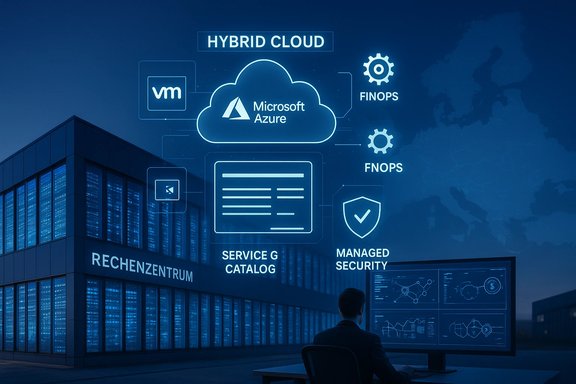
Cancom does not market a single monolithic product. Its stack is modular, and each layer is sold as a service or a managed offering:- Hybrid cloud and managed infrastructure: design and operation of mixed estates spanning hyperscalers (primarily Microsoft Azure) and private or on‑prem environments. Offerings include data‑center modernization, container platforms, backup/DR and Kubernetes-based architectures.
- Modern workplace and collaboration: Microsoft 365 rollouts, device‑as‑a‑service, virtual desktop infrastructure and Teams/UC enablement — effectively outsourcing endpoint lifecycle and license management.
- Managed security: identity and access management, SOC operations, network security, compliance consulting and incident response tiers.
- Professional services and transformation: cloud migration, re‑architecture, FinOps and automation to reduce cloud cost and drift.
Technical posture and partner ecosystem
Technically, Cancom is deliberately ecosystem‑centric rather than single‑vendor proprietary. The company’s strategy is anchored in the Microsoft stack — Azure and Microsoft 365 act as the primary control plane for many of its services — but delivery integrates VMware, Cisco, Dell/EMC, HP, Palo Alto Networks and other specialists. Cancom has public Microsoft solution designations across Infrastructure (Azure), Modern Work, Security and Data & AI, and it has pursued higher‑level Azure partner credentials and specializations. This Microsoft anchoring is a deliberate go‑to‑market bet: in the DACH region Microsoft is the dominant productivity and identity platform, and aligning delivery reduces integration friction for the majority of enterprise customers. Security partnerships are material to the product story: Cancom teams with vendors such as Palo Alto Networks to deliver SOC, XDR and AI‑enhanced monitoring as managed services. Some joint materials highlight measurable outcomes (for example, vendor‑reported reductions in incident volumes and operational cost), but those specific percentages should be treated as vendor claims and validated in customer pilots.Market positioning: rivals and the competitive map
Cancom sits in the middle of a crowded European IT services map. Competitors include:- Bechtle: a larger German incumbent with broad e‑commerce and system‑house operations; strong in procurement and scale but less narrowly focused on productized hybrid cloud managed services.
- T‑Systems (Deutsche Telekom): strong telco integration, sovereign cloud offerings and network reach; favoured by heavily regulated sectors and megaprojects.
- Atos / Eviden (Tech Foundations): Europe‑scale outsourcing and transformation play with deep SAP and mainframe expertise and large multinational footprints.
Why Cancom’s approach can work (the strengths)
- Productized managed services create leverage. Standard modules reduce delivery cost, cut implementation time and create predictable recurring revenue — the sort of revenue profile capital markets now prefer for IT services companies. Cancom’s fiscal statements show growth in gross profit and heavy cash‑flow improvement in 2024, lending some credence to the claim that productization can scale margins.
- Microsoft ecosystem alignment. In a region dominated by Windows, Office and Entra/Microsoft 365, deep Microsoft skills are a strong commercial lever. Achieving multiple Microsoft solution designations and Azure specializations opens co‑sell and delivery acceleration paths. Cancom’s multi‑year focus on Microsoft competencies is well‑documented.
- Regional focus and customer proximity. German‑language support, knowledge of local procurement rules, and a track record with public‑sector and regulated customers are critical differentiators versus global players. Cancom’s client awards and references (for example recurring “Partner of the Year” recognitions) reinforce practical customer traction.
- Security as a margin driver. Managed security and SOC services command higher recurring margins and long‑term engagement. Third‑party recognition like ISG placing Cancom as a leader in managed security services supports the company’s claims in this space.
Where the model is fragile (the risks)
- Hyperscaler dependence and vendor risk. A Microsoft‑centric strategy accelerates deals, but it ties Cancom to changing partner economics, licensing changes, and hyperscaler feature roadmaps. Microsoft partner programs evolve rapidly; maintaining specializations and certifications across a large bench of engineers is expensive and operationally heavy. Cancom mitigates this with multi‑vendor integrations, but the dependency remains material.
- Talent squeeze and delivery scale. Europe suffers a shortage of experienced cloud, security and data engineers. While Cancom is large enough to build specialized teams (the company reports 5,600+ employees and 80+ locations), competition for senior talent pushes up delivery costs and can slow program ramp‑up for new service lines.
- Margin pressure from projects vs. subscriptions. Transitioning from project revenue to recurring revenue is operationally and commercially hard. Projects still dominate parts of the pipeline for many customers (SAP migrations, large‑scale consolidation), and delays or budget freezes can depress near‑term earnings even as the recurring book grows. Investors monitor the managed services share carefully because headline revenue growth alone doesn’t guarantee margin improvement. Cancom’s investor statements flag this risk and have shown some quarterly variability.
- Sovereignty and regulatory complexity across Europe. EU regulatory changes (Data Act, AI Act and related frameworks) increase demand for local controls but also add compliance cost and contractual friction. While regulatory momentum favors providers with local presence, it also raises the bar for contractual SLAs, auditability, and data portability — all of which are expensive to deliver at scale. These macro trends are documented in EU policy updates and analysis and materially shape procurement decisions.
- Vendor‑reported performance claims. Co‑branded materials (for example those from Palo Alto and Cancom) cite dramatic incident reductions and cost savings for SOC customers; these are useful marketing signals but should be validated via customer references and PoCs before being relied upon as proof points.
Financial impact and what it means for Cancom Aktie
Cancom’s 2024 results and 2025 guidance sketch a company in transition: revenue growth, materially higher gross profit, and a notable improvement in operating cash flow in 2024 that helped the firm invest in services and balance sheet strength. The firm’s investor releases show 2024 revenue around €1.74 billion and improved operating cash flow approaching €193 million. Management proposed a stable dividend and framed 2025 as a year to balance volatile markets with the shift toward recurring business. For public markets, the core valuation question is simple: can Cancom convert more of its top line into predictable, subscription‑style gross profit and EBITDA while controlling delivery costs? If recurring managed services and security offerings grow as a share of gross profit, the multiple investors apply to Cancom Aktie could expand. If projects remain the dominant margin lever and macro IT spend weakens, sentiment can swing quickly — similar to other integrators. Market data aggregators show the share trading in the mid‑teens to high‑twenties euro range per share in late 2025, with a market cap in the mid‑hundreds of millions to low‑billion euro band depending on the exact snapshot; those numbers vary intraday and should be checked at trade time. For example, a December 2025 snapshot showed a price near €26.65 and a market cap around €840 million on one financial portal — an illustration, not a recommendation. Always confirm live quotes before any financial decision.Execution: what to watch in the next 12–24 months
- Managed services share of revenue. The clearest signal of strategic success is not top‑line growth alone, but the proportion of revenue that is recurring, managed and security‑centric. Investors will track quarterly disclosures for this mix and for backlog quality. Cancom’s public guidance and investor materials emphasize this metric.
- Large contract wins and reference customers. For mid‑market and regulated accounts, evidence of multi‑year SOC, hybrid cloud or workplace deals — and demonstrable migration outcomes — will validate the productized approach.
- Microsoft partner elevation and specializations. Attaining and maintaining higher Azure partner credentials (for example, Azure Expert MSP level or equivalent Microsoft designations) materially boosts commercial optics and co‑sell potential. Cancom’s push on Microsoft competencies is explicit in its partner announcements.
- Operationalizing AI and compliance. As enterprises adopt Copilots, Fabric and Foundry primitives, Cancom’s ability to embed AI safely into the managed workplace and security stack (with governance attested to contractually) will be a differentiator — and a compliance obligation under EU rules. The emergence of Microsoft Foundry and similar AI governance platforms is changing the commercial calculus for partners.
- Talent and delivery scale. Hiring, retention and the development of repeatable automation playbooks (for FinOps, runbooks and incident response) will determine margins more than any single sales motion.
Critical analysis: strengths, blind spots and strategic recommendations
- Strength: Cancom’s focus on industrialized delivery and Microsoft alignment is not glamorous, but it is pragmatic — and the market rewards pragmatism in the middle market. Standardized blueprints reduce variability, and Microsoft affiliation opens a pipeline of workplace and Azure consumption opportunities. Public recognition (awards, ISG placements) and the company’s own revenue/cashflow trend in 2024 support the thesis that Cancom is executing on this playbook.
- Blind spot: productization is only as strong as the repeatability of the underlying engineering. Large heterogenous SAP, Citrix or legacy estates still require bespoke engineering. If Cancom underestimates the tail of bespoke work, margins will remain volatile. Investors should press for disclosure on the split between templated “XaaS” runs and bespoke project work.
- Risk: hyperscaler economics and partner program shifts. Microsoft changes program rules, incentive terms and certification requirements periodically. Cancom’s Microsoft dependence increases strategic optionality but reduces control over pricing levers. Keeping a balanced vendor portfolio and explicit exit/portability playbooks for clients is essential.
- Recommendation for buyers: insist on measurable KPIs and runbooks before signing large managed services contracts. Require explicit FinOps governance, data portability clauses (aligned with the EU Data Act), SLAs for security telemetry residency and third‑party audit rights (SOC 2 / ISO27001) for any managed SOC offering. Regulatory change (Data Act, AI Act) increases contractual complexity; procurement teams should get legal and technical teams involved early.
The broader market context: why providers like Cancom are relevant to Europe’s IT future
European enterprises are not primarily choosing between hyperscalers — they are choosing how to orchestrate multiple clouds while keeping legacy systems running, compliant and secure. That operational headache — multi‑cloud governance, FinOps discipline, identity and secure workplace delivery — is where Cancom has staked its claim.Regulatory frameworks such as the EU Data Act and the EU AI Act are elevating the bar for who can credibly run sensitive workloads; localized delivery, auditability and legal clarity matter. Cancom’s local presence, German‑language support and partner certifications position it well for customers that place an explicit premium on sovereignty, auditability and German‑language SLAs. At the same time, the ecosystem of partner plays and platform changes (Microsoft’s Foundry, SAP’s EU AI Cloud initiatives, hyperscaler regional expansions) means integrators must invest rapidly in competence, automation and legal templates. This market motion is visible across partner announcements and industry analysis.
Conclusion
Cancom SE is not trying to build a hyperscaler, nor is it attempting to out‑scale the largest global integrators. Its plan is narrower and more surgical: turn the endemic complexity of European enterprise estates into packaged, operationally repeatable services, anchored around Microsoft technologies and rounded out with managed security and workplace capabilities.That approach is well‑suited to the DACH mid‑market and regulated customers who prefer a proximate, German‑language partner that can guarantee compliance and continuity. The company’s recent financial results and partner recognitions provide tangible evidence its model is gaining traction, but execution risks remain — especially around talent, hyperscaler economics and the project-to‑subscription transition.
For CIOs and procurement teams, Cancom represents a pragmatic option when the problem to be solved is not “cloud choice” but cloud orchestration and sustained operations. For investors, the critical question remains whether Cancom can materially grow the recurring, high‑margin slice of its business and sustain that improvement through a volatile enterprise IT cycle. The next year of quarterly disclosures, contract wins and partner certifications will tell the story.
Cancom is a case study in industrializing services for the hybrid era: not glamorous, but exactly the sort of behind‑the‑scenes engineering that keeps Europe’s enterprise wheels turning.
Source: AD HOC NEWS Cancom SE: How a German IT Integrator Is Quietly Building a Hybrid Cloud Powerhouse
