

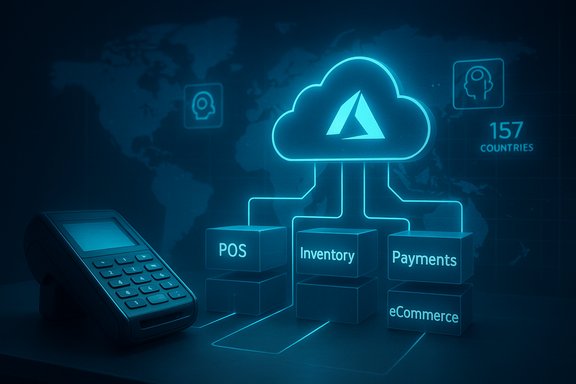
LS Retail’s vice president for the Americas, Jeff Miller, laid out a concise, Microsoft-centric playbook for global retail deployments, AI integration, and partner-led delivery in a recent AI Agent & Copilot Podcast episode — a snapshot that highlights how a decades-old ISV is positioning unified commerce, composable point-of-sale, and copilot-driven automation as the operational backbone for modern stores.
Background / Overview
LS Retail began life as a specialist in POS and retail business software and now presents itself as a unified commerce platform built on the Microsoft stack — notably Microsoft Dynamics and Azure — and operated through a certified global partner network. The vendor’s public profile frames its market footprint in terms of stores/outlets served, countries covered, years of service, and partner reach — figures LS Retail publishes on its corporate site as approximately 100,000 stores, operating in 157 countries, with 30 years of product history and roughly 280 partners. That public positioning dovetails with Aptos’s acquisition narrative (LS Retail has been part of the Aptos family since 2021), which underlined LS Retail’s large installed base and channel-led GTM (go-to-market) model. Aptos’ press materials cite LS Retail’s long history of partner-driven global distribution and the strategic case for combining unified commerce capabilities across geographies. The Cloud Wars podcast with Jeff Miller summarized the company’s practical posture: a composable solution built from modular building blocks that scale from a POS rollout to a full enterprise commerce stack, a focus on localization and fiscalization to enable country-by-country compliance, and an intentional embrace of Microsoft Copilot tools and Copilot Studio for internal development and testing workflows.
What LS Retail says it does: Composable unified commerce and global scale
Composable building blocks, from POS to enterprise ERP
LS Retail defines its product strategy as a composable solution: modular building blocks (POS, inventory, staff management, payments, eCommerce connectors) that can be combined depending on a retailer’s scope and maturity. This modular approach serves two practical goals: faster time-to-value for specific use cases (e.g., a single-store POS rollout), and the ability to grow into enterprise features without ripping and replacing the initial investment. Jeff Miller emphasized that the company “comes to a market” with those building blocks and can assemble tailored solutions to meet a range of retailer needs. Benefits of the composable model include:
- Rapid deployments for single-site or regional pilots.
- Incremental upgrades with lower risk and lower upfront cost.
- Easier partner-led implementations because modules map to discrete responsibilities (payments, inventory, fiscal compliance).
Localization, fiscalization and operating across jurisdictions
One of LS Retail’s repeatedly stated strengths is localization — the fiscal and tax customizations needed for retailers to operate legally and efficiently across multiple countries. Fiscalization (country-level tax and reporting systems), POS behavior that matches local consumer expectations, and localized payment flows are all non-trivial engineering and product tasks, and LS Retail claims that those capabilities are a key differentiator enabling global rollouts. Jeff Miller noted that the company and its partners have done the heavy lifting to ensure the software handles local fiscal rules and tax nuances. This matters because cross-border retail deployments often fail not for core POS stability but for the “last mile” of compliance: tax calculations, electronic invoicing, point-of-sale fiscal printers, and jurisdictional reporting. LS Retail’s playbook is to supply certified adaptations through its partner network so that stores in different countries can run a consistent core while still complying with local requirements.
Azure as the cloud foundation
Cloud-native deployment on Microsoft Azure is central to LS Retail’s narrative: Azure provides the global compliance posture, scale, and integration surface for Microsoft Dynamics and Copilot tooling. For ISVs that market themselves as Microsoft-centric, the combination of Dynamics for ERP capabilities, Azure for hosting and edge services, and Copilot tooling for automation and testing presents a tidy technology stack that appeals to Microsoft-first customers and partners. Milller cited Azure explicitly as the deployment mechanism that enables “seamless” implementation across geographies.
AI integration and “customer zero” engineering
Using Copilot and Copilot Studio inside the ISV
LS Retail positions AI as both an engineering productivity lever and a product enhancement. Internally, the company uses Microsoft Copilot and Copilot Studio for tasks like code automation and testing — essentially applying copilot tooling to accelerate development lifecycles and improve test automation coverage. Jeff Miller described the approach as being part of “customer zero” behavior: using Microsoft’s own agent tooling internally to refine product development before delivering those patterns to customers. External use cases extend to domain-specific agents (copilots) the vendor co-develops with customers. An example Jeff Miller highlighted is a pharmacy agent developed for European customers that automates prescription handling, refills, and related workflows; LS Retail is exploring expanding that agent to markets such as Latin America. These agents illustrate the direction many retail ISVs are taking: embed AI to automate operational tasks that are repetitive and rules-heavy, but keep humans firmly in the loop for compliance and safety-critical decisions.
Practical AI patterns for retail ISVs
From LS Retail’s described practices, a practical AI adoption pattern emerges:
- Apply Copilot tools to internal developer productivity and QA automation (reduce regression cycles).
- Build domain copilots for high-value, repeatable workflows (pharmacy prescriptions, inventory exceptions, returns handling).
- Validate agent behavior with customers in narrow pilots (human-in-the-loop required), then scale with governance guardrails.
This method mitigates the two biggest AI risks in retail: hallucinations in operational guidance and compliance failures due to over-automation.
Partner-led global delivery: certification and scale
Channel-first GTM and partner certification
LS Retail emphasizes a partner-first distribution model. The company’s corporate site quantifies its partner ecosystem in the hundreds (LS Retail’s website currently lists about 280 partners) and states a focus on partner certification to ensure consistent technical delivery and local support capabilities. Jeff Miller repeated this angle on the podcast: global deployments are driven by certified partners who understand local business practices and regulatory needs. Key advantages of a certified partner network:
- Local subject-matter expertise (taxes, fiscal printers, local payment methods).
- Faster go-lives using partner-proven deployment playbooks.
- Regional support and SLAs that large centralized ISVs often cannot deliver without local presence.
Numbers and the reality of scale (a note on the data)
Public numbers about stores, partners, and geographic coverage vary across sources. LS Retail’s own “About” page lists 100,000 stores/restaurants/outlets, 157 countries, and 280 partners, backed by the company’s corporate profile. The Cloud Wars summary of the podcast referenced “over 110,000 retail locations” and “over 300 business partners,” numbers that differ slightly from LS Retail’s public dashboard. Those are reasonable in the range of large enterprise ISV metrics, but they are not identical across citations — a cautionary reminder that marketing materials and press summaries are often updated at different cadences. When citing footprint metrics for procurement or RFPs, enterprises should request the most current audit-ready numbers directly from the vendor or from contracts. Aptos’s acquisition materials (2021) also provided historical context and different counts (e.g., referencing tens of thousands of customer sites at the time) which confirms the vendor’s substantial installed base but also underlines that counts change over time as new deployments and consolidations occur. Cross-referencing LS Retail’s corporate page and Aptos press materials gives a more defensible view of scale than relying on a single third-party write-up.
Strengths: Why LS Retail’s approach matters for modern retail
- Vertical focus and domain depth. LS Retail’s product scope across retail, hospitality, pharmacy, forecourt, and restaurants means it has deep, industry-specific features — not a generic POS that then needs heavy customization. That reduces implementation risk for vertical workflows like pharmacy prescriptions or gas-station forecourt compliance.
- Microsoft-native architecture. Being built on Microsoft Dynamics and Azure reduces integration friction for customers heavily invested in Microsoft stacks. For many mid-market and enterprise buyers, this equals faster integrations, shared identity and security models, and tighter alignment with Microsoft’s Copilot/agent roadmap.
- Partner-enabled local compliance. The certified partner model addresses the single most common failure point for global rollouts: local fiscal, tax, and regulatory compliance. By delegating local adaptations to certified partners, LS Retail offers a replicable operational model for global expansions.
- Early adoption of Copilot tooling. Using Copilot and Copilot Studio internally for code automation and testing is a low-risk, high-reward strategy — it brings efficiency gains while also raising the company’s maturity in agent development patterns that can later be productized for customers.
Risks and caveats: what to watch for
1. Variant metrics and “marketing drift”
As noted, public counts for stores and partners can differ between vendor websites, press summaries, and analyst write-ups. Contracts and procurement should rely on auditable metrics (partner SLAs, active seats, support response times) rather than headline numbers in marketing collateral. Ask vendors to provide exportable, dated metrics for transparency.
2. AI governance and human-in-the-loop requirements
AI agents in regulated workflows (pharmacies, forecourts with controlled products, transactions with fiscal consequences) must retain human oversight. The pharmacy agent example LS Retail references should be treated as a productivity aid until sufficient provenance, traceability, and audit trails are in place. Vendors and customers must agree on approval, rollback, and audit processes before agentic automation performs any write-backs or legally sensitive actions.
3. Vendor lock-in and platform concentration
Deep integration with Microsoft Dynamics, Azure, and Copilot tooling accelerates time-to-value but also concentrates operational dependency. Organizations should document exit paths (data exports, object-level extracts) and negotiate contractual protections against opaque consumption-based Copilot costs or unexpected API deprecations. Aptos/LS Retail’s product integration story is compelling — but so is the need for clear SLAs and contingency planning.
4. Partner skill variance
A certified partner ecosystem improves global reach, but certification levels and local technical competence vary by geography. Enterprises should include partner validation steps in procurement: ask for partner references, on-site proof-of-concept results, and evidence of localized fiscal and tax testing in the target jurisdictions.
Practical guidance for IT and retail leaders evaluating LS Retail or similar ISVs
- Require audited, date-stamped metrics for footprint claims (stores, active seats, partners). Marketing numbers are helpful but not a substitute for contractual evidence.
- Build an AI governance checklist for any agent that touches regulatory processes: provenance, human sign-off, model versioning, and rollback controls. Treat copilots as augmentation, not autonomous decision-makers.
- Request partner capability maps and local compliance test cases for each geography involved in the rollout. Include partner performance SLAs in the master services agreement.
- Validate cloud architecture: confirm multi-region Azure deployments, data residency options, and offline/edge modes for stores with unreliable connectivity. Azure-based deployments are flexible, but the design still matters for latency, failover, and data sovereignty.
- Start with a phased pilot: pick a representative geography and use case (e.g., single-store POS + loyalty + payment) and measure KPIs such as checkout time, inventory accuracy, and time-to-resolution for fiscal exceptions.
The bigger picture: ISVs, Microsoft, and the retail tech ecosystem
LS Retail’s trajectory exemplifies an ISV evolution many Microsoft-aligned vendors are following: modular, partner-enabled software built on Azure and Dynamics, with AI/agent tooling increasingly integrated both as internal developer aids and as product features. The acquisition by Aptos amplifies that trajectory by combining scale, capital, and a broader enterprise product set, which in turn accelerates investment in compliant, localized solutions for global retailers. For Microsoft, the outcome is strategic: by enabling ISVs like LS Retail to use Copilot Studio and Azure, Microsoft creates ecosystems where enterprise workflows, agents, and copilots align naturally with its cloud services — an outcome that simplifies procurement and reduces integration overhead for customers deeply invested in Microsoft technologies.
Conclusion
Jeff Miller’s podcast appearance is a compact case study in how a long-standing ISV is translating decades of retail experience into a Microsoft-centric, partner-delivered, AI-enhanced operational model. The core thesis — composable solutions, partner-enabled localization, and pragmatic AI copilots — is sound for retailers that need global reach without losing local compliance.
That said, buyers must treat headline metrics and AI promises with due diligence: verify footprint and partner numbers with vendor-supplied audit evidence, insist on rigorous agent governance, and ensure contractual protections against lock-in and unexpected consumption costs. LS Retail’s claims about global scale and partner certification are supported in corporate materials and by Aptos’s acquisition disclosures, but third-party summaries vary, so procurement should rely on date-stamped, auditable data rather than marketing blurbs. For retailers and IT leaders evaluating unified commerce platforms, LS Retail represents a mature Microsoft-aligned choice — particularly for verticals like pharmacy, hospitality, and forecourt — but success will depend on disciplined partner selection, careful AI governance, and a staged rollout strategy that turns composability into measurable outcomes rather than marketing promises.