

Sabenza IT & Recruitment’s listing for an IT Infrastructure Manager in Cape Town is a clear signal: organisations across the Global South are now recruiting senior technical leaders who can own complex hybrid environments and translate on-premises realism into resilient cloud-first operations. This full‑time role asks for a blend of hands‑on engineering and strategic leadership across Microsoft Azure, HP and Aruba hardware, Hyper‑V clustering, SAN storage, and Microsoft SQL Server high‑availability — a stack that reflects the transitional reality many enterprises face as they straddle legacy datacentres and cloud services. The job is not just another vacancy; it maps to a broader trend where infrastructure managers are expected to be architects, incident commanders, automation leads, and people managers all at once.
The advertised position centres on ownership of a hybrid infrastructure that mixes on‑premises HP servers and SAN storage with Microsoft Azure services, and includes networking operated on HP and Aruba platforms, Windows and Linux servers, and SQL Server clusters. The Infrastructure Manager is expected to deliver availability, security, scalability and disaster recovery for multiple business divisions — responsibilities that reach from policy and roadmap setting down to scripting and DR testing. This combination of strategic and operational tasks is increasingly the baseline for senior infrastructure roles in mid‑sized and enterprise organisations.
Why this matters now: organisations that once treated cloud as an experiment are consolidating hybrid architecture blueprints. That requires senior hires who understand Fibre Channel SANs and blade servers as well as Azure native services and hybrid integration points. The Sabenza advert is an archetype of these converged expectations: deep on‑prem skills remain relevant, but complementing them with cloud governance, automation pipelines and modern DR practices is now mandatory.
The posting is emblematic of how infrastructure leadership is evolving: not purely operational, not purely architectural, but a necessary intersection where technology strategy, people leadership and relentless execution meet. Candidates who bring both the deep technical experience the advert asks for and a track record of automation, DR maturity and team development will find this role a career‑defining step — provided the employer pairs the role with realistic authority, budget and expectations.
Source: Global South Opportunities Sabenza IT & Recruitment is Seeking an IT Infrastructure Manager - Global South Opportunities
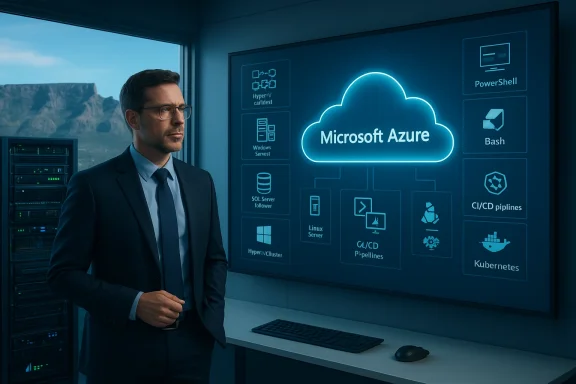 Background / Overview
The advertised position centres on ownership of a hybrid infrastructure that mixes on‑premises HP servers and SAN storage with Microsoft Azure services, and includes networking operated on HP and Aruba platforms, Windows and Linux servers, and SQL Server clusters. The Infrastructure Manager is expected to deliver availability, security, scalability and disaster recovery for multiple business divisions — responsibilities that reach from policy and roadmap setting down to scripting and DR testing. This combination of strategic and operational tasks is increasingly the baseline for senior infrastructure roles in mid‑sized and enterprise organisations.Why this matters now: organisations that once treated cloud as an experiment are consolidating hybrid architecture blueprints. That requires senior hires who understand Fibre Channel SANs and blade servers as well as Azure native services and hybrid integration points. The Sabenza advert is an archetype of these converged expectations: deep on‑prem skills remain relevant, but complementing them with cloud governance, automation pipelines and modern DR practices is now mandatory.
The role — responsibilities unpacked
Strategic ownership and roadmap
The role’s first responsibility is strategic planning: building a roadmap for hybrid infrastructure that matches business growth and risk tolerance. That means:- Translating business SLAs into infrastructure availability and capacity targets.
- Prioritising cloud migrations and hybrid integrations where cost, compliance and performance demand it.
- Setting lifecycle and replacement policies for HP servers, SAN arrays and networking stacks.
Day‑to‑day operations and high availability
Operational accountability spans:- Managing Windows Server and Linux hosts, Hyper‑V clusters and SAN storage.
- Overseeing Microsoft SQL Server failover clusters and ensuring database durability.
- Running LAN/WAN/VPN architectures and IP telephony platforms on HP and Aruba equipment.
Disaster recovery and business continuity
A core remit is DR design and execution:- Drafting and maintaining DR frameworks and recovery runbooks.
- Running regular DR drills and post‑mortem exercises.
- Ensuring DR posture aligns with business continuity planning and regulatory needs.
Automation, DevOps and modern practices
The listing emphasises automation and DevOps‑aligned improvements. Typical expectations include:- Scripting in PowerShell and Bash for routine tasks and incident remediation.
- Using CI/CD pipelines to deploy infrastructure as code, configuration and runbooks.
- Familiarity with containers (Docker, Kubernetes) for new application patterns.
Leadership and team building
Beyond technical skills, the role demands:- Leading, mentoring and coaching infrastructure engineers.
- Developing triage and escalation models that scale across time zones and business units.
- Maintaining accurate technical documentation and runbooks — a discipline that correlates strongly with faster incident resolution and safer DR tests.
The technology stack explained
The job description includes a broad, enterprise‑scale list. Below are the core technology areas and what they imply for candidates.Cloud and collaboration
- Microsoft Azure: Expect hands‑on management of virtual networks, storage, identity (Azure AD), and hybrid server management tooling. Hybrid integration points (site‑to‑site VPN, ExpressRoute, Azure Arc) will be part of the daily conversation.
- Microsoft 365 and SharePoint Online: While these are collaboration platforms, they often intersect with identity, security and compliance responsibilities.
Servers, storage and virtualisation
- HP servers and blade infrastructure: Blade chassis and converged infrastructure demand lifecycle planning and spare‑parts strategies.
- SAN storage (HPE/Fibre Channel): SAN administration, zoning and capacity planning remain specialised skills.
- Hyper‑V and clustering: High‑availability Hyper‑V clusters require thorough patching windows, host reserve planning, and regular health checks.
Operating systems and databases
- Windows Server and Linux: Dual‑OS realities are the norm; teams must be cross‑platform literate.
- Microsoft SQL Server: Expect administration, performance tuning and failover clustering experience. Database availability and backups are central to recovery strategies.
Networking and connectivity
- HP and Aruba networking equipment: Managing LAN/WAN, VLANs, routing, firewalling and VPNs is central.
- IP telephony: VoIP systems add another layer of availability and QoS requirements.
Why this job matters for the Global South technology market
- Hybrid reality is the norm: Many organisations in Africa and the broader Global South operate with a mix of legacy infrastructure and rapid cloud adoption. Roles like this are evidence that employers are seeking leaders who can span both worlds successfully.
- Skills translation drives local opportunity: Proficiency in both traditional enterprise hardware and cloud platforms increases employability and market value. Employers prize candidates who can reduce vendor risk while accelerating automation and cloud consumption.
- Talent scarcity and leadership premium: There’s a premium on candidates who combine deep technical chops with management experience. Eight-plus years of infrastructure experience plus five years in leadership — as the Sabenza listing suggests — is typical for these strategic hires.
- Capacity building and on‑the‑job reskilling: Senior managers in these roles are often expected to upskill their teams for cloud operations and modern practices — which means opportunities to influence local talent pipelines and workplaces.
Strengths of the Sabenza job posting
- Clear hybrid focus: The ad explicitly acknowledges both on‑premises and Azure, signalling a realistic, pragmatic approach rather than assuming a pure cloud conversion.
- Depth of stack: Listing HP/Aruba hardware, Hyper‑V and SANs shows the role is substantial — not a superficial cloud admin position.
- Leadership and documentation emphasis: The call for mentorship and documentation standards indicates maturity in operations expectations.
- DR and continuity responsibilities: Making recovery planning an explicit responsibility elevates the job from routine operations to strategic resilience.
Risks, ambiguities and red flags candidates should watch for
- Missing compensation and on‑call terms: The advert does not specify salary bands or on‑call expectations. Lack of transparency on compensation and after‑hours responsibilities can hide significant workload. Candidates should demand explicit clarity on on‑call rotas and compensation. (This is a common omission in many technical adverts and should be treated as unverified until clarified.)
- Scope creep risk: The breadth of technologies suggests potential for role overload — ownership across SANs, Azure, networking and telephony can be a large remit for one manager. Ensure there is a realistic team and vendor support model.
- Vendor lock and lifecycle risk: Heavy reliance on specific hardware platforms (HP/HPE blade and SAN) requires clear upgrade and end‑of‑support strategies; otherwise, technical debt can balloon.
- DR realism: Stating responsibility for DR is good — but candidates should confirm the frequency of drills, budget for testing, and expectations during failover events. A DR plan on paper is not the same as operational readiness.
- Automation vs. legacy constraints: The job asks for DevOps approaches while retaining legacy infrastructure. Expect friction where replacement or refactor budgets are limited; be prepared to negotiate phased automation plans rather than overnight transformations. Similar modernisation roadmaps emphasise staged IaC, container pilots and CI/CD adoption as pragmatic approaches.
How candidates should prepare to apply — practical checklist
- Update an achievements‑focused résumé that quantifies outcomes: uptime improvements, recovery time reductions, automation ROI, vendor consolidation savings.
- Prepare three short STAR stories showing: (1) a successful DR activation or test; (2) a hybrid migration or integration you led; (3) an automation or standardisation win that reduced operational toil.
- Demonstrate scripting and automation: include PowerShell and Bash snippets or a short Git repo with example runbooks or IaC (if allowed by prior employers).
- Show evidence of people leadership: examples of mentoring, onboarding programs, or documented runbooks you authored.
- Be ready to discuss vendor management and procurement examples: how you negotiated maintenance, extended warranties, or replacement cycles.
- Ask targeted screening questions: current team size, on‑call model, DR test cadence, budget authority, and expected KPIs for the first 6–12 months.
A recommended 90‑day plan for the role (practical, interview‑ready)
- Days 0–30: Assess and document
- Inventory all infrastructure, map dependencies, collect runbooks.
- Meet key stakeholders and establish SLA expectations.
- Days 31–60: Stabilise and prioritise
- Fix critical vulnerabilities and low‑effort availability gaps.
- Run at least one DR tabletop exercise and document gaps.
- Days 61–90: Automate and roadmap
- Identify 2–3 automation wins (patching, backups, monitoring) and begin delivery.
- Present a 12‑month roadmap aligned to business outcomes.
Employer and recruiter considerations
For organisations hiring at this level, success depends on the package and environment you provide:- Provide a realistic team or vendor model. A single manager cannot sustainably own all technologies without appropriate direct reports or outsourced vendor partners.
- Specify compensation bands and on‑call expectations to attract senior talent.
- Commit to training budgets and career development to retain staff as they modernise the estate.
- Allow time and budget for DR testing and documentation — these activities require organisational buy‑in and cannot be performed as side projects.
Conclusion
Sabenza’s IT Infrastructure Manager role in Cape Town encapsulates the modern reality of enterprise infrastructure work in the Global South: a hybrid environment demanding classical data‑centre expertise together with cloud governance, automation skills and leadership capability. For candidates, the job is an opportunity to lead resilience programs, design pragmatic hybrid architectures and build teams that can operate across hardware lifecycles and cloud services. For employers, hiring this profile requires a commitment to clarity on scope, compensation and support — the manager will need resources and time to convert operational fragility into repeatable, automated reliability.The posting is emblematic of how infrastructure leadership is evolving: not purely operational, not purely architectural, but a necessary intersection where technology strategy, people leadership and relentless execution meet. Candidates who bring both the deep technical experience the advert asks for and a track record of automation, DR maturity and team development will find this role a career‑defining step — provided the employer pairs the role with realistic authority, budget and expectations.
Source: Global South Opportunities Sabenza IT & Recruitment is Seeking an IT Infrastructure Manager - Global South Opportunities
