Dell and Microsoft have taken another decisive step to fold private infrastructure into the Azure ecosystem: Dell is extending Azure Local support to include Dell Private Cloud and Dell PowerStore, positioning a full‑stack, vendor‑backed private cloud option that aims to simplify hybrid operations while giving enterprises tighter control over costs, data locality and lifecycle management.
Azure Local is Microsoft’s on‑premises, validated Azure software stack that brings a subset of Azure services, lifecycle tooling, and Azure Arc management to customer‑owned hardware. It’s designed to let organizations run VMs, containers and selected Azure platform services on bare‑metal appliances or validated racks while retaining centralized visibility and management from the Azure portal. Azure Local is sold and billed as an Azure offering and supports a wide partner ecosystem. Dell’s new move folds two of its flagship private‑cloud and storage products—Dell Private Cloud and PowerStore—into Azure Local’s validated hardware catalogue and support model. That combination is meant to provide a single‑vendor, end‑to‑end option for customers who want cloud‑like operations but need data residency, performance or cost characteristics that push them away from pure public cloud consumption.
This integration is a clear example of how hyperscalers and hardware vendors are converging around a pragmatic hybrid model: customers keep hardware where it matters, but gain the cloud‑style operational model for governance, telemetry and lifecycle. The tradeoffs are familiar—simpler contracts and predictable hardware economics on one hand, and the need to verify vendor claims and contractual protections on the other. Smart IT procurement and architecture teams will insist on concrete validations and pilot data before making multi‑year commitments.
Source: IT Pro Dell Technologies targets private cloud gains with new Azure Local features
 Background / Overview
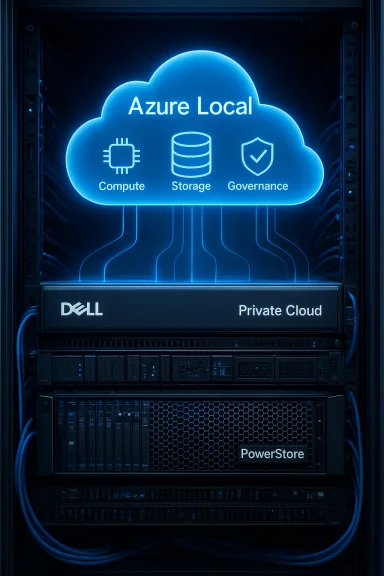
Azure Local is Microsoft’s on‑premises, validated Azure software stack that brings a subset of Azure services, lifecycle tooling, and Azure Arc management to customer‑owned hardware. It’s designed to let organizations run VMs, containers and selected Azure platform services on bare‑metal appliances or validated racks while retaining centralized visibility and management from the Azure portal. Azure Local is sold and billed as an Azure offering and supports a wide partner ecosystem. Dell’s new move folds two of its flagship private‑cloud and storage products—Dell Private Cloud and PowerStore—into Azure Local’s validated hardware catalogue and support model. That combination is meant to provide a single‑vendor, end‑to‑end option for customers who want cloud‑like operations but need data residency, performance or cost characteristics that push them away from pure public cloud consumption. What Dell announced (in plain terms)
- Dell will make Dell Private Cloud a supported Azure Local offering: a full‑stack solution that bundles compute, networking and external storage under a single procurement and support umbrella. Dell markets this as the “first Azure Local offering” for private cloud delivered end‑to‑end by one vendor.
- Dell will add PowerStore—its NVMe, all‑flash enterprise array family—as a validated storage option for Azure Local deployments, enabling independent scaling of compute and storage (disaggregation) and bringing PowerStore’s always‑on data reduction to Azure Local customers.
- Early access for the combined Azure Local + Dell Private Cloud + PowerStore experience is scheduled to begin in Spring 2026, per Dell. Microsoft’s Azure Edge Infrastructure leadership framed the partnership as part of a broader goal to simplify hybrid operations.
Why this matters: the technical and operational case
Azure Local (and similar validated on‑prem Azure packages) is a response to three persistent enterprise problems:- Data sovereignty and regulatory controls that require certain workloads to run in‑country or in customer‑owned facilities.
- Latency and throughput needs for stateful, I/O‑heavy or AI inference workloads that are expensive or impractical to run in public cloud tiers.
- The operational burden of managing heterogeneous stacks across cloud and on‑premise locations—tooling and lifecycle automation that mimic the cloud promise is a major selling point.
PowerStore: what it brings — and what to check
Dell highlights three practical benefits of PowerStore in an Azure Local context:- NVMe performance for latency‑sensitive workloads and AI inference near the data.
- Always‑on data reduction (compression + dedupe) that reduces capacity needs and claims to do so with low or no performance impact.
- A 5:1 Data Reduction Ratio (DRR) guarantee for “reducible workloads,” which Dell and partners promote as a financial and capacity planning assurance.
- Confirm which PowerStore features (e.g., inline compression variants, encryption at rest, replication, snapshot functionality) are fully supported and validated in the Azure Local + Dell Private Cloud configuration.
- Understand the data reduction guarantee terms: what constitutes “reducible data,” how Dell measures baseline ratios, the time window for measurement, and the remediation path if the system fails to meet the guarantee.
- Model real‑world compression/dedupe using representative datasets rather than synthetic lab profiles; field results can deviate materially from vendor claims.
Strategic context: hybrid, repatriation and vendor playbooks
Dell’s announcement arrives amid a renewed debate about cloud repatriation and hybrid architectures. Some organizations have publicly documented large savings after shifting certain workloads off hyperscalers and into owned or colocated infrastructure; industry coverage has cited examples (e.g., 37signals / Basecamp and Ahrefs) as emblematic of a broader calculus where predictable hardware costs, sovereignty and TCO considerations outweigh the elasticity benefits of public cloud for specific workloads. However, these case studies are company‑specific, and savings depend on scale, workload profile and capital vs. operational cost choices. Survey data quoted in coverage suggests hybrid operations remain the dominant enterprise posture—most firms mix cloud and private infrastructure rather than choosing one or the other outright. For procurement and architecture teams, the practical decision is rarely “cloud vs on‑prem” but rather “which workloads, when, and under what governance and cost models.” Dell and Microsoft are clearly positioning Azure Local + Dell Private Cloud as a turnkey option for organizations that have classified significant workloads as candidates for local hosting.Risks, limitations and vendor tradeoffs
Every vendor‑led, validated private cloud offering carries tradeoffs. IT leaders should weigh these explicitly.- Billing and commercial model: Azure Local pricing is typically charged per physical core on host machines while hardware and ongoing support may be contracted through the vendor. That blended model can create surprising line items (host fees plus Dell hardware and support), so precise total cost of ownership (TCO) modeling is essential.
- Compatibility and validation surface: Microsoft’s shift to support external SANs and larger Azure Local scales increases flexibility but also the validation burden. Enterprises must insist on a written compatibility matrix (validated server SKUs, supported PowerStore firmware, SAN interop, GPU SKUs and driver versions) as procurement attachments. Marketing language such as “hundreds of servers” or “industry’s best” needs concrete day‑one compatibility matrices to be meaningful.
- Update cadence and control: Azure Local intends to automate lifecycle updates from the Azure control plane. Automation reduces operational toil but also transfers update cadence control to the vendor ecosystem; ask how updates are scheduled, how rollback is handled, and whether critical maintenance windows and testing regimes can be enforced in SLAs.
- Lock‑in and exit strategy: A combined, single‑vendor stack simplifies support but can complicate exit scenarios. Define exit and migration pathways (e.g., ability to run PowerStore outside the Dell Private Cloud configuration, supported exports, and a clear separation of responsibility for software and hardware).
- Security and sovereignty caveats: Azure Local includes options for disconnected or air‑gapped operations, but “in‑country processing” and sovereign guarantees require contractually binding documentation—don’t assume marketing statements suffice for regulatory audits. Insist on written commitments if legal or procurement requirements depend on locality or isolation.
Practical checklist for IT teams evaluating Dell Private Cloud + PowerStore on Azure Local
- Get the written compatibility matrix: server SKUs, PowerStore models, firmware, NICs, GPU SKUs and validated network topologies.
- Request feature parity documentation: which PowerStore/PowerProtect features are supported inside the Azure Local validated bundle.
- Test with representative datasets: run a pilot using your production‑like I/O and data profiles to measure true DRR, latency and throughput.
- Model TCO across scenarios: include Azure Local host fees, Dell hardware, power/cooling, support, and any migration or refactor costs.
- Negotiate lifecycle controls: define update cadence, blackout windows and rollback SLAs in the contract.
- Validate recovery and ransomware posture: test cyber‑recovery playbooks and ensure immutable snapshots, offsite vaulting and automated recovery workflows meet RTO/RPO targets.
- Define exit and portability clauses: ensure you can extract data, move workloads or repurpose hardware without punitive penalties.
- Run a security and compliance gap analysis: map Microsoft’s in‑country/disconnected claims to contracts and verify for audits.
How this changes the vendor landscape
Dell’s move is both defensive and opportunistic. It defends existing enterprise relationships by making Dell hardware the “fastest path” to Azure management, while offering Microsoft a broader set of partner‑validated options to sell into regulated and latency‑sensitive accounts. Competitors—HPE, Pure Storage, Lenovo and others—are pursuing similar Azure Local or hybrid integrations (some with their own managed variants and storage bundling); buyers will increasingly compare:- Single‑vendor simplicity (Dell’s pitch) vs. multi‑vendor best‑of‑breed.
- Managed (Dell‑operated) options vs. customer‑managed control.
- Upfront capex + peacetime OPEX predictability vs. cloud consumption elasticity.
Independent verification and caveats about claims
Key Dell claims are verifiable against vendor documentation and independent testing reports, but they require careful interpretation:- The Dell blog and product pages announce the Azure Local integrations and the SPRING 2026 early access window; IT press coverage reproduced those dates and quotes from Dell and Microsoft executives. Those are accurate representations of vendor intent.
- The 5:1 PowerStore data reduction guarantee is a real, marketed program; independent lab reports and Dell’s own field data indicate the guarantee is achievable in many reducible‑data scenarios, but actual ratios vary and the guarantee applies under defined conditions. Treat the figure as a planning baseline to be validated with representative data.
- Publicized “repatriation” savings (e.g., published company statements about millions saved by moving workloads on‑prem) are company‑specific and are not universally replicable. Those case studies should be used as directional evidence rather than firm ROI guarantees for other organizations. Validate savings assumptions with your own workload telemetry and cost models.
Bottom line: who wins, and who should care?
- Who benefits most: Regulated enterprises, large‑scale data centers with steady‑state, throughput‑sensitive workloads, and organizations that want a single‑vendor support path into an Azure‑managed private cloud will find the Dell + Azure Local option compelling. The combination reduces multi‑vendor orchestration pain and promises predictable lifecycle management.
- Who should be cautious: Teams that prize platform portability above vendor convenience, or that run highly variable, bursty workloads better suited to public cloud elasticity, will need rigorous cost and exit modeling. Customers should avoid signing long, opaque consumption contracts without clear exit and portability terms.
- Practical final recommendation: Treat the Dell Private Cloud + PowerStore on Azure Local announcement as a strategic procurement option worth piloting. Conduct a focused proof‑of‑value using representative datasets and workloads; obtain written compatibility matrices and contractual guarantees (update cadence, DRR measurement, SLAs and exit paths) before committing to production rollouts.
This integration is a clear example of how hyperscalers and hardware vendors are converging around a pragmatic hybrid model: customers keep hardware where it matters, but gain the cloud‑style operational model for governance, telemetry and lifecycle. The tradeoffs are familiar—simpler contracts and predictable hardware economics on one hand, and the need to verify vendor claims and contractual protections on the other. Smart IT procurement and architecture teams will insist on concrete validations and pilot data before making multi‑year commitments.
Source: IT Pro Dell Technologies targets private cloud gains with new Azure Local features