

Dell Technologies’ decision to bring Microsoft Azure Local to Dell Private Cloud and Dell PowerStore shifts hybrid-cloud strategy from vendor-specific islands to an integrated, Azure-managed on‑premises option — a move that promises unified lifecycle management, NVMe performance for latency‑sensitive workloads, and a single‑vendor support model aimed at simplifying procurement and operations.
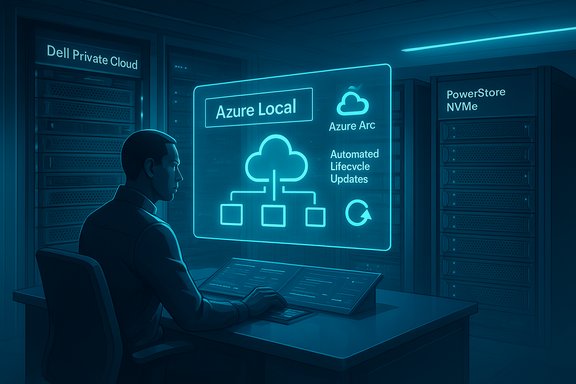
Azure Local is Microsoft’s packaged, on‑premises variant of Azure that provides a consistent control plane, selected Azure platform services (including AKS), and Azure Arc management for validated hardware running in customer data centers or edge locations. It is designed to deliver cloud‑like operations where data residency, latency, or disconnected operation make public cloud impractical. Dell’s newly announced integration lists two principal components: Dell Private Cloud (a disaggregated, full‑stack private cloud built on Dell compute, networking and validated external storage) and Dell PowerStore (an NVMe, all‑flash enterprise array optimized for performance and inline data efficiency). Dell positions Dell Private Cloud as the first Azure Local offering to provide a full‑stack solution delivered end‑to‑end by one vendor, backed by solution‑level support and automated lifecycle management. Early access for the combined offering is scheduled to begin in spring 2026.
For IT leaders considering adoption, the practical path is clear: secure validated SKUs and SLAs, run representative PoCs early, and treat performance and data‑efficiency guarantees as testable contractual clauses rather than marketing expectations. For the right workloads — regulated data, latency‑sensitive databases, and near‑data AI inference — Dell Private Cloud plus PowerStore under Azure Local is a strong, enterprise‑grade option that deserves serious evaluation. Caitlin Gordon captured the shift in tone succinctly: managing mixed environments “simply and consistently” is the real enterprise challenge today, and this joint Dell–Microsoft effort is explicitly engineered to deliver on that promise — if customers demand the verification steps that make vendor marketing accountable in real operations.
Source: techbuzzireland.com Dell Technologies and Microsoft redefine Hybrid Cloud with Azure local integration
 Background
Azure Local is Microsoft’s packaged, on‑premises variant of Azure that provides a consistent control plane, selected Azure platform services (including AKS), and Azure Arc management for validated hardware running in customer data centers or edge locations. It is designed to deliver cloud‑like operations where data residency, latency, or disconnected operation make public cloud impractical. Dell’s newly announced integration lists two principal components: Dell Private Cloud (a disaggregated, full‑stack private cloud built on Dell compute, networking and validated external storage) and Dell PowerStore (an NVMe, all‑flash enterprise array optimized for performance and inline data efficiency). Dell positions Dell Private Cloud as the first Azure Local offering to provide a full‑stack solution delivered end‑to‑end by one vendor, backed by solution‑level support and automated lifecycle management. Early access for the combined offering is scheduled to begin in spring 2026. What Dell and Microsoft Announced — Plain and Practical
The high‑level promise
- A validated Azure Local path that uses Dell Private Cloud as a single‑vendor, full‑stack private cloud option, simplifying procurement and escalation by consolidating compute, networking and validated external storage under Dell’s support umbrella.
- Validation of Dell PowerStore as an Azure Local storage option, bringing NVMe performance, always‑on data reduction, and enterprise resilience features into Azure‑managed on‑prem deployments.
- Joint lifecycle automation and management through Azure tooling (Azure Arc and Azure Update Manager) plus Dell’s Automation Platform to reduce manual steps for provisioning and updates.
Why it matters now
The market is no longer binary — enterprises increasingly operate a mixture of public cloud, private cloud, and edge systems. The major practical drivers for this announcement are:- Data sovereignty and regulatory demands that keep certain workloads local.
- Latency‑ and I/O‑sensitive, stateful workloads (databases, near‑data AI inference, media production) that benefit from NVMe performance close to compute.
- Operational fatigue with multi‑vendor stacks and disjointed lifecycle processes; consolidated Azure management aims to reduce operational complexity.
Deep Dive: Dell Private Cloud — Full Stack, Disaggregated, Automated
Architecture and operational model
Dell Private Cloud is presented as a disaggregated private‑cloud architecture: compute nodes, validated networking, and external storage arrays (such as PowerStore) are recombined into validated, manageable stacks. The disaggregated approach allows independent scaling of compute and storage, which is critical when NVMe performance requirements diverge from capacity economics. Automated lifecycle management through the Dell Automation Platform aims to reduce provisioning steps and accelerate cluster delivery. Dell claims significant reductions in manual deployment steps and rapid cluster provisioning times in controlled scenarios.What “single‑vendor full stack” means in practice
- Procurement: One purchase order and one vendor SLA to engage for hardware, software stack, and validated Azure Local support.
- Support: Solution‑level support where Dell coordinates hardware, firmware and validated software troubleshooting, rather than the customer needing to mediate across multiple vendors.
- Lifecycle: Coordinated firmware, driver and software update windows that align Dell automation with Azure update bundles to reduce mismatched patches.
Dell PowerStore in Azure Local — Performance, Efficiency, Caveats
Capabilities being emphasized
- NVMe, all‑flash performance: PowerStore brings high IOPS and low latency for transactional and AI‑adjacent workloads when co‑located with compute.
- Always‑on data reduction: Inline compression and deduplication that Dell markets with a 5:1 Data Reduction Ratio (DRR) guarantee for eligible reducible workloads. This is framed as a contractual guarantee under Dell’s program terms.
- Enterprise resiliency: Snapshots, replication and native data protection integrations suitable for mixed legacy and cloud‑native workloads.
Important caveats and realism checks
The marketed 5:1 DRR figure is not a universal promise; it is conditional on reducible datasets, measured under Dell’s eligibility and testing criteria. Real‑world DRR varies widely with dataset entropy, file types, and workload behavior. Treat the 5:1 figure as a contractual floor for specific data profiles rather than a guaranteed outcome for arbitrary production data. Verification via representative PoCs is essential.Management, Governance, and Lifecycle: How Operations Change
The unified control plane
Azure Local connects to the Azure control plane and Azure Arc, enabling centralized policy, telemetry and lifecycle updates from Azure while the hardware remains customer‑owned. This brings consistent monitoring and governance across public Azure and on‑prem deployments, simplifying compliance reporting and centralized security posture management.Lifecycle orchestration
Monthly coordinated update bundles from Azure plus Dell’s automation tooling promise:- Predictable coordinated updates for drivers, firmware and software.
- Reduced manual effort for provisioning and patching, with Dell claiming orders‑of‑magnitude reductions in manual steps for cluster delivery (Dell’s published figures are deployment‑scenario specific).
Commercial and Contractual Considerations
Support boundaries and telemetry
A single‑vendor model simplifies troubleshooting, but raises questions about:- Telemetry and data access: What management telemetry does Dell collect, who can access it, and where is it stored? These details matter for compliance in regulated industries.
- Escalation SLAs: Does Dell’s solution‑level support include Azure Local software issues, or are some Azure platform problems still routed to Microsoft under separate Azure support contracts? Clarify the cross‑vendor escalation matrix before signing.
Pricing model and TCO
Azure Local consumption models can include Azure subscription/host fees in addition to Dell hardware and support costs; PoCs must measure both CapEx and ongoing consumption lines (including any CloudPools or tiering egress effects). Model scenarios should also include exit costs and portability.Vendor lock‑in and exit mechanics
A single validated stack increases integration benefits but can deepen operational and contractual coupling. Procurement should demand clear exit mechanics: data export procedures, runbooks, knowledge transfer, and staged handback options to avoid being “locked” into a single‑vendor operating model.Risk Assessment — Where the Proposal Excels and Where to Watch Out
Strengths
- Operational simplicity: Bundled procurement, single‑vendor support and coordinated updates materially reduce day‑to‑day complexity for large estates.
- Performance for stateful workloads: NVMe PowerStore co‑located with Azure‑managed compute reduces latency for high‑IOPS applications and near‑data inference tasks.
- Unified governance: Azure Arc and Azure Local provide a familiar Azure control plane for policy, telemetry and security integration across hybrid estates.
Risks and limitations
- Conditional guarantees: The 5:1 DRR guarantee is conditional on reducible datasets and eligibility—actual DRR will vary. Rely on PoCs, not marketing figures.
- Update cadence control: Coordinated update automation improves consistency but reduces unilateral control over firmware/driver rollouts. Explicit rollback and staging agreements are essential.
- Contractual complexity: The “single‑vendor” promise can obscure where Microsoft’s responsibilities end and Dell’s begin for Azure Local software issues; clarify escalation paths and Azure support entitlements.
- Regional and SKU variability: Early access (spring 2026) will likely roll out regionally with validated SKU matrices; feature parity and availability can vary by geography. Procurement must confirm the validated matrix for target regions.
Practical Guidance for IT Leaders — From Evaluation to Pilot
Immediate checklist before committing to a pilot
- Request the validated hardware compatibility matrix and the exact SKUs Dell plans to certify for Azure Local in your region.
- Demand clear SLAs that specify update windows, rollback procedures, telemetry access, and an explicit cross‑vendor escalation matrix.
- Define measurable KPIs for PoCs: IOPS/latency targets, DRR measurement methodology, recovery time objectives (RTO), and recovery point objectives (RPO).
- Run PoCs with representative datasets — not synthetic benchmarks — to validate real‑world DRR and performance.
- Model TCO including Azure Local host/consumption fees, Dell hardware/support, and any egress/tiering costs with realistic growth curves.
A suggested PoC sequence
- Baseline: Capture current performance and data reduction numbers on production‑like datasets.
- Deploy: Stand up a small Dell Private Cloud cluster with PowerStore as the validated external storage under Azure Local early‑access terms.
- Measure: Run production workloads or replay captured traces to measure latency, throughput and DRR using Dell’s and Azure’s recommended measurement windows.
- Validate lifecycle operations: Simulate coordinated updates, emergency rollbacks, and failover exercises to test SLA promises and support responsiveness.
- Review commercial terms: Compare observed performance and operational outcomes against contractual promises before scaling to larger production rollouts.
Market Context and Competitive Landscape
Microsoft’s Azure Local sits in a competitive hybrid‑cloud market where hyperscalers and traditional infrastructure vendors are converging on on‑prem, edge and sovereign solutions. Dell’s announcement deepens a long‑standing engineering partnership and follows other joint initiatives (PowerScale for Azure, PowerProtect services) that aim to bring Dell’s storage pedigree into Azure’s operational fold. For organizations reconsidering VMware-centric architectures after market consolidation, Azure Local plus validated vendor stacks presents a credible alternative pathway that combines cloud governance with on‑site control. Independent trade coverage underscores the strategic logic: enterprises want cloud‑like operations without fully exporting sensitive or latency‑sensitive workloads to public cloud — and vendor‑validated stacks lower the friction of achieving that balance. Still, competitive choices remain (other vendors also validate hardware for Azure Local, and alternate private‑cloud models such as HCI from other vendors continue to evolve). Decision makers should treat Dell’s single‑vendor pitch as one strong option among several, chosen based on workload fit and contractual clarity.Balanced Conclusion
Dell Technologies’ integration of Microsoft Azure Local with Dell Private Cloud and PowerStore is a pragmatic, well‑timed response to enterprise demand for consistent Azure governance across on‑prem and edge footprints. It bundles two compelling capabilities — automated cloud‑style lifecycle management and NVMe‑class performance — into a vendor‑validated path that reduces operational friction for many enterprises. However, the offering is not a turnkey panacea. Key commercial and technical claims (notably the 5:1 data reduction guarantee) are conditional and must be validated against representative production datasets. The single‑vendor model trades simplicity for vendor dependency; rigorous contractual safeguards, PoCs, and clear exit mechanics are non‑negotiable.For IT leaders considering adoption, the practical path is clear: secure validated SKUs and SLAs, run representative PoCs early, and treat performance and data‑efficiency guarantees as testable contractual clauses rather than marketing expectations. For the right workloads — regulated data, latency‑sensitive databases, and near‑data AI inference — Dell Private Cloud plus PowerStore under Azure Local is a strong, enterprise‑grade option that deserves serious evaluation. Caitlin Gordon captured the shift in tone succinctly: managing mixed environments “simply and consistently” is the real enterprise challenge today, and this joint Dell–Microsoft effort is explicitly engineered to deliver on that promise — if customers demand the verification steps that make vendor marketing accountable in real operations.
Source: techbuzzireland.com Dell Technologies and Microsoft redefine Hybrid Cloud with Azure local integration
