

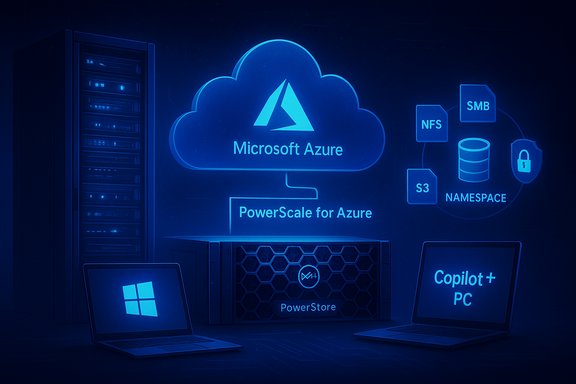
Dell and Microsoft’s latest announcements at Microsoft Ignite sharpen a growing industry trend: hybrid AI is moving from pilot projects to packaged, co-engineered services that promise enterprise-grade performance, integrated management, and tighter security for AI workloads that span cloud, private data centers, edge sites and intelligent endpoints.
Background / Overview
Over the past 18 months the conversation about enterprise AI has shifted from raw model capability to the realities of running AI at scale: where the data lives, how fast it can be accessed, how governance and compliance are enforced, and how operational teams keep systems running without ballooning costs. In response, Dell Technologies and Microsoft are advancing a coordinated hybrid-AI-cloud strategy built around several concrete offerings and integrations unveiled at Microsoft Ignite and through partner blogs and product updates.At the heart of the announcements are four linked pillars:
- Expanded support for Azure Local (Microsoft’s rebranded on-premises/edge offering formerly known as Azure Stack HCI) across Dell Private Cloud, PowerStore, and other Dell platforms.
- The public preview and co-engineered roll-out of Dell PowerScale for Microsoft Azure, an Azure-native, fully managed file-storage service built on Dell OneFS to support data-intensive AI pipelines.
- New or enhanced Dell-managed services such as Dell APEX File Storage for Microsoft Azure and PowerProtect Backup Services for hybrid resilience and cyber recovery.
- Continued focus on hybrid endpoints: Dell Copilot+ PCs and an expanded Dell AI Factory that bridge on-device inference with Azure cloud services.
What was announced — the product and technical highlights
Dell PowerScale for Microsoft Azure (Azure-native, public preview)
- What it is: A co-developed, Azure-native managed service that brings Dell’s OneFS scale‑out file system into Microsoft Azure as a first-party experience in the Azure portal.
- Target workloads: AI/ML pipelines, high-throughput analytics, media and entertainment, life sciences, EDA and other use-cases needing parallel, scale-out file access.
- Key technical claims: Support for a single namespace up to multiple petabytes (announced platform numbers indicate support up to ~8.4PB), multi-protocol access (NFS, SMB, S3 in the same namespace), and purpose-built compute SKUs that include NVRAM for high throughput and low latency.
- Deployment models: Customer-managed option for tighter control, and a Dell-managed option (public preview) for organizations that prefer a managed, hands-off experience.
- Azure integration: Provisioning, billing, monitoring and lifecycle management are available through Azure-native tooling.
Azure Local integrations: PowerStore and Dell Private Cloud
- What it is: Extended support for Azure Local (the rebranded hybrid option that brings Azure services on-premises) on Dell Private Cloud and PowerStore hardware, enabling customers to adopt an Azure operational model without buying new hardware.
- Value proposition: Independent scaling of compute and storage, automated lifecycle management, and the ability to run Azure services where data sovereignty, latency, or regulatory constraints demand on‑prem control.
Dell APEX File Storage for Microsoft Azure and APEX Protection Services
- What it is: Dell’s APEX portfolio extended to Azure — managed file storage options plus protection services that aim to simplify backup and cyber-resilience across hybrid estates.
- Security features: Vendor messaging emphasizes immutability, encryption, multi‑factor authentication, and role‑based access controls as part of a broader cyber resilience posture.
- Operational benefits: Dell-managed backups with AI-driven recovery analytics to reduce recovery time and complexity.
Dell Copilot+ PCs and the Dell AI Factory
- What it is: Endpoint-level investment in NPU-equipped Copilot+ PCs designed to deliver on-device Copilot experiences and offload sensitive inference tasks from the cloud.
- Developer tooling: Integration points with Microsoft Copilot Studio and Azure AI Studio to simplify agent and Copilot application development and deployment across device, edge and cloud.
Why this matters: strategic and technical implications
1. Hybrid AI is increasingly data-first
The announcements underscore a fundamental truth of enterprise AI: compute alone isn’t enough — data infrastructure is the gating factor. High-performance, scalable file storage with low-latency access is a prerequisite for production AI workflows (training, fine-tuning, pre-processing, and inference serving). By bringing PowerScale natively into Azure, Dell and Microsoft aim to reduce friction for organizations that need parallel high‑throughput file access without redesigning their applications.2. Operational consistency across cloud and on-prem reduces friction
Enterprises are investing heavily in standardizing operational models. Aligning Dell Private Cloud and PowerStore with Azure Local and Azure Arc means customers can apply Azure governance, security policies, and lifecycle processes across heterogeneous environments. This reduces duplicated tooling and training costs and shortens time to production for projects that span cloud and private infrastructure.3. Managed options accelerate adoption while shifting OPEX and control trade-offs
The Dell-managed variant of PowerScale for Azure and APEX-managed services can be attractive for organizations that lack deep storage or AI ops expertise. Managed services accelerate deployment and reduce operational burdens, but they move control and some compliance responsibilities to the provider — a trade-off that must be weighed against time-to-value.4. On-device and edge AI keep sensitive data local
Dell’s emphasis on Copilot+ PCs and on-device NPUs reflects a broader market pattern: industries with stringent data privacy or regulatory requirements (healthcare, finance, government) are more comfortable keeping certain inference workloads local. This reduces cloud egress, improves responsiveness, and closes a security vector for sensitive data.Technical verification and reality checks
Multiple vendor communications and Microsoft community posts make consistent technical claims about capability and scale. Public preview documentation and partner blogs indicate:- PowerScale for Azure supports very large namespaces (vendor statements and community posts reference figures in the multi‑petabyte range).
- The service provides multi-protocol access (NFS, SMB, S3) and Azure-native management via the portal.
- Dell offers both customer-managed and Dell‑managed deployment models, with Dell managing monitoring, maintenance, and updates for the managed service.
- Vendor performance numbers (for example, “X times faster than competitor Y” or throughput improvements tied to NVRAM-enabled SKUs) are useful directional metrics but must be validated with independent benchmarks in each customer's workload. Enterprise file-system performance is highly dependent on workload characteristics (IO size, concurrency, metadata patterns).
- Public preview status for some services means capabilities and pricing can change before GA (General Availability). Organizations should account for feature maturation and contractual terms when planning migration or architecture changes.
Security, compliance and cyber resilience analysis
Security was positioned as a core theme across the stack:- Immutability and hardened backup services are central to modern ransomware resilience strategies. Integrating protection services with Azure infrastructure adds a consistent operational model.
- Role‑based access controls (RBAC) and encryption are baseline expectations; Azure integration allows customers to reuse established Azure identity and policy controls.
- For regulated industries, Azure Local plus on-device processing can deliver the physical and logical separation required by data sovereignty and privacy regulations.
- Managed services introduce new supply‑chain and third‑party risks. When Dell manages backups and storage in Azure, customers must understand the shared responsibility model and contractual guarantees around data residency, access logs, and auditability.
- Integration complexity: any time you bridge identity, storage and network across cloud and on-prem, misconfigurations can expand the attack surface. Organizations must treat these hybrid integrations like any cross-domain trust boundary and apply robust monitoring and segmentation.
- Recovery SLAs and immutable retention policies need independent validation. Marketing claims on cyber-resilience time-savings should be tested in realistic tabletop exercises and DR tests before relying on them for compliance reporting.
Business and procurement implications
- CapEx vs OpEx: Dell-managed APEX and Dell-managed PowerScale convert capital investments into subscription-style operational expenses. That can improve balance-sheet flexibility but may increase long-term TCO depending on usage profiles.
- Vendor lock-in risk: Deep, co-engineered integrations (Azure-native features that depend on specific Dell SKUs or compute instances) deliver convenience at the potential cost of portability. Organizations with multi-cloud strategies must map the escape hatch carefully — e.g., how easily can workloads be replicated to alternative cloud storage services or on-prem systems without significant refactoring?
- Cost predictability: High-throughput AI workloads can generate unpredictable storage and network egress costs. Managed service pricing models should be reviewed alongside forecasted training and inference cycles to model long-term expense profiles.
- Support and skill pooling: Moving to a co-managed or vendor-managed model reduces internal staffing needs but creates reliance on vendor SLAs and escalation paths. IT organizations will need to realign vendor management, procurement, and incident response processes.
Practical deployment considerations — a checklist for IT leaders
- Inventory and data classification
- Identify datasets that require high-throughput, low-latency file access.
- Classify data by sensitivity and regulatory requirements to decide on on‑device, on‑prem or cloud placement.
- Select a deployment model
- Choose between customer‑managed and Dell‑managed PowerScale for Azure based on internal expertise, compliance needs, and appetite for outsourcing operations.
- Pilot with representative workloads
- Run benchmarks using real IO patterns (metadata-heavy vs large sequential reads/writes) to validate performance claims before large-scale migration.
- Validate security and compliance
- Confirm immutability, encryption-at-rest/in-transit, role‑based controls, and audit logging meet regulatory and internal audit requirements.
- Network and latency planning
- For hybrid setups, ensure network paths between on‑prem compute, Azure services, and endpoints meet expected throughput and latency SLAs.
- Cost modeling
- Model storage tiering, expected scale growth, and egress for training/inference cycles. Compare managed-service fees with internal OpEx and CapEx trade-offs.
- DR and recovery validation
- Conduct full recovery exercises that include vendor-managed components and verify recovery time objectives (RTO) and recovery point objectives (RPO).
Strengths of the Dell–Microsoft hybrid-AI approach
- Co-engineered integration: Native Azure management and portal integration removes a major operational barrier for teams that standardize on Azure tooling.
- End-to-end portfolio: From on-device NPU-enabled Copilot+ PCs to on‑prem PowerStore and cloud PowerScale, Dell + Microsoft presents a one‑stop path for many enterprise AI scenarios.
- Scalability for data-heavy workloads: Scale‑out file systems with multi‑protocol support are better suited for certain AI pipelines than object-only solutions, especially where legacy applications or parallel file access are required.
- Managed options reduce operational friction: Enterprises that lack deep storage operations teams can get to production faster with vendor-managed services.
Potential risks and areas to watch
- Performance claims need independent validation. Vendor-supplied benchmarks are useful but not a substitute for workload-specific testing. Expect variance in performance based on concurrency, IO patterns, and data locality.
- Lock-in to co-engineered SKUs and Azure-native features could limit portability across clouds, complicating future multi-cloud strategies.
- Managed services shift trust and compliance obligations. Legal and security teams must validate contract terms, data handling, and audit access before committing sensitive workloads.
- Cost surprises from scale and egress. High-volume training or frequent model updates can generate large storage and network costs; careful cost governance is necessary.
- Preview status and feature drift. Some components are in public preview; features, pricing and SLAs may evolve before GA. Procurement and legal teams should seek explicit timelines and exit clauses.
Competitive and market context
The Dell–Microsoft alignment is part of a broader industry pattern: hyperscalers are making it easier to run partner storage and specialized data services inside their clouds, and OEMs are building managed stacks to capture enterprise customers who value simplified operations.- Hyperscaler-first file and block services have matured (including provider-native offerings), but co-engineered partner services provide differentiated capabilities — notably in multi-protocol support and operational continuity with on‑prem deployments.
- Vendors that can deliver both on‑device intelligence (Copilot+ PCs) and hardened hybrid storage/backup solutions position themselves well for regulated industries that prioritize data locality and governance as much as model performance.
Recommendations — how to evaluate Dell + Microsoft hybrid-AI options
- Treat the announcements as opportunities to simplify AI infrastructure, not as turnkey solutions that eliminate necessary planning.
- Start with a narrowly scoped pilot that mirrors production workloads. Validate throughput, latency and metadata behavior in your environment.
- Negotiate contractual terms for:
- Data residency and access controls.
- Performance SLAs and credible remedies.
- Exit and data-portability clauses for managed services.
- Require tabletop and live DR exercises that include Dell-managed components.
- Build cost governance controls (e.g., budgets for storage tiers, model-training quotas, and egress alerts).
- Maintain a parallel plan for portability — ensure data export formats and interfaces are supported so that a future multi-cloud move is feasible.
Conclusion
Dell and Microsoft’s hybrid-AI-cloud work reflects an important market shift: enterprises want the power of cloud AI without surrendering control of their most valuable data. By bringing Dell PowerScale into Azure, expanding Azure Local support across Dell hardware, and offering managed APEX services together with on-device Copilot capabilities, the partners aim to remove operational friction and accelerate AI adoption across regulated and data‑sensitive industries.These advances are meaningful for IT leaders: they reduce integration complexity, offer choice between managed and customer-controlled deployments, and deliver higher-performance file access for demanding AI workloads. Yet they also carry trade-offs — particularly around vendor dependency, contractual clarity and real-world performance versus marketing claims.
The pragmatic path forward is clear: validate with pilots, insist on contractual protections, and architect for data governance and portability. For organizations that require hybrid AI with enterprise-grade resilience and Azure-centric operations, the Dell–Microsoft portfolio now presents a coherent, production-ready option — provided the claim checks are performed and the governance, security and cost models are aligned up front.
Source: SiliconANGLE Hybrid-AI-cloud innovation: Dell and Microsoft advance AI - SiliconANGLE
