

Dell and Microsoft’s latest hybrid-cloud move is a practical reminder that enterprise IT has entered an era of engineered compromise: cloud consistency and on‑premises control, NVMe performance and centralized governance, vendor simplicity and procurement trade‑offs. The integration of Microsoft Azure Local with Dell Private Cloud and Dell PowerStore promises a single‑vendor route to run Azure‑managed services on customer‑owned infrastructure, with early access slated for spring 2026 and a clear focus on lifecycle automation, disaggregated scaling, and data‑centric performance.
Hybrid cloud is no longer a transitional architecture — it is the default posture for most large organisations. Enterprises now balance data sovereignty, latency-sensitive workloads, steady-state economics, and cloud‑native services in the same IT portfolio. Microsoft’s Azure Local is designed to be the consistent control plane that extends Azure tooling to validated on‑prem hardware; Dell’s work here is to make that hardware stack easier to buy, deploy and support as a cohesive offering. Azure Local is Microsoft’s full‑stack on‑premises package that runs on bare‑metal partner hardware and uses Azure Arc and the Azure Portal for centralized management and lifecycle orchestration. It is explicitly sold and billed as Azure software that customers run on hardware they own, with Microsoft providing the validated software stack and update bundles. Dell is positioning Dell Private Cloud as the first Azure Local offering that delivers a single‑vendor, full‑stack route — compute, networking and external storage — with coordinated lifecycle management and solution‑level support. PowerStore is the NVMe, all‑flash storage layer validated for this path. Early public‑facing coverage and Dell’s corporate posts indicate early access will begin in spring 2026, with broader availability and regional rollouts to follow as validated SKUs and program agreements are finalised. Independent trade outlets have confirmed the broad contours of the Dell–Microsoft announcement and highlighted the same operational, performance and procurement claims.
Conclusion
The arrival of Azure Local support for Dell Private Cloud and PowerStore reframes an old IT question — cloud versus on‑prem — into a new one: how to operate consistently across both. The technical ingredients are in place (Azure Local’s control plane, Dell’s disaggregated infrastructure, PowerStore’s NVMe performance), and early access in spring 2026 will give customers the chance to validate whether the promise matches reality. With proper procurement discipline, PoCs on representative datasets, and contractual protections around data reduction, update cadence and portability, organisations can convert this joint offering into measurable operational and economic gains. Without that discipline, the risk is that neat marketing will obscure the real work required to make hybrid cloud reliably deliver on its promises.
Source: Irish Tech News Hybrid Cloud now has Azure local integration
 Background
Hybrid cloud is no longer a transitional architecture — it is the default posture for most large organisations. Enterprises now balance data sovereignty, latency-sensitive workloads, steady-state economics, and cloud‑native services in the same IT portfolio. Microsoft’s Azure Local is designed to be the consistent control plane that extends Azure tooling to validated on‑prem hardware; Dell’s work here is to make that hardware stack easier to buy, deploy and support as a cohesive offering. Azure Local is Microsoft’s full‑stack on‑premises package that runs on bare‑metal partner hardware and uses Azure Arc and the Azure Portal for centralized management and lifecycle orchestration. It is explicitly sold and billed as Azure software that customers run on hardware they own, with Microsoft providing the validated software stack and update bundles. Dell is positioning Dell Private Cloud as the first Azure Local offering that delivers a single‑vendor, full‑stack route — compute, networking and external storage — with coordinated lifecycle management and solution‑level support. PowerStore is the NVMe, all‑flash storage layer validated for this path. Early public‑facing coverage and Dell’s corporate posts indicate early access will begin in spring 2026, with broader availability and regional rollouts to follow as validated SKUs and program agreements are finalised. Independent trade outlets have confirmed the broad contours of the Dell–Microsoft announcement and highlighted the same operational, performance and procurement claims. What was announced (the essentials)
- Dell Private Cloud will be offered as an Azure Local‑validated full‑stack option that bundles compute, networking and external storage under coordinated lifecycle automation and single‑vendor solution support. Dell frames this as simplifying procurement and support escalation for enterprises seeking Azure‑managed on‑prem infrastructure.
- Dell PowerStore — Dell’s NVMe all‑flash array family — is validated as an Azure Local storage option, bringing NVMe performance, inline data reduction and enterprise resiliency features into the Azure‑managed on‑prem environment. Dell highlights an industry‑level 5:1 data reduction guarantee for eligible reducible datasets as part of its program.
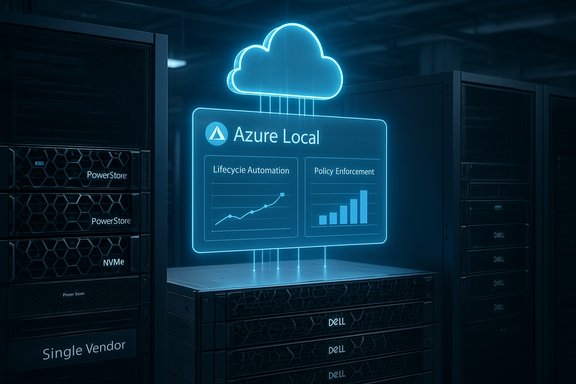
- Microsoft Azure Local remains the control plane: day‑to‑day visibility, update bundles and policy/policy enforcement come through Azure tooling (including Azure Update Manager and Azure Arc), while customers retain hardware ownership and operational control.
Technical deep dive
Azure Local: what it provides on premises
Azure Local is built to deliver a cloud‑like operational experience on validated hardware. Key technical attributes include:- A full Azure software stack pre‑validated to run on partner hardware, with built‑in Azure Arc capabilities and centralized management through the Azure Portal.
- Support for VMs, containers (AKS) and selected Azure platform services locally, enabling the same governance, telemetry and patching approaches used in public Azure.
- An update and lifecycle model that surfaces monthly or coordinated update bundles via Azure Update Manager, designed to keep firmware, drivers and software aligned across distributed clusters.
Dell Private Cloud: disaggregated, automated, single vendor
Dell Private Cloud is a disaggregated architecture intentionally designed to let compute and storage scale independently — a crucial capability for organisations that need NVMe performance without over‑provisioning compute or paying for excess controller resources.- The Dell Automation Platform handles zero‑touch onboarding and lifecycle tasks; Dell claims cluster provisioning in hours rather than days through automation.
- The validated stack combines Dell compute nodes, validated networking and external arrays such as PowerStore into a single procurement and support boundary. This is Dell’s answer to multi‑vendor complexity and update mismatch.
- In the Dell model, solution‑level support bundles hardware and validated software troubleshooting under one engagement, theoretically shortening mean time to repair during complex incidents. This is a support‑model design decision, not a technical silver bullet; real outcomes will depend on the SLA specifics.
PowerStore in the Azure Local stack
PowerStore brings Dell’s modern NVMe architecture and inline data efficiency to Azure Local deployments:- NVMe all‑flash performance for high IOPS and low latency use cases — for example transactional databases, near‑data inference and real‑time analytics.
- Inline compression and deduplication marketed as “always‑on data reduction,” and a headline 5:1 Data Reduction Ratio (DRR) guarantee for eligible, reducible workloads. This guarantee is conditional and subject to measurement terms.
- Enterprise resilience features — snapshots, replication and integrations with Dell’s protection portfolio — to support hybrid backup and cyber recovery use cases.
Why this matters: practical value for enterprises
Hybrid reality is messy: some workloads must stay local for regulatory, latency, or data‑gravity reasons, while others are more efficiently run in public cloud. This Dell–Microsoft integration addresses core operational pain points:- Operational consistency: Azure Local gives a single management plane and update model across cloud and on‑prem; packaging that in a vendor‑backed Dell Private Cloud reduces the number of parties involved in support escalations.
- Performance and latency: Co‑locating NVMe PowerStore with compute reduces tail latency and improves throughput for I/O‑bound workloads that are expensive to run in public cloud tiers.
- Data sovereignty and compliance: Azure Local lets organisations keep data in‑country while using Azure governance and policy tools, which is critical in regulated industries.
- Cost predictability for steady workloads: For large, steady state workloads, validated on‑prem Azure stacks can provide a more predictable TCO compared to fully elastic public cloud consumption. Independent coverage notes that repatriation and hybrid optimisation are common enterprise strategies.
Strengths and notable benefits
- Single‑vendor procurement and support: Consolidating compute, networking and storage under one vendor simplifies procurement workflows, reduces coordination overhead, and narrows the escalation path during outages. Dell positions this feature as a key operational benefit.
- Independent scaling (disaggregation): Adding capacity or performance independently (storage vs compute) reduces waste and better matches economics to workload needs. This is particularly useful for AI inference or database workloads where IOPS and capacity profile diverge.
- Automated lifecycle management: Coordinated update bundles via Azure Update Manager and Dell Automation reduce patching friction and the risk of mismatched firmware/software stacks that historically cause outages.
- NVMe performance and data‑efficiency economics: PowerStore’s NVMe architecture plus inline reduction can materially lower usable capacity needs for reducible datasets, improving density and lowering per‑GB cost for eligible workloads. Dell advertises a 5:1 DRR guarantee under specific program conditions.
Risks, caveats and practical limitations
No vendor offering is risk‑free. The most important buyer cautions are operational, contractual and technical.- Marketing vs contractual reality: Dell’s claim that Dell Private Cloud is the “first” single‑vendor Azure Local full‑stack offering is a positioning statement. Procurement teams should validate the exact technical matrix, supported SKUs, cluster size limits, and feature parity that apply to their SKUs and countries before signing contracts. Treat vendor positioning as a starting point for technical confirmation, not proof.
- Data reduction guarantees are conditional: The advertised 5:1 DRR is a program guarantee for reducible datasets and will not apply universally. DRR depends heavily on dataset entropy, application I/O patterns, and whether dedupe/compression are effective for the specific workload. Require written measurement windows, sample datasets or PoC results, and remediation clauses in the contract.
- Vendor lock‑in and exit strategy: A single‑vendor appliance plus an Azure‑managed control plane creates contractual and technical coupling. Buyers must insist on clear data export, metadata preservation, and documented handover procedures (runbooks, snapshot export formats) so they can move workloads if strategic priorities change. Independent coverage frequently flags exit strategy and portability as procurement priorities.
- Update cadence and operational autonomy: Azure Local’s model surfaces update bundles and notifications in the Azure Portal, but the cadence and the degree to which customers can delay or control updates must be contractually explicit for high‑assurance environments. For air‑gapped or disconnected sites, confirm Microsoft’s and Dell’s documented disconnected operation guarantees and timelines.
- Feature parity limits: Not every Azure service or feature will necessarily be available in Azure Local on every validated hardware profile. Confirm the availability of specific platform services (AKS, Azure SQL Edge, GPU support, etc. and limits for your deployment size before committing.
Procurement checklist — what to insist on before you buy
- Written validated hardware compatibility matrix for your target SKUs and region, including limits for cluster size, GPU support, and replication features.
- Exact SLA, escalation and solution‑level support terms showing Dell’s role versus Microsoft’s responsibilities for Azure Local updates and incident management.
- Clear data reduction guarantee terms (what “reducible datasets” means, measurement windows, PoC methodology, and remediation steps).
- Exit and portability clauses (snapshot and metadata exports, standard formats, runbooks, and transfer assistance).
- A representative PoC using your real datasets to validate latency, DRR, throughput and restore/testing workflows — not just vendor synthetic benchmarks.
Practical rollout steps for IT teams
- Start with a scoped PoC: define a small set of production‑representative workloads, traffic patterns, and datasets. Measure latency and DRR over the vendor’s accepted measurement period.
- Validate lifecycle operations: test update windows, rollback procedures, and vendor coordination on incident drills. Confirm who will perform firmware updates and how emergency rollbacks are handled.
- Confirm security telemetry flows: determine where logs and telemetry are stored, who has access, and how key management (customer‑managed keys vs vendor) is implemented. This is critical for compliance.
- Run recovery exercises: demonstrate backup and restore scenarios, cyber‑recovery isolation, and failover behaviour across both on‑prem and Azure‑backed control planes.
- Negotiate commercial protections: include caps on consumption, cost review windows for Azure billing elements tied to on‑prem hosts, and performance KPIs for support response.
How this fits into broader vendor and market dynamics
This Dell–Microsoft integration is part of a larger industry movement: hyperscalers and traditional hardware vendors are converging on hybrid solutions that blur the lines between cloud and owned infrastructure. Dell’s strategy is to offer both technical parity (via Azure Local validation) and commercial simplicity (single‑vendor buying and support) to win enterprise workloads that prioritize control and performance. Microsoft’s Azure Local, meanwhile, is a strategic product to retain governance and management parity with public Azure while recognising that hardware ownership patterns vary across regulated, latency‑sensitive and high‑data‑gravity industries. Independent coverage has also highlighted complementary Dell moves — such as PowerScale for Azure, PowerProtect backup services on Azure, and new PowerStore hardware variants — that together create a broader, hybrid‑first portfolio targeted at data‑intensive workloads and cyber resilience. These moves position Dell to capture more of the stack while Microsoft secures management and billing relationships.Final assessment and recommendations
The expansion of Azure Local to include Dell Private Cloud and PowerStore is a meaningful, pragmatic step for organisations that want cloud‑grade governance with on‑premises performance and control. The strengths are operational simplicity, disaggregated economics, and NVMe performance for critical workloads. These are tangible benefits for regulated enterprises, latency‑sensitive applications, and organisations rebalancing cloud spend. However, buyers must be disciplined. Key company claims — including single‑vendor full‑stack positioning and the 5:1 DRR guarantee — should be validated in writing, tested with real data, and included in contractual protections. Treat vendor marketing as the starting point for a technical and commercial negotiation, not the final answer. Negotiate PoCs, SLAs, exit clauses and clear measurement windows before moving production workloads. The practical playbook for enterprise IT leaders is straightforward:- Use a representative PoC to validate performance and data‑reduction claims.
- Demand written matrices and SLAs that cover update cadence, rollback procedures, telemetry ownership and exit rights.
- Model TCO using your own steady‑state workload profiles (not vendor synthetic tests).
- Build recovery drills into procurement milestones to ensure cyber resilience and operational trust.
Conclusion
The arrival of Azure Local support for Dell Private Cloud and PowerStore reframes an old IT question — cloud versus on‑prem — into a new one: how to operate consistently across both. The technical ingredients are in place (Azure Local’s control plane, Dell’s disaggregated infrastructure, PowerStore’s NVMe performance), and early access in spring 2026 will give customers the chance to validate whether the promise matches reality. With proper procurement discipline, PoCs on representative datasets, and contractual protections around data reduction, update cadence and portability, organisations can convert this joint offering into measurable operational and economic gains. Without that discipline, the risk is that neat marketing will obscure the real work required to make hybrid cloud reliably deliver on its promises.
Source: Irish Tech News Hybrid Cloud now has Azure local integration
