

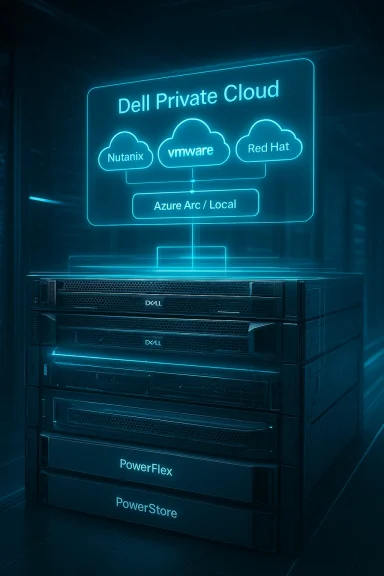
Dell has quietly widened the aperture of its on‑prem private cloud by adding Nutanix AHV support to Dell Private Cloud, joining VMware and Red Hat as first‑class hypervisor choices and signalling a deliberate push toward multi‑hypervisor, disaggregated private clouds. (blocksandfiles.com)
Enterprises have spent a decade wrestling with two competing forces: the operational simplicity of public cloud and the control, cost predictability and data locality of on‑premises infrastructure. Dell Private Cloud is Dell’s answer to that tension — a validated, disaggregated private‑cloud offering that packages PowerEdge compute, validated networking, and external storage such as PowerFlex and PowerStore under coordinated lifecycle automation and single‑vendor support.
Nutanix, historically synonymous with hyperconverged infrastructure (HCI) and the AHV hypervisor, has spent recent years decoupling its software from pure HCI constraints: supporting external storage, public cloud runtimes and hybrid control planes. The two companies first widened cooperation in 2024 with joint engineering plans to deliver Nutanix software on Dell hardware and Posince then the relationship has evolved toward deeper integrations across platforms.
At the same time Microsoft has been expanding Azure’s footprint into the customer data center with branded on‑prem packages (Azure Local) and Azure Arc management. Dell has woven these threads together: Dell Private Cloud now acts as a vehicle for Azure‑managed on‑prem experiences while adding partner software stacks such as Nutanix to give customers multiple runtime choices.
Dell’s corporate messaging frames the move as enabling customers to “deploy the right platform for each workload without multiplying management complexity,” pointing to the company’s disaggregated architecture that allows compute and storage to scale independently. Dell has also emphasised lifecycle automation — provisioning, firmware and software updates — via the Dell Automation Platform and Azure‑managed update bundles.
Nutanix and Dell press materials from earlier stages of the partnership laid the groundwork: a Nutanix Cloud Platform appliance on Dell PowerEdge servers, Nutanix Cloud Platform for PowerFlex (compute via Nutanix, storage via PowerFlex), and now AHV running as a supported runtime in Dell Private Cloud. Nutanix’s public commentary positions this as broader customer choice rather than a shift away from Nutanix’s core HCI model.
For customers, the choice set has never been more varied: run workloads in public cloud, use Azure Local on validated hardware, adopt Nutanix on Dell hardware with external arrays, or centralise on a single HCI vendor. Each path trades off portability, cost predictability, operational effort and innovation speed. Dell and Nutanix are positioning this configuration as the pragmatic middle: Azure‑like operations, Nutanix simplicity and Dell infrastructure pedigree.
However, the announcement is not a plug‑and‑play panacea. The value for any given customer will depend on precise SKU validation, contractual SLAs, DRR measurement rules, and clearly documented responsibilities across Dell, Nutanix and Microsoft. Buyers who accept headline claims at face value risk surprises when they scale beyond the initial validated configurations or when real datasets fail to meet advertised data‑reduction ratios. Treat this offering as an attractive, but conditional, option: validate, pilot, and contract carefully.
Source: Blocks and Files Nutanix invited inside Dell's Private Cloud
 Background
Enterprises have spent a decade wrestling with two competing forces: the operational simplicity of public cloud and the control, cost predictability and data locality of on‑premises infrastructure. Dell Private Cloud is Dell’s answer to that tension — a validated, disaggregated private‑cloud offering that packages PowerEdge compute, validated networking, and external storage such as PowerFlex and PowerStore under coordinated lifecycle automation and single‑vendor support. Nutanix, historically synonymous with hyperconverged infrastructure (HCI) and the AHV hypervisor, has spent recent years decoupling its software from pure HCI constraints: supporting external storage, public cloud runtimes and hybrid control planes. The two companies first widened cooperation in 2024 with joint engineering plans to deliver Nutanix software on Dell hardware and Posince then the relationship has evolved toward deeper integrations across platforms.
At the same time Microsoft has been expanding Azure’s footprint into the customer data center with branded on‑prem packages (Azure Local) and Azure Arc management. Dell has woven these threads together: Dell Private Cloud now acts as a vehicle for Azure‑managed on‑prem experiences while adding partner software stacks such as Nutanix to give customers multiple runtime choices.
What Dell actually announced (and what Blocks & Files reported)
The public reporting by Blocks & Files on February 11, 2026 summarises the announcement succinctly: Dell will support Nutanix AHV inside Dell Private Cloud, extending the list of supported hypervisor options beyond VMware and Red Hat. Initial support will work with Dell PowerFlex external storage today, with Dell PowerStore integration scheduled later this year. Nutanix’s Prism management experience is preserved for customers choosing that stack, Dell says, to avoid workflow disruption. (blocksandfiles.com)Dell’s corporate messaging frames the move as enabling customers to “deploy the right platform for each workload without multiplying management complexity,” pointing to the company’s disaggregated architecture that allows compute and storage to scale independently. Dell has also emphasised lifecycle automation — provisioning, firmware and software updates — via the Dell Automation Platform and Azure‑managed update bundles.
Nutanix and Dell press materials from earlier stages of the partnership laid the groundwork: a Nutanix Cloud Platform appliance on Dell PowerEdge servers, Nutanix Cloud Platform for PowerFlex (compute via Nutanix, storage via PowerFlex), and now AHV running as a supported runtime in Dell Private Cloud. Nutanix’s public commentary positions this as broader customer choice rather than a shift away from Nutanix’s core HCI model.
Technical implications — what this enables for customers
- Multi‑hypervisor choice: Customers can now pick AHV for some workloads, VMware for others, and Red Hat virtualization where it fits best — all inside the same vendvate Cloud framework. This matters where organisations wish to avoid single‑hypervisor lock‑in and want to optimise cost and operational fit per workload. (blocksandfiles.com)
- Disaggregated scaling: Dell’s architecture separates compute and storage, enabling organisations to scale NVMe storage independently of PowerEdge compute nodes. For throughput‑sensitive, stateful workloads this is a practical benefit: add storage capacity or performance without touching compute cluster topology.
- External storage options: PowerFlex support for Nutanix is already in place; PowerStore support — bringing NVMe all‑flash arrays and Dell’s always‑on data‑reduction capabilities — is slated for early access / summer wendor materials. That widens the storage‑backing options for Nutanix on Dell.
- Centralised lifecycle & Azure integration: Dell has aligned Private Cloud with Azure Local and Azure Arc timelines so that customers can benefit from Azure’s update bundles, centralized policy and telemetry while running workloads in their own data centers. That alignment is a strategic move for customers already invested in Microsoft tooling.
Timeline and availability — verified specifics
Several of the time‑sensitive claims made by Dell and Nutanix are consistent across multiple vendor statements and industry coverage:- Dell PowerFlex with Nutanix Clonced and reached general availability in 2025.
- Dell’s public briefings and blogs say PowerStore support for Nutanix is expected to enter early access in spring 2026 with general availability later in 2026 (Dell’s messaging lists spring/early access and summer/GA windows depending on the note).
- Blocks & Files reported the Nutanix AHV addition to Dell Private Cloud on February 11, 2026, and noted PowerFlex support is current with PowerStore integration coming this year. (blocksandfiles.com)
Strategic rationale — why Dell and Nutanix are doing this now
- Multi‑hypervisor demand is real. Blocks & Files explicitly cited a Gartner f of IT leaders were considering multi‑hypervisor strategies after disruptive VMware licensing changes and acquisitions — a context that makes platform choice a competitive selling point. Offering Nutanix AHV as a supported option helps Dell address that demand. (blocksandfiles.com)
- Bridging cloud operations to on‑premises estates. Large customers increasingly want Azure‑like operations and governance while keeping data local. By marrying Dell automation and Azure Local/Arc tooling with partner runtimes like Nutanix, Dell creates a consumption path that looks like cloud but stays on customer premises.
- Commercial and channel dynamics. For Dell, expanding its partner software portfolio inside Dell Private Cloud turns hardware transactions into full‑stack opportunities that the company can sell and support end‑to‑end. For Nutanix, being offered by a major OEM inside a validated private cloud expands dits customers that want Nutanix but standardise on Dell hardware. Vendor cooperation reduces friction for customers who otherwise must integrate multiple suppliers.
Strengths: what corporate and technical buyers should like
- Choice without ripping and replacing hardware: Nutanix AHV srs to adopt Nutanix operations while retaining Dell hardware investments and Dell’s lifecycle automation. That lowers migration friction. (blocksandfiles.com)
- Independent scaling: Disaggregated architecture addresses a long‑standing practical constraint of HCI: storage capacity limits driven by compute node counts. With PowerFlex or PowerStore as external storage, organisations can right‑size capa
- Operational consistency via Azure integration: Customers using Azure tooling can extend consis and update mechanics across public Azure and Dell Private Cloud, simplifying compliance and governance at scale.
- Familiar management surface for Nutanix customers: Dell has stated it will preserve Prism-based workflows for Nutanix adopters, reducing the learning curve and minimizing day‑to‑day n. (blocksandfiles.com)
Risks, caveats and the fine print you must verify
Vendor announcements are marketing‑grade summaries, not the legal or technical contracts procurement teams rely on. Here are the main risks and caveats — each requires documentable, technical confirmation before purchase.- “Single‑vendor” vs validated matrix: Dell has positioned Dell Private Cloud as a “single‑vendor” Azure Local offering; that is a commercial framing. In practice, any multi‑vendor software stack (e.g., Microsoft Azure Local on Dell hardware running Nutanix software) requires detailed validated hardware compatibility matrices, supported SKUs and explicit SLAs for each region and configuration. Buyers should request the validated matrix and a deployment‑specific support matrix in writing.
- PowerStore 5:1 data reduction guarantee is conditional: Dell markets an up‑to 5:1 Data Reduction Ratio (DRR) guarantee for eligible, reducible datasets. The guarantee applies only under defined, testable conditions; real‑world ratios vary wildly with dataset entropy. Treat 5:1 as a conditional marketing floor, not a universal expectation, and demand contractual measurement windows and remediation processes if targets are missed.
- Boundary of responsibilities: Who patches what, who troubleshoots firmware incompatibilities, and who owns lifecycle windows across Azure update bundles, Nutanix software patches and Dell firmware upgrades must be clear. Multiple vendors mean complex escalation paths — even with a “single‑vendor” sales vehicle, vendors can and do push back on root causes unless roles are contractually defined. Require a single escalation contact and SOW commitments for joint engineering support.
- Scale and feature parity with public Azure: The marketing framing of Azure Local often implies parity with public Azure services; in practice, some platform services are unavailable or limited in on‑prem packages. Confirm the exact Azure platform features, GPU/accelerator support and cluster scale limits in writing for your SKU and region.
- Licensing disconnects: Nutanix, Microsoft and Dell all have distinct licensing models. Locking an on‑prem Azure Local consumption model into Dell procurement may simplify buying but can also obscure future portability and egress costs. Insist on license portability clauses and clear exit terms.
Practical checklist for procurement and architects
Before you sign any order or begin a migration pilot, validate these items explicitly and in writing:- Obtain the validated hardware compatibility matrix (ell Private Cloud SKU and region.
- Confirm Nutanix AHV feature parity and Prism workflow availability on the validated SKU.
- Get the PowerStore/PowerFlex feature set map — which array features are supported in the validated Dell Private Cloud + Nutanix combination.
- Request the DRR guarantee terms, measurement methodology, and remediation prolly define update windows and who is responsible for firmware/software regression testing during Azure update bundle rollouts.
- Secure a single escalation contact and joint support SLA for cross‑vendor incidents.
- Clarify exit options: data egress pricing, license portability, and transitional engineering support for moving off the stack.
- Run representative workload capacity/latency testing on the intended validated SKUs — don’t rely on lab numbers alone.
Competitive and market context
This move sits within a broader industry trend: HCI vendors and OEMs are decoupling software from tightly coupled hardware and embracing external storage and hybrid control planes. Nutanix has been broadening its interoperability (PowerFlex, Pure Storage partnerships, cloud‑native projects) to remain relevant as customers look beyond a single hypervisor or hardware vendor. Dell’s strategy — provide a validated, automated on‑prem cloud with multiple partner runtimes — attempts to capture both the hardware margin and the higher‑value services around lifecycle and support.For customers, the choice set has never been more varied: run workloads in public cloud, use Azure Local on validated hardware, adopt Nutanix on Dell hardware with external arrays, or centralise on a single HCI vendor. Each path trades off portability, cost predictability, operational effort and innovation speed. Dell and Nutanix are positioning this configuration as the pragmatic middle: Azure‑like operations, Nutanix simplicity and Dell infrastructure pedigree.
What this means for IT operations and SRE teams
Operationally, expect a short transition period followed by two sustained challenges:- First, orchestration complexity: integrating Azure update bundles, Dell automation and Nutanix lifecycle tools will require careful runbook design and likely some initial co‑engineering to iron out automation edge cases. Plan a non‑production pilot for at least one quarter.
- Second, observability and telemetry: centralising logs, metrics and configuration states across three product families (Dell firmware/hardware telemetry, Nutanix Prism/Prism Central, and Azure Arc management) is non‑trivial. Invest in a normalized telemetry plane and automated alerting that maps incidents to the owning vendor as defined in your SLA.
Final assessment — strength, but not a turnkey panacea
Dell’s invitation to Nutanix inside Dell Private Cloud is a clear, pragmatic response to customer demands for choice and cloud‑like operations on premises. It is a strategic win for both companies: Dell expands the appeal of its Private Cloud as a flexible, validated platform; Nutanix gains distribution and validation on a major OEM’s private cloud product. The technical benefits — AHV as a supported runtime, disaggregated scaling with PowerFlex/PowerStore, and Azure Local integration — are meaningful and will matter for regulated, latency‑sensitive and cost‑sensitive workloads. (blocksandfiles.com)However, the announcement is not a plug‑and‑play panacea. The value for any given customer will depend on precise SKU validation, contractual SLAs, DRR measurement rules, and clearly documented responsibilities across Dell, Nutanix and Microsoft. Buyers who accept headline claims at face value risk surprises when they scale beyond the initial validated configurations or when real datasets fail to meet advertised data‑reduction ratios. Treat this offering as an attractive, but conditional, option: validate, pilot, and contract carefully.
Conclusion
The addition of Nutanix AHV into Dell Private Cloud tightens a narrative that has defined enterprise infrastructure for the last couple of years: customers want cloud‑style governance and lifecycle automation without surrendering data control or performance. Dell’s platform-level approach — validate hardware, partner with software vendors, and fold management into an Azure‑compatible control plane — offers a credible path to that outcome. For IT leaders the takeaway is pragmatic: this is a useful new option in the hybrid cloud toolkit, but its promise depends on careful validation, contractual clarity and operational readiness. If you are evaluating private cloud alternatives this year, include a Dell + Nutanix pilot in your shortlist — but bring a checklist and insist on written validation for the features that matter to your workloads. (blocksandfiles.com)Source: Blocks and Files Nutanix invited inside Dell's Private Cloud
