Dell Private Cloud with Azure Local and PowerStore: A single vendor hybrid stack

  • Thread Author
Dell Technologies’ latest move folds Microsoft’s Azure Local into two of its flagship on‑prem products — Dell Private Cloud and Dell PowerStore — creating a vendor‑backed, Azure‑managed path for enterprises that want cloud‑style operations with on‑site control and NVMe performance. This integration promises a single‑vendor, full‑stack option that bundles compute, networking and external storage under coordinated lifecycle management and support, with early access slated for spring 2026.

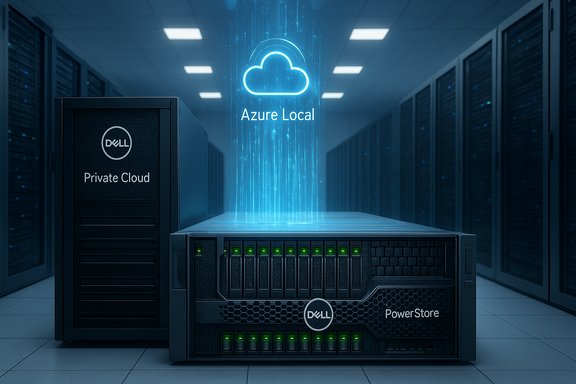
A data center rack with a glowing blue cloud icon and dashboards for Dell Private Cloud and Azure Local.Background​

Azure Local is Microsoft’s on‑premises Azure packaging that extends Azure management, selected platform services and Azure Arc governance to validated hardware running in customer data centers or edge locations. It’s Microsoft’s answer to enterprises that need cloud consistency but require data residency, high performance, or disconnected operation. Azure Local has been marketed as a validated software stack that runs on dozens of partner platforms and can scale from edge appliances to larger private‑cloud footprints. Dell’s announcement builds on prior co‑engineering work with Microsoft (for example the AX System and PowerFlex integrations) and extends the Azure Local validated matrix to include Dell Private Cloud as a full‑stack offering and Dell PowerStore as a validated NVMe storage option. The vendor frames this as a next step in simplifying hybrid cloud operations and enabling independent scaling of compute and storage for mixed legacy and modern workloads.

What Dell announced — the essentials​

  • Dell Private Cloud will be offered as an Azure Local‑validated, single‑vendor private cloud option that packages compute, networking and external storage with end‑to‑end solution‑level support. Dell positions this as the first Azure Local offering that delivers a full stack from one vendor.
  • Dell PowerStore — Dell’s NVMe, all‑flash enterprise array family — is now a validated storage option for Azure Local deployments, bringing always‑on data reduction and enterprise resilience to on‑prem Azure stacks. Dell highlights a marketed 5:1 data reduction ratio (DRR) guarantee for eligible, reducible workloads.
  • Early access for the combined Azure Local + Dell Private Cloud + PowerStore experience is planned to begin in spring 2026; general availability details and regional roll‑outs will depend on validated SKUs and contractual program timelines.
These headline points are consistent across Dell’s corporate briefings and independent industry coverage, which emphasize operational consistency, disaggregated scaling, and lifecycle automation as the core value propositions.

Why this matters: the technical and business case​

Enterprises are increasingly adopting hybrid cloud architectures that mix public cloud services with on‑premises deployments for reasons that include regulatory compliance, latency, cost predictability and data gravity. Three concrete problems this integration addresses:
  • Data locality and sovereignty: Azure Local + Dell Private Cloud lets sensitive data remain on customer premises while management and governance flow through Azure’s control plane. This preserves contractual and compliance controls many regulated organizations demand.
  • Latency and performance for stateful workloads: Co‑locating NVMe PowerStore arrays with local compute reduces I/O latency for transactional databases, near‑data inference and real‑time analytics that struggle in public cloud tiers.
  • Operational consistency and lifecycle simplicity: Azure Local’s managed update bundles, Azure Arc integration and unified portal visibility reduce heterogeneity across distributed estates, while Dell’s single‑vendor support model aims to shorten escalation paths.
For IT leaders, the proposition is straightforward: recreate Azure‑like operations on‑prem with a validated, supported hardware and software stack that combines Microsoft’s cloud control plane and Dell’s infrastructure pedigree.

The technical architecture — what to expect​

Dell Private Cloud as an Azure Local full‑stack​

Dell Private Cloud is designed as a disaggregated private‑cloud architecture built on Dell compute nodes, validated networking and external storage arrays such as PowerStore. Key technical attributes Dell highlights:
  • Automated lifecycle management using the Dell Automation Platform combined with Azure’s update and orchestration tooling, designed to reduce manual steps for provisioning and upgrades.
  • Independent scaling of compute and storage (disaggregation) so organizations can match NVMe performance with capacity economics.
  • Vendor‑backed solution‑level support that bundles hardware and software troubleshooting under one engagement model for faster mean time to repair.
This architecture is meant to let customers run VMs, Kubernetes clusters and selected Azure platform services locally while enjoying unified governance through the Azure portal.

PowerStore in Azure Local: NVMe and data efficiency​

Dell PowerStore brings several claimed capabilities into Azure Local deployments:
  • NVMe‑backed, all‑flash performance for high IOPS and low latency workloads.
  • Always‑on data reduction combining inline compression and deduplication; Dell markets a 5:1 DRR guarantee for reducible datasets under the terms of its program.
  • Enterprise resiliency features: snapshots, replication and integrations designed for mixed legacy and cloud‑native workloads.
Operationally, PowerStore in an Azure Local validated stack enables independent storage expansion without ripping out compute nodes, which is a practical win for capacity planning and cost control.

Where the claims hold up — independent validation and caveats​

Multiple vendor communications and respected trade outlets corroborate the high‑level claims:
  • Dell’s own product blog and corporate press releases outline the feature set and timing for Azure Local support on Dell Private Cloud and PowerStore.
  • Industry coverage from outlets such as ITPro and Blocks & Files has independently reported on the integration, repeating both the 5:1 reduction guarantee and the spring 2026 early access window.
  • Historical context on Azure Local and its validated hardware approach is well documented in Azure/industry coverage and explains why partners like Dell are extending support to full private cloud stacks.
That said, several critical caveats must be stressed:
  • The marketed 5:1 data reduction guarantee is conditional. It applies to eligible, reducible datasets and requires defined measurement windows and operational conditions. Real‑world DRR varies widely by dataset entropy and application pattern; buyers should treat 5:1 as a contractual marketing floor under narrow conditions, not a universal expectation.
  • Marketing language calling Dell Private Cloud the first single‑vendor, full‑stack Azure Local offering is a vendor positioning claim. While Dell positions it that way, procurement teams should still request the validated hardware compatibility matrix and written SLAs that confirm scale and feature parity for their targeted SKUs and regions.
  • Scale and feature parity with public Azure services is not automatic. Exact limits for cluster size, GPU counts, SAN interoperability and Azure platform service availability must be obtained in writing for each deployment. Microsoft’s “hundreds of servers” messaging for Azure Local broadens potential scale but requires explicit compatibility matrices to be meaningful.

Practical benefits for enterprise IT​

  • Faster troubleshooting: bundled support across compute, network and storage reduces multi‑vendor finger‑pointing and can shorten incident resolution windows.
  • Better performance fit: NVMe PowerStore gives latency‑sensitive workloads a higher likelihood of meeting SLA targets when co‑located with local compute.
  • Predictable lifecycle: coordinated monthly update bundles and Azure‑managed telemetry lower the operational cost of keeping firmware, drivers and software aligned across distributed sites.
  • Procurement simplicity: where Marketplace or consumption billing is available, customers can fold hardware or managed services into existing Azure commercial relationships for streamlined purchasing.
These strengths make the Dell‑Microsoft combination particularly attractive to regulated industries (finance, healthcare, government), large enterprises repatriating steady state workloads, and organizations that need predictable performance for AI inference and transactional systems.

Risks, tradeoffs and procurement checklist​

This integration reduces operational complexity, but it introduces new areas where due diligence is essential. The following checklist captures the most important commercial and technical checks:
  • Obtain the validated hardware compatibility matrix for your exact configuration, including supported server SKUs, PowerStore models, networking firmware and SAN compatibility.
  • Secure a written DRR guarantee for the specific PowerStore SKU you plan to deploy, including definition of “reducible” data, measurement methodology and remediation steps if targets aren’t met.
  • Negotiate explicit update cadence, testing windows and rollback processes to ensure coordinated monthly bundles do not disrupt critical applications.
  • Clarify telemetry and log retention policies for Dell‑managed deployments: who can access management telemetry and where is it stored? This matters for compliance and incident response.
  • Model TCO scenarios that include Azure Local host fees (where applicable), Dell hardware and support costs, CloudPools or tiering egress impacts, and the cost of potential data egress to Azure public cloud.
Key operational risks include vendor lock‑in (combining Azure Local with Dell‑managed stacks shifts more control to the vendor), potential mismatch between advertised and real‑world DRR and the need to validate scale and performance under representative workloads rather than relying on lab figures.

Deployment scenarios and edge use cases​

Ideal fits​

  • Regulated enterprises that must keep data on‑site but want the Azure security and governance model.
  • Workloads requiring low latency and high IOPS (transactional databases, real‑time inference pipelines, media production).
  • Large enterprises rebalancing spend and seeking predictable, on‑prem TCO for monotonically scaled workloads.

Edge and disconnected operations​

Azure Local’s design includes disconnected and ruggedized operation in some variants. When combined with PowerStore and Dell’s NativeEdge features, this integration can support remote branch and edge sites that need local processing with infrequent uplinks to central telemetry. However, offline feature parity and recovery procedures must be validated before deployment.

Timing, availability and what to expect next​

Dell says early access begins in spring 2026, with broader availability and regional roll‑outs to follow as validated SKUs and supply chains align. Enterprises considering pilots should:
  • Engage Dell and Microsoft early to obtain the validated matrix and to schedule proof‑of‑concepts (PoCs).
  • Request feature‑level confirmations (e.g., which PowerStore replication and snapshot features are supported in the Azure Local stack).
  • Run PoCs with representative datasets to validate performance, DRR and recovery workflows rather than relying on vendor lab results.
Independent coverage and Dell’s own briefings show that Microsoft and Dell are positioning this as part of a broader hybrid and sovereign‑capable ecosystem (including PowerScale for Azure and PowerProtect backup services), so customers evaluating the Dell Private Cloud + PowerStore option should consider adjacent integrations that may alter architecture or commercial terms.

Final assessment: pragmatic, powerful — but demanding of scrutiny​

Dell Technologies and Microsoft have delivered a pragmatic expansion of Azure Local that aligns with enterprise needs for performance, control and unified operations. The core strengths are clear: single‑vendor support, NVMe performance, disaggregated scaling, and Azure‑native lifecycle management. For organisations that must keep data local while standardizing on Azure governance and tooling, the offering presents a practical on‑ramp. However, the commercial promises have technical and contractual caveats. The marketed 5:1 data reduction ratio is conditional and must be validated per SKU and dataset; scale claims and “first full‑stack” positioning are vendor statements that procurement teams should verify with written compatibility matrices and SLAs. Lifecycle automation brings operational efficiency, but it also shifts update control into vendor coordination — enterprises must insist on test windows, rollback policies and clear exit mechanics.
In short: this integration is an important engineering and go‑to‑market step for hybrid cloud. It offers genuine value for the right workloads and customers, but it requires standard enterprise discipline: PoCs with real datasets, explicit contractual protections, and cautious TCO modeling. When those boxes are checked, Dell Private Cloud plus PowerStore under Azure Local will be a compelling option for organizations balancing performance, sovereignty and cloud‑consistency across complex environments.
Acknowledging the broader ecosystem: the Dell‑Microsoft expansion sits alongside other hybrid cloud evolutions — managed PowerScale in Azure, PowerProtect backup services and vendor‑specific Azure Local appliances — and will influence procurement strategies for enterprises that demand high performance and local control without losing the centralized governance of Azure. The pragmatic path forward for CIOs is clear: treat the offering as an accelerant for hybrid strategies, but require written technical matrices, test validations and iron‑clad commercial protections before production adoption.

Source: techbuzzireland.com Dell Technologies and Microsoft redefine Hybrid Cloud with Azure local integration
 

Dell and Microsoft’s new integration — bringing Microsoft Azure Local to Dell Private Cloud and Dell PowerStore — reframes hybrid cloud as an operational model rather than a binary choice, promising an Azure‑managed control plane on validated Dell hardware with NVMe performance, automated lifecycle management, and single‑vendor solution support.

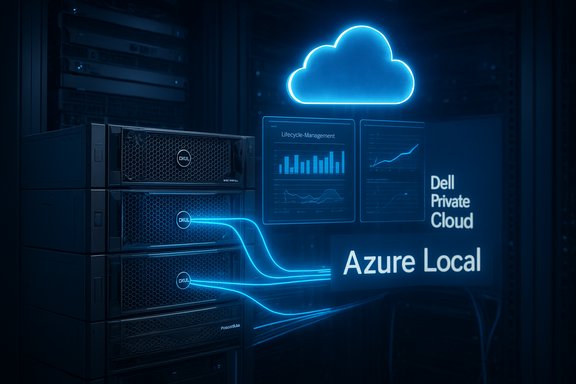
Dell Private Cloud and PowerStore servers in a data center, connected to Azure Local.Background​

Azure Local is Microsoft’s on‑premises variant of Azure designed to extend Azure governance, lifecycle tooling, and selected platform services to validated customer‑owned hardware through Azure Arc and the Azure portal. It aims to provide cloud‑consistent management for workloads that must remain local for latency, sovereignty, or availability reasons. Microsoft documents Azure Local as a distributed infrastructure solution that supports VMs, Kubernetes (AKS), and many Azure services while using Azure Arc as the unifying control plane. Dell’s announcement folds its Dell Private Cloud and Dell PowerStore families into Microsoft’s Azure Local validation and support matrix, positioning Dell Private Cloud as a single‑vendor, full‑stack Azure Local offering (compute, networking, external storage) and PowerStore as the NVMe all‑flash storage option for these validated deployments. Dell expects early access to the combined offering to begin in spring 2026.

Why this matters now​

The enterprise IT landscape has consolidated around hybrid and multicloud operating models. Organizations routinely mix public cloud, private infrastructure, and edge sites to balance data gravity, latency, compliance, and cost. Azure Local is Microsoft’s answer to the need for operational parity between public Azure and on‑prem infrastructure — and Dell’s validation of full private cloud and flagship NVMe storage with Azure Local removes friction for customers who want Azure‑style governance without moving data offsite. Independent industry coverage has treated the announcement as a pragmatic operational step rather than a pure marketing exercise. Key strategic drivers that make this integration timely:
  • Data sovereignty and regulatory requirements that mandate local storage of certain datasets.
  • Latency and throughput demands for stateful workloads (databases, near‑data inference, media and EDA pipelines) that benefit from NVMe‑backed local storage.
  • Operational complexity from multi‑vendor stacks and fragmented lifecycle processes; Azure Local’s centralized control plane reduces heterogeneity.

What Dell Private Cloud + Azure Local actually provides​

A single‑vendor, full‑stack validated option​

Dell positions Dell Private Cloud as the first Azure Local full‑stack offering that bundles compute, networking and external storage under one vendor with solution‑level support and integrated lifecycle automation. The value proposition is procurement and escalation simplification: one vendor to call for hardware, validated software stacks, firmware, and support coordination. This packaging aims to cut friction in provisioning and incident response for large, heterogeneous estates.

Disaggregated architecture and independent scaling​

Dell Private Cloud is presented as a disaggregated architecture that allows compute nodes and storage arrays (like PowerStore) to scale independently. This matters in practice: NVMe performance and IOPS needs frequently diverge from raw capacity economics, so disaggregation can yield better price/performance ratios and allow targeted upgrades. Dell’s automation tooling aims to streamline provisioning and lifecycle tasks.

Azure Local control plane, Azure Arc integration, and lifecycle automation​

Azure Local remains Microsoft’s control plane for day‑to‑day visibility, policy enforcement, and update bundles — delivered via Azure Portal, Azure Update Manager, and Azure Arc telemetry. Dell’s automation platform is intended to coordinate hardware/firmware updates to align with Azure update cadences, reducing mismatched patch-levels that historically cause outages. Administrators should expect the Azure portal to represent on‑prem resources alongside public Azure subscriptions.

PowerStore: NVMe performance with data efficiency​

Dell PowerStore is Dell’s NVMe, all‑flash array family. In the Azure Local context it is validated as the primary external storage option, offering:
  • NVMe low latency and high IOPS for transactional and inference workloads.
  • Always‑on data reduction (inline compression and deduplication) with capacity accounting and visibility introduced in PowerStoreOS 4.x.
  • A marketed 5:1 Data Reduction Ratio (DRR) guarantee for eligible, reducible datasets under Dell’s program terms.
Important practical note: the 5:1 DRR is a contractual guarantee that applies only to reducible data profiles under defined operational conditions — it is not a universal expectation for all workloads. Dell’s support documentation and guarantee terms explicitly define eligibility criteria and measurement windows.

Technical implications — an operator’s checklist​

1. Validate the Azure Local BOM and compatibility matrix​

Azure Local runs on validated hardware. Enterprises must confirm which Dell SKUs, node counts, network fabrics, and PowerStore models are validated for their target scale and Azure Local release. Don’t assume the marketing “full‑stack” claim automatically covers every SKU or regional variant. Obtain the validated hardware matrix and offered cluster size limits in writing.

2. Confirm feature parity and supported Azure services​

Azure Local supports a curated set of Azure platform services locally. Teams must verify which services (AKS, specific storage providers, VM feature sets) are available in their Azure Local validated release and whether any features remain cloud‑only. Microsoft’s Learn documentation and Azure Local release notes list supported features and known limitations.

3. Test data reduction expectations with representative datasets​

Data reduction is extremely workload dependent. Run proof‑of‑concepts with production‑like datasets and capture DRR under normal operational patterns. Insist on written DRR measurement methods, sample windows, and remediation steps in the SLA if you plan capacity or TCO assumptions on the 5:1 figure.

4. Define update, rollback, and maintenance SLAs​

Azure Local’s lifecycle model uses coordinated update bundles; however, the cadence, forcefulness, and rollback policies must be contractual. High‑assurance environments (air‑gapped, regulated systems) should secure explicit maintenance windows, allowed delays, and rollback/runbook guarantees.

5. Map exit and portability strategies​

Single‑vendor packaging and an Azure‑managed control plane create technical and contractual coupling. Require documented export formats, snapshot/backup handover runbooks, and transition support (data egress assistance, knowledge transfers) so workloads can be repatriated or moved to alternate platforms in the future.

Strengths and practical benefits​

  • Operational consistency across cloud and on‑prem: Azure Local with Azure Arc provides a single governance surface for policies, monitoring, and telemetry — reducing tool fragmentation and staff training costs.
  • Procurement and support simplification: A single vendor SKU and solution‑level support can accelerate procurement cycles and shorten incident escalation loops. For enterprises with complex multi‑vendor blame games, this is materially valuable.
  • Performance fit for stateful, latency‑sensitive workloads: NVMe PowerStore next to local compute reduces application tail latency compared to remote public cloud storage tiers.
  • Independent scaling (compute vs storage): Disaggregation helps align economics and capacity planning with workload requirements, avoiding over‑provisioned controller resources.
  • Managed and Dell‑operated options: Dell offers both customer‑managed and Dell‑managed variants for certain services (e.g., PowerScale for Azure), letting organizations choose operational control levels.

Risks, caveats, and realistic expectations​

  • Marketing language vs contractual reality
    Vendors naturally want to position firsts and unique advantages. Dell’s claim of being the “first Azure Local full‑stack offering delivered end‑to‑end by one vendor” is a positioning statement; procurement teams must validate scale limits, SKUs, and exact support boundaries in writing before committing. Treat marketing as a conversation starter, not final truth.
  • Data Reduction Ratio variability
    The advertised 5:1 DRR guarantee has strict eligibility and operational criteria. Many real datasets (host‑compressed, encrypted, media files) are inherently unreducible and will never approach that figure. Use PoCs and contract clauses rather than marketing numbers for capacity planning.
  • Vendor lock‑in and portability risk
    Single‑vendor full‑stack solutions improve operational simplicity but increase coupling. Ensure export tools, snapshot formats, and handover runbooks are included in contracts to preserve mobility and to avoid costly migrations later.
  • Update cadence and operational autonomy
    Azure Local applies coordinated update bundles. For mission‑critical or air‑gapped systems, the extent to which you can delay or stage updates must be spelled out. Uncontrolled auto‑updates can be disruptive; controlled update windows and rollback capabilities are non‑negotiable for high‑availability services.
  • Feature parity with public Azure is not automatic
    Azure Local provides parity for many management features but not all platform services behave identically on‑prem. Confirm GPU counts, cluster sizing, AKS feature parity, and any performance or scale limits for Azure services you depend on.

Procurement and deployment — recommended sequence​

  • Gather requirements: catalog latency, sovereignty, scale, and compliance constraints.
  • Identify candidate SKUs: request Dell’s validated BOM and the Azure Local compatibility matrix for your region.
  • Run PoCs: replicate production dataset shapes to validate DRR, IOPS, and latency.
  • Define SLAs: include update windows, rollback policies, DRR measurement windows, and transition support.
  • Pilot in a non‑critical environment: exercise lifecycle updates, failover, and support escalation paths.
  • Negotiate exit/portability clauses: ensure you can export snapshots and metadata in open formats.
  • Scale progressively: move workloads in phases and monitor operational telemetry for at least one full update cycle.

Competitive landscape and partner context​

Microsoft’s Azure Local is a partner‑centric approach — other OEMs are also validating hardware and offering Azure Local‑premised solutions. HPE, for example, advertises Premier Azure Local solutions on ProLiant hardware with NVIDIA GPU support for edge and AI workloads. The presence of multiple validated partners means buyers can compare design tradeoffs — Dell’s differentiation is a single‑vendor full‑stack procurement model plus PowerStore NVMe economics. Evaluate comparative TCO, support models, and regional availability before locking with a single OEM.

Security, compliance and resilience considerations​

  • Azure Local inherits many Azure security controls (Azure Policy, Microsoft Defender, and Azure Monitor), but the shared responsibility model still applies: customers retain hardware custody and must secure local networks, firmware, and physical access. Confirm SOC/ISO reports, pentest results, and supply‑chain attestations where needed.
  • For cyber resilience, integrate PowerProtect or equivalent backup/immutable snapshots into recovery plans. Managed backup options (Dell APEX Protection Services) can reduce operational burden but shift control and must be scrutinized for retention, immutability, and egress policies.
  • For regulated workloads, ensure that Azure Local licensing and billing models (per physical core or consumption) match procurement rules for in‑country billing and that contracts clarify data residency paths. Microsoft’s Azure Local pricing model and partner billing approach are explicit about per‑core and consumption components.

Cost, licensing and commercial notes​

Azure Local is sold as Azure software that runs on customer hardware and generally bills per physical core plus any optional consumption services. The presence of validated hardware from Dell enables streamlined procurement via Azure marketplace or partner commercial channels in many geographies, but exact contracting routes, consumption tiers, and marketplace availability vary by region and partner program. Ask for a detailed TCO comparison across likely lifetime scenarios (3–5 years) that include hardware refresh paths, support hours, and DRR assumptions for capacity.

Practical verdict for IT leaders​

Dell’s integration of Azure Local with Dell Private Cloud and PowerStore is a pragmatic answer to the operational pains enterprises face when managing hybrid estates. It simplifies procurement and support escalation, provides a clear upgrade and lifecycle model through Azure tooling, and fits workloads that need NVMe performance and data locality. However, the real value depends on careful verification: validate the exact SKUs and scale limits, test DRR and performance with representative data, secure clear SLAs around updates and rollback procedures, and insist on portability and exit terms.
This is an operational play, not a technical panacea — it lowers friction for organizations willing to accept a tighter vendor relationship in exchange for simpler lifecycle management and predictable performance. For organizations that prioritize absolute vendor independence, the trade‑offs must be weighed carefully.

Final recommendations — five concrete steps before you sign​

  • Request Dell’s validated hardware compatibility matrix for Azure Local and get it in writing.
  • Run a representative PoC for DRR and NVMe IOPS using your production dataset shapes; require acceptance criteria.
  • Negotiate update cadence, rollback windows, and emergency support SLAs with explicit penalties.
  • Secure a contractual portability plan: data export formats, snapshot handover runbooks, and transitional support hours.
  • Compare alternate partner options (HPE and other Azure Local OEMs) to confirm the single‑vendor benefit materially outweighs the lock‑in cost for your use case.

Dell and Microsoft’s collaboration to place Azure Local on Dell Private Cloud and PowerStore is a significant step toward treating hybrid cloud as a unified operational model rather than a set of disconnected silos. The offering neatly answers long‑standing enterprise problems — lifecycle complexity, storage‑compute mismatch, and data sovereignty — but it also demands rigorous procurement discipline, realistic performance testing, and contractual safeguards to turn vendor promises into reliable production outcomes.

Source: Irish Tech News Hybrid Cloud now has Azure local integration
 

Back
Top