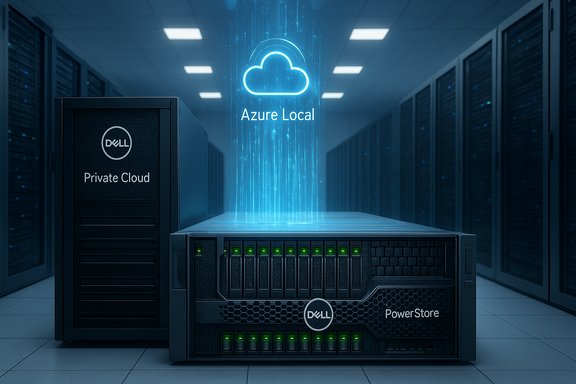
Dell Technologies’ latest move folds Microsoft’s Azure Local into two of its flagship on‑prem products — Dell Private Cloud and Dell PowerStore — creating a vendor‑backed, Azure‑managed path for enterprises that want cloud‑style operations with on‑site control and NVMe performance. This integration promises a single‑vendor, full‑stack option that bundles compute, networking and external storage under coordinated lifecycle management and support, with early access slated for spring 2026.
Azure Local is Microsoft’s on‑premises Azure packaging that extends Azure management, selected platform services and Azure Arc governance to validated hardware running in customer data centers or edge locations. It’s Microsoft’s answer to enterprises that need cloud consistency but require data residency, high performance, or disconnected operation. Azure Local has been marketed as a validated software stack that runs on dozens of partner platforms and can scale from edge appliances to larger private‑cloud footprints. Dell’s announcement builds on prior co‑engineering work with Microsoft (for example the AX System and PowerFlex integrations) and extends the Azure Local validated matrix to include Dell Private Cloud as a full‑stack offering and Dell PowerStore as a validated NVMe storage option. The vendor frames this as a next step in simplifying hybrid cloud operations and enabling independent scaling of compute and storage for mixed legacy and modern workloads.
In short: this integration is an important engineering and go‑to‑market step for hybrid cloud. It offers genuine value for the right workloads and customers, but it requires standard enterprise discipline: PoCs with real datasets, explicit contractual protections, and cautious TCO modeling. When those boxes are checked, Dell Private Cloud plus PowerStore under Azure Local will be a compelling option for organizations balancing performance, sovereignty and cloud‑consistency across complex environments.
Acknowledging the broader ecosystem: the Dell‑Microsoft expansion sits alongside other hybrid cloud evolutions — managed PowerScale in Azure, PowerProtect backup services and vendor‑specific Azure Local appliances — and will influence procurement strategies for enterprises that demand high performance and local control without losing the centralized governance of Azure. The pragmatic path forward for CIOs is clear: treat the offering as an accelerant for hybrid strategies, but require written technical matrices, test validations and iron‑clad commercial protections before production adoption.
Source: techbuzzireland.com Dell Technologies and Microsoft redefine Hybrid Cloud with Azure local integration
 Background
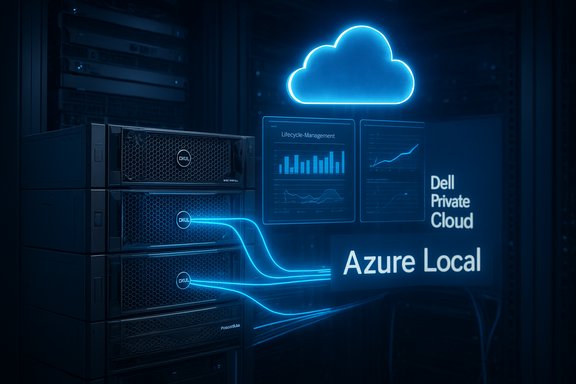
Azure Local is Microsoft’s on‑premises Azure packaging that extends Azure management, selected platform services and Azure Arc governance to validated hardware running in customer data centers or edge locations. It’s Microsoft’s answer to enterprises that need cloud consistency but require data residency, high performance, or disconnected operation. Azure Local has been marketed as a validated software stack that runs on dozens of partner platforms and can scale from edge appliances to larger private‑cloud footprints. Dell’s announcement builds on prior co‑engineering work with Microsoft (for example the AX System and PowerFlex integrations) and extends the Azure Local validated matrix to include Dell Private Cloud as a full‑stack offering and Dell PowerStore as a validated NVMe storage option. The vendor frames this as a next step in simplifying hybrid cloud operations and enabling independent scaling of compute and storage for mixed legacy and modern workloads. What Dell announced — the essentials
- Dell Private Cloud will be offered as an Azure Local‑validated, single‑vendor private cloud option that packages compute, networking and external storage with end‑to‑end solution‑level support. Dell positions this as the first Azure Local offering that delivers a full stack from one vendor.
- Dell PowerStore — Dell’s NVMe, all‑flash enterprise array family — is now a validated storage option for Azure Local deployments, bringing always‑on data reduction and enterprise resilience to on‑prem Azure stacks. Dell highlights a marketed 5:1 data reduction ratio (DRR) guarantee for eligible, reducible workloads.
- Early access for the combined Azure Local + Dell Private Cloud + PowerStore experience is planned to begin in spring 2026; general availability details and regional roll‑outs will depend on validated SKUs and contractual program timelines.
Why this matters: the technical and business case
Enterprises are increasingly adopting hybrid cloud architectures that mix public cloud services with on‑premises deployments for reasons that include regulatory compliance, latency, cost predictability and data gravity. Three concrete problems this integration addresses:- Data locality and sovereignty: Azure Local + Dell Private Cloud lets sensitive data remain on customer premises while management and governance flow through Azure’s control plane. This preserves contractual and compliance controls many regulated organizations demand.
- Latency and performance for stateful workloads: Co‑locating NVMe PowerStore arrays with local compute reduces I/O latency for transactional databases, near‑data inference and real‑time analytics that struggle in public cloud tiers.
- Operational consistency and lifecycle simplicity: Azure Local’s managed update bundles, Azure Arc integration and unified portal visibility reduce heterogeneity across distributed estates, while Dell’s single‑vendor support model aims to shorten escalation paths.
The technical architecture — what to expect
Dell Private Cloud as an Azure Local full‑stack
Dell Private Cloud is designed as a disaggregated private‑cloud architecture built on Dell compute nodes, validated networking and external storage arrays such as PowerStore. Key technical attributes Dell highlights:- Automated lifecycle management using the Dell Automation Platform combined with Azure’s update and orchestration tooling, designed to reduce manual steps for provisioning and upgrades.
- Independent scaling of compute and storage (disaggregation) so organizations can match NVMe performance with capacity economics.
- Vendor‑backed solution‑level support that bundles hardware and software troubleshooting under one engagement model for faster mean time to repair.
PowerStore in Azure Local: NVMe and data efficiency
Dell PowerStore brings several claimed capabilities into Azure Local deployments:- NVMe‑backed, all‑flash performance for high IOPS and low latency workloads.
- Always‑on data reduction combining inline compression and deduplication; Dell markets a 5:1 DRR guarantee for reducible datasets under the terms of its program.
- Enterprise resiliency features: snapshots, replication and integrations designed for mixed legacy and cloud‑native workloads.
Where the claims hold up — independent validation and caveats
Multiple vendor communications and respected trade outlets corroborate the high‑level claims:- Dell’s own product blog and corporate press releases outline the feature set and timing for Azure Local support on Dell Private Cloud and PowerStore.
- Industry coverage from outlets such as ITPro and Blocks & Files has independently reported on the integration, repeating both the 5:1 reduction guarantee and the spring 2026 early access window.
- Historical context on Azure Local and its validated hardware approach is well documented in Azure/industry coverage and explains why partners like Dell are extending support to full private cloud stacks.
- The marketed 5:1 data reduction guarantee is conditional. It applies to eligible, reducible datasets and requires defined measurement windows and operational conditions. Real‑world DRR varies widely by dataset entropy and application pattern; buyers should treat 5:1 as a contractual marketing floor under narrow conditions, not a universal expectation.
- Marketing language calling Dell Private Cloud the first single‑vendor, full‑stack Azure Local offering is a vendor positioning claim. While Dell positions it that way, procurement teams should still request the validated hardware compatibility matrix and written SLAs that confirm scale and feature parity for their targeted SKUs and regions.
- Scale and feature parity with public Azure services is not automatic. Exact limits for cluster size, GPU counts, SAN interoperability and Azure platform service availability must be obtained in writing for each deployment. Microsoft’s “hundreds of servers” messaging for Azure Local broadens potential scale but requires explicit compatibility matrices to be meaningful.
Practical benefits for enterprise IT
- Faster troubleshooting: bundled support across compute, network and storage reduces multi‑vendor finger‑pointing and can shorten incident resolution windows.
- Better performance fit: NVMe PowerStore gives latency‑sensitive workloads a higher likelihood of meeting SLA targets when co‑located with local compute.
- Predictable lifecycle: coordinated monthly update bundles and Azure‑managed telemetry lower the operational cost of keeping firmware, drivers and software aligned across distributed sites.
- Procurement simplicity: where Marketplace or consumption billing is available, customers can fold hardware or managed services into existing Azure commercial relationships for streamlined purchasing.
Risks, tradeoffs and procurement checklist
This integration reduces operational complexity, but it introduces new areas where due diligence is essential. The following checklist captures the most important commercial and technical checks:- Obtain the validated hardware compatibility matrix for your exact configuration, including supported server SKUs, PowerStore models, networking firmware and SAN compatibility.
- Secure a written DRR guarantee for the specific PowerStore SKU you plan to deploy, including definition of “reducible” data, measurement methodology and remediation steps if targets aren’t met.
- Negotiate explicit update cadence, testing windows and rollback processes to ensure coordinated monthly bundles do not disrupt critical applications.
- Clarify telemetry and log retention policies for Dell‑managed deployments: who can access management telemetry and where is it stored? This matters for compliance and incident response.
- Model TCO scenarios that include Azure Local host fees (where applicable), Dell hardware and support costs, CloudPools or tiering egress impacts, and the cost of potential data egress to Azure public cloud.
Deployment scenarios and edge use cases
Ideal fits
- Regulated enterprises that must keep data on‑site but want the Azure security and governance model.
- Workloads requiring low latency and high IOPS (transactional databases, real‑time inference pipelines, media production).
- Large enterprises rebalancing spend and seeking predictable, on‑prem TCO for monotonically scaled workloads.
Edge and disconnected operations
Azure Local’s design includes disconnected and ruggedized operation in some variants. When combined with PowerStore and Dell’s NativeEdge features, this integration can support remote branch and edge sites that need local processing with infrequent uplinks to central telemetry. However, offline feature parity and recovery procedures must be validated before deployment.Timing, availability and what to expect next
Dell says early access begins in spring 2026, with broader availability and regional roll‑outs to follow as validated SKUs and supply chains align. Enterprises considering pilots should:- Engage Dell and Microsoft early to obtain the validated matrix and to schedule proof‑of‑concepts (PoCs).
- Request feature‑level confirmations (e.g., which PowerStore replication and snapshot features are supported in the Azure Local stack).
- Run PoCs with representative datasets to validate performance, DRR and recovery workflows rather than relying on vendor lab results.
Final assessment: pragmatic, powerful — but demanding of scrutiny
Dell Technologies and Microsoft have delivered a pragmatic expansion of Azure Local that aligns with enterprise needs for performance, control and unified operations. The core strengths are clear: single‑vendor support, NVMe performance, disaggregated scaling, and Azure‑native lifecycle management. For organisations that must keep data local while standardizing on Azure governance and tooling, the offering presents a practical on‑ramp. However, the commercial promises have technical and contractual caveats. The marketed 5:1 data reduction ratio is conditional and must be validated per SKU and dataset; scale claims and “first full‑stack” positioning are vendor statements that procurement teams should verify with written compatibility matrices and SLAs. Lifecycle automation brings operational efficiency, but it also shifts update control into vendor coordination — enterprises must insist on test windows, rollback policies and clear exit mechanics.In short: this integration is an important engineering and go‑to‑market step for hybrid cloud. It offers genuine value for the right workloads and customers, but it requires standard enterprise discipline: PoCs with real datasets, explicit contractual protections, and cautious TCO modeling. When those boxes are checked, Dell Private Cloud plus PowerStore under Azure Local will be a compelling option for organizations balancing performance, sovereignty and cloud‑consistency across complex environments.
Acknowledging the broader ecosystem: the Dell‑Microsoft expansion sits alongside other hybrid cloud evolutions — managed PowerScale in Azure, PowerProtect backup services and vendor‑specific Azure Local appliances — and will influence procurement strategies for enterprises that demand high performance and local control without losing the centralized governance of Azure. The pragmatic path forward for CIOs is clear: treat the offering as an accelerant for hybrid strategies, but require written technical matrices, test validations and iron‑clad commercial protections before production adoption.
Source: techbuzzireland.com Dell Technologies and Microsoft redefine Hybrid Cloud with Azure local integration