

Capita’s deployment of Microsoft Copilot to triage and summarise incoming Civil Service Pension Scheme (CSPS) cases is the most visible sign yet of how generative AI is being rushed into mission‑critical public services — and it arrives against the backdrop of a catastrophic handover that left tens of thousands of members waiting for money they depend on. What Capita told MPs — that a Copilot agent has been scanning “Contact Us” forms since the go‑live on 1 December 2025 and is being used to read attachments, score priority, and produce case summaries for human caseworkers — crystallises both the promise and the peril of using large language models to accelerate overstretched operations in the public sector.
The Civil Service Pension Scheme administration transferred to Capita on 1 December 2025. At takeover Capita reported inheriting a far larger work‑in‑progress load than anticipated: roughly 86,000 outstanding cases, plus about 16,000 unread emails and many millions of corrupted or mismatched data lines. Many members suffered delayed lump sums, missed first pension payments and other serious hardships; parliamentary evidence showed around 12,000 members were due payments at the moment of transition but had not been set up for payout, and Capita itself reported approximately 8,500 recently retired members were waiting for their first monthly pension payment in the weeks that followed.
Within that context Capita told the Public Accounts Committee that it had been using Microsoft Copilot from day one to help with intake, triage and summarisation. Capita’s broader corporate reporting and investor materials already signalled heavy internal use of Copilot across the group: the company disclosed deploying dozens of Copilot agents across functions and testing a “MyPensions Buddy” agent in its pensions business well before the CSPS transition. The Cabinet Office and Capita issued joint statements acknowledging service failures, apologising for hardship caused, and describing an urgent recovery plan that prioritises bereavements, ill‑health retirements and hardship cases while deploying surge staff and interim support for those affected.
This article analyses what Capita’s Copilot deployment actually means in operational terms, examines the technical and governance risks, assesses the public‑policy implications of outsourcing mission‑critical benefits administration to an AI‑assisted third party, and sets out pragmatic mitigations that must be in place if AI is to be a stabiliser rather than an amplifier of administrative failure.
What the CSPS episode shows is that AI must be introduced into public services with meticulous attention to data governance, independent oversight, human‑centred safeguards, and clear accountability. The organisation that deploys Copilot must be able to prove, to members and to regulators, that AI outputs are reliable, auditable and reversible, and that no person’s welfare depends solely on a machine’s judgement.
If Capita and the Cabinet Office can combine surge human capacity with rigorous AI governance, independent verification and transparent KPIs, Copilot could help reduce harm and speed recovery. If those governance conditions are not met, however, the technology risks becoming the latest layer that hides — rather than fixes — the structural weaknesses that caused the crisis in the first place.
The immediate imperative remains simple and urgent: get money to people who are owed it, ensure every high‑harm case receives a human check within hours, and publish independent assurances that AI is being used safely, lawfully and transparently while the recovery continues. Only then can the public reasonably be asked to accept that Copilot has a legitimate role in administering the pensions people depend on.
Source: The Register https://www.theregister.com/2026/02/17/capita_microsoft_copilot_pensions/?td=keepreading/
 Background / Overview
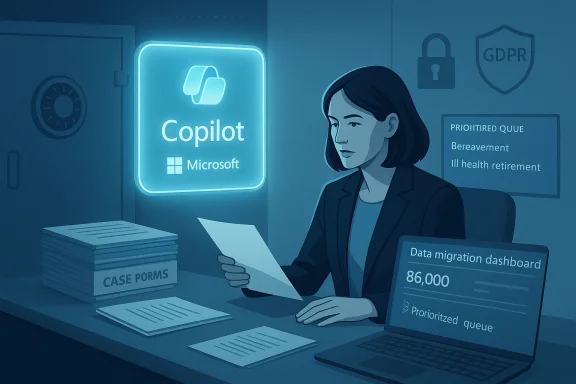
The Civil Service Pension Scheme administration transferred to Capita on 1 December 2025. At takeover Capita reported inheriting a far larger work‑in‑progress load than anticipated: roughly 86,000 outstanding cases, plus about 16,000 unread emails and many millions of corrupted or mismatched data lines. Many members suffered delayed lump sums, missed first pension payments and other serious hardships; parliamentary evidence showed around 12,000 members were due payments at the moment of transition but had not been set up for payout, and Capita itself reported approximately 8,500 recently retired members were waiting for their first monthly pension payment in the weeks that followed.Within that context Capita told the Public Accounts Committee that it had been using Microsoft Copilot from day one to help with intake, triage and summarisation. Capita’s broader corporate reporting and investor materials already signalled heavy internal use of Copilot across the group: the company disclosed deploying dozens of Copilot agents across functions and testing a “MyPensions Buddy” agent in its pensions business well before the CSPS transition. The Cabinet Office and Capita issued joint statements acknowledging service failures, apologising for hardship caused, and describing an urgent recovery plan that prioritises bereavements, ill‑health retirements and hardship cases while deploying surge staff and interim support for those affected.
This article analyses what Capita’s Copilot deployment actually means in operational terms, examines the technical and governance risks, assesses the public‑policy implications of outsourcing mission‑critical benefits administration to an AI‑assisted third party, and sets out pragmatic mitigations that must be in place if AI is to be a stabiliser rather than an amplifier of administrative failure.
What Capita says Copilot is doing — the operational picture
AI as intake, summariser and triage engine
Capita’s public testimony describes three primary uses for Copilot in CSPS operations:- Automatic intake parsing: Copilot reads free‑form text submitted through the portal’s “Contact Us” form so cases are created consistently and without the delays of manual inbox triage.
- Attachment summarisation: Copilot examines attachments and produces short summaries for the caseworker, with the intent of reducing the time human staff spend deciphering long or mixed‑format documents.
- Priority scoring and queuing: Copilot is instructed to flag cases that indicate high potential detriment — bereavement, ill‑health retirement, missed payments — and place them into a prioritised work queue for immediate human review.
How Capita frames the human‑AI workflow
Capita insists Copilot’s outputs are read and acted on by trained caseworkers. Their stated aim is to “instantaneously identify” the worst cases so human effort can be focused where it matters most. The company says it has ramped staff numbers significantly — to roughly 750 people across the operation including surge staff provided by government departments — and that AI is being used to absorb volume where simple processing would otherwise clog phone lines and inboxes.The timeline and scale
Key operational facts that shape the Copilot story:- Transition date: 1 December 2025 (Capita took over administration).
- Reported inherited backlog: ~86,000 outstanding cases.
- Unread emails: ~16,000 transferred at go‑live.
- Cases due payments on transition: ~12,000.
- Members waiting first monthly payment: ~8,500 (reported weeks after transition).
- Copilot deployment: Capita testified Copilot was in use from 1 December to read forms and prioritise.
The technical reality: what Copilot can and cannot do in this setting
What the technology excels at
Generative AI systems like Microsoft Copilot are well‑suited to several front‑office and knowledge‑worker tasks that fit the CSPS problem:- Rapidly extracting salient facts from unstructured text: names, dates, indicators of harm (e.g., “bereavement”, “late pension payment”, “terminal diagnosis”).
- Producing short, consistent summaries of attachments that would otherwise require manual reading.
- Applying simple prioritisation heuristics at scale to reduce human triage effort.
- Enabling a faster acknowledgement and routing mechanism so human capacity is targeted to high‑impact cases.
Crucial technical limitations
However, the technology has practical constraints that matter in a pensions environment:- Hallucination and fabrication risk: generative models can invent plausible but incorrect summaries or facts when faced with ambiguous inputs. An invented detail in a pension case can have material financial consequences.
- Misclassification risk: priority scoring depends on model sensitivity and recall. A false negative — where a case indicating severe harm is not flagged — is a direct risk to an individual’s wellbeing.
- Context and provenance: Copilot can summarise an attachment but cannot (without careful integration) reliably assert provenance, dates of documents, or reconcile multiple conflicting records.
- Data hygiene and mapping: Capita inherited systems with corrupted or mismatched records. AI summarisation does not fix underlying master‑data errors; it can only surface or help identify them.
- Explainability: caseworkers and managers need transparent, auditable reasons for why a case was prioritised; black‑box outputs complicate dispute resolution.
Human impact and operational outcomes
Where AI can speed relief — and where it cannot
AI triage can make a practical difference if used to:- Immediately surface and flag bereavements and ill‑health retirements so payments or lump sums are fast‑tracked.
- Generate consistent case summaries that shorten human review time for routine documentation.
- Provide rapid acknowledgements to members, reducing anxiety and MP casework.
- Reconstruct missing, corrupted or mismatched master‑data needed to calculate entitlements.
- Replace the legal checks, eligibility verification, actuarial computations and secure payroll updates that govern pension payments.
- Substitute for meaningful communication with members where trust has already been eroded.
Evidence from the ground
Public testimony and reporting show mixed results. MPs highlighted heartbreaking examples where cases only progressed after parliamentary intervention. Capita says Copilot‑assisted routing placed many priority cases into the correct queue — and in at least some cited cases, payments followed within days of escalation. But the broader picture is that AI became one part of an emergency response: surge staffing, Cabinet Office oversight, and hardship loan arrangements were also required. AI alone was not, and is not, a cure.Data protection, privacy and security — the high‑stakes dimension
The sensitivity of pension data
Pension administration involves highly sensitive personal data: employment records, dates of birth, National Insurance numbers, bank details, health and bereavement information, and legally binding benefit calculations. These data are protected under UK privacy law and GDPR, and their mishandling can create both individual harm and regulatory exposure.Key data risk vectors introduced by AI usage
- Data flow to third‑party AI processors: using Microsoft Copilot typically involves processing text within Microsoft cloud services. Even where enterprise guarantees exist, organisations must be explicit about sub‑processors, retention, and deletion policies.
- Special category data: medical or terminal‑illness information appears routinely in ill‑health retirement cases. This heightens the need for a full Data Protection Impact Assessment (DPIA) before AI processing and for documented lawful bases for processing sensitive data.
- Access control and privileged data leakage: Copilot agents must not be able to retrieve, regenerate or leak information across cases or to non‑authorised staff.
- Auditability and contestability: members must be able to ask how decisions were reached and to have them reviewed by a human; AI outputs need to be logged and explainable in practice.
What good practice looks like
Responsible deployment should include:- A published and up‑to‑date DPIA and a clear legal basis for processing sensitive pension data through Copilot agents.
- Robust role‑based access controls, encryption in transit and at rest, and strict retention policies for Copilot transcripts and summaries.
- Contractual assurances from Microsoft (and any other cloud or AI provider) on data residency, sub‑processor lists, deletion on demand and bounds on model training with customer data.
- Independent, third‑party audits of the AI‑assisted workflows and of security controls.
Governance, oversight and accountability
Where current arrangements fall short
The CSPS transfer exposed a failure of due diligence and contingency planning: the size and age of the inherited backlog were far larger than Capita anticipated, and crucial elements (unread emails, corrupted data) were not visible until migration. Introducing AI on top of that fragile operational state raises governance questions:- Were data protection and DPIA processes completed and reviewed by independent oversight before deploying Copilot on live member communications?
- Is there an agreed, published escalation and audit trail for AI‑flagged prioritisation decisions so MPs, members and regulators can inspect them?
- How are performance improvements measured and validated? Capita has cited productivity metrics for Copilot interactions in other contexts, but there is no publicly available independent audit of Copilot’s effectiveness in CSPS triage or its error rates.
The oversight architecture that must exist
- Immediate independent audit: an independent technical and privacy audit of the Copilot deployment and the wider data migration situation should be commissioned and made public to restore trust.
- Transparent KPIs: publish clear operational KPIs tied to member outcomes (e.g., average time to pay priority lump sums, error rate on calculated payments) and how Copilot affects them.
- Regulator engagement: active engagement with the Information Commissioner’s Office (ICO) and formal sign‑off where special category data is processed by AI systems.
- Member recourse and redress: clear routes for members to appeal AI‑influenced triage decisions and to request human review.
Risk matrix: immediate and medium‑term threats
- Operational harm: misprioritisation can delay life‑critical payments; hallucinated summaries can lead to incorrect actions.
- Regulatory exposure: failures in lawful processing of special category data or lack of DPIA could provoke ICO enforcement.
- Reputational damage: public trust in both Capita and government administration is fragile; AI mistakes would escalate scrutiny.
- Vendor lock‑in and dependency: heavy reliance on a single hyperscaler for Copilot agents risks operational dependency and commercial leverage.
- Employer and union opposition: trade unions and staff may resist further automation unless safeguards and job guarantees are negotiated.
- False confidence: treating AI as a capacity fix rather than a augmenting tool risks underinvesting in the human and data‑quality work required.
Practical mitigations and a checklist for safer AI in pensions administration
To avoid turning AI into an accelerant of failure, Capita and the Cabinet Office should ensure the following immediate and medium‑term measures are in place:- Conduct and publish an independent DPIA and security audit that specifically evaluates Copilot integration with CSPS data.
- Ensure human‑in‑the‑loop is mandatory for all high‑harm decisions; no AI‑only decision should be able to trigger payment changes or legal confirmations.
- Implement deterministic fallback rules: when Copilot confidence is below a threshold, route the case to a human triage pool rather than trusting the model.
- Maintain full, immutable logs of AI inputs and outputs, and preserve evidence required for audits and member disputes.
- Require Microsoft (or any AI vendor) to provide contractual guarantees on data handling: no retention for model training, strict sub‑processor transparency, and deletion on demand.
- Publish transparent KPIs and publish periodic independent verification of productivity claims and error rates.
- Run red‑team exercises and adversarial testing aimed at hallucination, data leakage and misclassification scenarios.
- Strengthen member communications: acknowledge receipt, explain the triage process in plain language, and give clear routes to human review.
- Enshrine an escalation protocol for any case flagged as potential serious detriment that guarantees immediate human contact and welfare checks.
- Maintain surge human capacity until system stability, data integrity and auditability are independently verified — do not reduce staff solely because “AI is working”.
Wider policy questions: outsourcing, resilience and the public interest
The CSPS debacle is not just a case study in AI deployment; it is a test of the wider outsourcing model for core public services. Several policy questions arise:- Should administration of essential, life‑making benefits be outsourced to a private contractor when risks to continuity and resilience are significant?
- If outsourcing remains the model, what minimum contractual and technical requirements must be mandatory for AI usage in public service delivery?
- Are existing procurement, due‑diligence and data‑migration practices sufficiently rigorous to detect “aged” backlogs and corrupted data prior to transition?
How to judge progress: what success looks like
Recovery — and a credible case for AI in CSPS — should be measured by member outcomes, not vendor KPIs. Clear markers of genuine progress include:- Payment restorations for all priority cases completed and verified by independent auditors.
- Measurable reductions in time‑to‑payment for bereavement, ill‑health and hardship cases.
- A downward trend in complaints and parliamentary casework directly attributable to triage failures.
- Transparent publication of AI performance metrics: false negative rate for priority detection, hallucination incidents, and human override frequency.
- A published, independent review of the Copilot deployment and data migration that confirms compliance with data‑protection law.
Conclusion: Copilot is a tool, not a silver bullet
Capita’s use of Microsoft Copilot to triage and summarise Civil Service Pension Scheme cases is an understandable, even necessary, tactical move in the face of an overwhelming backlog. Generative AI can accelerate intake, reduce routine friction and help prioritise the most vulnerable members — but it cannot repair broken master data, restore trust, or substitute for legal and actuarial verification.What the CSPS episode shows is that AI must be introduced into public services with meticulous attention to data governance, independent oversight, human‑centred safeguards, and clear accountability. The organisation that deploys Copilot must be able to prove, to members and to regulators, that AI outputs are reliable, auditable and reversible, and that no person’s welfare depends solely on a machine’s judgement.
If Capita and the Cabinet Office can combine surge human capacity with rigorous AI governance, independent verification and transparent KPIs, Copilot could help reduce harm and speed recovery. If those governance conditions are not met, however, the technology risks becoming the latest layer that hides — rather than fixes — the structural weaknesses that caused the crisis in the first place.
The immediate imperative remains simple and urgent: get money to people who are owed it, ensure every high‑harm case receives a human check within hours, and publish independent assurances that AI is being used safely, lawfully and transparently while the recovery continues. Only then can the public reasonably be asked to accept that Copilot has a legitimate role in administering the pensions people depend on.
Source: The Register https://www.theregister.com/2026/02/17/capita_microsoft_copilot_pensions/?td=keepreading/
