

Capita has turned to Microsoft for urgent technical support after the chaotic launch of the Civil Service Pension Scheme (CSPS) member portal left thousands of users locked out, unable to update critical data and facing a user interface that looked unfinished and untested.
The Cabinet Office awarded a high‑profile CSPS administration contract worth £239 million to Capita in late 2023; the handover to the new supplier began in late 2025 and Capita formally took operational control of the scheme’s administration on 1 December 2025. The contract has been reported with slightly different term lengths in public coverage (seven years in some watchdog coverage, ten years in the vendor announcement), a discrepancy that underlines how summary figures in media and even official briefings can diverge and should be read with caution. The scheme itself is large and operationally complex: parliamentary briefing and NAO material describe the Civil Service Pension Scheme as covering roughly 1.5–1.7 million current and former civil servants, with total future liabilities in the region of £189 billion. That scale—coupled with extensive remediation work inherited from the previous administrator—makes the migration and go‑live exceptionally high risk. Capita’s award and the transition plan were repeatedly scrutinised in 2024 and 2025 by parliamentary and audit bodies. The National Audit Office (NAO) and the Public Accounts Committee (PAC) raised concerns about missed milestones, staff levels, and an elevated backlog of remediation and McCloud‑related work; the Cabinet Office at one point withheld transition payments while transition milestones were reassessed. Those pre‑existing concerns framed both the operational pressure on go‑live and public scrutiny after the portal problems surfaced.
For public administrators and procurement officials, the immediate imperative is sharper contractual controls: enforceable milestones for technical readiness, explicit fallbacks for sensitive data migration, and transparent post‑incident reporting to rebuild member trust. For the scheme’s 1.5–1.7 million members, the most important reassurance will be demonstrable evidence that beneficiary nominations, retirement payments and other critical functions have been validated end‑to‑end—and not simply declared “fixed” in a vendor statement.
Where facts remain unreported—most notably the exact nature of Microsoft’s involvement and the precise internal root causes—those gaps should be explicitly acknowledged by Capita and the Cabinet Office and resolved with timely, verifiable technical summaries. Until then the public must treat vendor and partner reassurances as provisional, and regulators should continue to provide independent oversight of remediation and the phased rollout promised through March 2026.
Source: theregister.com Capita seeks Microsoft help with pension service failure
 Background
The Cabinet Office awarded a high‑profile CSPS administration contract worth £239 million to Capita in late 2023; the handover to the new supplier began in late 2025 and Capita formally took operational control of the scheme’s administration on 1 December 2025. The contract has been reported with slightly different term lengths in public coverage (seven years in some watchdog coverage, ten years in the vendor announcement), a discrepancy that underlines how summary figures in media and even official briefings can diverge and should be read with caution. The scheme itself is large and operationally complex: parliamentary briefing and NAO material describe the Civil Service Pension Scheme as covering roughly 1.5–1.7 million current and former civil servants, with total future liabilities in the region of £189 billion. That scale—coupled with extensive remediation work inherited from the previous administrator—makes the migration and go‑live exceptionally high risk. Capita’s award and the transition plan were repeatedly scrutinised in 2024 and 2025 by parliamentary and audit bodies. The National Audit Office (NAO) and the Public Accounts Committee (PAC) raised concerns about missed milestones, staff levels, and an elevated backlog of remediation and McCloud‑related work; the Cabinet Office at one point withheld transition payments while transition milestones were reassessed. Those pre‑existing concerns framed both the operational pressure on go‑live and public scrutiny after the portal problems surfaced. What happened at go‑live
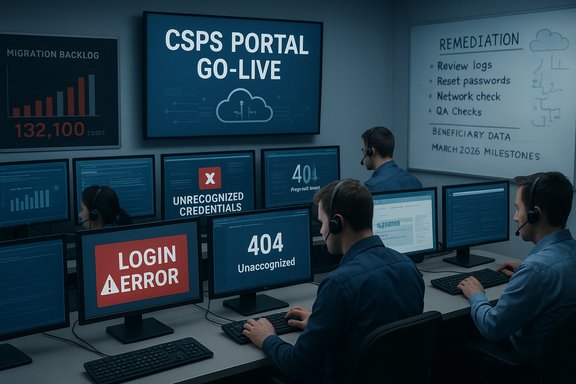
On 1 December 2025 Capita launched a new member portal intended to replace the system maintained by MyCSP. Within hours scheme members reported a catalogue of faults: newly registered accounts that could not log in, password resets or credentials marked “unrecognised,” circular and broken links, visible placeholder or “dummy” text in site headers and sections, and, crucially, the inability for many users to view or update beneficiary (death‑benefit nomination) data. Social media and forum posts amplified the complaints and unions took the issue directly to the scheme and Capita. Capita publicly acknowledged teething problems, described the launch as “the largest ever on‑time transition of a public sector pension scheme in the UK,” and said it had fixed many of the immediate issues while continuing to remediate others over the subsequent days. The company reported tens of thousands of successful registrations within the first few days, and stated that beneficiary data lagged in the migration and would be fully uploaded over the following days. Capita also confirmed that Microsoft “is one of several technology partners on this contract” and that it had engaged support from Microsoft during remediation. The union representing scheme administrators, the Public and Commercial Services Union (PCS), publicly registered complaints from members and said it had raised the matter urgently with scheme administrators. PCS officials reported that Capita was deploying extra staff and seeking Microsoft assistance as part of remedial action. The union also emphasised the stress and practical impact of site errors where members could not confirm essential information such as beneficiaries.Why this mattered: the operational and human impact
Pensions administration is highly time‑sensitive and legally consequential. Incorrect or unavailable beneficiary data, delayed retirement quotes, or lost documentation can affect payments, tax treatments, and survivors’ entitlements. For many scheme members—some retired, some due to retire imminently—failures in the portal translate to real‑world anxiety and financial exposure. The public interest in the continuity and security of the CSPS service is therefore not just theoretical; it has immediate consequences for livelihoods. At launch, Capita said it had inherited a substantial backlog: 132,100 complex remediation cases to complete after go‑live, with the existing work‑in‑progress from the previous operator reported as more than double the agreed figure at contract signature. Rising voluntary exits in the Civil Service were also cited as increasing demand on the system. Those inherited operational pressures materially raise the risk of queueing, slow response times and human error while staff learn new systems and processes.Technical failure modes — what likely went wrong (and what is inference)
Public reporting named several observable symptoms: authentication failures after new account creation, broken links and placeholder text in the UI, and delayed migration of beneficiary records. Those symptoms point to three broad technical and programmatic problem areas:- Data migration and reconciliation: beneficiary nominations and other member records are clearly sensitive to schema mismatches or extraction/transformation errors when moving data between legacy and new platforms. If the “read‑across” of beneficiary fields was incomplete, records would be present in source systems but not visible in the new portal. Capita confirmed beneficiaries were still being read across.
- Identity and authentication gaps: unrecognised passwords immediately after registration suggest problems either with the registration/login flow (for example, a failure to finish account provisioning) or with how credentials were stored or validated across systems (for example, different hashing algorithms, password salt/pepper implementations, or session/cookie configuration mismatches). Without access to internal logs and configuration, this is an inference, but the pattern is consistent with identity migration faults and/or asynchronous provisioning. (This paragraph is an informed technical inference, not a confirmed fact.
- Deployment and quality assurance gaps in the front‑end: visible “dummy” text and broken links indicate that at least parts of the user interface shipped with placeholder content or incomplete integration testing. This suggests engineering and QA pipelines did not capture some UAT (user acceptance testing) failures before live traffic. That can happen in any large‑scale cutover, but the public visibility of such artifacts undermines user confidence.
Governance, procurement and risk: the broader context
This go‑live did not occur in a vacuum. The NAO’s earlier reporting and the PAC hearings flagged several governance risks before the cutover: missed IT milestones, concerns about staffing and automation targets, and the size of the inherited McCloud remediation portfolio. The Cabinet Office at times withheld transition payments while it assessed readiness. Those governance frictions increase the reputational and operational stakes of any go‑live glitch. Contractual public sector handovers of this scale typically include a cutover window during which services may be partially unavailable: advice issued to employers and staff said the existing portal and app would be closed during the migration window that began on 21 November 2025 and continued to the 1 December cutover. That planned blackout increases member contact volumes immediately after go‑live and tightens the recovery timeline for any operational defects. Capita’s stated staffing model at handover indicates an initial go‑live workforce of several hundred full‑time equivalent (FTE) employees—Capita told the PAC it would go live with 332 FTEs and increase to over 500 FTEs in short order, including a planned contact‑centre uplift. Even so, the combination of legacy backlog, high contact volumes at launch, and incomplete digital functionality can overwhelm even a materially scaled contact operation.Security history and heightened scrutiny
Capita’s security track record is an important part of the risk profile for any sensitive public service. The company was the subject of a major cyber incident in March 2023 which, following an ICO investigation, resulted in an October 2025 monetary penalty of £14 million for failings in its protection and incident response. That episode exposed the data of millions and has led regulators and clients to watch Capita’s cybersecurity posture closely. In the CSPS context, any migration of sensitive pension and personal data will draw extra scrutiny because of that history. That prior breach does not by itself explain the portal’s functional problems at go‑live, but it does magnify the reputational liability of any failure and raises legitimate questions about change controls, penetration testing, and operational resilience. The ICO’s findings (which included slow response to internal alerts and insufficient privileged account controls in the earlier breach) are precisely the sorts of governance weaknesses that make complex transitions riskier.What Capita and the Cabinet Office said and promised
Capita’s public responses combined three themes: (1) affirmation that the transition was on schedule and had completed the major cutover; (2) acknowledgment of teething problems that were rapidly being fixed with partners and increased staffing; and (3) a promise that data such as beneficiaries would be uploaded fully in the days following launch, with manual overrides available in the interim. Capita also highlighted the long‑term plan to use automation and AI to improve the service by March (the end of the initial evolution window). The Cabinet Office has kept the position that Capita’s transition would proceed and that the department would continue to assess readiness during the changeover, while signalling that enhanced functionality may be phased in through March 2026. Separately, the PCS union’s recognition agreement with Capita—signed just before the handover—was intended to stabilise the workforce and ease industrial relations after a period of strikes and unrest at the previous contractor.Independent verification and discrepancies to note
There are three areas where public reporting diverges and where readers must be cautious:- Contract length: Capita corporate material and some coverage describe a 10‑year commercial arrangement; other watchdog and trade coverage refers to a seven‑year contract plus an option to extend. This discrepancy likely reflects different ways of framing the commercial terms (e.g., core period vs. potential total term under extension), but it should be resolved by consulting the actual contract schedule or the Cabinet Office contract notice. Until that is publicly posted, treat the headline term with caution.
- Scheme population: reporting alternates between roughly 1.5 million and 1.7 million members. Parliamentary evidence and NAO reporting consistently place the scheme in the 1.5–1.7 million range; the difference may hinge on whether the figure includes very recent joiners, deferred members or all historical members. Both figures are materially accurate as summaries, but precise planning should use the most recent official ledger.
- Nature of Microsoft support: public statements confirm Microsoft is a named technology partner and that Capita sought Microsoft’s help for remediation. They do not disclose which Microsoft products or which Microsoft teams were engaged. Any technical claim attributing the resolution of specific faults to a named Microsoft service is therefore unverified without confirmation from the parties.
Practical implications for members and recommended immediate actions
The portal problems create short‑term friction for members who need to confirm beneficiary nominations, access payslips or request retirement quotes. Based on what is publicly known and the patterns of similar public sector transitions, the following steps are the pragmatic mitigations that members, employers and administrators should prioritise:- Use helplines and secure messaging for urgent actions (retirement notifications, death‑benefit nominations) rather than relying on incomplete web forms. Capita has increased staffing and urged members to use the contact channels for urgent items.
- Confirm beneficiary nominations once the portal shows the migrated data; where the portal is missing entries, insist on a written confirmation from Capita that the pre‑migration nomination will stand until the new system displays the record. Capita stated that migrated updates will supersede previous records once uploaded.
- Keep copies of any pre‑existing correspondence or forms proving nomination or entitlement, and request paper confirmation where necessary. Public sector schemes typically accept paper evidence as a fallback during technical migration windows.
- Monitor communications from the Cabinet Office/CSPS for official guidance and staged re‑enrolment or corrective updates; employers and HR teams should coordinate retirements as usual while documenting any delays caused by portal outages.
What the episode says about public‑sector IT delivery and cloud partnerships
This incident is instructive for how large public services are replatformed in the cloud era. Several lessons—already foreshadowed in the NAO’s pre‑cutover concerns—are now visible in practice:- Complex data migrations need staged, end‑to‑end reconciliation and resilient fallbacks. Even if a new portal is functionally superior, the business logic mapping for beneficiary nominations, legacy identifiers and pension calculations must be exhaustively validated before cutover.
- Partnership transparency matters. Names like Microsoft carry operational reassurance for some audiences, but the mere presence of a large vendor does not absolve the prime contractor of responsibility for testing, integration and incident response. Public statements that a partner “is helping” are useful PR; they do not replace clear, public‑facing technical explanations of root causes where citizens’ finances are concerned.
- Contract governance should embed concrete, measurable milestones for both service continuity and innovation claims (AI/automation). The NAO highlighted that projected savings from automation were not yet tied to measurable milestones; transitions that depend on future AI capabilities must still guarantee baseline levels of human oversight and performance at handover.
- Historical security incidents elevate the need for proactive change control and independent assurance. With a major regulatory fine in Capita’s recent past, independent auditors, the NCSC and the ICO’s expectations for penetration testing and incident response must be central to any transition plan.
Conclusion: risk managed or risk deferred?
Capita’s claim that the lion’s share of issues were “snagging” items fixed within days is plausible and matches the pattern of many large cutovers. The company’s rapid scale‑up of staff and its public commitment to finish data migration reduce the immediate probability of permanent harm for most members. At the same time, the episode confirms the fragility of large outsourced IT transitions when they intersect with legacy backlogs, union unrest and recent cybersecurity failings.For public administrators and procurement officials, the immediate imperative is sharper contractual controls: enforceable milestones for technical readiness, explicit fallbacks for sensitive data migration, and transparent post‑incident reporting to rebuild member trust. For the scheme’s 1.5–1.7 million members, the most important reassurance will be demonstrable evidence that beneficiary nominations, retirement payments and other critical functions have been validated end‑to‑end—and not simply declared “fixed” in a vendor statement.
Where facts remain unreported—most notably the exact nature of Microsoft’s involvement and the precise internal root causes—those gaps should be explicitly acknowledged by Capita and the Cabinet Office and resolved with timely, verifiable technical summaries. Until then the public must treat vendor and partner reassurances as provisional, and regulators should continue to provide independent oversight of remediation and the phased rollout promised through March 2026.
Quick reference: the verified public facts (summary)
- Capita began operating the Civil Service Pension Scheme administration and launched a new portal on 1 December 2025.
- Members reported login failures, broken links, visible placeholder text in the UI, and inability to view or update beneficiary nominations immediately after go‑live.
- Capita acknowledged the issues, confirmed Microsoft as one of several technology partners, and said it sought Microsoft’s support to remediate problems. Capita also stated a significant number of registrations completed successfully in the first days.
- The NAO and PAC had previously raised concerns about transition milestones, staffing and backlogs; payments were at times withheld pending milestone delivery. Capita inherited a large remediation caseload from the prior provider.
- Capita has previously suffered a major cyber incident in March 2023 that resulted in an ICO monetary penalty of £14 million, increasing regulatory and public interest in its security and change‑management practices.
Source: theregister.com Capita seeks Microsoft help with pension service failure
