

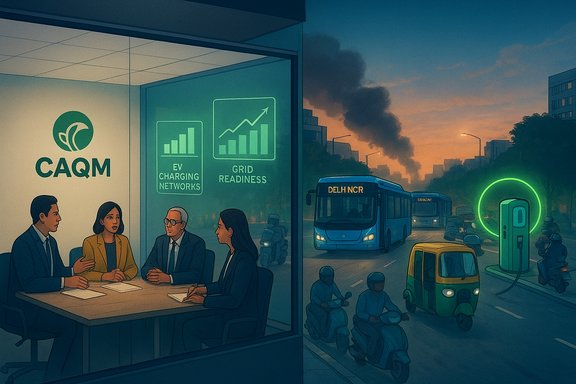
The Commission for Air Quality Management (CAQM) has convened a 15‑member expert committee to draft a multi‑pronged roadmap for cutting vehicular emissions in Delhi‑NCR, a move that spotlights an urgent policy pivot toward stricter vehicle controls, accelerated electric vehicle adoption and targeted incentives to decarbonize urban mobility.
Delhi and the surrounding National Capital Region (NCR) have long been at the center of India’s air‑quality crisis. Multiple source‑apportionment and emissions inventory studies over the past decade place the transport sector among the leading contributors to fine particulate pollution (PM2.5) during winter and high‑pollution episodes, even as the exact share varies by study, season and method. The CAQM’s new expert panel — to be chaired by Professor Ashok Jhunjhunwala (IIT Madras) with former AIIMS director Dr. Randeep Guleria as co‑chair — is explicitly charged with reviewing Bharat Stage (BS) emission norms, electric mobility initiatives and fuel‑efficiency standards across Delhi‑NCR. The first meeting is scheduled for 15 December and the committee has two months to deliver recommendations. Why this matters now: Delhi’s winter pollution continues to trigger escalated responses under the Graded Response Action Plan (GRAP), and CAQM has already used its statutory powers to impose fleet‑level and sectoral measures earlier in the year. The creation of a concentrated technical committee signals a transition from ad‑hoc emergency measures toward an evidence‑led strategy focused on the transport sector’s structural contribution to air quality and public health.
If the panel prioritizes high‑exposure vehicle segments, pairs regulatory phase‑outs with targeted financial support, and produces a robust technical annex for charging and grid integration, its two‑month output could become the blueprint for meaningful, near‑term reductions in roadside pollution across the NCR. Absent that level of operational detail, recommendations risk joining a long list of policy intentions that fall short at the implementation stage. The report due in two months will therefore be the first real test of whether the CAQM’s evidence‑based rhetoric can be converted into measurable air‑quality gains for millions of city dwellers.
Source: The Hindu CAQM panel to recommend measures for reduced vehicular emissions
 Background
Delhi and the surrounding National Capital Region (NCR) have long been at the center of India’s air‑quality crisis. Multiple source‑apportionment and emissions inventory studies over the past decade place the transport sector among the leading contributors to fine particulate pollution (PM2.5) during winter and high‑pollution episodes, even as the exact share varies by study, season and method. The CAQM’s new expert panel — to be chaired by Professor Ashok Jhunjhunwala (IIT Madras) with former AIIMS director Dr. Randeep Guleria as co‑chair — is explicitly charged with reviewing Bharat Stage (BS) emission norms, electric mobility initiatives and fuel‑efficiency standards across Delhi‑NCR. The first meeting is scheduled for 15 December and the committee has two months to deliver recommendations. Why this matters now: Delhi’s winter pollution continues to trigger escalated responses under the Graded Response Action Plan (GRAP), and CAQM has already used its statutory powers to impose fleet‑level and sectoral measures earlier in the year. The creation of a concentrated technical committee signals a transition from ad‑hoc emergency measures toward an evidence‑led strategy focused on the transport sector’s structural contribution to air quality and public health. What the CAQM committee will review
Mandate and scope
The expert committee has a broad, policy‑to‑technology remit:- Policy instruments: Review of BS emission norms and any gaps in current regulation.
- Clean mobility programs: Assessment of electric vehicle (EV) policies, incentives and uptake barriers.
- Fuel efficiency standards: Examination of regulatory levers to raise in‑use fleet efficiency.
- Segment‑wise analysis: Identify contributions and exposure risks by vehicle class (two‑wheelers, autos, cars, buses, heavy goods vehicles).
- Technology and infrastructure readiness: Evaluate charging infrastructure, grid impacts, and enabling systems for EV uptake.
- Cost and incentives: Study the fiscal implications, potential subsidies, and incentive design for accelerated electrification.
Why a segment‑wise approach is important
Research consistently shows that the relative impact of different vehicle categories changes by time of day, locality and season. Studies using atmospheric modelling find on‑road transport contributes anywhere between roughly 10–40% of surface PM2.5 in Delhi, with two‑ and three‑wheelers and heavy‑duty vehicles often disproportionately responsible for on‑road transport contributions. That heterogeneity makes targeted interventions (for example, earlier electrification of buses, incentives for e‑three‑wheelers, and stricter controls on urban diesel fleets) more efficient than blanket measures.Technical and regulatory context
Bharat Stage norms and where they stand
India leapfrogged directly to Bharat Stage VI (BS‑VI) emissions standards for new vehicles nationwide on 1 April 2020, skipping an intermediate BS‑V step. BS‑VI tightened limits for NOx and PM and forced adoption of after‑treatment technologies across light and heavy‑duty categories. That regulatory jump delivered important tailpipe reductions for new vehicles, but it left a large legacy of older vehicles still in use — the very fleet that drives near‑term roadside exposure and chronic health impacts. Any CAQM recommendations on BS norms must therefore balance type‑approval stringency with practical measures for the in‑use fleet.EV policy and incentives: the existing architecture
India’s EV push rests on a patchwork of instruments — the central FAME (Faster Adoption and Manufacturing of Hybrid & Electric Vehicles) programme, state EV policies with purchase and charging incentives, and CAQM’s own region‑level directives (for instance, constraints on commercial fleets). These have produced nascent but uneven EV adoption across segments — buses and two‑/three‑wheelers have seen earlier public programme adoption, while private four‑wheelers and freight remain nascent. The CAQM panel will need to reconcile national incentives with urban‑scale delivery requirements like depot charging, load management, and system interoperability.Critical analysis — strengths of CAQM’s approach
1) Evidence‑first and multi‑disciplinary design
The committee pulls together academics, public‑health clinicians, and automotive research institutions. That composition improves the odds of integrated recommendations that span epidemiology, vehicle technology and policy levers — exactly the multi‑sector approach called for by atmospheric science literature. Such an approach is essential to target interventions where they will deliver the largest health gains per rupee.2) Explicit focus on technological and infrastructure readiness
CAQM’s instructions to examine charging infrastructure, grid impacts and incentive plans acknowledges a perennial gap: policy ambition without last‑mile delivery. By mandating technical readiness assessments, the committee can help ensure recommended timelines are matched to realistic infrastructure roadmaps, avoiding the common pitfall of unattainable targets.3) Short timetable for recommendations
A two‑month deadline encourages rapid, actionable outputs — useful for informing winter‑season containment strategies and fiscal planning. If CAQM produces interim recommendations, they can be operationally valuable even before a full final report is ready.Risks, blind spots and implementation challenges
1) Two months is short for transformational policy design
High‑quality policy design for an EV transition and fleet modernization requires extensive stakeholder consultation, modelling of electricity demand and distribution upgrades, and commercial negotiations with vehicle manufacturers and fleet operators. A compressed timetable risks producing high‑level recommendations without the detailed operational roadmaps required for implementation. Any recommendations delivered under time pressure should therefore be expected to require substantial follow‑through.2) Legacy fleet management is politically and economically fraught
BS‑VI tackled new vehicle emissions, but the in‑use fleet — older petrol, diesel and compressed natural gas vehicles — remains a large source of emissions and exposure. Policies such as accelerated scrappage, purchase subsidies or entry restrictions for older vehicles can reduce exposures quickly but have significant social and political costs, particularly for lower‑income vehicle owners and small logistics operators. Designing equitable, legally robust phase‑out mechanisms will be difficult and will need compensatory measures. Evidence on the distributional impacts of scrappage or retrofit programmes must be central to any recommendations.3) Grid and charging infrastructure constraints
Scaling public and depot charging for buses, taxis and light goods vehicles requires rapid investments in distribution assets, demand‑side management, and standardized payment and roaming systems. Without careful integration with utilities and state electricity regulators, rapid vehicle electrification can create localized grid stress, increased emissions from power generation if not decarbonized, or suboptimal user experiences that stall adoption. CAQM’s review must therefore link EV targets to granular grid readiness assessments.4) Incentive design and fiscal sustainability
Tax breaks and capital subsidies accelerate uptake but are costly. Poorly targeted incentives can disproportionately benefit wealthier private buyers (e.g., higher‑end electric SUVs) without delivering large air‑quality benefits. Effective incentive design requires precise marginal‑abatement cost estimates and careful targeting toward high‑exposure vehicle segments (buses, two‑ and three‑wheelers, last‑mile logistics). The committee’s cost‑implication analysis must be rigorous and transparent; otherwise, recommendations risk being politically attractive but fiscally unsustainable.Policy options the committee is likely to evaluate
The committee’s mandate includes many policy levers. Below are the high‑impact options that analysis and precedent suggest CAQM should weigh.Regulatory measures
- Strict enforcement of BS‑VI in use via periodic in‑use emissions testing and OBD checks.
- Low Emission Zones (LEZs) or differentiated entry regimes for older vehicles in central Delhi.
- Stricter age‑based access rules for diesel fleets and targeted bans on the most polluting vehicles.
Incentives and fiscal instruments
- Time‑bound purchase incentives for public‑service EVs (buses, taxis, three‑wheelers).
- Subsidies or concessional credit for electrifying last‑mile logistics fleets.
- Targeted scrappage vouchers tied to income verification to reduce distributional harm.
Infrastructure and technical standards
- Depot and on‑route charging plans for buses and commercial fleets with utility coordination.
- Minimum charging infrastructure standards for new residential and commercial buildings.
- Interoperability and roaming standards for public charging networks.
Complementary measures
- Prioritize bus electrification and improved public transport to reduce private vehicle dependency.
- Non‑motorized transport and active mobility investments to lower short trips and local exposures.
- Emissions control for heavy‑duty vehicles, including retrofits (DPFs, SCR) where technically feasible.
Practical recommendations for CAQM to increase impact
- Deliver a prioritized shortlist: produce a short list (3–6) of immediately implementable measures that can be enforced within 6–12 months (e.g., LEZs, targeted fleet electrification for buses and city logistics).
- Publish a technical annex: include grid impact modelling, costs per tonne of PM2.5 avoided, and a roadmap for charging infrastructure roll‑out.
- Build equity protections: couple vehicle‑retirement measures with vouchers, low‑interest loans and targeted support for small transport entrepreneurs.
- Mandate monitoring and accountability: set quantifiable, time‑bound milestones (e.g., number of electric buses, depot chargers installed) and require periodic public reporting.
- Create pilot corridors: test electrification and charging solutions on high‑exposure routes (school zones, central business districts) before scaling.
Industry, consumer and fiscal impacts
Automotive manufacturers and suppliers
Manufacturers accelerated BS‑VI compliance in 2020; the next phase will be about cost optimization for electrified drivetrains, localizing battery supply chains and scaling manufacturing capacities. Any fast‑track timelines for EV targets will require clear signals from CAQM to OEMs and component makers on procurement volumes and phase‑in schedules. Capital and supply‑chain bottlenecks (cells, BMS, cooling systems) remain potential pinch points.Operators and logistics firms
Last‑mile logistics and aggregator platforms may be the low‑hanging fruit for electrification because of predictable routes and centralized depots. However, the capital‑intensity of fleet replacement or conversion — and the need for consistent, high‑availability charging — means incentives and financing will be essential. Mandates without financial support risk creating operational strain and price pass‑throughs to consumers.Fiscal considerations
Accelerated scrappage, direct subsidies, and charging‑infrastructure grants will place demands on government budgets. The committee’s cost estimates must be transparent and balanced against the public‑health savings from reduced pollution exposure, avoided hospitalizations and productivity gains. Quantifying these health co‑benefits will strengthen the business case for targeted public investment.Monitoring, verification and legal authority
CAQM derives statutory powers from the Commission for Air Quality Management Act and has exercised emergency and regulatory directives in the NCR. However, many measures (charging infrastructure, electricity tariffs, vehicle registration rules) sit with other ministries and state agencies. Effective implementation will require the CAQM’s recommendations to be translated into coordinated action by the Ministry of Road Transport & Highways, state transport departments, power utilities and municipal agencies. Institutional coordination mechanisms and clear lines of authority will be crucial.What to watch for in the committee’s report
- Concrete timelines: whether the panel sets short‑, medium‑ and long‑term milestones tied to quantifiable emissions reductions.
- Segment targeting: whether the committee prioritizes buses, three‑wheelers and freight — the segments where modelling suggests the biggest near‑term gains.
- Infrastructure roadmaps: whether the report includes realistic charging‑infrastructure deployment plans integrated with grid upgrades.
- Equity measures: explicit compensation or financing strategies for informal or low‑income vehicle owners subject to restrictions.
- Cost‑effectiveness analysis: per‑tonne costs of different interventions, allowing comparison of scrappage, retrofit, electrification and demand‑reduction measures.
Cautionary notes and unverifiable claims
Several items may appear in media summaries or stakeholder statements that are not independently verifiable at the time of reporting. For instance, precise lists of committee membership or internal cost‑estimates that have not been published in CAQM’s official order should be treated as provisional until the committee’s formal documentation appears. The CAQM press release and reputable news outlets confirm the panel’s formation, chairs, general remit and timelines; however, detailed policy options, modelling assumptions and specific cost numbers will only be authoritative if published by the committee or corroborated by technical annexes. Any headline statements about rapid, wholesale electrification timelines should be read alongside the committee’s infrastructure and grid readiness assessments before being treated as firm policy.Conclusion
CAQM’s newly constituted expert committee represents a consequential moment for Delhi‑NCR’s air‑quality strategy. By explicitly linking emissions standards, electric mobility readiness and fiscal incentives under a single multi‑disciplinary body, the commission has the opportunity to deliver a coherent, health‑driven pathway that aligns technical feasibility with regulatory force. The committee’s success will depend on its ability to translate high‑level ambition into operationally specific, time‑bound measures that account for infrastructure realities, equity implications and fiscal constraints.If the panel prioritizes high‑exposure vehicle segments, pairs regulatory phase‑outs with targeted financial support, and produces a robust technical annex for charging and grid integration, its two‑month output could become the blueprint for meaningful, near‑term reductions in roadside pollution across the NCR. Absent that level of operational detail, recommendations risk joining a long list of policy intentions that fall short at the implementation stage. The report due in two months will therefore be the first real test of whether the CAQM’s evidence‑based rhetoric can be converted into measurable air‑quality gains for millions of city dwellers.
Source: The Hindu CAQM panel to recommend measures for reduced vehicular emissions