

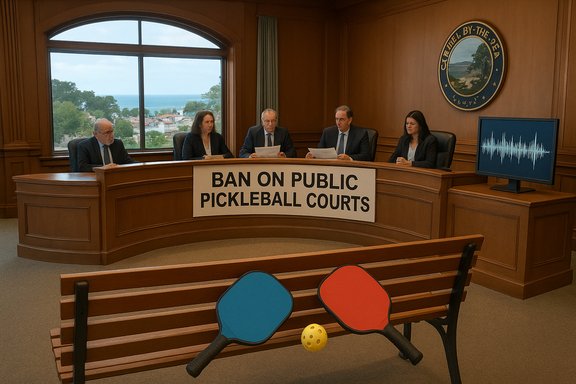
Carmel’s city leaders have moved from a temporary moratorium to instructing staff to draft a permanent ordinance that would bar pickleball play on the municipality’s only public courts, a decision prompted by years of neighborhood complaints about the sport’s distinctive “pop‑pop‑pop” sound and the city’s limited capacity to police compliance.
Pickleball exploded from a backyard pastime to one of the fastest‑growing recreational sports in the United States, prized for its accessibility and relatively low physical barrier to entry. Cities and park systems nationwide have raced to add courts, repurpose tennis lines, and expand programming to meet demand. That rapid growth has produced a counter‑trend: an increasing number of noise and nuisance complaints from residents living near courts, and a wave of municipal attempts to balance public recreation with neighborhood livability. Carmel‑by‑the‑Sea’s case has become shorthand for that conflict. Forest Hill Park houses the village’s only public pickleball courts; after repeated neighbor complaints, the council first imposed restrictions and a temporary pause and, in early November, directed staff to draft a permanent ban for city‑run facilities. The move is notable because, if finalized, it would be among the first explicit citywide bans on public pickleball courts in California.
However, the path chosen carries meaningful downsides. A permanent prohibition on public courts favors residents with private property or resources to travel to other towns, raising equity concerns. It also risks exporting the problem rather than solving it. Moreover, the decision augments the regulatory power of a small city over public recreation in a way that other communities may find troubling — particularly where the population that uses pickleball skews older and more dependent on low‑impact public recreation. Finally, if the ordinance is drafted without objective, measurable standards it could invite legal challenge and community distrust.
In short: Carmel’s policy is defensible from a local governance standpoint but represents a blunt instrument in a policy space where a combination of engineering, staffing and community design often offers more tailored answers.
Source: eBaum's World California City Plans to Permanently Ban Pickleball
 Background
Pickleball exploded from a backyard pastime to one of the fastest‑growing recreational sports in the United States, prized for its accessibility and relatively low physical barrier to entry. Cities and park systems nationwide have raced to add courts, repurpose tennis lines, and expand programming to meet demand. That rapid growth has produced a counter‑trend: an increasing number of noise and nuisance complaints from residents living near courts, and a wave of municipal attempts to balance public recreation with neighborhood livability. Carmel‑by‑the‑Sea’s case has become shorthand for that conflict. Forest Hill Park houses the village’s only public pickleball courts; after repeated neighbor complaints, the council first imposed restrictions and a temporary pause and, in early November, directed staff to draft a permanent ban for city‑run facilities. The move is notable because, if finalized, it would be among the first explicit citywide bans on public pickleball courts in California. What actually happened in Carmel
The immediate actions
City officials began by limiting play: a Forest and Beach Commission resolution and subsequent council action restricted hours and days while staff tested quieter equipment as a mitigation measure. After a short trial period, residents reported noticeable relief, and concerns about enforcement logistics — the city lacks a staffed parks department to ensure compliance — persuaded councilmembers that trial fixes would be difficult to sustain. The council then voted to keep the temporary prohibition in place and instructed the city attorney to draft a permanent ordinance codifying the ban on the city‑run courts.Key claims the city made
- The city’s noise monitoring found play at Forest Hill Park repeatedly exceeded what nearby residents considered acceptable. Staff concluded that informal time limits and voluntary quiet‑ball trials would be difficult to enforce without dedicated personnel.
- Councilmembers framed the issue as one of enforcement capacity and neighborhood quality of life rather than a categorical opposition to the sport itself; private courts and courts in adjacent towns remain available to players.
Why pickleball sounds so different — the acoustics of the game
Understanding the Carmel dispute requires a technical look at why pickleball alarms some neighbors while appearing innocuous to others. The sport’s noise signature is not measured only by how loud it is but by its frequency content, impulsive pattern, and repetition.- Pickleball impacts create short, high‑frequency impulses: the plastic ball striking a solid paddle produces rapid transient sounds that carry farther and are more audible at mid‑range frequencies to which the human ear is especially sensitive. That makes the repeated “pop” more intrusive than an equivalent decibel of lower‑frequency noise.
- Field measurements have been mixed. Community studies — such as an Oakmont Village study cited by local pickleball organizations — recorded average ambient and play levels in the mid‑40s dB from neighboring patios, with peaks in the 60s dB range; other engineered studies for urban rooftop courts have measured LAFmax values higher enough that mitigation (walls, barriers) is recommended. Context — distance to homes, topography, and reflective surfaces — strongly influences perceived intrusion.
The evidence cities use: noise studies and mitigation experiments
Cities confronting pickleball complaints typically commission short, targeted acoustic studies. Those studies commonly measure:- Ambient noise baselines over 24 hours;
- Short bursts (minutes) of continuous play to capture impulsive peaks;
- Predicted sound propagation to the nearest residences; and
- The effectiveness of mitigation options (ball type, paddle type, fencing, vegetative buffers, sound walls).
Strengths of Carmel’s decision (from a policy perspective)
1. Responsive governance and neighbor protection
The council responded to repeated, documented complaints and relied on staff analysis of enforceability. In neighborhoods where residents report chronic disturbance, governments have a duty to consider quality‑of‑life protections; codifying limits can end protracted disputes and clarify expectations for all parties.2. Avoids under‑resourced pilot programs that fail
Carmel’s council expressed skepticism that voluntary rules — time limits, borrowed “quiet” balls — would be complied with or enforced without dedicated staff. Turning a temporary ban into a permanent rule folds that enforcement question into law rather than leaving it to informal compliance that may collapse once players return.3. Protecting residential character in constrained sites
Forest Hill Park sits in a compact, acoustically reflective area; the proximity of courts to homes amplifies the nuisance. In such geometries, building new courts without major investment in mitigation is likely to produce ongoing conflict. The city’s decision recognizes that some outdoor recreation belongs in different, better‑buffered sites.Risks, costs and unintended consequences
A. Equity and public‑health tradeoffs
Pickleball is particularly popular among older adults because it is lower‑impact and highly social. A ban that affects public courts disproportionately affects people who rely on municipal facilities rather than private clubs. Removing free access without a meaningful nearby alternative risks reducing seniors’ exercise options and widening disparities in who benefits from public recreation.B. Precedent and regional spillover
Carmel’s move could ripple across the Monterey Peninsula. Players may simply travel to neighboring towns, concentrating demand (and potential noise) at other facilities and increasing traffic. That relocation dynamic can shift the problem rather than solve it and may create pressure on neighboring jurisdictions.C. Legal challenges and administrative risk
A permanent ban may invite litigation — for example, claims that the ordinance is arbitrary, capricious, or violates equal‑protection norms if selectively enforced. While courts generally give municipalities broad discretion in land‑use and park operations, poorly drafted ordinances that lack objective standards for what is prohibited and why could be vulnerable. The city attorney’s drafting task is therefore a high‑stakes legal exercise.D. Community polarization
The public record shows residents on both sides are deeply invested. Permanently banning play on public courts risks solidifying divisions; residents who play the sport see the court closure as a loss of public amenity, while those who supported the ban see it as a restoration of peace. Entrenching either community without offering alternatives makes longer‑term reconciliation harder.Mitigation options the city considered — and why some were rejected
Carmel’s staff tested and discussed several measures widely proposed elsewhere:- Quiet balls and softer paddles: These change the acoustic signature, sometimes lowering peaks. But they also alter play dynamics and are only effective if everyone uses them; that raises enforcement and replacement logistics issues. Players often dislike the new feel, which reduces voluntary compliance.
- Strict scheduling and reservation systems: Limiting play to certain hours reduces nighttime and early‑morning disturbance but requires monitoring and signage to be effective. In cities with full park staffing, reservation enforcement is feasible; in low‑staff jurisdictions it is not.
- Physical barriers and redesigned layouts: Sound walls, earth berms, denser vegetation, or relocating courts to a less reflective site can materially cut noise at houses but often come with capital costs and permitting complexities. Studies in other cities show such measures can reduce LAFmax by several decibels, sometimes enough to bring levels below annoyance thresholds.
- Relocation or partnering with adjacent jurisdictions: Building new courts at a site with better buffers, or working with neighboring municipalities to provide access, spreads the burden — but requires intergovernmental coordination and funding.
A pragmatic checklist for other cities facing this dilemma
Cities that want to avoid Carmel’s polarizing route — or, if they are already in the middle of such debates, want to reach more durable outcomes — should consider the following sequence:- Commission a short, transparent acoustic study that models the court‑to‑home sound path, measures impulsive peaks, and tests specific mitigation options.
- Run a time‑limited pilot that pairs mitigation (quiet balls, temporary barriers) with an enforceable monitoring plan, including staff hours, volunteer stewards, or reservation software.
- Quantify costs: construction of sound barriers, staffing, signage, and ball replacement programs, and compare to benefits (health, access).
- Create clear compliance rules with measurable triggers (e.g., X dB Leq or LAFmax at property line). Objective standards lower the risk of arbitrary enforcement claims.
- Provide equitable alternatives: if closing a public site, partner with nearby municipalities or community organizations to ensure low‑cost access for seniors and low‑income residents.
- Maintain a formal appeals and review schedule so a permanent ban — if enacted — can be revisited when funding or technology changes.
What Carmel’s decision signals for the rest of the country
Carmel’s decisive step will be watched by local governments nationwide as a case study in making a binary choice: accommodate and mitigate, or restrict and regulate. The broader trend suggests:- Expect more local-level battles over outdoor recreation in acoustically sensitive neighborhoods. The ease of converting tennis courts into multiple pickleball courts has accelerated exposure in places with limited buffers, creating a surge of complaints.
- Technical fixes help but rarely end conflicts alone. Quiet balls and paddles, when combined with site planning and staffed enforcement, can be effective; when applied piecemeal they often fail because voluntary compliance is incomplete.
- Smaller, wealthier jurisdictions with high property values and strong resident clout may be early adopters of strict measures. Conversely, suburban and urban jurisdictions with constrained parkland and fewer alternative sites may be forced to invest in sound mitigation and staffing to preserve public access.
Practical implications for players, neighbors and municipal planners
- For players: Short term, the immediate consequence is loss of free local play and possibly longer drives to neighboring courts. Long term, the case underscores the value of community engagement — proactive dialogue with neighbors and willingness to pilot low‑noise equipment and controlled schedules can preserve access in many jurisdictions.
- For neighbors: The Carmel decision signals that persistent complaints backed by data and political pressure can change municipal policy. However, longer‑term tradeoffs — reduced public amenities and potential impacts on social cohesion — should be part of the civic calculation.
- For planners and parks directors: The case is a reminder to integrate acoustic feasibility analyses into any court‑conversion project, to budget for enforcement or mitigation, and to design sites with adequate setbacks and vegetation buffers when possible.
Critical analysis: was this the right policy move?
There is no single “right” answer — the merits depend on local priorities, budgets, and geography. Carmel’s approach has clear strengths: it resolves a persistent neighborhood grievance and avoids an under‑resourced pilot that could have failed and returned the city to the same standoff. The decision also protects residents’ expectations about residential quiet in a compact seaside community.However, the path chosen carries meaningful downsides. A permanent prohibition on public courts favors residents with private property or resources to travel to other towns, raising equity concerns. It also risks exporting the problem rather than solving it. Moreover, the decision augments the regulatory power of a small city over public recreation in a way that other communities may find troubling — particularly where the population that uses pickleball skews older and more dependent on low‑impact public recreation. Finally, if the ordinance is drafted without objective, measurable standards it could invite legal challenge and community distrust.
In short: Carmel’s policy is defensible from a local governance standpoint but represents a blunt instrument in a policy space where a combination of engineering, staffing and community design often offers more tailored answers.
Conclusion
Carmel’s move to codify a ban on pickleball at its public courts crystallizes a national tension: how to reconcile an explosive recreational craze with the everyday rights of neighbors to quiet and undisturbed living. The city’s decision rests on two pragmatic findings — that the sport’s acoustic footprint is uniquely intrusive in certain geometries, and that the municipality lacks the enforcement resources to make soft‑touch fixes reliable. For other jurisdictions, Carmel’s story is both a caution and a template. It cautions against assuming that informal fixes will hold; it tempts cities to adopt simple prohibitions rather than investing in mitigation, staffing, and inclusive planning. The better path — though harder and costlier — is to pair rigorous acoustic assessment with enforceable, equitable mitigation and to prioritize outreach and access so the benefits of physical activity are shared fairly across communities. The final shape of Carmel’s ordinance will matter; it will also be instructive to planners, parks directors, and elected officials wrestling with the same popping sound at their own neighborhood fences.Source: eBaum's World California City Plans to Permanently Ban Pickleball
