

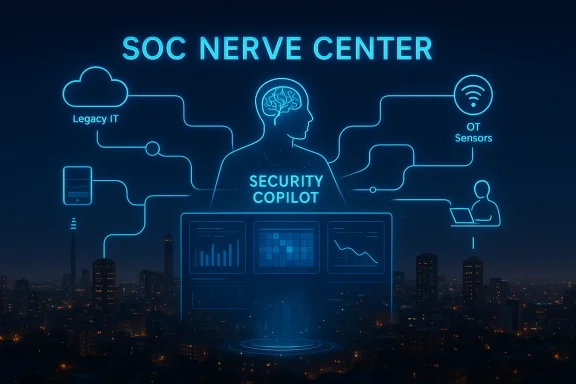
Protecting a modern metropolitan government is no longer just about firewalls and endpoint tools. It is about securing a sprawling mesh of cloud services, legacy IT, operational technology, and remote workers while keeping essential public services available every hour of every day. The City of Johannesburg says Microsoft Security Copilot has helped it do exactly that, turning a reactive security operation into a more automated, intelligence-driven SOC with sharper visibility and faster response.
The Johannesburg story matters because it sits at the intersection of three of the biggest forces in public-sector cybersecurity today: AI-assisted defense, hybrid infrastructure, and skills scarcity. It also reflects Microsoft’s broader push to position Security Copilot as the connective tissue across its security stack, including Defender, Sentinel, Entra, Intune, and third-party signals. In practical terms, the city’s case is less about novelty and more about whether AI can meaningfully reduce noise, compress triage time, and help overstretched analysts focus on the threats that actually matter.
Johannesburg is South Africa’s largest metropolitan municipality, and that scale makes its digital estate unusually complex. Public-sector organizations at this size do not run a single neat environment; they operate layers of citizen-facing services, internal business systems, remote access paths, and, increasingly, operational technology that supports the physical city. As Microsoft notes in its Security Copilot positioning, SOC teams face fragmented tooling, expanding data volumes, and a shortage of experienced security talent, all of which are amplified in a city environment with many users and many moving parts. (adoption.microsoft.com)
That broader problem is not unique to Johannesburg, but the city’s circumstances make it a strong case study. When IT and OT begin to converge, the security team has to monitor not only traditional enterprise threats but also the possibility that an intrusion could affect physical services, utilities, or administrative continuity. In a municipal context, downtime is never just downtime; it can quickly become a public-service issue. Microsoft’s own Security Copilot materials emphasize incident response, threat hunting, intelligence gathering, and posture management as the core use cases for this kind of environment. (adoption.microsoft.com)
The city’s move also fits a wider pattern in Microsoft’s customer storytelling. Over the past year, Microsoft has increasingly framed Security Copilot as an AI layer that improves operational efficiency across security workflows rather than as a standalone product in isolation. The company’s March 2025 Security blog introduced a new wave of Security Copilot agents designed to automate repetitive SOC work and reduce friction in investigation and response. That context matters because Johannesburg’s adoption appears to be part of a larger transition from “AI as an assistant” to AI as an operational layer.
Johannesburg’s story is also notable because the city was already a Microsoft 365 E5 customer before deploying Security Copilot. That means the municipality was not starting from zero; it already had a security platform foundation and then layered Copilot on top to unify signals and streamline analysis. That sequencing is important. Organizations with mature Microsoft investments often get more value from Security Copilot because the product can draw from Defender, Sentinel, and identity data in a way that feels integrated rather than bolted on. (adoption.microsoft.com)
A public institution also has an additional burden: governance and accountability. It is not enough to stop attacks; the security team must also explain what happened, what was affected, and how the response aligns with policy and compliance obligations. That makes streamlined reporting and executive visibility just as important as technical detection.
That detail may sound operational rather than strategic, but it is a major point. In 2026, many organizations still underestimate how much security posture depends on frictionless telemetry. If the data is hard to collect, it becomes hard to defend.
That integration-first design is the product’s central advantage. Instead of asking analysts to manually jump from one console to another, Copilot can consolidate context and present it in a way that speeds decision-making. In a municipal SOC, where staffing and time are both constrained, consolidated context is often more valuable than fancy automation alone.
That has two implications. First, it accelerates newer analysts who may not yet be fluent in every platform detail. Second, it reduces cognitive overhead for senior staff, who can focus on interpretation instead of syntax. In practice, that means the SOC spends less time operating the tools and more time using the tools to defend the city.
For Johannesburg, that matters because the city needed Security Copilot to become part of SOC workflows within three months, with Microsoft engineering working closely with the city and CSIR. That kind of embedding is where AI projects often succeed or fail. If Copilot stays at the edge of the workflow, adoption stalls. If it sits inside the workflow, it starts to change operating behavior.
Johannesburg’s reported 95% reduction in false positives is therefore more than a nice efficiency stat. It suggests that AI can act as a filtering layer, not just an enrichment layer. Microsoft’s own March 2025 Security announcements around phishing triage were explicitly framed around reducing false positives and analyst fatigue, which aligns closely with the city’s reported experience.
This is also where the city’s use of Security Copilot agents becomes important. The agents take on repetitive tasks such as reviewing alerts, correlating threat intelligence, and initiating response actions. That does not eliminate human judgment; it simply moves human judgment higher up the value chain. That distinction is crucial because the goal of security automation is not to remove the analyst, but to remove the analyst’s least strategic work.
Microsoft’s adoption materials describe these agents as autonomous AI built to tackle high-volume tasks while still keeping the team in control. That language matters. Public-sector buyers are rarely willing to hand full autonomy to a black box, especially in environments tied to critical services. (adoption.microsoft.com)
That matters because the practical value of AI in security is often determined by the quality of the surrounding automation. A model that is good at summarizing but disconnected from response systems is useful, but a model that can pass context into a structured workflow is much more powerful.
In a public institution, this is even more important because governance often has to be communicated across multiple stakeholders. A cleaner, benchmarked view can help bridge the gap between technical staff, management, and oversight bodies.
That said, benchmarks are not outcomes. A good score does not guarantee resilience, and a weak one does not automatically mean breach risk. The value lies in how the benchmark prompts action and clarifies priorities.
The city’s use of Copilot to reduce dependence on constant VPN access for telemetry collection is also more than a convenience. It helps maintain security while making it easier for distributed employees to work without adding friction. That is the kind of quiet improvement that public-sector users often notice only when it is missing.
That means the battleground is shifting from AI capability to workflow effectiveness. Vendors that cannot connect models to live security operations are likely to sound impressive but deliver less real value.
Still, procurement teams will likely ask hard questions about data handling, control boundaries, and measurable return on investment. Those are healthy questions, and they will become even more important as AI-assisted security tools spread.
Another thing to watch is whether more South African municipalities or public institutions follow the same path. Public-sector IT teams often move cautiously, but once a city reference shows measurable gains, peer organizations tend to examine the pattern closely. If that happens, Security Copilot could become less of a one-off deployment and more of a repeatable public-sector model.
Johannesburg’s Security Copilot deployment is a useful signpost for where public-sector cybersecurity is headed. The winning formula is no longer just more tools or more alerts; it is better orchestration, better visibility, and better use of scarce human expertise. If Microsoft can keep turning that promise into measurable operational gains, the City of Johannesburg may be remembered not simply as an early adopter, but as an example of how AI can quietly reshape the defensive posture of a critical metropolitan government.
Source: Microsoft City of Johannesburg strengthens critical infrastructure security with Microsoft Security Copilot | Microsoft Customer Stories
The Johannesburg story matters because it sits at the intersection of three of the biggest forces in public-sector cybersecurity today: AI-assisted defense, hybrid infrastructure, and skills scarcity. It also reflects Microsoft’s broader push to position Security Copilot as the connective tissue across its security stack, including Defender, Sentinel, Entra, Intune, and third-party signals. In practical terms, the city’s case is less about novelty and more about whether AI can meaningfully reduce noise, compress triage time, and help overstretched analysts focus on the threats that actually matter.
 Background
Johannesburg is South Africa’s largest metropolitan municipality, and that scale makes its digital estate unusually complex. Public-sector organizations at this size do not run a single neat environment; they operate layers of citizen-facing services, internal business systems, remote access paths, and, increasingly, operational technology that supports the physical city. As Microsoft notes in its Security Copilot positioning, SOC teams face fragmented tooling, expanding data volumes, and a shortage of experienced security talent, all of which are amplified in a city environment with many users and many moving parts. (adoption.microsoft.com)That broader problem is not unique to Johannesburg, but the city’s circumstances make it a strong case study. When IT and OT begin to converge, the security team has to monitor not only traditional enterprise threats but also the possibility that an intrusion could affect physical services, utilities, or administrative continuity. In a municipal context, downtime is never just downtime; it can quickly become a public-service issue. Microsoft’s own Security Copilot materials emphasize incident response, threat hunting, intelligence gathering, and posture management as the core use cases for this kind of environment. (adoption.microsoft.com)
The city’s move also fits a wider pattern in Microsoft’s customer storytelling. Over the past year, Microsoft has increasingly framed Security Copilot as an AI layer that improves operational efficiency across security workflows rather than as a standalone product in isolation. The company’s March 2025 Security blog introduced a new wave of Security Copilot agents designed to automate repetitive SOC work and reduce friction in investigation and response. That context matters because Johannesburg’s adoption appears to be part of a larger transition from “AI as an assistant” to AI as an operational layer.
Johannesburg’s story is also notable because the city was already a Microsoft 365 E5 customer before deploying Security Copilot. That means the municipality was not starting from zero; it already had a security platform foundation and then layered Copilot on top to unify signals and streamline analysis. That sequencing is important. Organizations with mature Microsoft investments often get more value from Security Copilot because the product can draw from Defender, Sentinel, and identity data in a way that feels integrated rather than bolted on. (adoption.microsoft.com)
Why the City Needed a Different Model
The key issue for Johannesburg was not merely that it had threats, but that it had too much security work relative to available specialist capacity. The municipality’s SOC was operating reactively, which is common when incident volume outpaces analyst bandwidth. In that model, teams spend too much time reviewing alerts, too much time stitching together context, and not enough time on higher-value investigation and hardening.Fragmentation is the real enemy
Fragmentation is often more damaging than raw attack volume. If analysts have to pivot across disconnected tools, manually compare telemetry sources, and hunt for context in separate consoles, every incident becomes slower and more error-prone. Microsoft’s own Security Copilot overview explicitly calls out complex and fragmented tooling as a central challenge for SOC analysts, and Johannesburg’s deployment appears to be a direct answer to that problem. (adoption.microsoft.com)A public institution also has an additional burden: governance and accountability. It is not enough to stop attacks; the security team must also explain what happened, what was affected, and how the response aligns with policy and compliance obligations. That makes streamlined reporting and executive visibility just as important as technical detection.
Remote work added more friction
Johannesburg also faced a familiar modern problem: telemetry collection in a distributed workforce. If security data only arrives cleanly when employees remain tethered to the network through a VPN, then defenders inherit a blind spot whenever users are remote, mobile, or intermittently connected. The city said Security Copilot helped remove that friction by making logs flow more securely into the SOC without saturating remote connections or requiring constant VPN access.That detail may sound operational rather than strategic, but it is a major point. In 2026, many organizations still underestimate how much security posture depends on frictionless telemetry. If the data is hard to collect, it becomes hard to defend.
The skills gap matters
The city also lacked sufficient specialist cybersecurity skills, which is where AI tools can have the biggest practical effect. Security Copilot is not replacing analysts; it is trying to let a smaller team operate with more leverage. Microsoft’s positioning is explicit here: it says Security Copilot helps junior staff perform advanced tasks while reserving expert attention for the hardest cases. (adoption.microsoft.com)- Fragmented tools slow every investigation.
- Remote work can disrupt telemetry and visibility.
- Skills shortages reduce proactive defense.
- Executive governance becomes harder when reporting is manual.
- OT/IT convergence increases the stakes of missed signals.
How Security Copilot Fits the Microsoft Security Stack
Security Copilot is most effective when it can sit across a broader ecosystem rather than act as a point product. Microsoft describes it as a generative AI-powered security solution with a natural-language interface for incident response, threat hunting, intelligence gathering, and posture management. It is designed to integrate with Microsoft Defender XDR, Microsoft Sentinel, Microsoft Intune, Microsoft Entra, and third-party services. (adoption.microsoft.com)That integration-first design is the product’s central advantage. Instead of asking analysts to manually jump from one console to another, Copilot can consolidate context and present it in a way that speeds decision-making. In a municipal SOC, where staffing and time are both constrained, consolidated context is often more valuable than fancy automation alone.
A natural-language layer over security operations
The most obvious benefit is the natural-language interface. Analysts can ask questions, summarize incidents, or initiate hunts without needing to write everything from scratch. Microsoft says that the Threat Hunting Agent can turn natural-language hypotheses into executable KQL, which lowers the barrier to sophisticated queries and makes advanced workflows more accessible. (adoption.microsoft.com)That has two implications. First, it accelerates newer analysts who may not yet be fluent in every platform detail. Second, it reduces cognitive overhead for senior staff, who can focus on interpretation instead of syntax. In practice, that means the SOC spends less time operating the tools and more time using the tools to defend the city.
Embedded experiences matter more than standalone chat
One of the more important architectural shifts in Microsoft’s current security strategy is the move toward embedded Copilot experiences inside the security products people already use. Microsoft now describes out-of-the-box agents for phishing triage, dynamic threat detection, threat hunting, and threat intelligence briefing. The idea is that security workflows should feel more native and less like a bolt-on chatbot experience. (adoption.microsoft.com)For Johannesburg, that matters because the city needed Security Copilot to become part of SOC workflows within three months, with Microsoft engineering working closely with the city and CSIR. That kind of embedding is where AI projects often succeed or fail. If Copilot stays at the edge of the workflow, adoption stalls. If it sits inside the workflow, it starts to change operating behavior.
Executive reporting is part of the value
Security Copilot is also being used as a governance tool, not just a detection tool. The city said it gained a streamlined CISO dashboard, executive-level reporting, and benchmarking against Microsoft security standards. That means the platform is helping leadership see the posture of assets, users, applications, and permissions in a more visual and actionable way.- Natural-language access lowers the skill barrier.
- Embedded agents reduce workflow switching.
- Centralized signals improve incident context.
- Executive dashboards support governance.
- Benchmarking makes posture discussions more concrete.
The SOC Productivity Gains
Johannesburg’s most eye-catching claims are the productivity numbers. The city says false positives have been reduced by up to 95%, analysts complete tasks up to 26% faster, and productivity gains range from 23% to 46.7% across triage, investigation, and reporting. Those are significant figures, and they should be treated as customer-reported outcomes rather than universal guarantees. Still, even allowing for implementation differences, the directional message is clear: less noise, more throughput.Reducing false positives is the first big win
SOC teams drown in alerts when detection systems are too noisy. That creates alert fatigue, and alert fatigue is one of the most dangerous hidden costs in security operations. If analysts are forced to inspect too many false alarms, they become slower at distinguishing the real ones, and the organization risks missing the attack that matters most.Johannesburg’s reported 95% reduction in false positives is therefore more than a nice efficiency stat. It suggests that AI can act as a filtering layer, not just an enrichment layer. Microsoft’s own March 2025 Security announcements around phishing triage were explicitly framed around reducing false positives and analyst fatigue, which aligns closely with the city’s reported experience.
Faster triage changes the rhythm of the SOC
When triage is faster, the whole incident lifecycle changes. Analysts can spend more time validating impact, scoping exposure, and initiating containment rather than simply deciding whether an alert deserves attention. That translates into more consistent response times and, in many cases, reduced dwell time for attackers.This is also where the city’s use of Security Copilot agents becomes important. The agents take on repetitive tasks such as reviewing alerts, correlating threat intelligence, and initiating response actions. That does not eliminate human judgment; it simply moves human judgment higher up the value chain. That distinction is crucial because the goal of security automation is not to remove the analyst, but to remove the analyst’s least strategic work.
Productivity is not just speed
The more interesting claim is not that analysts are faster, but that they are more productive across multiple stages of work. Triage, investigation, and reporting all improved. That suggests the tool is not merely accelerating a single workflow, but reducing context switching across the entire case lifecycle.- Alert arrives.
- Copilot helps classify and enrich the alert.
- Analyst investigates with more context.
- Response actions are initiated faster.
- Reporting and executive summaries become easier to assemble.
Automation, Agents, and the New SOC Operating Model
Microsoft has been leaning hard into the concept of agents inside Security Copilot, and Johannesburg’s deployment is a real-world example of why. The city said Copilot agents now handle repetitive SOC tasks and can trigger custom logic apps for more detailed recommendations tied to specific vulnerabilities or incidents. That turns the platform from an assistant into a workflow orchestrator.Agents are useful because they are bounded
Security automation has always worked best when the tasks are repetitive, high-volume, and decision-light. Reviewing routine alerts, correlating known indicators, and collecting supporting evidence are all excellent candidates. Security Copilot agents fit this mold because they are designed to work within specific security guardrails and with analyst oversight.Microsoft’s adoption materials describe these agents as autonomous AI built to tackle high-volume tasks while still keeping the team in control. That language matters. Public-sector buyers are rarely willing to hand full autonomy to a black box, especially in environments tied to critical services. (adoption.microsoft.com)
Custom logic apps extend the value
Johannesburg also appears to be using custom logic apps triggered through Security Copilot. That makes the deployment more interesting than a generic chatbot implementation, because it links AI output to the city’s own operational playbooks. In other words, Copilot is not just summarizing a problem; it is helping route the organization toward the next best action.That matters because the practical value of AI in security is often determined by the quality of the surrounding automation. A model that is good at summarizing but disconnected from response systems is useful, but a model that can pass context into a structured workflow is much more powerful.
The human role becomes more strategic
Automation changes the skill profile of the SOC. Analysts must still validate, interpret, and decide, but they spend less time on routine assembly work. That frees more bandwidth for threat modeling, policy refinement, and proactive hunting. It also creates room for junior analysts to perform more advanced work sooner, which can help organizations partially offset the talent shortage Microsoft calls out in its Security Copilot materials. (adoption.microsoft.com)- Repetitive tasks are the best automation candidates.
- Analysts remain essential for judgment and escalation.
- Logic apps connect AI to response playbooks.
- Bounded autonomy is more acceptable in public-sector environments.
- Better workflows can partially compensate for staffing shortages.
Visibility, Governance, and Executive Control
One of the more underappreciated elements of the Johannesburg case is the shift in visibility. Security tools often produce mountains of data, but without a usable executive view, the information never fully translates into governance. The city says Security Copilot now offers a visual representation of its entire environment and how it compares against Microsoft cybersecurity benchmarks.Visibility is a leadership issue, not just a technical one
CISOs and municipal executives need to understand risk in business terms. That means knowing what assets are exposed, which identities are privileged, where applications are weak, and whether the organization is improving over time. A dashboard that pulls those threads together is valuable because it gives leadership a way to prioritize investment and measure progress.In a public institution, this is even more important because governance often has to be communicated across multiple stakeholders. A cleaner, benchmarked view can help bridge the gap between technical staff, management, and oversight bodies.
Benchmarking changes the conversation
Benchmarking against Microsoft standards may not be the same as benchmarking against a regulator or an industry framework, but it still provides a useful point of comparison. It can show whether the city is ahead or behind common security practices, and it can help justify remediation work that otherwise looks like abstract “security hardening.”That said, benchmarks are not outcomes. A good score does not guarantee resilience, and a weak one does not automatically mean breach risk. The value lies in how the benchmark prompts action and clarifies priorities.
Security governance needs evidence
The city’s emphasis on reporting suggests that Security Copilot is helping convert security activity into evidence. That is critical when budgets are tight and leadership wants proof that investments are paying off. It is also helpful when the SOC needs to justify why a particular control, alert, or response path deserves further attention.- Executive dashboards turn telemetry into decisions.
- Benchmarking supports prioritization.
- Reporting helps justify security investment.
- Visibility improves accountability across stakeholders.
- Better evidence strengthens governance discussions.
Enterprise Impact Versus Citizen Impact
It is easy to read a security customer story and think only about internal efficiency. But for a municipality, the difference between enterprise gain and citizen gain is much narrower than it is in a private company. When defenders move faster, reduce noise, and gain better visibility, those improvements can ripple outward into better service continuity and fewer disruptions for residents.Internal efficiency supports public service continuity
The direct enterprise benefit is clear: fewer false positives, faster investigation, and lower operational overhead. But in government, those benefits usually show up externally as better uptime, fewer service interruptions, and more reliable operations behind the scenes. That is especially important when IT and OT coexist, because a compromise can affect not just data but physical or civic service delivery.The city’s use of Copilot to reduce dependence on constant VPN access for telemetry collection is also more than a convenience. It helps maintain security while making it easier for distributed employees to work without adding friction. That is the kind of quiet improvement that public-sector users often notice only when it is missing.
Citizens do not see the SOC, but they feel its output
Most residents will never know whether a phishing alert was triaged by an analyst or an agent. What they will notice is whether online services stay available, whether data remains protected, and whether service outages are contained quickly. That makes security automation in government a classic indirect value story: the public benefits, but the mechanism is hidden.Hybrid work changes expectations
Johannesburg’s experience also reflects a broader shift in public-sector employment models. Hybrid work is now normal, not exceptional, and that means security tools have to support a distributed, variable network reality. In that environment, the best security systems are the ones that preserve control while removing unnecessary friction.- Internal productivity improvements can support external service reliability.
- Security visibility is part of civic resilience.
- Less VPN friction can improve both security and usability.
- Distributed workforces need distributed telemetry models.
- Public-sector security is increasingly a service-continuity issue.
Competitive and Market Implications
Johannesburg’s adoption is also a signal to the broader market. Microsoft is showing that Security Copilot is not just a futuristic add-on for enterprise security teams, but a practical platform for governments and other complex institutions. That matters because public-sector buyers tend to be conservative, and one credible municipal reference can influence how peers evaluate the product.Microsoft is turning customer stories into category proof
A single customer case is not evidence of universal success, but it can be powerful category proof. Microsoft has been building a portfolio of Security Copilot references and agent announcements, and Johannesburg adds geographic diversity, public-sector relevance, and an OT/IT dimension that many other examples lack. It also reinforces the company’s broader AI narrative in South Africa, where Microsoft has been highlighting local adoption across sectors.Rivals will have to answer the integration question
The competitive challenge for other security vendors is increasingly not whether they can offer AI features, but whether those features are deeply integrated enough to reduce real operational toil. Security teams have seen plenty of AI marketing. What they want now is better triage, lower noise, better hunts, and faster reporting without having to rebuild their entire stack.That means the battleground is shifting from AI capability to workflow effectiveness. Vendors that cannot connect models to live security operations are likely to sound impressive but deliver less real value.
Public sector buying criteria are evolving
Government buyers tend to care about governance, auditability, and fit with existing infrastructure. Security Copilot’s value proposition aligns well with that, because it sits on top of Microsoft’s existing security ecosystem and does not require the city to abandon its investments. That lowers adoption friction and makes the business case more plausible.Still, procurement teams will likely ask hard questions about data handling, control boundaries, and measurable return on investment. Those are healthy questions, and they will become even more important as AI-assisted security tools spread.
- Integrated platforms may beat point tools.
- Public-sector references carry outsized influence.
- AI has to reduce toil, not just demo well.
- Workflow integration is now a key differentiator.
- Governance and auditability remain buying priorities.
Strengths and Opportunities
Johannesburg’s deployment highlights a convincing set of strengths: improved analyst leverage, better operational visibility, and a more scalable way to handle repeated security tasks. The real opportunity is that these gains can compound over time if the city keeps embedding Copilot into workflows and extends automation carefully rather than indiscriminately.- Major reduction in false positives can free analysts for higher-value work.
- Faster triage and investigation can shorten incident response cycles.
- Natural-language access lowers the barrier for junior staff.
- Executive dashboards improve governance and strategic decision-making.
- Integrated telemetry reduces the friction of remote and hybrid work.
- Custom logic apps allow the city to align AI with local playbooks.
- Microsoft ecosystem fit reduces adoption complexity for existing customers.
Risks and Concerns
The story is impressive, but it is still a vendor-reported success case, and that means readers should keep a few cautions in mind. AI tools can improve efficiency, but they can also create overreliance, blind spots, or inflated expectations if organizations assume automation is a substitute for strong security fundamentals.- Customer-reported metrics may not generalize to every environment.
- False-positive reduction is valuable, but aggressive filtering can theoretically miss edge cases if governance is weak.
- Overdependence on AI summaries could reduce analyst vigilance over time.
- Integration complexity may rise as more agents and workflows are added.
- Data governance concerns remain important for public-sector deployments.
- Benchmarking against vendor standards is useful, but it is not the same as independent assurance.
- Skills development still matters; AI cannot replace institutional security expertise.
What to Watch Next
The next phase will be whether Johannesburg can turn this early productivity boost into sustained operational maturity. The city will need to prove that gains remain stable as the environment changes, the agent set expands, and attackers adapt to the new workflow. That means the real test is not whether Copilot helps on day one, but whether it keeps helping six months and twelve months later.Another thing to watch is whether more South African municipalities or public institutions follow the same path. Public-sector IT teams often move cautiously, but once a city reference shows measurable gains, peer organizations tend to examine the pattern closely. If that happens, Security Copilot could become less of a one-off deployment and more of a repeatable public-sector model.
Key indicators to monitor
- Whether false-positive reduction remains near the reported levels over time.
- Whether analyst productivity improvements hold as more use cases are added.
- Whether the CISO dashboard becomes a routine management tool.
- Whether additional agents are deployed beyond alert review and triage.
- Whether other municipalities adopt similar Microsoft security workflows.
- Whether the city can tie efficiency gains to measurable service resilience.
- Whether governance controls keep pace with automation expansion.
Johannesburg’s Security Copilot deployment is a useful signpost for where public-sector cybersecurity is headed. The winning formula is no longer just more tools or more alerts; it is better orchestration, better visibility, and better use of scarce human expertise. If Microsoft can keep turning that promise into measurable operational gains, the City of Johannesburg may be remembered not simply as an early adopter, but as an example of how AI can quietly reshape the defensive posture of a critical metropolitan government.
Source: Microsoft City of Johannesburg strengthens critical infrastructure security with Microsoft Security Copilot | Microsoft Customer Stories
